Written by: FourPillars
Translated by: AididiaoJP, Foresight News
Key Points
The balance in the bank app is not money that you directly hold, but a recorded claim in the bank's ledger. This closed currency requires permission, depends on intermediaries, and is highly fragmented; once money needs to cross systems or borders, friction immediately becomes apparent.
Open currency shifts the center of money from institutional accounts to user wallets. A wallet is not a box for storing assets, but a key for moving assets. Based on self-custody, money becomes programmable and composable.
MetaMask is evolving the wallet into an operating system for money by layering mUSD, cards, and proxy payments. Storage, consumption, payments, and even proxy authorization all converge in the same wallet. This is the ultimate form of a wallet—open currency.
Do you really control your money?
Open your bank app on your phone. The balance displayed in the center of the main screen makes us naturally think it is our money. In daily life, this belief rarely poses issues. Salary arrives on time, and card swipes and transfers require only a few taps. In countries with well-developed financial infrastructure, user experience has almost no friction. Therefore, most people do not question, "Do I directly own this money?"
But structurally, the balance in the bank app is not a pile of cash. It is more like a payment obligation recorded in the ledger by the bank. In other words, it is more like a claim against the bank than cash in my hands. As long as this money is a bank's ledger entry, the ultimate power to decide whether it can be moved is difficult to fully belong to me.
This fact is not obvious under normal circumstances. But once faced with transfer limits or a frozen account, the balance appears to still be there, yet not a cent can be moved. On the surface, it looks like my asset, but structurally, it is a right against the bank, hence the power to block or freeze also exists outside of me.
If this friction arises from the legal nature of money, we must also consider the fragmented infrastructure of money flow. Even if the account is normal and there are no limits, friction occurs once money needs to enter another system. Take cross-border transfers as an example: filters not present within the same currency zone begin to emerge—foreign exchange, intermediary banks, fees, business days. I cannot completely control when the money will arrive.
These two types of friction stem from the same structure: institutions lock my money in closed ledgers, and these ledgers are fragmented from one another. Owning money and having the ability to move it according to one's own wishes are two completely different matters. We refer to this type of money that exhibits these characteristics in daily life as "closed currency." The bottlenecks created by this structure are often difficult to detect; they become clear only when money crosses borders, platforms, or systems.
Can this closed structure be opened? Open currency is an attempt to address this bottleneck. Its fundamental idea is: to let money flow like the internet, no longer locked within specific institutions or borders.
What is closed currency?
To understand open currency, one must first clarify closed currency.
First, closed currency requires permission. To move money, approval must be granted by someone. The bank approves transfers, card networks authorize payments, and payment networks process transactions. Users press buttons, but the actual movement of money is authorized within the system.
Closed currency is intermediated. Between me and my assets, there is always a third party. The bank app is a window to the bank's ledger, the broker app is the screen for the broker's account system, and the payment app has a smooth UX on the surface, but at its core is still the interface with banks, card companies, and merchant settlement networks.
Finally, closed currency is fragmented. Money in bank accounts, money in broker accounts, payment app balances, exchange balances, and dollars in overseas accounts all appear to be "my money," but in reality, they are scattered across different systems. Money needs to transfer from one system to another, and each time it must go through withdrawal, deposit, settlement, and approval processes.
This structure is stable. It contains consumer protections, often allows for funds to be reclaimed, and users are accustomed to it. Therefore, simply stating that "banks are fake" actually weakens the argument for open currency. People have been using it well, and this system has been running for hundreds of years.
The real question is: in an era where money has already moved via the internet, should it still remain so closed? Music has shifted from files to streaming, software has moved from CDs to the cloud, and information crosses the boundaries of portals and apps via APIs. Yet money still remains scattered in proprietary ledgers of institutions. Open currency is focused on this point.
What does open currency change?
Open currency shifts the center of money from institutional accounts to user wallets.
In the world of open currency, users connect to the network using wallets. Here, wallets are not just an app. On-chain, wallets are accounts, logins, signing permissions, and the key to moving assets. If the bank app is the window to the ledger, the wallet is closer to the power of directly moving assets.
Of course, assets do not physically exist in the wallet. On-chain assets are recorded at blockchain addresses; wallets manage the private keys and signing permissions that can move these address assets. Simply put, a wallet is not a box to store money, but a key to move money.
Directly holding this key means self-custody. Self-custody is not just "I store it myself," but controlling assets directly with a key I hold instead of depositing my money into someone else's account. The core of open currency is control.
The reason blockchain fits this structure clearly is that it converts money into a state on a public network rather than a record in a company’s database. Anyone can see the same rules, use the same address system, and interact using the same protocols. Assets can move at any time, can be automatically moved with conditions and logic through smart contracts, and services can connect without permission.
This is programmable money and composable money. Money is no longer just numbers being sent and received; it can combine with code, move automatically, connect with other financial protocols, and settle directly on a global network.
At this point, blockchain transforms from an abstract technical discussion into an experience that users can perceive. For example, freelancers receiving payments from overseas clients, startups paying multi-country teams, users wanting to hold and use stablecoins outside of exchanges. This also applies to internet-native economic activities such as gaming, creators, and AI agents, as well as on-chain users moving assets around the clock in open markets. For them, what matters is that money can flow without being locked into specific banks, countries, or apps.
This structure itself is not yet a completed alternative. Self-custody gives users control but also imposes responsibility. Key management, phishing, erroneous signatures, and recovery are risks that users must handle themselves. Therefore, the central issue of open currency is not just "do users directly control their money," but whether it can reduce friction in security and user experience while maintaining user control.
What does MetaMask aim to do?
The center of this transformation is self-custody wallets, and MetaMask is a clear example of how wallets evolve into financial platforms.
It started as a simple wallet. Before MetaMask, interacting with the Ethereum network meant dealing with command lines. Running nodes, connecting RPCs, directly handling private keys, and signing transactions one by one posed seemingly insurmountable challenges for ordinary users. MetaMask lowered these barriers with a browser extension. Creating an Ethereum account, connecting to dapps, signing transactions became tasks accomplished with just a few clicks.
As more wallets with similar structures emerged over time, the role of wallets began to change. Initially, it was just for storing tokens; later, it became a way to log into dapps, and eventually took on roles such as exchanges, cross-chain bridges, and multi-chain connections. Now, stablecoins, card payments, yield products, and derivatives are all entering wallets. Throughout this transition, financial functions are being absorbed into wallets based on self-custody.
Existing fintech super apps also layer many functions. They put transfers, investments, cards, points, and loans into one app. But most still operate on the ledgers of platform accounts and partner financial institutions. Users get convenient apps, yet the money remains in a closed system.
MetaMask takes a different direction. It positions the user's wallet at the center of financial activities. Whether users swap, hold stablecoins, cross chains, or use cards, the starting point is the user's wallet rather than a platform account. This may seem like a minor distinction, but in the structure of open currency, it is pivotal. The control of money shifts from platform accounts to user wallets.
USD in the wallet: mUSD
MetaMask's mUSD showcases this direction.
There are already various USD-backed stablecoins in the market. What distinguishes mUSD is not the issue of issuance itself, but its ability to be processed directly within the wallet experience. Users can hold USD-pegged assets in their wallets, exchange them, cross-chains, deposit into DeFi when needed, and also use them for payments.
Previously, this process was broken down into several steps. Users would buy assets on an exchange, transfer them to a wallet, connect to a dapp, and then transfer back to the exchange to cash out. For on-chain users, this was already cumbersome, and for ordinary users, it represented a real hurdle. They just wanted to use money, yet had to manipulate it like a plumber: knowing which chain to use, withdrawing to which network, what a bridge is, and why fees are necessary.
mUSD consolidates these steps within the wallet. When USD-pegged assets sit in the wallet and can simultaneously connect to on-chain finance and real-world payments, the wallet transitions from merely a storage place to a framework where storing, using, and paying can all be accomplished within one wallet.
Additionally, the mUSD held in the user's Money Account can yield up to 6% annual percentage yield (APY). This is not interest paid directly by MetaMask, but variable returns generated after deposit funds are automatically utilized in the on-chain lending market. Importantly, there is no lock-up period; users can freely spend, send, and trade these funds at any time.
On-chain money entering the real world: MetaMask Card
For open currency to truly work, it must ultimately be spendable.
Even if users manage their assets well on-chain, if they cannot buy a cup of coffee at a local cafe, the experience for the mass market remains incomplete. In real life, people care more about money that can actually be used for payments than financial philosophy. This is why the MetaMask card is so important.
Many existing crypto cards require users to deposit assets into exchange or card company accounts. They are convenient, but take users back to a custodial structure. To use cryptocurrency, users ultimately hand over their assets to a third party.
The MetaMask card keeps assets within the user's wallet until the very moment of payment. Users can connect assets from their wallets to the real-world card payment network. This marks the moment when on-chain assets are no longer just numbers in an investment app, but become a means of payment in daily life.
This is the most direct picture of open currency. Money remains in my wallet until the moment of payment, ready to be used at real merchants when needed. The center for storing, managing, and consuming money has transformed into a wallet.
There are still practical limitations, including supported countries, issuing institutions, card networks, regulations, and merchant policies. These issues are still being resolved, so the user experience varies by region. Even so, the direction that MetaMask demonstrates is clear: wallets are becoming the interface between on-chain assets and offline payments. At this stage, wallets are no longer "coin storage apps," but actual payment interfaces for using money.
Another tool of open currency: proxy wallets
Now let's look at a more forward-looking topic. Everything discussed thus far has a premise: the subject moving and using money is a person.
But what if the entity spending money is not a person? When AI agents conduct research, renew subscriptions, and settle fees for each API call, this premise begins to waver. If every payment made by the agent requires manual approval from a person via a signature popup, then it is not automated. This is precisely the bottleneck of proxy payments. Transactions need to happen at machine speed, but human decisions enter into each transaction.
The simplest solution would be to hand over the entire private key to the agent. But that directly undermines self-custody. Once the key is given away, the agent can freely use the entire wallet, and the user loses control. Automation comes at the cost of the control that open currency is supposed to protect.
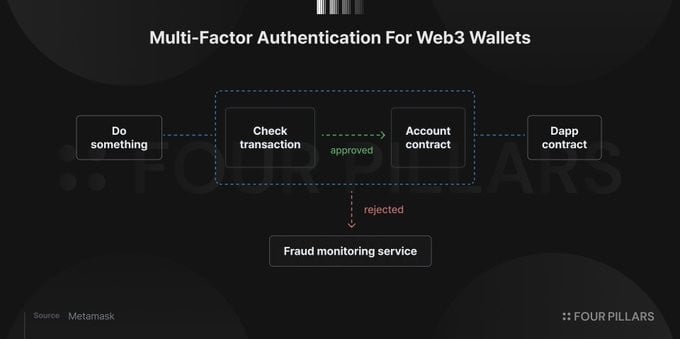
MetaMask takes another route. Smart accounts leverage account abstraction, delegating specific permissions without handing over keys. Through ERC-7710 delegation and ERC-7715 permission requests, users can grant agents limited permissions, such as "up to 10 USDC per day, for one month, only to buy ETH." Agents can trade autonomously within this range while overall control of the wallet remains in the hands of the user. This is where automation and self-custody can coexist without conflict.
This structure itself is not entirely a new idea. In 2023, MetaMask proposed a similar concept in the form of "trusted sessions." After the user approves a session key, transactions within that range no longer require new signatures each time. A typical example at the time was a blockchain game, where users did not want to process wallet popups for every action. This idea, which originated from gaming, has been standardized through ERC-7710 and ERC-7715 and now serves as the foundation for delegating permissions to proxies rather than humans.
One of the places to see this attempt is at the Smart Accounts Kit Hackathon co-hosted by MetaMask. A total of 321 developers and 142 submitted projects set a record for the highest number of projects in a MetaMask hackathon. The theme was applications for autonomous agent payments, with agents also participating in the judging.
In the realm of open currency, wallets ultimately become the permission layer through which human-delegated agents can move money. If a wallet is the operating system of money, proxy payments mark the moment when this operating system opens to both agents and humans simultaneously.
The ultimate goal of wallets is open currency
Returning to the title. Wallets initially served as simple signing tools. Sending tokens, connecting to dapps, and approving transactions constituted their entirety.
But if a wallet is the key for moving user assets, more financial functions will naturally build on top of it. Swapping, cross-chaining, stablecoins, yield products, card payments, multi-chain functionality, and derivatives trading will all enter wallets. This is not just a simple list of functions but the process of wallets becoming the operating system for money.
In the world of closed currency, financial apps are windows to institutional systems. In the world of open currency, wallets are the starting point for users to process money directly on the network. The issue is not whether wallets will completely replace banks. The focus is on the emergence of a new option. Existing finance will continue to handle daily domestic payments very well. However, global, programmable money that can move across apps and protocols requires a different structure. Wallets are at the center of that structure.
If the balance in the bank app is a number on the ledger, then the on-chain wallet is the key to directly move assets. Closed currency brings users into the system, while open currency enables users to freely move using their own wallets between systems.
This is why the ultimate goal of wallets is open currency. Token storage, dapp logins, NFTs are merely waypoints. The destination is a new layer: users directly control their money and move it freely, allowing money to flow like the internet.
免责声明:本文章仅代表作者个人观点,不代表本平台的立场和观点。本文章仅供信息分享,不构成对任何人的任何投资建议。用户与作者之间的任何争议,与本平台无关。如网页中刊载的文章或图片涉及侵权,请提供相关的权利证明和身份证明发送邮件到support@aicoin.com,本平台相关工作人员将会进行核查。


