Written by: Cookie, Rhythm
After more than four months, Binance Alpha has finally relaunched a meme coin, and it is a US stock meme coin MarsCoin.
We should be one of the first media to propose that US stock memes are likely to become a stage narrative:
“US stock memes, the Robinhood chain has finally found its narrative.”
In the above text, our assumption was that the Robinhood chain would lead the narrative of US stock memes, but the current situation seems to indicate that BSC has taken the spotlight.
So, how should we understand the current market situation? And how should we look forward to the possible future direction of the US stock meme narrative?
Binance's Thoughts on US Stock Memes
We have to admit that it was a mistake not to anticipate Binance's involvement in promoting this narrative mentioned at the beginning of the article, because Binance's strategy to compete for and stabilize the “on-chain asset pricing power” through Binance Alpha has been a development strategy for quite some time.
We won’t go into great detail about why only Binance does this and why other competitors do not. We just need to quickly summarize why we should keep an eye on the trends of relevant conceptual assets on BSC when we believe in the potential of the US stock meme narrative:
- Binance has the best liquidity advantage among all CEXs, making it challenging for other CEXs to lead this narrative and for retail investors to rally their emotions.
- Different CEXs emphasize different profit sources and have varying levels of concerns about compliance, leading to a lack of motivated and capable competitors like Binance.
- Public chains or DEXs certainly have the motivation to compete, and Solana also hopes to replicate the situation of meme coins on Binance from 2024. However, public chains and DEXs have far fewer cards in hand compared to Binance, making participating in such a single narrative competition a waste of effort.
Why spend space on the above points? First of all, whether for this round of US stock memes or new narratives that may appear next, once we acknowledge the above viewpoints, we should promptly pay attention to the trends on BSC, because Binance has the strength to drive a target with its previous Alpha and has the motivation to do so. As explained above, it is almost solely capable of meeting the criteria of both strength and motivation.
However, we cannot raise our expectations too high, as not every instance will lead to an Alpha situation, such as the recent "coin-draining" narrative driven by $ANSEM on Solana. Even if it goes up to Alpha, it cannot reach the heights experienced by Binance every time. The stimulating effect of short-term bullish sentiment diminishes with each occurrence.
If there are excessively high expectations for US stock memes based on CZ's tweet about "buying or selling some meme coins in the coming weeks to test out some new things," and then buying at ten million-level market caps hoping to sell at over one hundred million-level, one must carefully consider whether the ratio of odds to risks is appropriate.

The Popularity of US Stock Memes Has Emerged, But It Is Still Very Immature
Binance Alpha launching US stock memes is a good thing. But at the same time, we also need to see that as attention rises, the market's focus is overly placed on these short-term attention-grabbing events, such as the diversion of the Flap and Four platforms, whether CZ will make purchases, and so on.
This indicates two things. First, this narrative indeed has space worth expecting, after all, Binance has also recognized this narrative. Second, this narrative is still very immature right now, and at least the market has not yet taken it seriously. If the market is always playing around attention events like diversions and CZ's purchases, the height of this narrative cannot reach very high.
Of course, in the current market environment, hoping to see US stock memes reach billion-dollar-level market caps, and then have liquidity overflow after running like the engraved period ordi to twenty billion-dollar market caps, leading the entire market in a frenzy to create engravings, indeed seems like a daydream. However, if we hope to see such a high ceiling, especially in the current market environment, we need to imagine whether US stock memes can break out like this:
- Although everyone knows that Trump's coin will ultimately become a mess, at the time, everyone knew that as long as some time was given for this event to ferment in mainstream media, it would definitely break out.
- pump.fun got the whole scene pvp without distributing airdrops, which displeased many, but this fast-paced meme approach attracted a lot of young people to come in and mine gold; many entered through classmates or friends in games.
US stock memes cannot just be positioned as "another new asset issuance narrative" for inside players. Some currently visible gameplay, such as airdropping corresponding tokenized US stocks to holders or adding some DeFi gameplay, cannot break the circle.
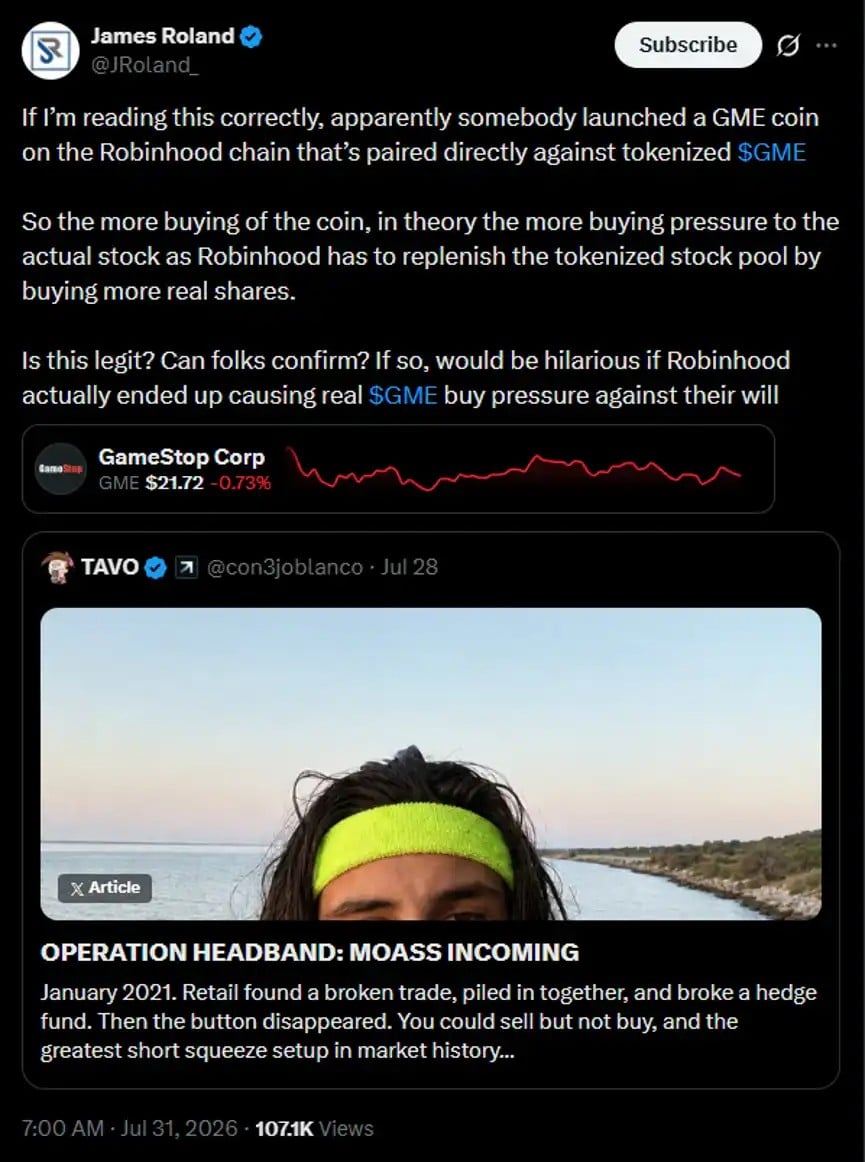
The path we can imagine for breaking the circle should involve the narrative fermenting within the circle, trading volume rising, leading the corresponding tokenized US stocks on various chains (mainly Robinhood and BSC) to be exhausted, and subsequently requiring continuous purchases of the corresponding targets from the stock market to mint on-chain. This was one reason why $GME on the Robinhood chain once became the focus of attention, as the heated trading caused the tokenized GameStop US stocks on the Robinhood chain to be sold at high premiums, which were then gradually bought from the stock market onto the chain for minting, filling the price gap.
If we want to recreate this situation, there are two ways. One is that there is conspiracy capital behind the scenes orchestrating a massive surge in a particular target, while the other is that the market spontaneously forms a certain “consensus standard,” such as a target that has built up and made the pool thicker, i.e., having more underlying real assets correlated to the tokens in the stock market plays a bigger role.
But this does not address the most crucial "communication problem"—this narrative of the meme coin driving stock market trends is meant to be communicated to stockholders. If the above situations reoccur and are substantial enough to break the circle naturally, that would be ideal. But if not, we must consider more practical "construction logic":
- Will the holder community of the paired stock assets be interested in the narrative that "meme coin trading can drive the stock market up"?
- Does the paired stock asset itself have meme properties, enabling it to develop new meme stories based on past or ongoing meme events?
Based on these two points, the most suitable target assets should be paired with "meme stocks" like GameStop, AMC, and Wendy's (Note: This doesn't mean these stocks lack real value; rather, the short squeeze events occurring with these stocks are sufficiently meme-worthy).
For example, let's take GameStop. People's impression of this stock may still dwell on last year's event when retail investors caused a short squeeze leading to significant consequences. Later, the on-chain ETH and Solana $GME meme coins surged due to a short-term attention event triggered by the return of the Roaring Kitty.
However, if we search for GameStop on X, we will find that it still remains a stock that retail investors discuss with great interest. Especially with GameStop’s recent ambition to "swallow the elephant" and acquire eBay, many people have raised doubts, while GameStop supporters continue to rally:
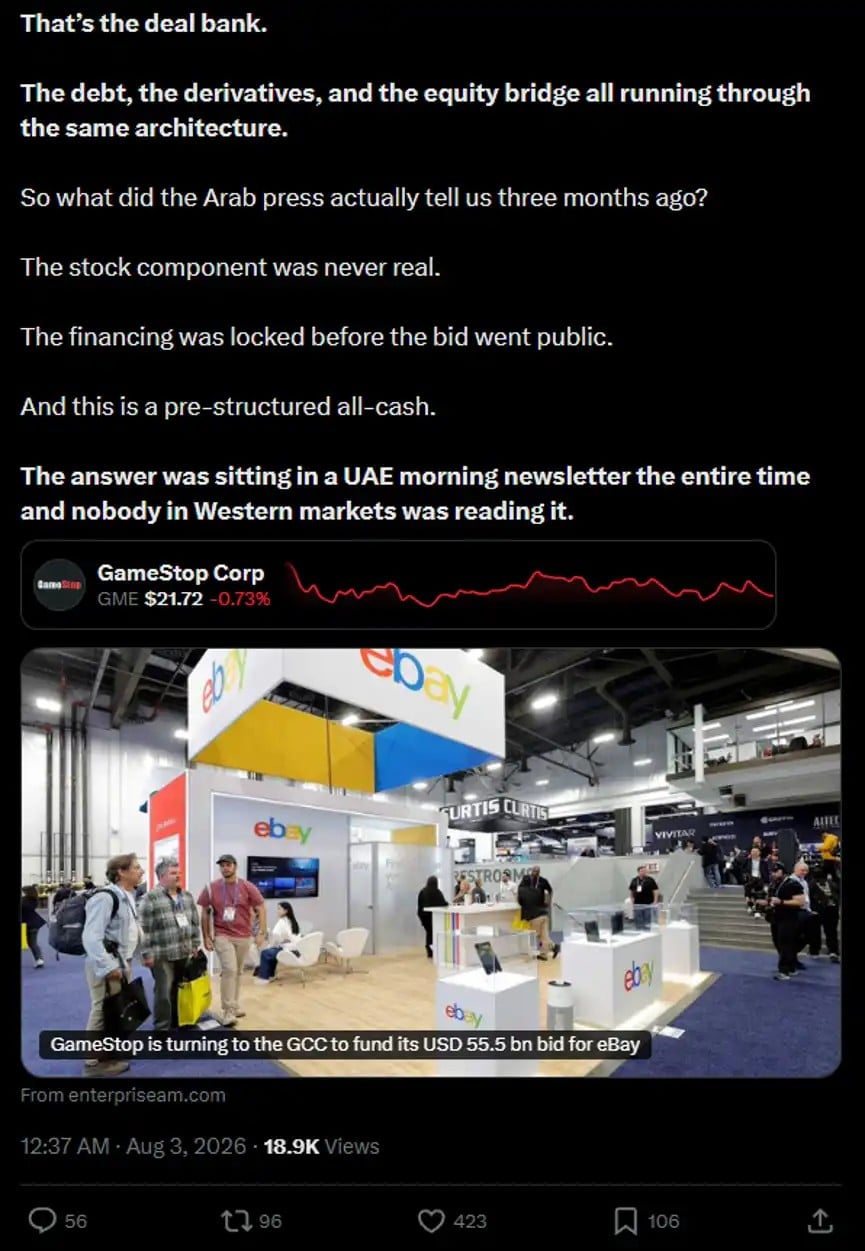
Additionally, there are many analyses of abnormal options movements for GameStop, as well as attention on GameStop CEO Ryan Cohen’s activities on X. These GameStop followers are likely among the stock players who would easily transition to the on-chain meme ecosystem; they can glean insights even from the fact that Ryan Cohen's X account currently only follows GameStop.
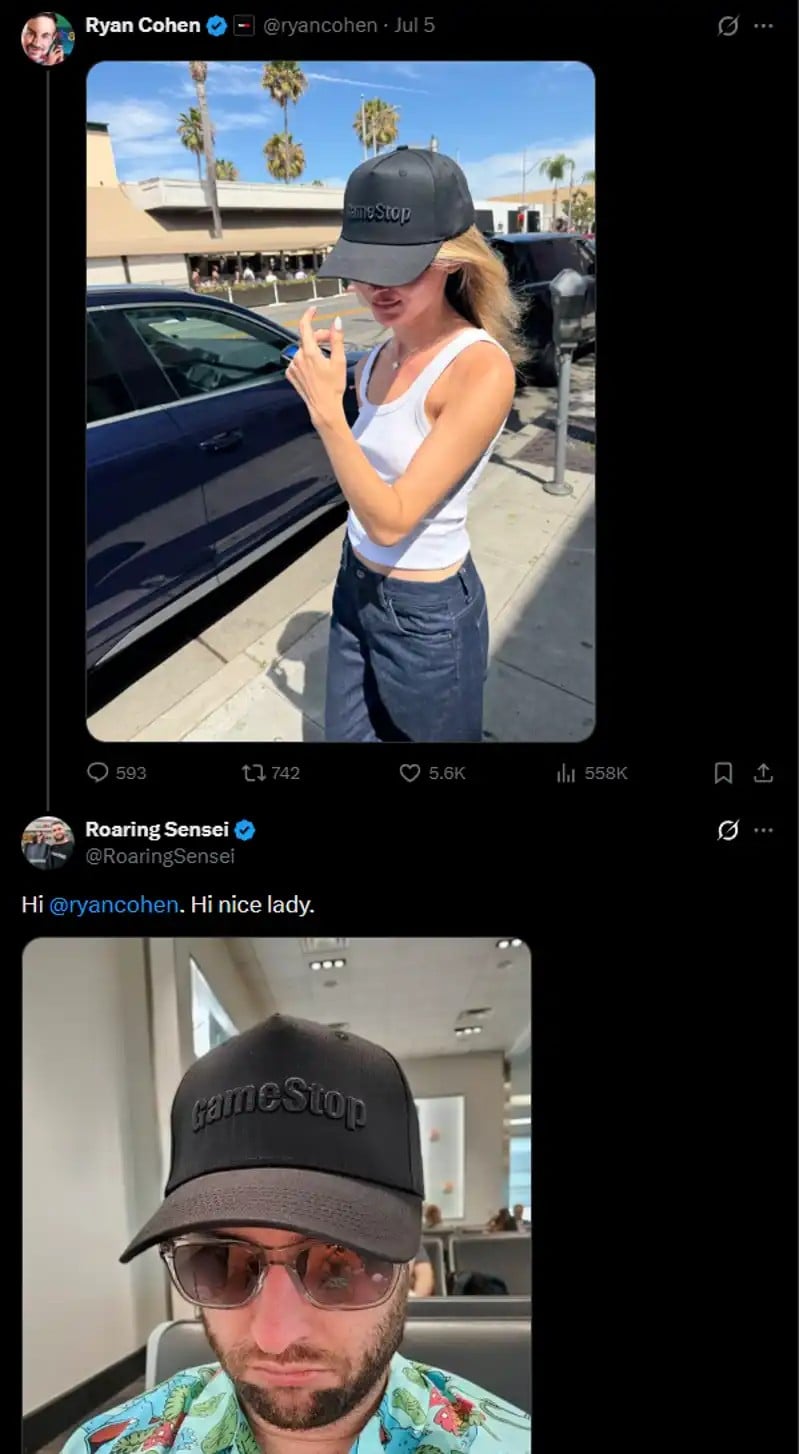
This kind of tweet, which seems very community-focused to us on-chain meme players, is also happening with GameStop:
We need to refine the narrative of "meme coins as catalysts for stock market buying" to systematize it and communicate it to retail investors. We can see a good start with GameStop, as there are some stock players who specifically focus on meme stocks:
Conclusion
Perhaps the frequent references to GameStop in the above content may make you feel I have a preference, but that is not the case; what I value is a "predictable, ultimately formed path for breaking the circle of communication."
Due to regulatory reasons, Robinhood is very unlikely to list the asset on its main site from its own chain, even though Robinhood CEO Vlad appears to understand the meme ecosystem well, for instance, unintentionally leaking $CASHCAT during a recent live stream through recent searches and occasionally liking certain ecosystem projects; but he may only be able to go this far.
Binance certainly has the capability to recreate a US stock meme version of Binance Life, but there is no real necessity. The Chinese meme period was something you could never have expected, let alone anticipate the play on the Chinese ticker, but now the situation of US stock memes resembles a market with a kart racing game, where Tencent follows suit with a QQ Fly Car; there is no need to bankrupt the kart racing game, it just needs to allow the market to play on BSC, especially given that BSC's MarsCoin is currently leading in market cap.
So, if this narrative ultimately manages to achieve a ceiling comparable to recreating a wealth myth, relying solely on internal forces offers little hope; it must break the circle. Excluding the unlikely fortune of betting on conspiracy, the above represents the ideal path we can envision.
免责声明:本文章仅代表作者个人观点,不代表本平台的立场和观点。本文章仅供信息分享,不构成对任何人的任何投资建议。用户与作者之间的任何争议,与本平台无关。如网页中刊载的文章或图片涉及侵权,请提供相关的权利证明和身份证明发送邮件到support@aicoin.com,本平台相关工作人员将会进行核查。


