

Author: Jae, PANews
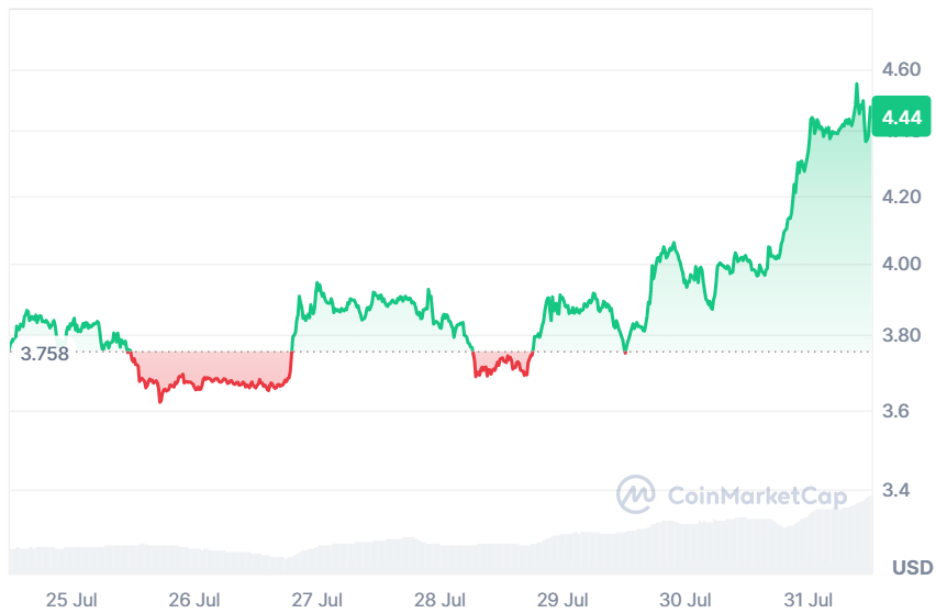
On the evening of July 30, alongside the resurgence of AI stocks, the leading DEX (Decentralized Exchange) Uniswap also fought back, with UNI prices soaring above the $4 mark, gaining over 10% in a single day, and a cumulative increase of more than 17% over the week, sweeping away the consolidation gloom of the past three months.
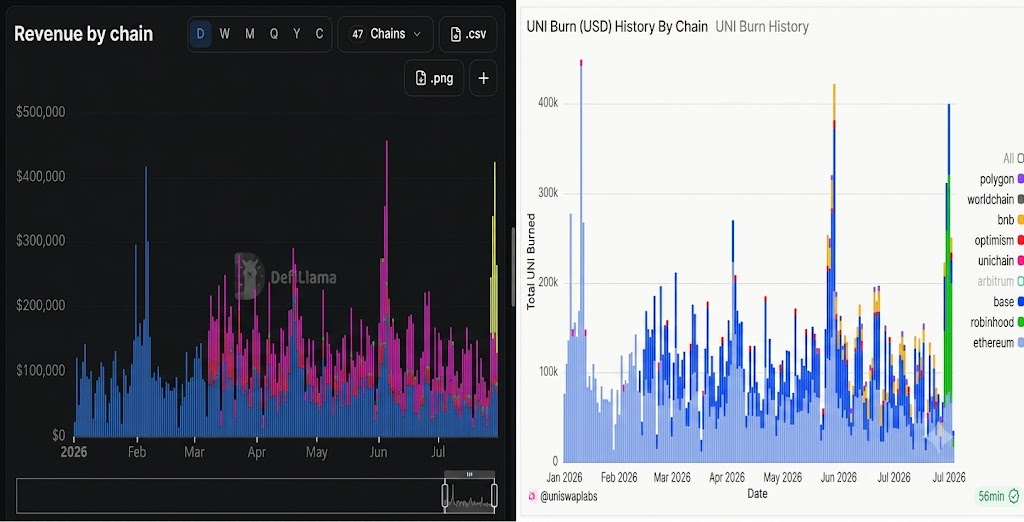
The direct driving force comes from the Fee Switch. On July 27, the Fee Switch was officially activated on Uniswap V4, leading to an explosive growth in the protocol's overall income: daily average income surged from $118,000 in early July to $318,000, an increase of about 2.7 times. Among them, the Robinhood Chain alone contributed an average of $168,000 per day, accounting for half of the protocol's total income.
Accompanying the income explosion is a wave of strong UNI destruction, with the daily burning of tokens reaching 106,000, previously setting a historical record of 186,000 tokens. Beneath the facade of celebration, the underlying concerns about traffic fundamentals, sustainable growth, and LP (Liquidity Provider) interests are also fermenting in parallel.
Flywheel Starts, Robinhood Chain Becomes Uniswap's Largest "Printing Machine"
In the conventional DEX fee mechanism, trading fees either flow entirely to LPs or are collected by front-end operators, making it nearly impossible for the protocol layer to capture value. By the end of 2025, Uniswap launched a comprehensive governance proposal called UNIfication, which introduced the TokenJar fund pool and Firepit destruction contract, creating a programmed fee allocation path.
In simple terms, TokenJar is like a transparent piggy bank that only takes in and does not let out; the fees collected by the protocol continually accumulate within it, but no one can withdraw money directly. The only way to "open the jar" is to prove to the system that you have destroyed the corresponding amount of UNI tokens.
This creates an arbitrage opportunity: when the value of the fees in the jar exceeds the cost of purchasing and destroying UNI, arbitrageurs (like MEV bots) will spontaneously buy UNI in the market and destroy it to unlock the fees in the jar and profit from the difference.
The entire process operates without human intervention and is entirely driven by on-chain economic incentives, forming a positive flywheel of “trading generates fees → arbitrageurs repurchase and destroy UNI → circulation decreases → token value increases.”
After the Fee Switch was activated, the currently hottest Robinhood Chain has replaced the Ethereum mainnet to become the core battlefield for Uniswap to capture protocol fees, also serving as a crucial catalyst in the UNI deflation wave.
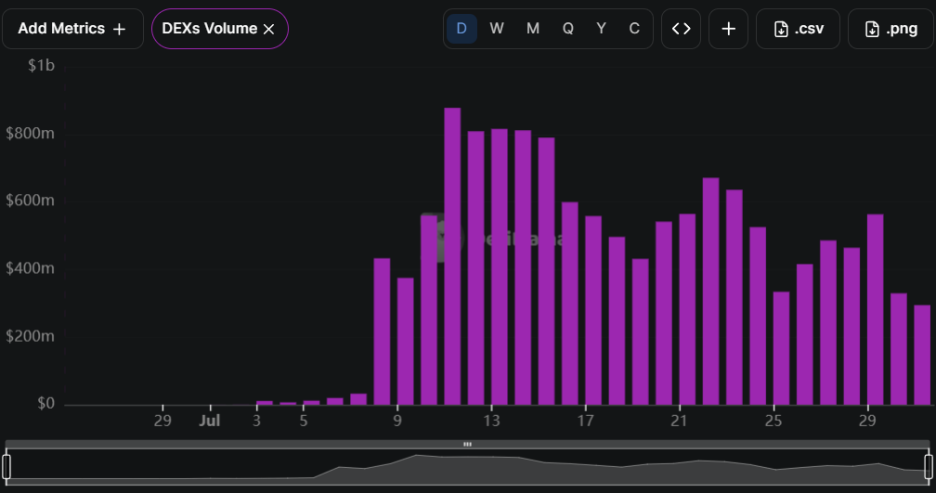
As a Layer2 network built on Arbitrum Orbit, Robinhood Chain, since its mainnet launch on July 1, has carried the aura of a financial technology giant. Free Gas fee subsidies and deep integration of Web2 user entry points have attracted massive influxes of capital. Data from DeFiLlama shows that within just one week of deploying Uniswap V2, V3, and V4 protocols, the total trading volume across the chain rapidly surpassed $6 billion.
Once the Fee Switch is activated on Robinhood Chain, massive transactions are transformed into real protocol income, contributing more than 52% of Uniswap's daily average protocol income, quickly becoming Uniswap's largest source of income and a strong buying force for UNI.
Underlying Concerns Hidden Beneath the Celebration: Meme Bubble, High Valuation, and Protocol Taxation
However, Uniswap’s highly concentrated income structure implies that the destruction rate of UNI will be closely tied to the traffic fluctuations of a single chain.
The “traffic core” of Robinhood Chain is far more fragile than it appears on the surface.
According to Oak Research statistics, over 99% of the trading volume generated since Robinhood Chain's launch has been driven by the speculation of Meme coins like CASHCAT.
A larger test will arrive in late September.
Currently, the high trading volume of Robinhood Chain is built on the basis of official Gas fee subsidies. Once the subsidy policy expires in late September and on-chain interactions return to real costs, the Meme coin speculation that relies on automated scripts and high-frequency trading may further cool down significantly.
In simple terms, the income supporting half of Uniswap today is largely from highly speculative, extremely volatile Meme coin trading, rather than from real asset trading that has long-term stability. Although Uniswap announced on July 30 the launch of the Launches beta version on Robinhood Chain, aimed at aggregating popular token issuances while providing distribution channels for them, it does not change the weak traffic structure of the protocol in recent times.
Furthermore, the market has already priced in extremely high growth expectations for UNI. From a valuation perspective, Uniswap's fully diluted market value (FDV) is about $4 billion, corresponding to approximately $41 million in annual revenue, with an implied P/E (price-to-earnings) ratio close to 100 times. Once the growth rate of earnings does not meet expectations, the high valuation will face adjustment pressure.
The most heated debate focuses on: Does the protocol taxation come at the expense of LP interests?
Direct competitor Aerodrome co-founder Alexander Cutler pointed out that the essence of the Fee Switch is that the protocol enforces a reallocation of the existing pie. After the activation of the Fee Switch in Uniswap V2 and V3 concentrated liquidity pools, it effectively cut up to 25% of LP’s original earnings; under the V4 structure, it has even imposed a disguised tax rate of up to 33% on liquidity interactions.
In response to market skepticism, Uniswap founder Hayden Adams clarified in a post that the protocol fees in Uniswap V4 adopt an “additive system” rather than a “deductive system.” The existing pooling fee rates for LPs will not undergo any deductions, and the protocol fee is an additional incremental fee collected from traders on this basis, and LP earnings have not been harmed.
Mathematically, Adams is correct; but from an economic perspective, the question remains unresolved: Will the overall increase in transaction fee rates raise trader costs, thereby suppressing trading volume and ultimately indirectly weakening LP’s actual transaction earnings? This dilemma still requires longer-term market data to validate.
Even so, Uniswap has completed an impressive “commercialization” debut, but whether it can turn this debut into a sustainable norm depends on whether it can expand more long-term valuable application scenarios on-chain.
免责声明:本文章仅代表作者个人观点,不代表本平台的立场和观点。本文章仅供信息分享,不构成对任何人的任何投资建议。用户与作者之间的任何争议,与本平台无关。如网页中刊载的文章或图片涉及侵权,请提供相关的权利证明和身份证明发送邮件到support@aicoin.com,本平台相关工作人员将会进行核查。


