Written by: Zuo Ye
The new Cold War has no iron curtain, only mutual entanglement.
The Cold War between the United States and the Soviet Union since 1945 is often described as localized hot wars under a comprehensive nuclear crisis, with both sides ready for steel clashes at any moment on the East European plains.
However, bypassing the bloody battles of World War II, since the "Great Depression" of 1929, the Soviet Union has been absorbing American technology and capital, until after World War II, when London established a huge Eurodollar system, primarily serving the Soviet bloc as well.
From this perspective, it makes sense to view the Cold War as a "trade war"; the Soviet Union established the Comecon system, which was inherently weaker than the U.S. and the West’s General Agreement on Tariffs and Trade (the precursor to the WTO), IMF, and World Bank, because the latter included sufficient game theory under the financial system.
When your enemy also cannot do without the dollar, the outcome of this contest is already decided.
Old Cold War Trade, New Cold War Finance
Economic crises are the cyclical clearing mechanisms of capitalism, and the survivors of each crisis continuously complicate America's financial system, incorporating the excessive reactions from previous crises.
The economic crisis of 1907 not only led to the creation of the Federal Reserve but by 1913, U.S. GDP and industrial output had already surpassed that of the UK. The Great Depression since 1929, although stemming from the distorted prosperity of the stock market, was fundamentally rooted in America's inability or unwillingness to maintain a global trade system centered around the U.S.
In fact, the Soviet Union's ability to attract U.S. production capacity after the Great Depression had to do with the reality that ideology was weaker than the survival reality; life always supersedes politics, both for the Soviet Union and the United States.
This can be simply understood as the world system before World War II centering on trade, that is, the transnational flow of tangible goods; the supply chains, SWIFT, and dollars that we are familiar with were not critical at that time; the tariff system was the key to whether trade could proceed.
With this habitual way of thinking, the Soviet Union after World War II chose the Comecon system, where trade settlements between countries were made in "transferable rubles (TR)," essentially a kind of bookkeeping point system, which was highly regulated and lacked sufficient flexibility.
However, at this time, the United States did not choose financial laissez-faire or disorderly freedom; the post-war Western trade system remained largely regulated. The heavy industry within the Comecon system could guarantee the most basic survival needs, while the Soviet Union's oil industry was always hard currency during the reconstruction of war-torn Europe.
The real shift came with neoliberalism since 1970, when the U.S., U.K., and others first dismantled their production lines, redirecting them to private or Asian hands; the only condition was to accept American technological controls, financial order, and the dollar system, which, from the Soviet Union's perspective at the time, was undoubtedly suicidal. Was the U.S. going to rely on Disney and foreigners to defend itself?
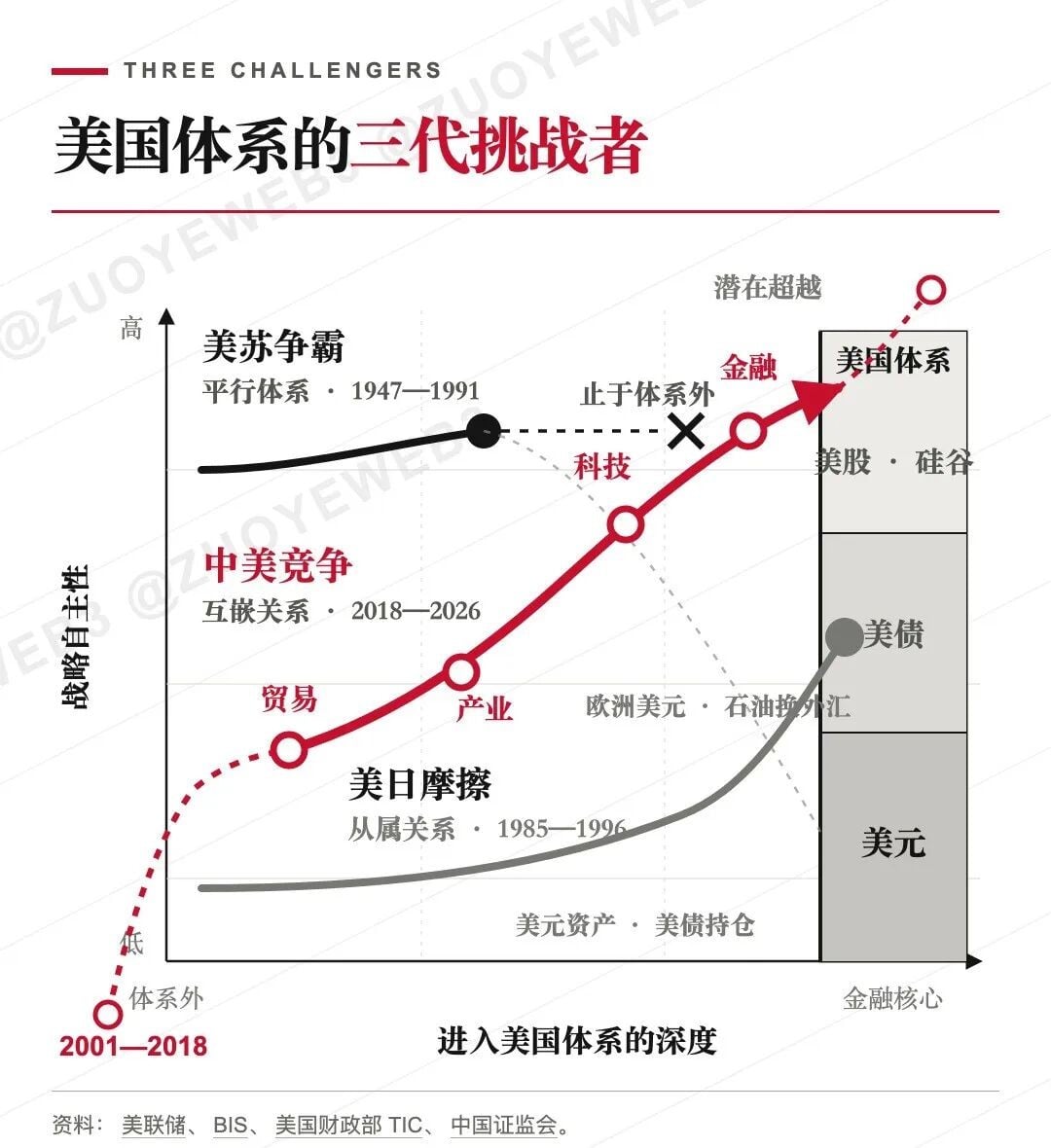
Image caption: Historical challengers of the American system
Image source: @zuoyeweb3
Ultimately, the United States, mired in the Vietnam quagmire and the oil crisis, defeated the Soviet steel tide with Disney.
It's hard to say what the Soviet Union did wrong; the hollowing out of American industry still leaves wounds in the Rust Belt today. Angry rednecks chose Trump, while "Iron Lady" Margaret Thatcher opted to trample on the coal miners of Ogilvy, leaving a collective trauma in the U.K. that remains unhealed to this day.
However, the legacy of the Soviet bloc was excessively rich; as markets and labor continuously flowed towards Europe and America, Google founder Brin and Ethereum leader Vitalik reaped invisible rewards; they were both prisoners of Disney, not AK-47s made from oil trade.
Thus, you cannot say it was the World Trade Organization that defeated Comecon, nor can you simplistically think that the Star Wars dragged down the Soviet Union; the social mobilization and penetration power of finance have long been underestimated. U2 cannot cross the Soviet MiG corridor, but the dollar can, and so can Victor Choi.
Exploiting and manufacturing the Soviet Union's demand for dollars ultimately led the Soviet Union to buy the noose that would strangle it.
If the Soviet Union represented an external financial war, then U.S.-Japan friction was an internal drive for reform.
At that time, Japan was at a crucial period of supporting DRAM with state power;
whether through the Plaza Accord of 1985 or subsequent mixed legislation, judiciary, and executive constraints on Japan's semiconductor industry, the U.S. has always pursued trade first, ultimately betting on finance — U.S. bonds.
Particularly under the pretext of Japanese companies like Mitsubishi and Hitachi "stealing" U.S. semiconductor IP, the 301 investigation emerged; in 1987, Reagan even sanctioned Japan's semiconductor industry and began transferring semiconductor technology to allies such as Taiwan and South Korea.
At this time, it was simply that Changxin replaced Toshiba, and Kimi K3 faced A\.
Compared to the Soviet Union's trade demand for dollars, Japan's demand for U.S. bonds skyrocketed after the Plaza Accord, as part of the "macroeconomic" cooperation between both sides, and currency rate liberalization was also a direct product of this movement.
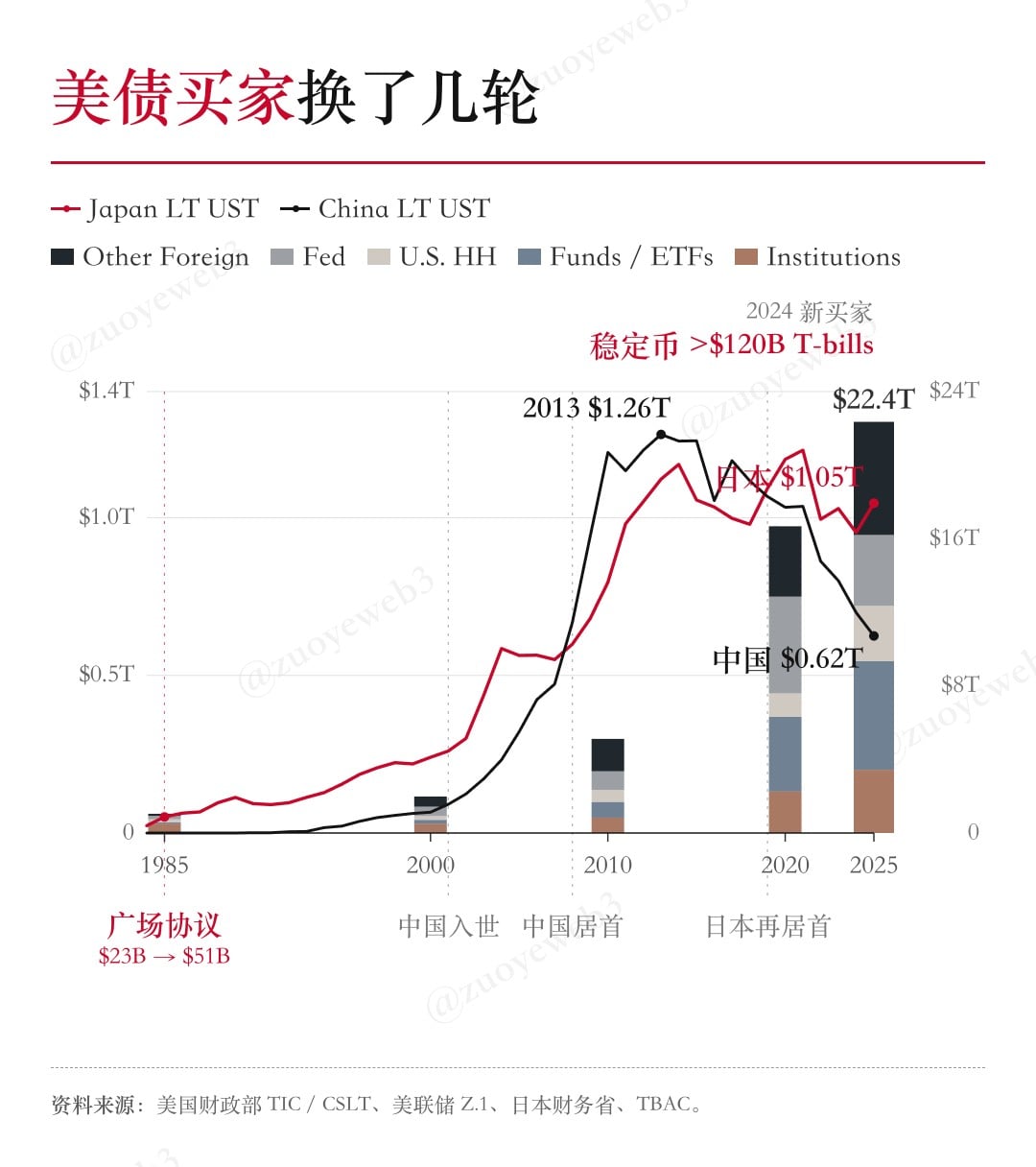
Image caption: U.S. bond racing competition
Image source: @zuoyeweb3
From the Soviet Union's oil trade for dollars to Japan's semiconductors for U.S. bonds, America's financial tactics have always been a step ahead.
China is no exception, entering the WTO in 2001, living a laborious life of trading 800 million shirts for Boeing airplanes, then facing a "trade war" in 2018, still employing the familiar tariff stick + 301 investigation.
But this time, both sides' policy toolboxes showed a complex situation of mixed usage; compared to the Soviet Union, China held excess dollars, and trade categories were no longer singular, but rather intertwined, linking goods + services closely.
Compared to Japan, China has already peaked in holding U.S. bonds, becoming the largest creditor of the United States. However, the U.S. cannot forcibly compel China to abandon its semiconductor industry; while Fujian Jin Hua was crushed, Changxin, Changchun, and SMIC continue to thrive.
From 2018 to 2026, during Trump's visit to China, America employed all previous trade-finance war means, and like the Russo-Ukrainian War, the rapid engagement of 1h22m became the prelude to a prolonged stalemate, entering a painful confrontation period, thus initiating the tech-finance war.
Financialization of Technology, Politicalization of the Stock Market
From the perspective of history, the three trade wars have an inherent continuity; the U.S.-Soviet Union were parallel systems, the U.S.-Japan was a subordinate relationship, and the U.S.-China is an interlocked relationship.
The U.S. is like a big boss; every new challenger is trying their best to challenge, but the Soviet Union couldn't even approach the economic closeness of Japan and the U.S., perishing as an outsider, while China has gone the farthest, now fully into the financial sector. This financialization transcends the established framework of the dollar and U.S. bonds, challenging the U.S. for the first time in terms of pricing power.
When the U.S. is weak in industry and strong in finance, it tends to further increase financial tools, while China is strong in industry but weak in finance, so after surviving the traditional trade war, it needs to translate industrial strength into financial advantage, from restricting individuals from buying U.S. stocks to introducing trust taxes, all concentrating funds to strengthen its own financial market, subsequently feeding back into its industrial system.
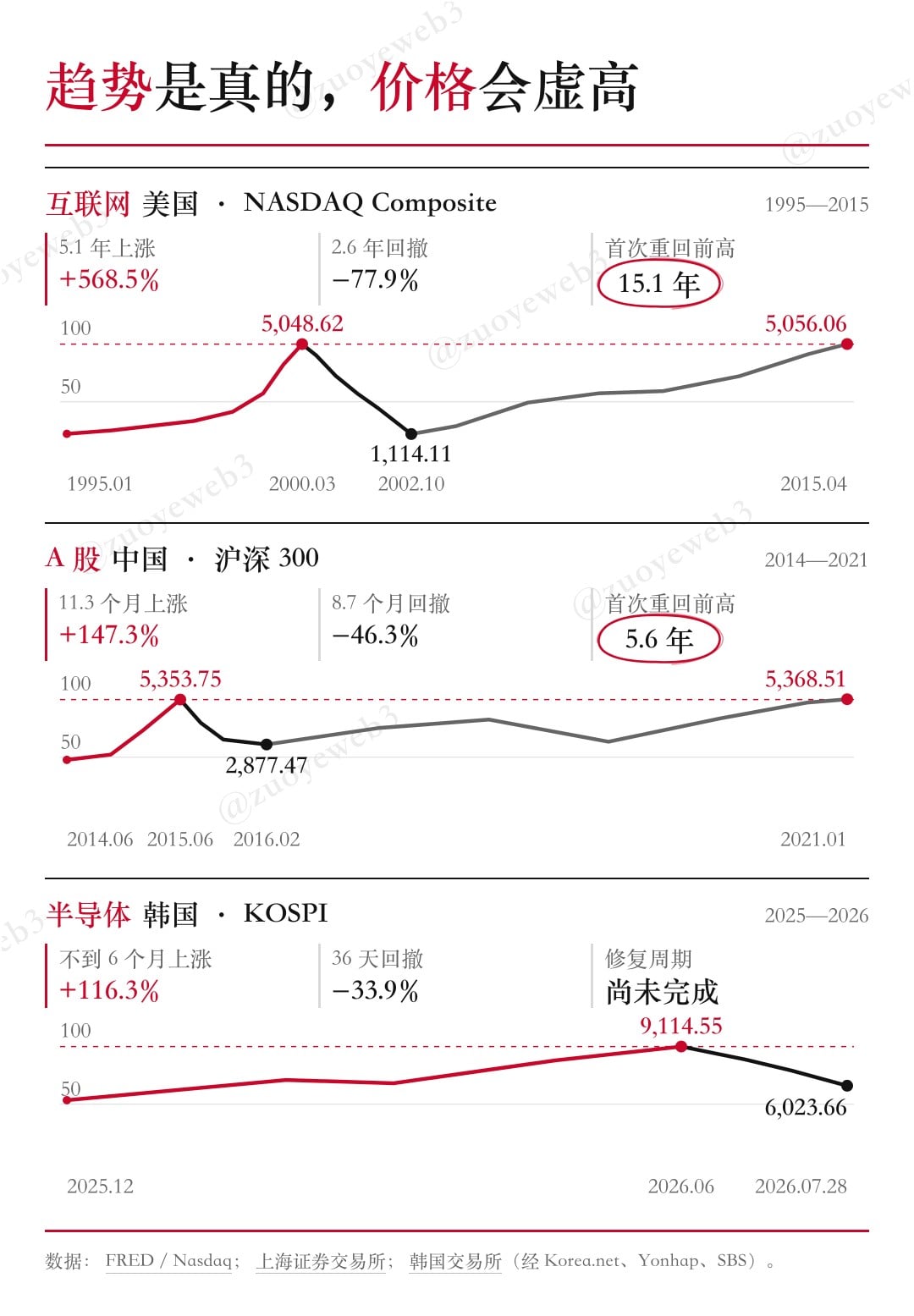
Image caption: Only policy bulls benefit
Image source: @zuoyeweb3
From this perspective, whether it was in March when Lee Jae-myung called for increased leverage, or in July when he began to limit leverage, South Korea's most beautiful summer not only was short but also extremely volatile due to artificial factors.
Meanwhile, the U.S. stock market in AI, semiconductors, and robotics is experiencing unprecedented prosperity, amid rumors of DeepSeek R1/Kimi K3/DUV lithography, under the daily calls for interest rate cuts from Powell—Kevin Walsh, remaining robust through the revolving door of Trump-Biden-Trump.
This robustness embodies national will, crossing partisan collective consciousness, or in other words, U.S. stocks are becoming a new sovereign-level asset.
This is not an exaggeration; the default of goldsmith bankers in 1672 led to the establishment of the Bank of England in 1694, where government bonds truly became "sovereign-level assets," and the petrodollar after the collapse of the Bretton Woods system, as well as today's AI U.S. stocks, are simply the fruits of crises over time.
Therefore, the China-U.S. trade war in 2018 was, in reality, a historic muscle memory for the U.S., attempting to exclude China from the global economic and trade system through a trade war, while also referencing the U.S. Plaza Accord with Japan, intending to use financial means to crush China's semiconductor industry.
After the ceasefire of the China-U.S. trade war, Trump would further shift to a technology war, which, to a great extent, is manifested in financial terms, where the most direct financial form is U.S. stocks.
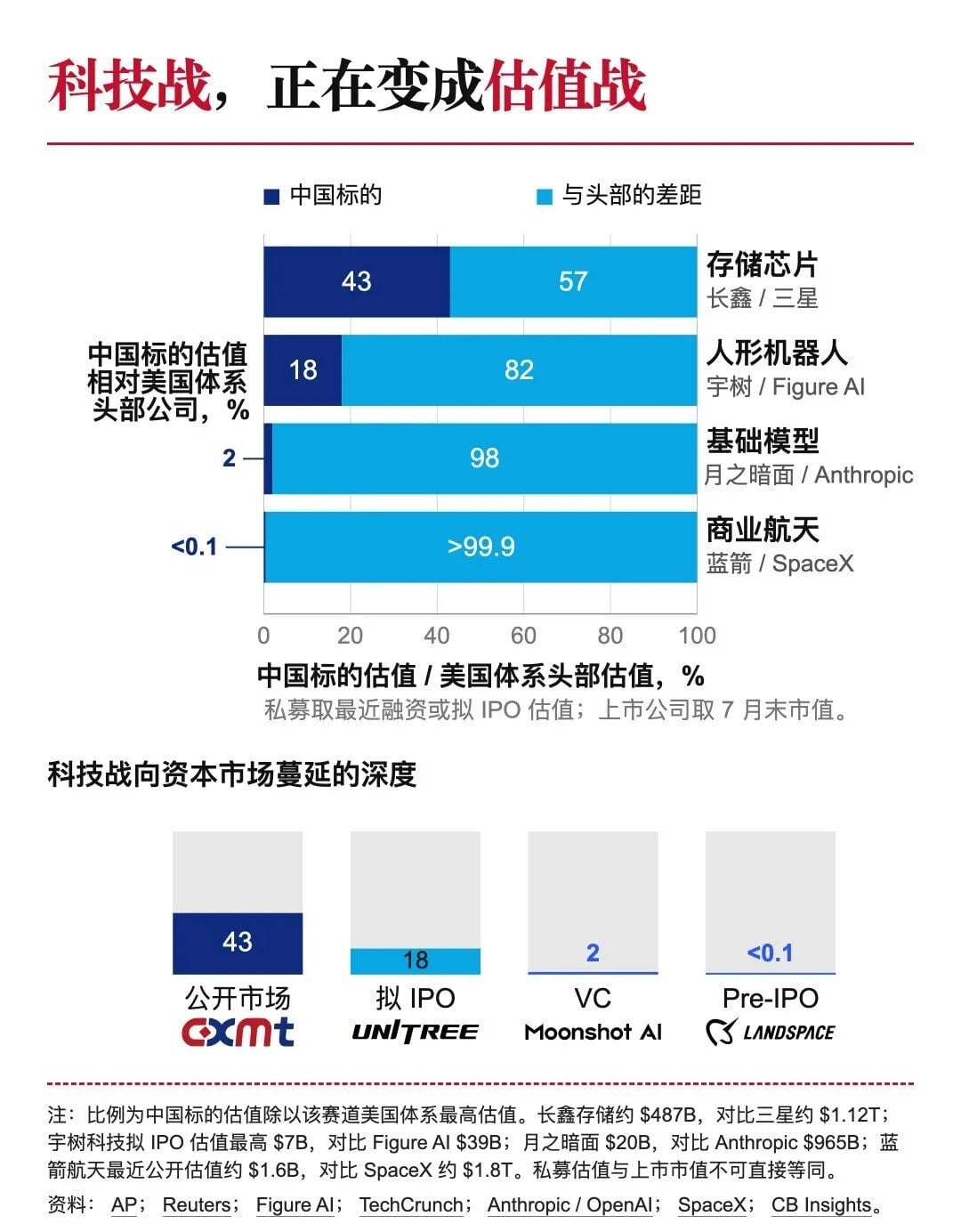
Image caption: New tactics in the technology war
Image source: @zuoyeweb3
Currently, the confrontation of U.S. and Chinese stock assets, exemplified by Changxin Technology and Moonfall, indicates that Changxin Technology has led to significant declines in South Korean semiconductors and U.S. stocks, while Moonfall has provoked complex attitudes in the U.S. towards open source; certainly, the U.S. FCC has already started banning robots, aiming at Chinese robotics industries represented by Yu Shu Technology.
This technology war does not suggest that U.S. and Western technology industries cannot outperform China in terms of scale or performance. Even at a comparable level, China's corresponding assets have achieved larger scale R&D and production based on completing a 0~1 foundation in the U.S., and the sales direction is also aimed at European and American markets, fundamentally remaining part of the U.S.-Western system.
Changxin, Hesai, DJI, and even BYD all aspire to enter the U.S. market, all seek to use dollars, propelled by decades of inertia.
However, the world is increasingly divided into two world systems, and both sides could achieve natural monopolies in their respective fields to significantly damage the other, only this time, the significant damage is targeted at the stock market, not traditional trade shares.
It should be noted, however, that while U.S. stocks are becoming a new sovereign-level asset, A-shares are becoming a new restricted asset. This does not mean that the two countries' stock markets will always rise; much like U.S. bond yields are recognized as the global risk-free rate, and U.S. bonds are a major headache for the U.S. government, these two matters are isomorphic and synchronized.
The real revelation lies in the fact that, over the past 30 years, consumption-grade monopolistic enterprises such as Apple and Google established with efficiency globally will yield to enterprises within their own systems that can earn monopolistic profits in localized regions, becoming targets in a new round of competition.
This is more important than whether AI is a bubble or whether the semiconductor summer has ended; everyone must make their own choice.
Conclusion
The craziest financial crisis hides the greatest Alpha returns in human history.
From the bankruptcy of bankers in 1672 to the establishment of the Bank of England, it cost a generation's youth, whether in discussions about banning robots or the ambiguities of DUV, the main subjects of service are not market demands, but the state will itself.
In a sense, figures like Peter Thiel have seen this turn; Silicon Valley + military industrial complex, such as Anduril, and cryptocurrency VCs have also seen new opportunities — America + manufacturing, like Paradigm investing in processing factories like SendCutSend.
Fortunately, TradeXYZ still has Pre-IPO Perp paving the way for Changxin; at least, arbitrage in this business remains the most expensive access channel amid the two great powers.
The greater the storm, the more valuable the fish; here’s to this era of great contention!
免责声明:本文章仅代表作者个人观点,不代表本平台的立场和观点。本文章仅供信息分享,不构成对任何人的任何投资建议。用户与作者之间的任何争议,与本平台无关。如网页中刊载的文章或图片涉及侵权,请提供相关的权利证明和身份证明发送邮件到support@aicoin.com,本平台相关工作人员将会进行核查。


