Written by: Vaidik Mandloi
Translated by: Luffy, Foresight News
Tokenized real-world assets (RWA) have surged by 179% this year. The trading volume of stocks and commodities on the Hyperliquid platform has now surpassed that of crypto tokens. The mainstream view in the market generally believes that traditional finance is finally moving on-chain.
However, if we trace the actual buyers of these RWA products, the conclusion is starkly different from common perception: it is not institutional capital entering the market. The vast majority of capital comes from within the crypto industry. Various protocols and DAO treasuries are continuously increasing their holdings, converting their reserve assets into tokenized assets.
This article will analyze how the RWA craze resembles an internal "dollarization" process in the crypto world rather than the entry of traditional institutional funds. It will also explore what it means when crypto-native protocols become the largest buyers of tokenized US Treasuries.
Who is buying RWA assets?
Let's rewind a few years. If you paid attention to the decentralized finance (DeFi) market from 2020 to 2021, you would have witnessed outrageously high yields. Lending pools promoted annualized returns of 15%-20% on dollar deposits, with some products even reaching as high as 40%. Billions of dollars flooded in, yet few questioned the sources of these yields.
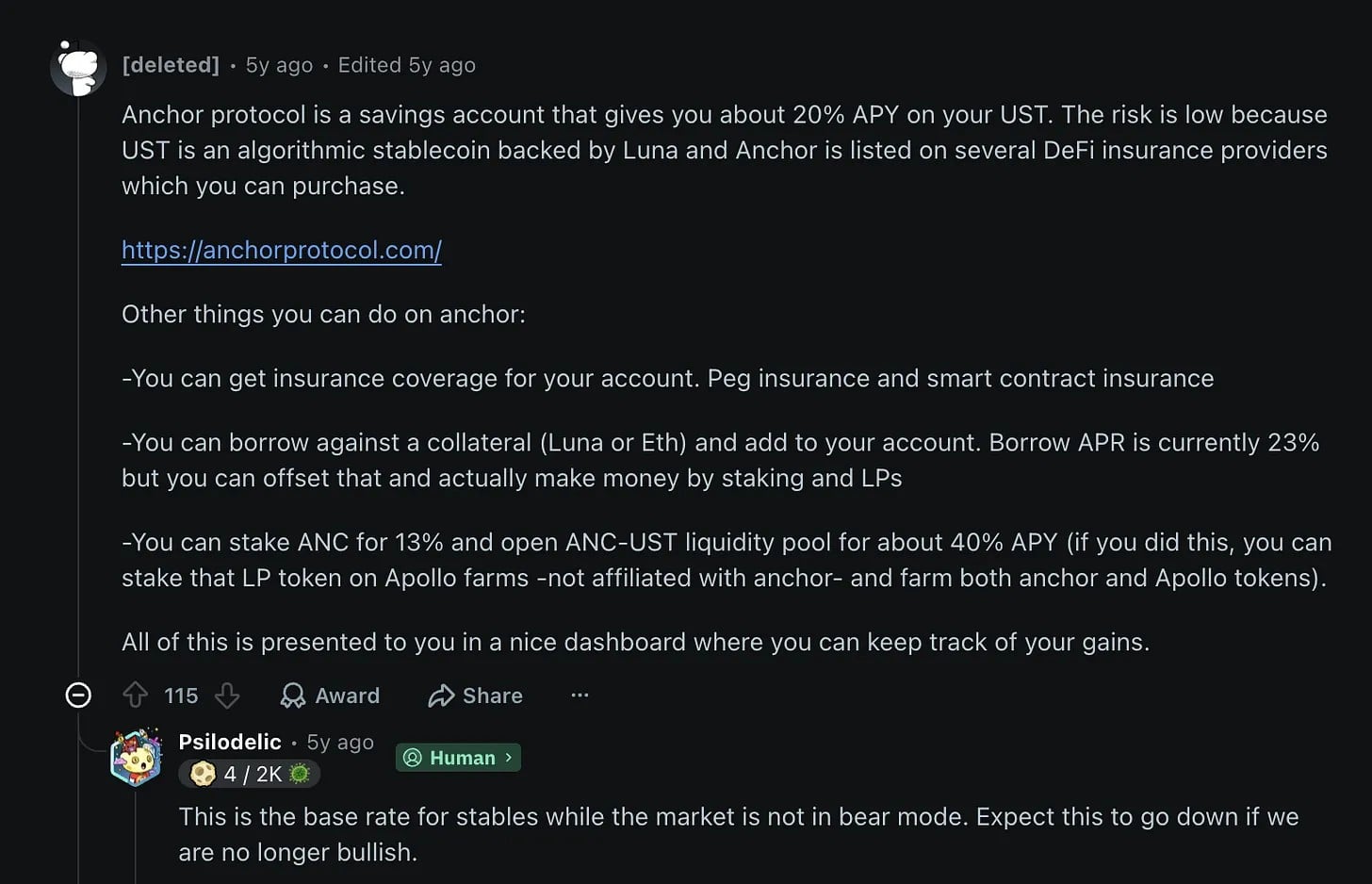
These yields essentially stem from the issuance of tokens: protocols mint governance tokens, distribute them to depositors as "rewards", and treat these subsidies as investment returns. This is the ultimate means to attract investors and boost total value locked (TVL), but the success of this model hinges on a continuous rise in the price of governance tokens. When the market subsequently crashed, various governance tokens plummeted by 80%-90%, revealing that the natural yield of DeFi was only 2%-3%.
This yield is not only lower than that of US short-term Treasuries but also carries significantly higher risks. This reveals a harsh reality: the financial system that the crypto industry has spent years building cannot generate competitive yields based solely on its economic activities. The past high yields relied on a continuous influx of new capital to take over governance tokens, rather than profits created from capital invested in real production. Once the inflow of new capital slows, the entire model will collapse.
Many protocols hold hundreds of millions in treasury funds, valued in their governance tokens, making it difficult to obtain competitive yields within the crypto market. In 2023, multiple tokenized US Treasury and dollar credit products were launched on-chain. For the first time, DeFi protocols could invest reserve funds into assets that generate real dollar returns without leaving the crypto ecosystem.
Since then, this practice has become the norm in the industry. Arrakis recently conducted research targeting on-chain buyers, tracking $91.3 billion in deposits across over 10 dollar-yield products. Among the $12.4 billion in identifiable funds, two-thirds came from crypto protocols and DAO treasury funds; the remaining funds were held by crypto-native investors, exchanges, and market makers.
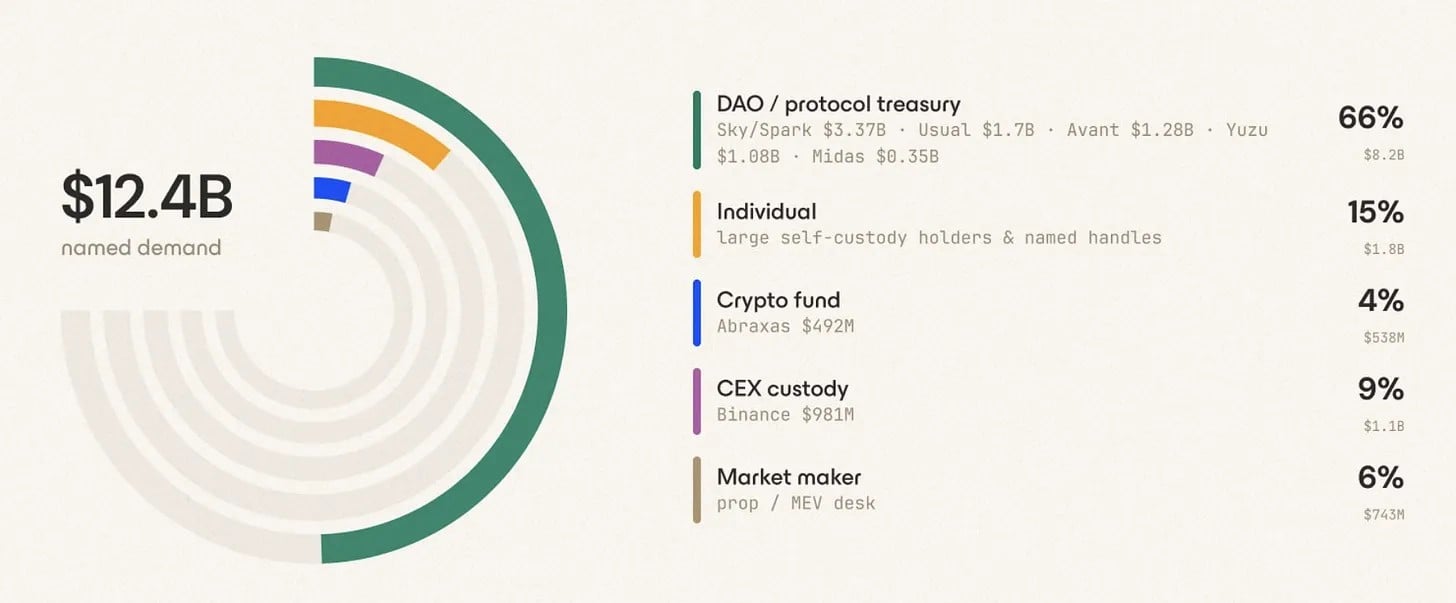
Data source: Arrakis
In the RWA sector, which has reached a scale of $36.2 billion and is heavily promoted as "institutional entry," the proportion of traditional institutional funds such as pensions, asset management companies, and banks is zero.
BlackRock launched the BUIDL fund with the intention of guiding institutional capital into the Ethereum ecosystem. This is a fully regulated, tokenized Treasury product that can provide risk-free returns, specifically designed for pension institutions to invest without the need to explain crypto assets to their boards. But to this day, 98% of fund holders are still crypto-native participants. Ethena holds over half of the assets in BUIDL through its USDtb product; the remaining positions among the top ten holders are occupied by protocols such as Ondo and MakerDAO's sub-DAOs.
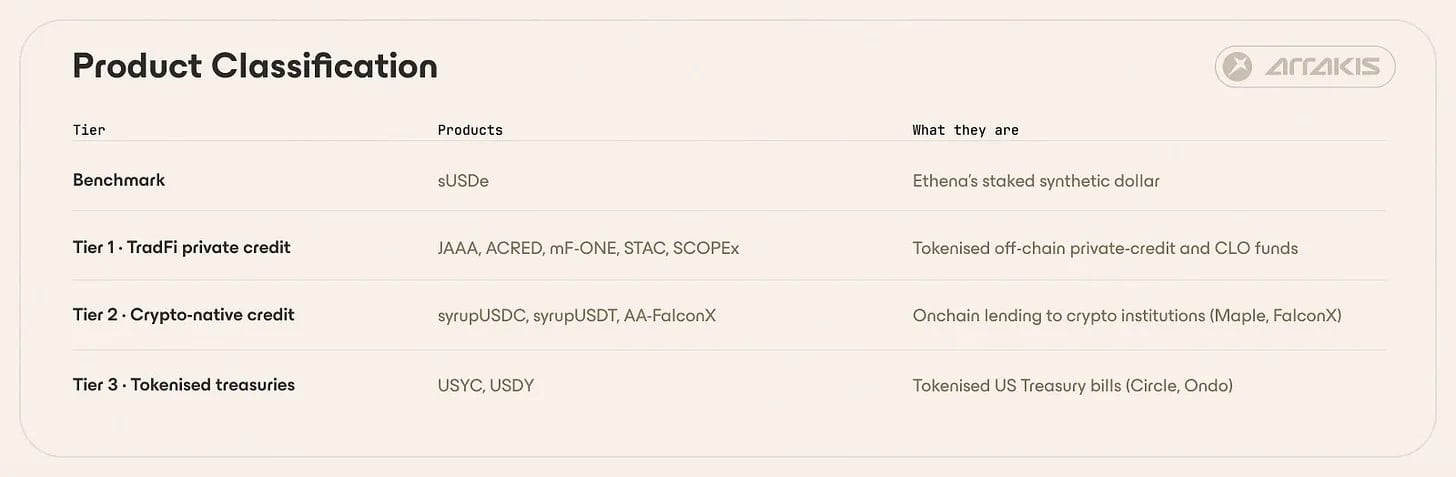
Data source: Arrakis
BUIDL is not an isolated case. Across the entire sector, almost every tokenized RWA product has the top five holders controlling over 90% of the circulating assets.
MakerDAO serves as the best example of anticipating the future direction of the industry. In 2021, the protocol held about $17 million in DAI corresponding to real assets; now this scale has expanded to $4 billion, with more than half of the collateral consisting of US Treasuries rather than crypto assets. The original vision of Maker was to issue stablecoins based on crypto-native collateral, using over-collateralization to guard against Ethereum price volatility. However, this model is extremely costly and requires locking up assets far exceeding the issuance limit. At that time, the community generally accepted that a lower capital utilization efficiency was an acceptable price to pay for achieving decentralization.
Reality, however, provides a contrary answer: at least at the large-scale implementation level, this path is unfeasible, as it still ultimately relies on the traditional financial system it intended to replace. Subsequently, MakerDAO completed a name change, restructured its governance framework, and established an independent sub-DAO to manage its Treasury investment portfolio.
This phenomenon is not limited to Maker, it is unfolding throughout the entire industry. No protocol can long hold large amounts of its own governance tokens as reserves. The price of tokens depends on the status of protocol development, and the health of treasury assets is in turn linked to token prices.
Uniswap DAO holds nearly $6 billion in treasury assets, almost entirely in UNI tokens. Last year, the community passed a governance proposal called "Reactivating the Uniswap Treasury," planning to reduce its native token holdings in exchange for stable assets. Voters have already realized that unless the UNI price permanently rises, holding other assets would be a better choice. Treating the native token as a reserve is akin to emerging market central banks treating their national bonds as foreign exchange reserves. As long as there is no need to liquidate, the balance appears robust forever.
There is a concept in international economics that precisely describes such a predicament: "Original Sin." Globally, only about five currencies can rely on their own currency for borrowing and reserve accumulation. All other countries, regardless of government intentions, ultimately move toward dollar-denominated pricing. The root cause lies in the absolute first-mover advantage of the dollar as the global accounting currency, with extremely high conversion costs and highly concentrated liquidity.
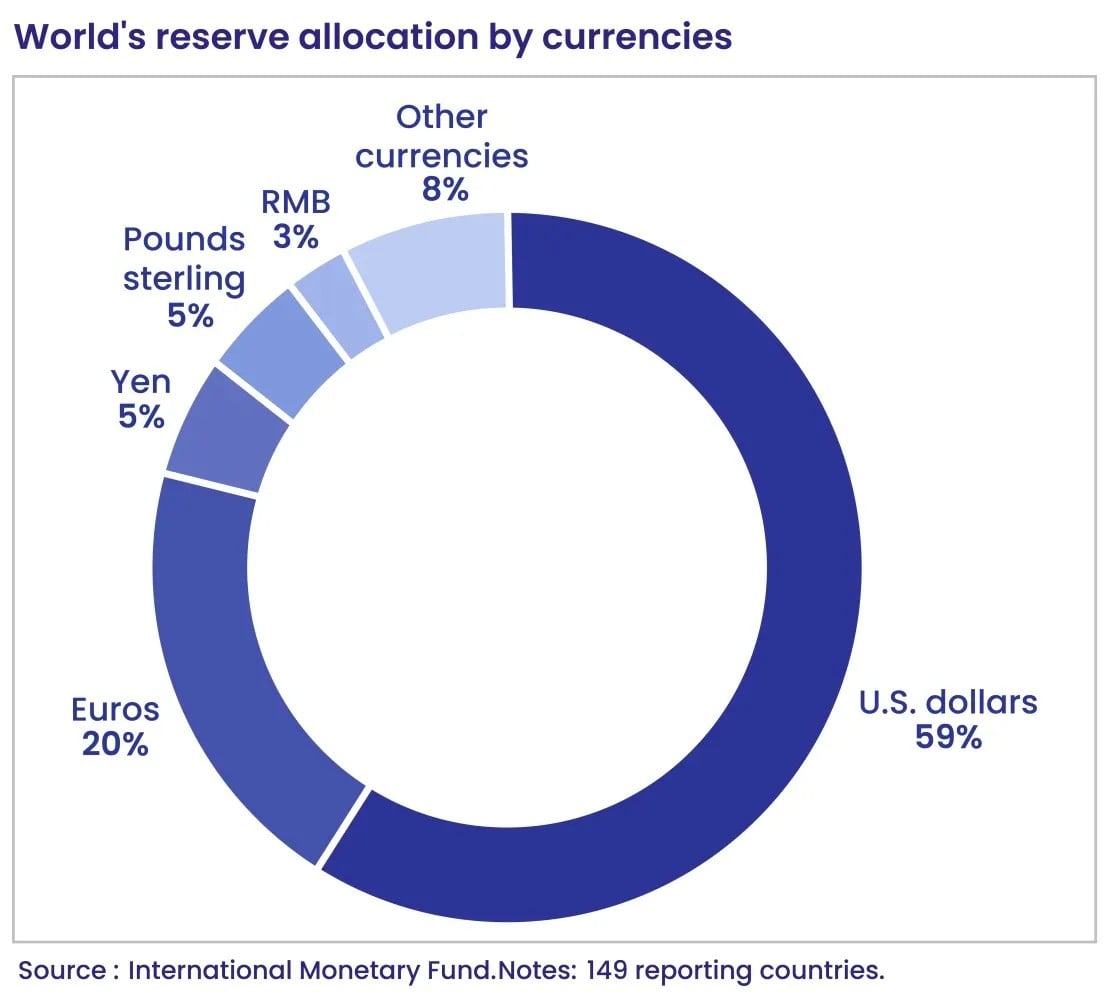
All protocols holding large treasuries ultimately reach the same conclusion: during market downturns, governance tokens struggle to retain value, and the crypto ecosystem cannot sustain sufficient yields in the long term. The only rational choice is to exchange for dollar-denominated assets. This network effect is what has allowed the dollar to dominate global finance and also enables stablecoins to rule the DeFi market. The large-scale allocation of tokenized US Treasuries represents the final step in the dollarization of crypto.
The Economic Logic Behind Dollarization
Economic theories regarding dollarization clearly divide the entire process into two phases, and the crypto industry has completed the full process.
Phase One: Asset substitution. Once people in emerging markets lose confidence in their local currency's purchasing power, savings shift to dollars. People still receive salaries in local currency and price goods in local currency, but savings flow into dollar accounts to stabilize purchasing power.
Phase Two: Currency substitution. When enough savings convert to dollars, lending activities also begin to settle in dollars, and everyone holds the same currency, making business transactions more convenient. The two phases reinforce each other. In traditional emerging markets, this complete process often takes years or even decades.
Interestingly, the crypto industry completed the entire process in just three years. Asset substitution occurred during the last bear market: major protocol treasuries converted fee income and other non-governance token dollar reserves into stable assets, no longer reinvesting in the DeFi market. Governance tokens remained on the balance sheet, but the revolving funds had completed dollar conversion.
Once treasuries began holding USDC and USDT, the currency substitution phase almost instantly kicked off. The lending market fully adopted stablecoin pricing; yield products uniformly labeled dollar yields; trading pairs that originally used ETH as the trading token gradually switched to stablecoin trading pairs. Now, with the popularization of tokenized US Treasuries, dollar pricing has progressed further: from synthetic dollar stablecoins to on-chain assets that generate risk-free returns in official US dollars.
Countries like Turkey have undergone decades of political turmoil and currency collapse to achieve such a transformation, while the crypto industry has managed it in just a few quarters. A report by Oliver Wyman earlier this year proposed that stablecoins have compressed the decades-long dollarization process in traditional markets into just a few months. Originally targeting emerging markets, this theory is even more applicable in the crypto industry. The crypto field lacks central banks that use capital controls and regulatory barriers to delay dollarization, and the cost of capital conversion is almost zero.
However, this also presents the paradoxical trap of dollarization: reversing this process entails conversion costs that are almost unimaginable. Economists refer to this as the "lag effect." Once dollarization takes root in an economy, even if the external conditions that initially propelled dollarization improve, it becomes almost impossible to completely reverse.
The crypto sector lacks opportunities similar to a supercycle in commodities that would allow governance tokens to surpass dollar-yielding assets. Protocols also find it difficult to enforce capital controls or reserve requirements on stablecoin deposits. Moreover, unlike sovereign nations, the crypto industry has no institutional memory of a "pre-dollarization" phase. The vast majority of DeFi projects have treated stablecoins as the default unit of account since their inception.
This is a one-way passage with heavy costs. Every time economic activity within DeFi is priced in USDC or USDT, the seigniorage revenue from currency issuance flows entirely to Circle and Tether, not to the various protocols generating transactional activity. Last year, Tether created nearly $10 billion in profit relying solely on about 100 employees; Circle completed its IPO, and Coinbase managed only the distribution of USDC, yet still gained half of the net interest income.
After Ecuador and El Salvador implemented dollarization, the seigniorage revenue that originally belonged to their central banks transferred to the Federal Reserve. Similarly, when DeFi operates relying on stablecoins, all seigniorage revenue is captured by Tether and Circle.
Protocols using currencies issued by others also lose the ability to control their own ecological economy. They cannot adjust the supply of their native tokens to respond to ecological cycle fluctuations, and core economic activities are no longer priced in native tokens. Their situation is akin to fully dollarized countries that cannot rely on currency depreciation to hedge against downturns. The only remaining measure is to cut spending. The entire DeFi sector has been doing just that for the past two years: numerous governance votes have reduced funding budgets, led to layoffs, and slowed the progress of protocol development, leaving the protocols without any other monetary tools to utilize.
The former MakerDAO and Circle executive team is building a project called M⁰, positioned as the "European Dollar System Manager." The team is developing infrastructure to support multiple issuers of stablecoins backed by US Treasuries, targeting the $20 trillion offshore dollar market. The project does not aim to replace the dollar but to create a more complete circulatory channel for the dollar.
I believe this is the ultimate form of dollarization in crypto: infrastructure is restructured to meet the demand for mainstream currency, with various native tokens relegated to secondary roles.
Some may ask, what about the original narrative of "Bitcoinization"? Even the most staunch Bitcoin supporters admit that this requires decades; it can only take root after the stability of the dollar system itself is shaken. But ironically, the reality is that the crypto industry has built the most efficient dollar circulation network in history. The crypto industry has not pushed its own monetary logic onto the world; rather, the existing global monetary rules have reshaped the crypto industry.
The entire industry is rushing to package the prosperity of RWAs as a story of Wall Street discovering blockchain efficiency. Of course, the first buyers are native cryptocurrency users, but two-thirds of identifiable funds have flowed into tokenized Treasuries. This is currently the safest and most fundamental financial product, merely wrapped in smart contracts.
免责声明:本文章仅代表作者个人观点,不代表本平台的立场和观点。本文章仅供信息分享,不构成对任何人的任何投资建议。用户与作者之间的任何争议,与本平台无关。如网页中刊载的文章或图片涉及侵权,请提供相关的权利证明和身份证明发送邮件到support@aicoin.com,本平台相关工作人员将会进行核查。


