Written by: Rita
Corning's enterprise optical communication business grew 65% in the second quarter, with overall revenue exceeding expectations. The median revenue guidance for the third quarter is $4.95 billion, lower than market expectations. The stock price dropped 19% in one day.
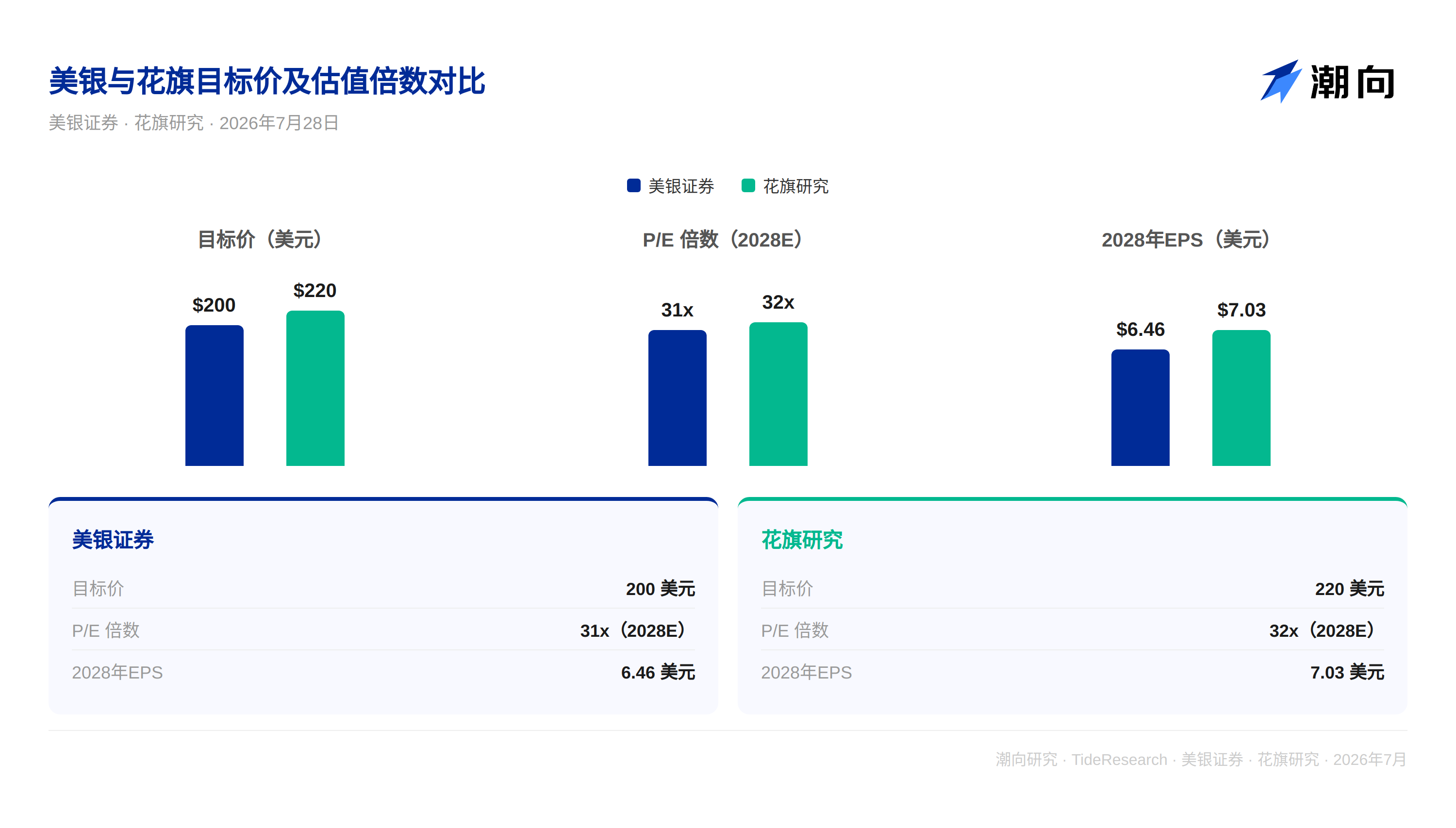
BofA Securities lowered its price target from $243 to $200, maintaining a buy rating. Citi Research reduced its price target from $240 to $220, also maintaining a buy rating. Both institutions have no disagreement in their assessments, believing that the decline is in the valuation bubble, not in the business itself. The divergence is only in magnitude, how much of a drop counts as a complete drop.
Slowing growth punctures the valuation bubble, AI demand has not disappeared
In the second quarter, Corning's enterprise optical communication revenue grew 65%, with sales related to generative AI nearly doubling sequentially, and the overall optical communication segment's 32% year-over-year growth is still impressive. BofA estimates this round of growth reflects only the horizontal expansion demand, while vertical expansion and co-packaged optics (CPO) demand have not yet started. Citi states more directly that the profits from Corning's optical communication come from high-value connectivity solutions, not bare optical fiber sold by the meter; the technical barrier remains.
The median third quarter guidance of $4.95 billion sees year-over-year growth sliding from 17% to 16%. The year-over-year growth of the optical communication business has dropped from 81% to 32%, marking a decline for three consecutive quarters. The issue lies in the pace, not the direction. The stock price previously surged to $271.78, a 52-week high, with the market assigning a more than 60 times price-earnings ratio for the expected 2026 earnings, while the five-year average is only 22 times. Corning's story is intact, but the price can't hold up.
Citi mentioned a structural change, where long-term supply agreements are becoming the ballast for the optical communication business, including advance payments, reserved capacity, and terms of unconditional payment, providing much greater order visibility than before.
The two major banks calculate the sustainability of AI infrastructure differently
BofA has compressed the valuation multiple from 37 times to 31 times, adjusting the 2028 earnings per share forecast from $6.50 to $6.46, only changing by 4 cents. BofA clearly states that the adjustment is to reflect market concerns about how long data center construction can sustain. A 31 times valuation is still high, with the historical median being 15 times, but it has narrowed from before.
Citi expects the 2028 earnings per share to reach $7.03, more optimistic than BofA, lowering the multiple from 35 times to 32 times, implicitly representing an EV/EBITDA of about 27 times. Citi believes the annual revenue run rate of $2 billion will reach the target a quarter earlier, maintaining a 19% compound annual growth rate guidance from 2026 to 2030, with profits growing faster than revenue, and free cash flow continuing to expand.
The price targets of the two banks differ by only $20. BofA is more conservative on multiples, while Citi is more optimistic about profits. How long capital expenditure for AI infrastructure can be sustained, the two calculations yield different answers.
The crash corrects the valuation, but the fundamentals are not rotten
Neither has turned bearish. BofA expects the enterprise optical communication business to continue growing quarter-over-quarter in the third quarter, with profits starting to recover after the solar plant shutdown ends, and operating profit margins expanding 184 basis points year-over-year to 20.9%. Citi predicts a rebound in solar profitability in the third quarter, with the impact of the shutdown already cleared, and management remains confident in the solar business, setting a target of over $3 billion with margins exceeding industry averages.
Consumer electronics are weak, but management believes they can withstand it, relying on unit value enhancement and new product introductions.
Corning's long-term logic remains unchanged. The market is shifting from explosive expectations to a sustainable growth pace. BofA gives $200 and Citi gives $220, which is 67% and 83% higher than the current stock price, respectively, but for these gains to be realized, the market must accept a valuation over 30 times. Corning now does not need to tell stories; it just needs to earn back trust with several consecutive quarters of performance.

Disclaimer
This article is a compilation and interpretation by Chao Xiang Research of third-party securities research reports (BofA Securities, July 28, 2026; Citi Research, July 28, 2026), combined with publicly available market information. The ratings, price targets, earnings forecasts, and related judgments quoted in the text are solely opinions of the analysts from the mentioned securities firms, only representing the stance of their respective institutions, and do not represent the views of Chao Xiang Research, nor do they constitute any investment advice.
There are risks in the market, and decisions should be made independently. This article should not be used as a basis for buying or selling any securities.
免责声明:本文章仅代表作者个人观点,不代表本平台的立场和观点。本文章仅供信息分享,不构成对任何人的任何投资建议。用户与作者之间的任何争议,与本平台无关。如网页中刊载的文章或图片涉及侵权,请提供相关的权利证明和身份证明发送邮件到support@aicoin.com,本平台相关工作人员将会进行核查。


