Earlier and broader price discovery has value, but it also comes with a cost.
Written by: 0xFacai, Rhythm
Under thin liquidity, actual transactions do not equal reliable prices.
On the morning of July 28, 2026, the pre-market in South Korea had only one share of SK Hynix traded at 1,272,000 KRW, approximately 868 USD. This transaction of less than 900 USD was then brought into the TradeXYZ pricing system, causing the SKHX perpetual contract to drop from a minimum of 1,128.2 USD to 927 USD within one minute.
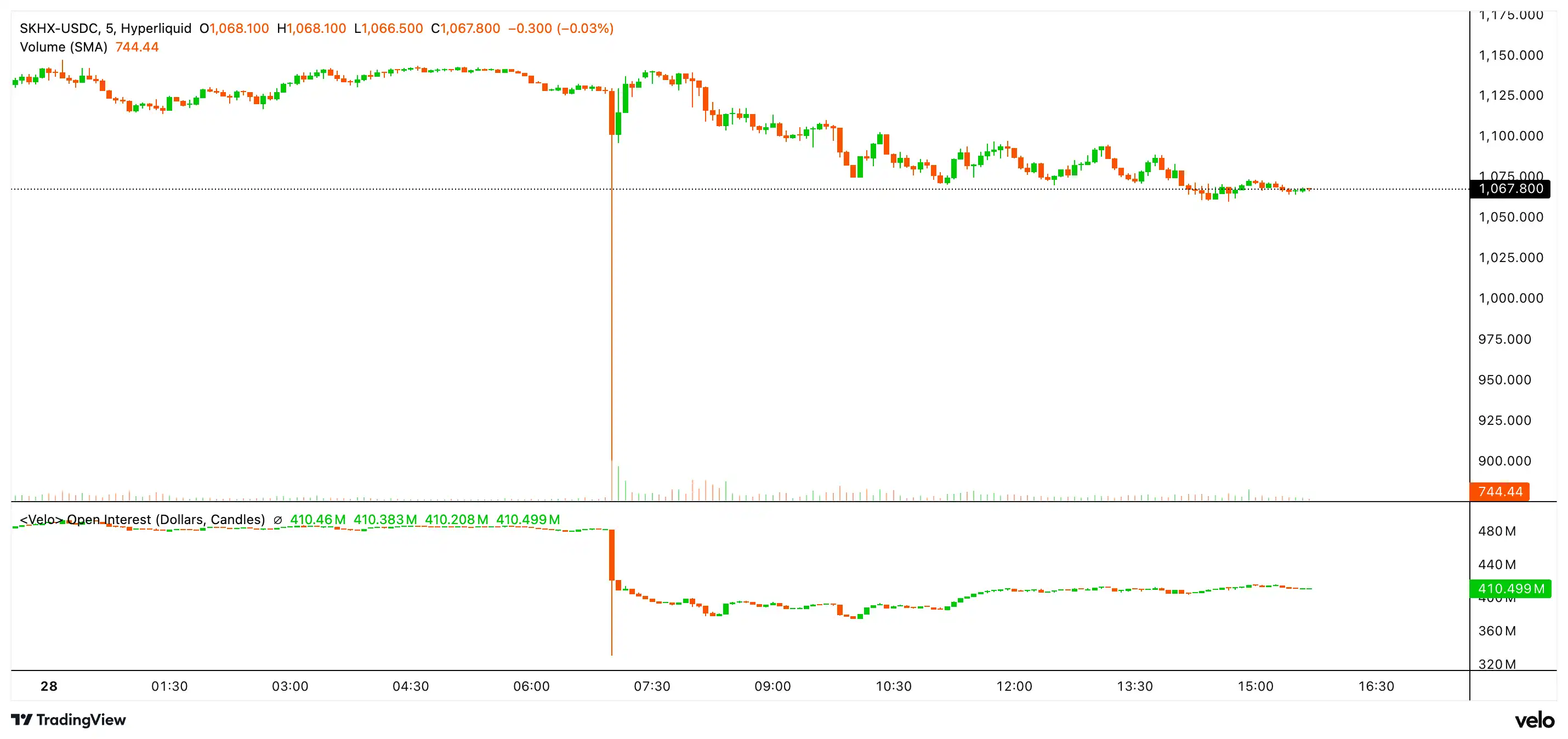
In less than three minutes, hundreds of accounts were taken over by the system. Over the next four hours, the liquidation scale rose to approximately 80 million USD.
868 USD triggered a hyperliquid SK Hynix perpetual contract market with a position size of 500 million USD.
Pre-Market Pricing of Korean Stocks
The starting point of the event was Nextrade, which is the alternative trading system NXT operating outside of KRX in South Korea.
NXT uses continuous bidding in the pre-market. If the buy price is higher than the sell price, the order is executed immediately. It has not deviated from the price limits of South Korean stocks; the upper and lower price limits are still based on the previous trading day's KRX closing price, with a range of about 30%.
The closing price of SK Hynix the previous day was about 1,816,000 KRW. Calculating down 30% and then adjusting according to the minimum price unit of South Korean stocks, 1,272,000 KRW falls right around the legal price lower limit.
This transaction did not violate market rules. The issue lies in the depth of the order book: the buy orders in the NXT pre-market were thin, and a sell order priced low enough to execute just one share pushed the latest transaction price to the lower limit.
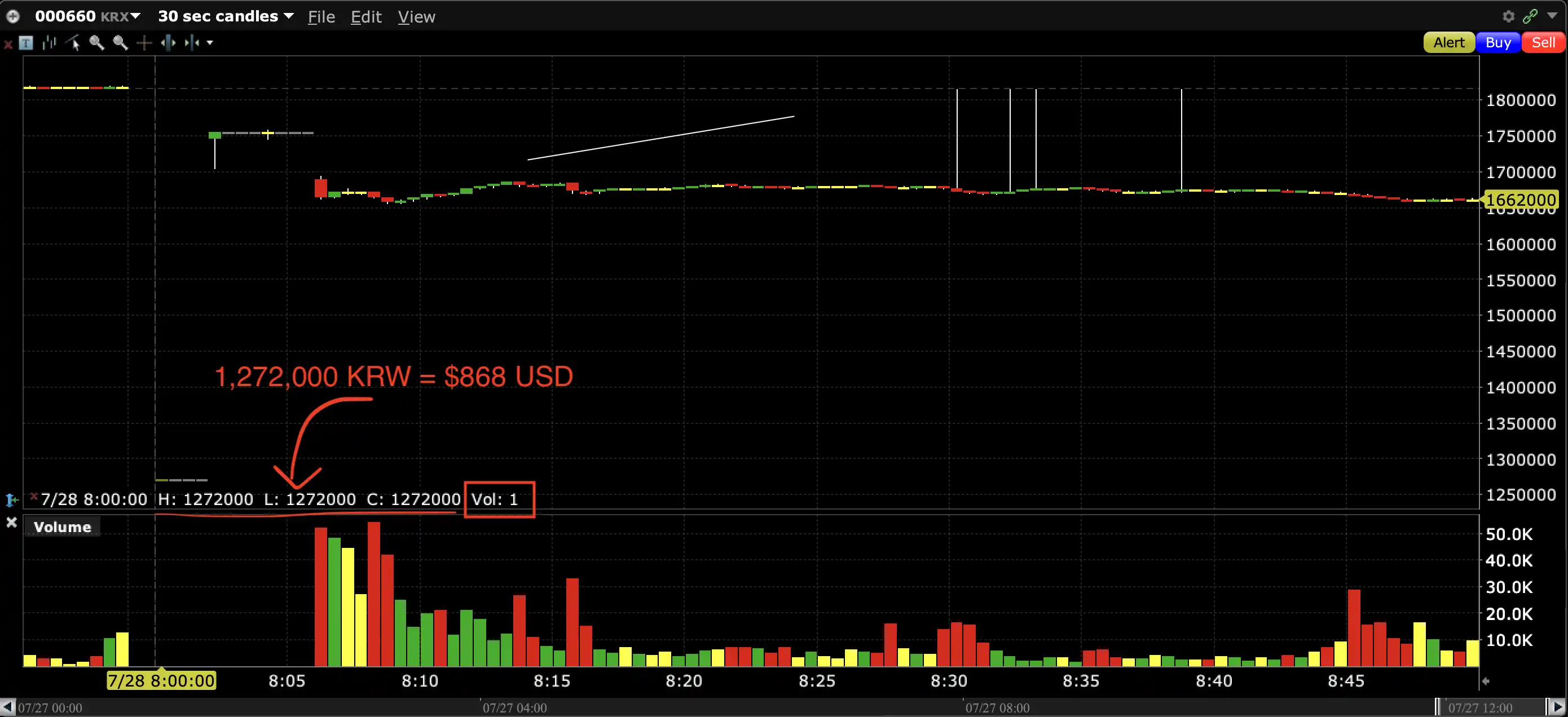 Source: @yourquantguy
There is currently no evidence to confirm whether the seller made an error, intended to push the price down, or was simply willing to sell at that price. For subsequent liquidation, subjective intent is not so important. It was a real transaction and also within the allowed price range, so external pricing systems had reason to accept it.
The danger begins here.
The Transmission Chain of Incorrect Pricing
According to TradeXYZ's official documentation, SKHX tracks the dollar value of one share of SK Hynix common stock. The calculation is straightforward: the KRW price of 000660.KS divided by the USDKRW exchange rate yields the oracle price of SKHX.
TradeXYZ has classified external oracle price feeds and internal pricing periods for Korean stocks. The pre-market external pricing period is from 8:00 AM to 8:50 AM KST, corresponding to 7:00 AM to 7:50 AM Beijing time. In other words, when NXT just started pre-market trading, TradeXYZ would obtain executable quotes from institutional data providers and input them as external prices.
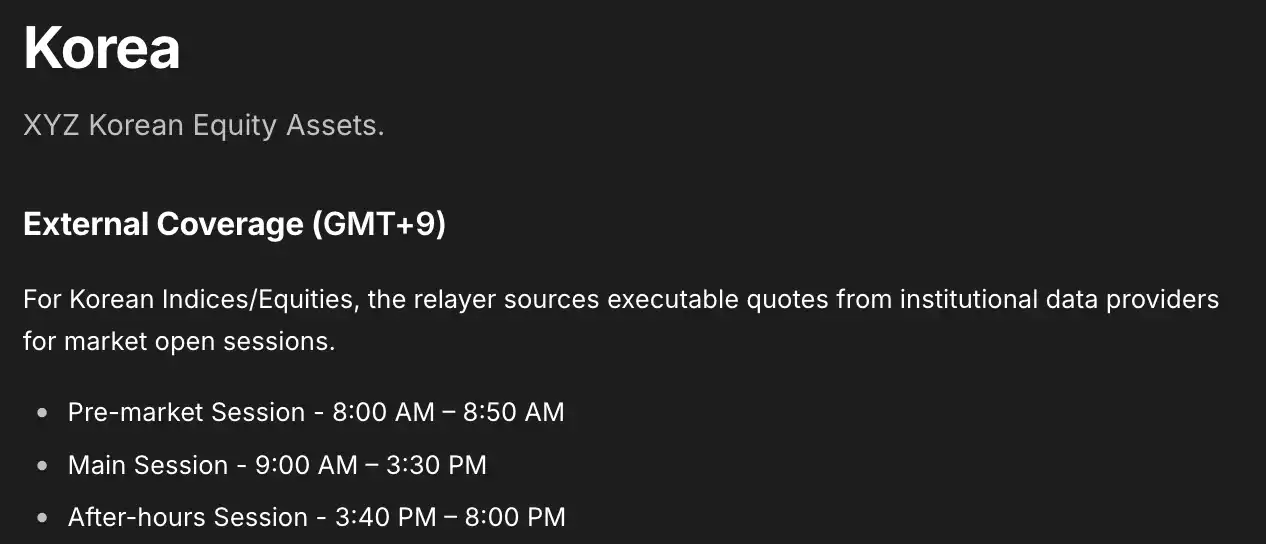
Before 7:00 AM Beijing time, SKHX was still in an internal pricing phase, and the oracle primarily adjusted based on the impact price from TradeXYZ's own order book. Once it reached 7:00 AM, external data resumed, and the oracle would then update to external prices.
This switch coincided exactly with the transaction of 868 USD for a single share.
According to on-chain records, at 07:00:21.678, TradeXYZ's "oracle update component" submitted an update to HyperCore: the external price of SKHX was 868.17 USD, the oracle price was 908.21 USD, and the two "mark price components" were 921.96 and 954.98 USD respectively.

The "mark price" is what TradeXYZ presents to users and actually uses. TradeXYZ will take the median of three numbers: the oracle price; the oracle price plus the 150-second EMA relative deviation of the perpetual contract midpoint from the oracle; and the median of the best buy price, best sell price, and last transaction price on the order book.
This design incorporates the order book and time smoothing mechanism of TradeXYZ, which can delay the transmission of abnormal prices, but it did not anticipate the lurking hidden dangers: external pricing may also rely on a market with insufficient liquidity.
In the minute from 07:00, SKHX opened at 1,128.2 USD, touched a low of 927 USD, and the contract volume reached 40,978 (contracts), generating a total of 7,501 transaction records. The internal pricing phase that limited the price discovery to a ±10% boundary did not prevent this drop, as external pricing had already resumed, and the reference anchor of the system consequently changed to the new external price.
Liquidation flowed from traders to the system's accounts.
The liquidation figures need to be broken down into two categories.
Based on HyperInsight's detailed statistics on on-chain addresses, the nominal liquidation amount for SKHX in a short period was approximately 79.398 million USD, with open contracts decreasing from 481 million USD to 331 million USD, a reduction of about 150 million USD. The top three addresses on the liquidation board totalled to 14.7754 million USD being liquidated, with the largest loss being approximately 3.957 million USD for an address starting with 0x320, realizing a loss of approximately 2.045 million USD.
In this liquidation, about 26.26 million USD flowed into a special address: 0x4000000000000000000000000000000000000001.
Between 07:00:21 and 07:00:48, it took over 406 long accounts, totaling 27,098.687 SKHX contracts, with a weighted average price of about 969.05 USD.
The liquidation process typically sends forced liquidation orders into the order book. If the market buyers can digest the sell orders, the positions will be closed in the open market; if the order book cannot execute in time, the account margin continues to deteriorate, and the system must transfer the remaining positions out. In this event, 0x400...0001 played the role of backstop and liquidation intermediary.
It passively became a long position.
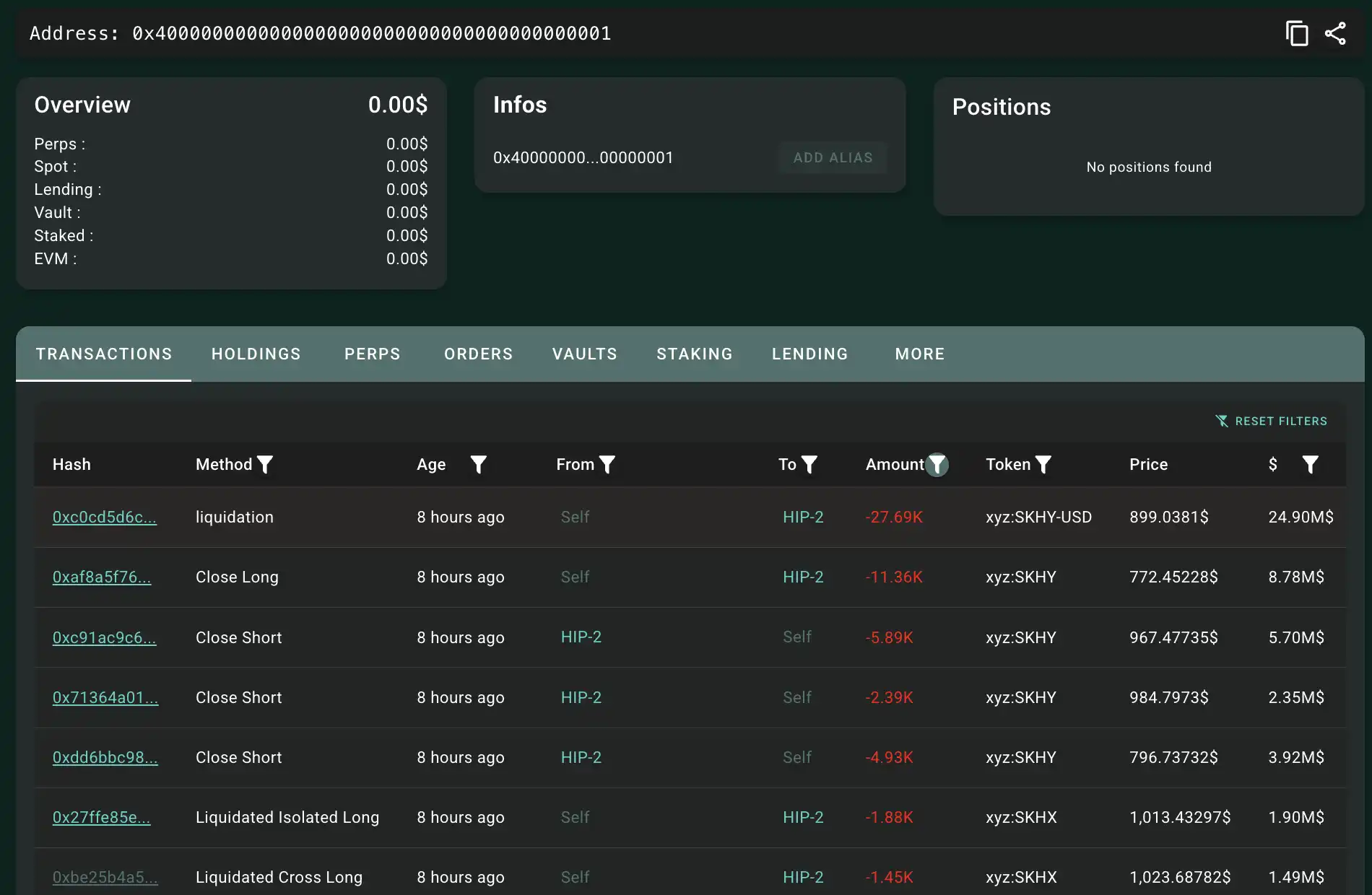
The takeover did not end the risk. After the price continued to fall, on-chain records began listing 0x400...0001 itself as a liquidated account. This address had a total of 26,560.549 long positions entering the next wave of liquidation, corresponding to a nominal transaction amount of about 2.47374 million USD, realizing a loss of 1.001 million USD.
There is also a documentation issue. TradeXYZ's public page still states that XYZ assets are not protected by the HLP Liquidator Vault, and that there is currently no backstop liquidator; however, actual on-chain data marks these positions as backstop. Therefore, 0x400...0001 cannot be directly equated with the HLP treasury. A more prudent definition is that it is the system backstop account called by HyperCore in this SKHX incident. The public documentation has yet to explain the relationship between this existing process and the previous version.
Binance Abandoned External Quotes for an Hour, This Time Escaped Disaster
The same transaction on the South Korean spot market also affected Binance's SK Hynix perpetual contract, but the results were much lighter.
High-frequency trader Boywus made a direct comparison of the two mechanisms: at 7:00 AM Beijing time, TradeXYZ on Hyperliquid had already connected to the external pre-market quotes from South Korea; Binance was still in the internal pricing phase and switched to external quotes only around 8:00 AM when the main market opened.
Binance's official documentation shows that stock perpetual contracts use the order book to impact the midpoint price when external markets are closed and applies EWMA smoothing to reduce opening price jumps and the risk of forced liquidations during low liquidity periods. In the first minute of the morning at 7:00, the SKHYNIXUSDT index only fell from 1,132.49 USD to 1,130.66 USD;
TradeXYZ absorbed the earlier price discovery at 7:00, while Binance abandoned this hour of external quotes and lost some timeliness but avoided the impact of directly entering the liquidation system at 868 USD.
This is unrelated to centralization or decentralization. The difference lies only in when external prices take over, whether the transition process is smooth, and whether the liquidation price has independent abnormal value protection.
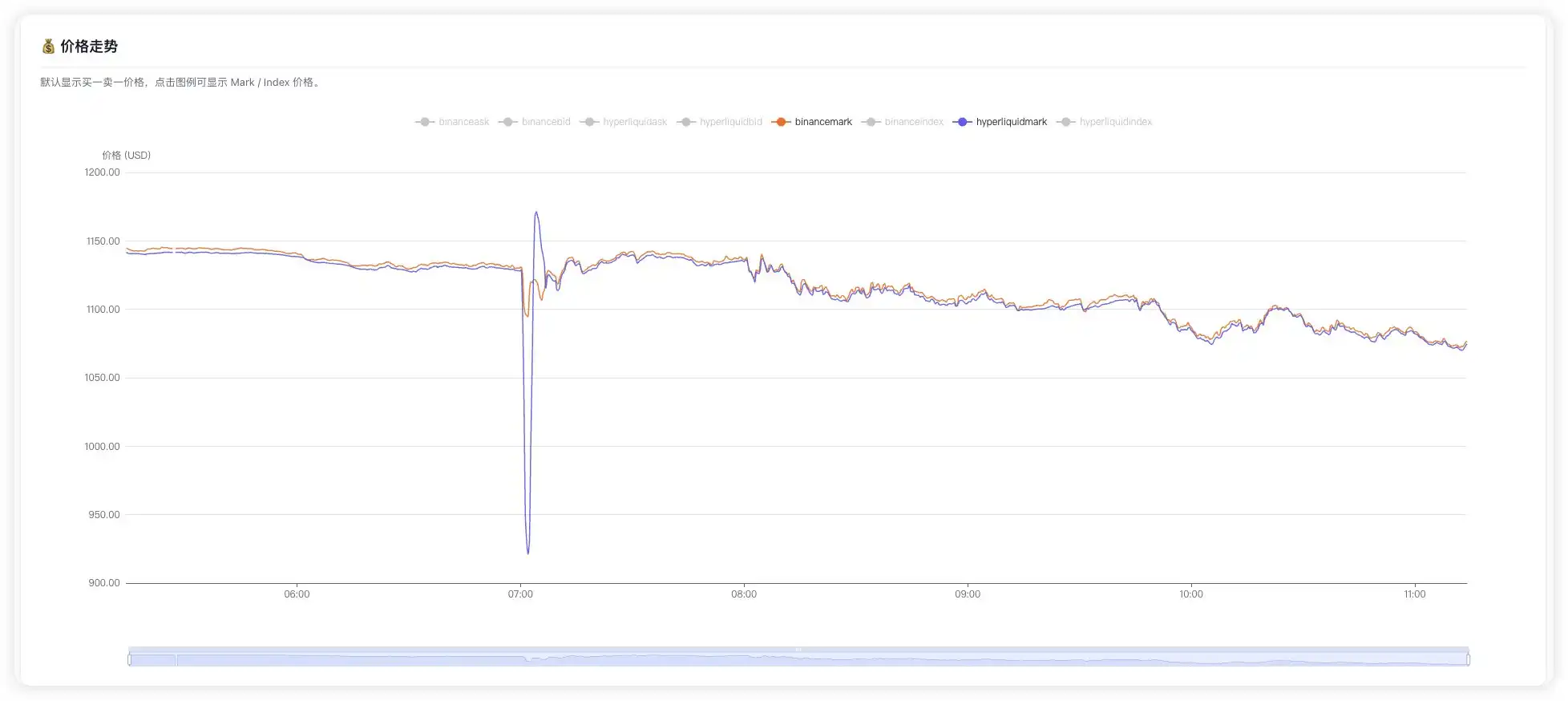
Source: @Boywus
At This Point
Some may think that TradeXYZ simply faithfully reflects the real market situation. 1,272,000 KRW did indeed transact, the data provider didn't make an error, and all the modules of the trading platform followed established rules to relay the prices on-chain. From this perspective, compensation for the loss is hard to find a clear rule-based justification.
But correct price discovery does not mean that the liquidation design is rational.
Traditional markets have long differentiated the latest transaction price, index price, and fair price used for risk control. The existence of the "mark price" is to prevent a localized transaction from directly determining the fate of high-leverage accounts. In this incident, although the external quotation underwent median, EMA, and update amplitude limitations, it still triggered approximately 80 million USD in liquidation within one minute, indicating that the existing protection mechanisms are not well-matched with the depth of the reference market.
Having more quotation providers won't solve this problem individually. Multiple data sources are observing the same NXT pre-market order book, and a low single-share transaction will simultaneously enter their quotes, leading the median to ultimately converge on the same abnormal price. The service providers may be decentralized, but the underlying liquidity is not dispersed.
Hyperliquid has assigned the definition and operational responsibility of the oracle for the HIP-3 market to the deployer, but the liquidation is executed by HyperCore, meaning that risk and reputation will not be limited to the HIP-3 deployer's responsibility.
Earlier and broader price discovery has value, but it also has a cost. I hope Hyperliquid and TradeXYZ can learn from this experience.
免责声明:本文章仅代表作者个人观点,不代表本平台的立场和观点。本文章仅供信息分享,不构成对任何人的任何投资建议。用户与作者之间的任何争议,与本平台无关。如网页中刊载的文章或图片涉及侵权,请提供相关的权利证明和身份证明发送邮件到support@aicoin.com,本平台相关工作人员将会进行核查。


