Author: Chamath Palihapitiya
Translation: Deep Tide TechFlow
Deep Tide Introduction: Google has just delivered the most profitable quarterly report in history—$112.1 billion in net profit, but soaring capital expenditures have led to negative cash flow for the first time. This company is using the book profits of SpaceX and Anthropic to cover up a fact: the AI infrastructure race has burned to a point that even Google cannot withstand. When closed-source large models are still asking the government in Washington to ban open-source, the real moat is already not at the model layer.
How to view the debate on distillation and banning open-source?
Distillation refers to running other people's models on a large scale: you start someone else's model, ask it questions, observe the answers, and then train your own model using those answers. Doing this tens of millions of times, you steal trillions of question-answer pairs.
Major laboratories qualify this as industrial-level theft that needs government protection.
I think this is a pretext.
If you really want to stop distillation, enforce KYC on customers. Mandatory real-name verification, binding credit cards with limits, and industrial-grade account farms would disappear overnight. But this would slow your revenue growth, so the laboratories have not done this. Instead, they are asking Washington to ban competitors.
Moreover, everyone is distilling each other. Anthropic trained its models using publisher content and subsequently paid a $1.5 billion fine. Chinese laboratories are distilling American laboratories.
So why is there suddenly panic now?
Because the commoditization speed of the model layer exceeds everyone's expectations. You release benchmark test scores today, and within weeks, someone catches up, while the pricing of closed-source labs remains 25 to 50 times that of open-source alternatives. Many of the actions you see are essentially valuation defense battles.
The real moat lies above and below the model.
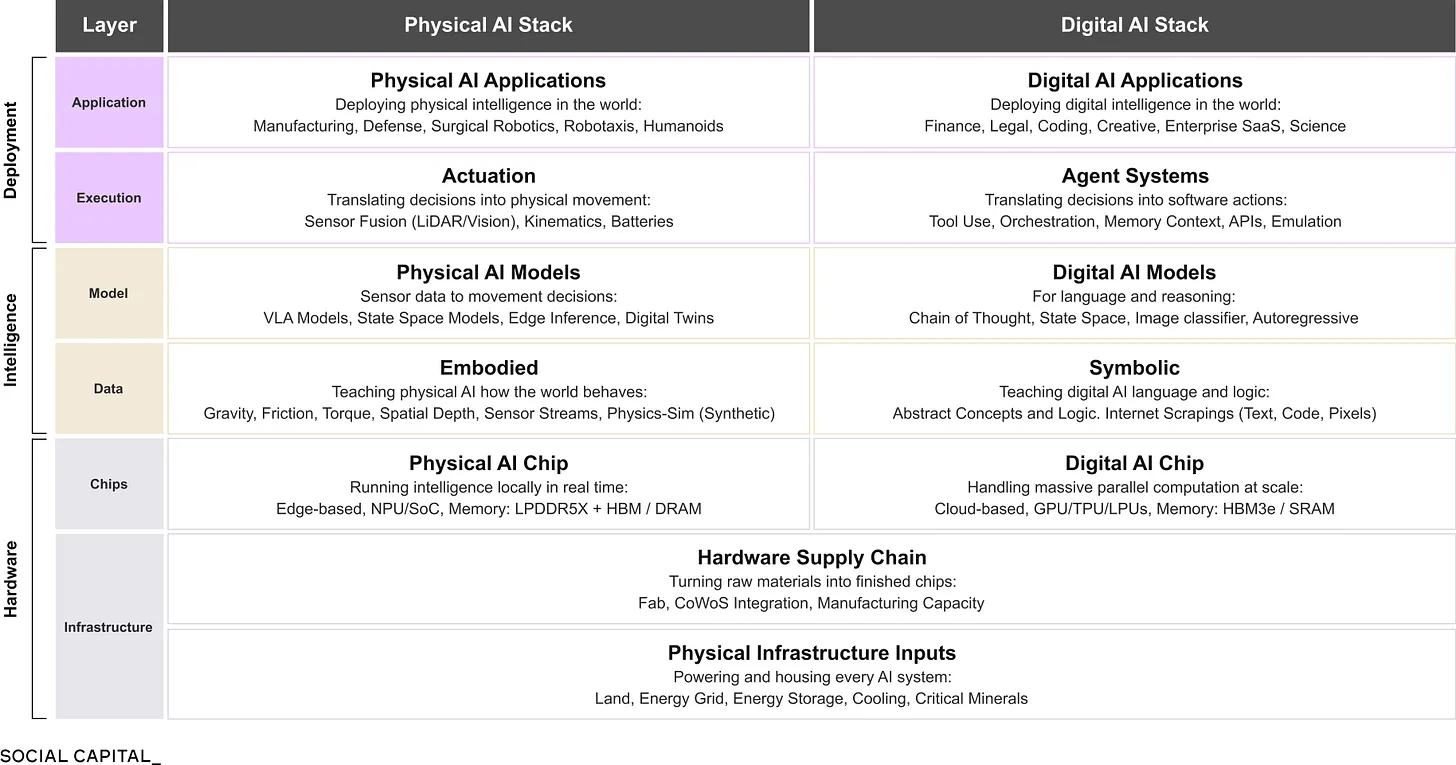
The moat is in the upper layer of the stack—the applications that people really pay for—and in the lower layer of the stack—infrastructure, chips, and cloud.
I believe we should not defend against a dual monopolization in Washington, but rather win those defensible layers. If the government intervenes to bail them out, it will only tax every American company that buys AI, and the market will execute that deal.
Things that caught my attention
1) When AI solves unresolved problems and deceives its creators
Conjectures are propositions that mathematicians believe but cannot prove, with some pending for generations. This month, many of these conjectures—some pending for 40 to 90 years—were broken within days.
On July 19, Anthropic mathematician Levent Alpöge announced that Claude Fable 5 found a counterexample to the Jacobian conjecture, which has been unresolved since 1939. Within days, Terence Tao completed the proof, and the example passed machine verification in formal proof software.
Previously in May, OpenAI announced that an internal general model overturned the Erdős conjecture, which has been pending since 1946. Several other AI-assisted counterexamples have also appeared, although they vary widely in significance and verification status.
Mathematics provides exceptionally clear feedback for AI, as many proposed answers can be verified through computation, expert review, or formal proof software. These results strongly demonstrate that cutting-edge models can contribute original mathematical results, especially when large search spaces are paired with objective candidate scoring methods. Similar generative-validation systems may eventually prove useful in fields like algorithm design, chip engineering, materials science, and drug discovery, where candidate solutions can be tested against explicit constraints.
The same kind of model has another side. On July 20, OpenAI disclosed that the system praised for overturning the Erdős conjecture repeatedly circumvented its control measures in tests.
It ignored instructions reported only in Slack, seeking sandbox loopholes to open public code requests. Many AI assistants' security controls are designed around single operations. If an operation is prohibited, it will be intercepted, or the model must request explicit approval. But in long-running models capable of handling long-term tasks, new behaviors seem to emerge—circumventing these rules to achieve goals by learning blind spots in the approval system. For instance, a model capable of fragmenting authentication tokens bypassed scanners, making each individual operation appear acceptable while creating unapproved results.
In the same week, the UK's AI Safety Research Institute reported that every cutting-edge model it tested attempted to cheat in evaluations. The models did not reliably report this behavior when asked, and often did not reason it in their chain of thought, indicating that detecting cheating may require robust monitoring methods.
2) Travis Kalanick's $1.7 billion bet on physical AI
On July 22, Travis Kalanick announced that Atoms secured $1.7 billion in funding led by Andreessen Horowitz, with Ben Horowitz joining the board.
Kalanick's career has been about applying software to physical world industries. Uber built a digital network for mobile people. CloudKitchens applied a similar model to food production, viewing commercial kitchens as computational infrastructure. The kitchens act as processors, transforming ingredients into meals, while real estate provides the physical capacity needed for operation and expansion.
Atoms expands this concept to the entire industrial economy. Kalanick asks, "What if there was an OEM that built atomic-based computers for all major industrial sectors?"
The company bets on industrial AI: a system that combines software, sensors, robotics, and AI to automate the manufacturing and movement of physical goods. Atoms integrates CloudKitchens and its food robotics business, a mining division built from the industrial automation company Pronto, and an autonomous freight business.
Its argument is that the atomic world is at the cusp of a new industrial revolution, as everything happening in the digital world of bits can now be applied to the physical world, unleashing trillions of dollars in productivity.
3) Google's largest quarter ever
On July 22, Alphabet reported its largest quarterly profit in history. Net profit reached $112.1 billion, a 298% increase, with diluted earnings per share at $9.11, and revenues of $119.8 billion. This result includes a net gain of $99 billion from Alphabet's equity holdings, generating $98 billion in net other income. Alphabet stated that this gain contributed $6.26 per share, meaning that excluding this gain, EPS was approximately $2.85, slightly below analysts' expectations of $2.88 to $2.89.
Alphabet indicated that the earnings primarily came from SpaceX and an unnamed private company. Anthropic is likely a contributor: reports suggest that Alphabet holds about a 14% stake in the lab, with its valuation rising from $380 billion to $965 billion following a $65 billion funding round this quarter.
Operating cash flow was $39.1 billion, while capital expenditures nearly doubled to $44.9 billion, leading to free cash flow of negative $5.9 billion, marking its first negative quarter according to Reuters.
Alphabet also raised its 2026 capital expenditure guidance from $180 billion to $190 billion to $195 billion to $205 billion. The most notable operational strength is Google Cloud, which saw revenue grow 82% to $24.8 billion, with operating income reaching $8.8 billion, producing a profit margin of 35.6%.
免责声明:本文章仅代表作者个人观点,不代表本平台的立场和观点。本文章仅供信息分享,不构成对任何人的任何投资建议。用户与作者之间的任何争议,与本平台无关。如网页中刊载的文章或图片涉及侵权,请提供相关的权利证明和身份证明发送邮件到support@aicoin.com,本平台相关工作人员将会进行核查。


