Author: Zen, PANews
“Circle focuses on long-term development, believing that the stock price will eventually provide answers.”
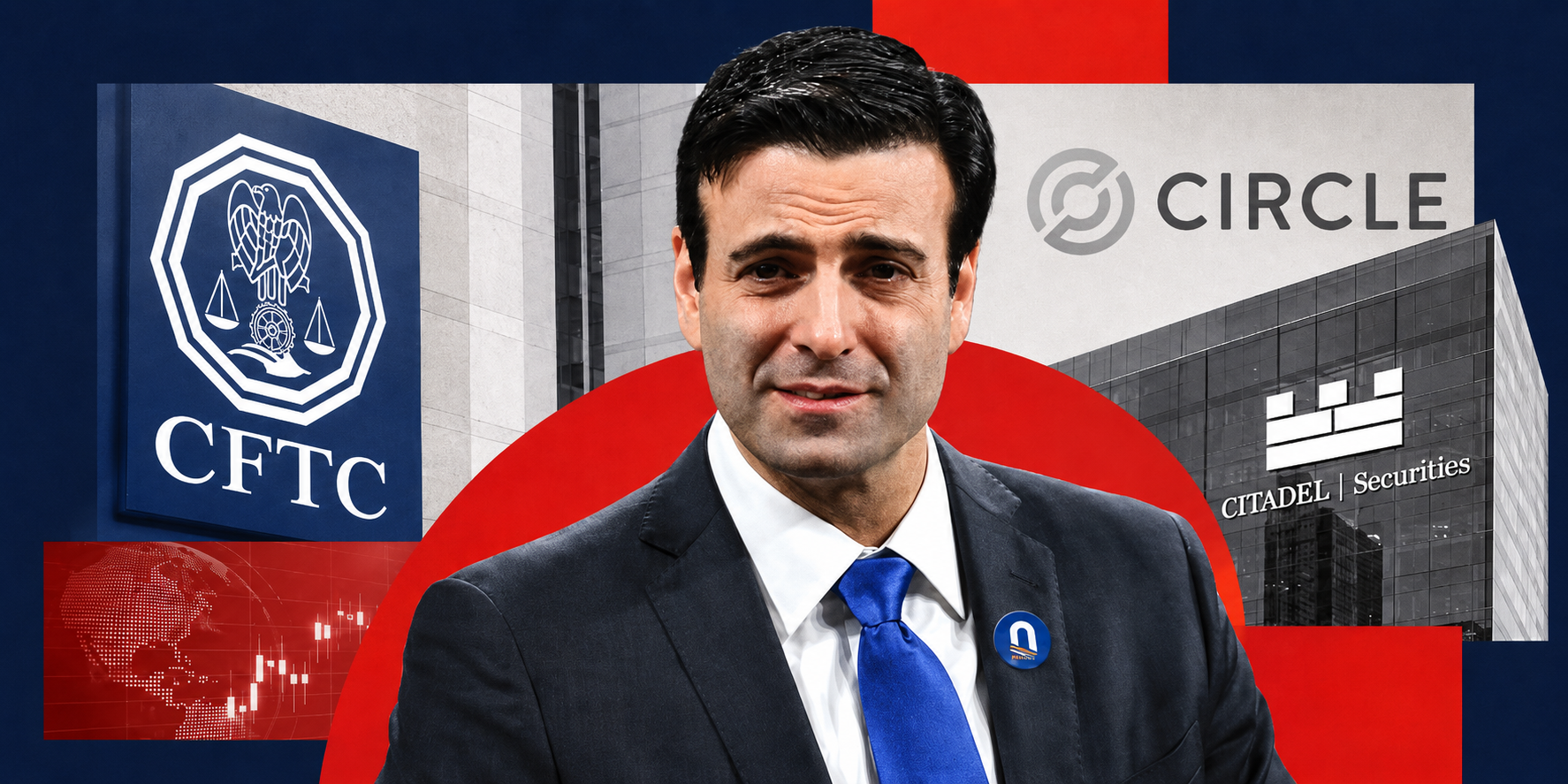
Faced with the grim reality of a stock price that has dropped by 70% from its high point and a market value evaporated. On July 14, former CFTC Chairman and Circle President Heath Tarbert stated the above viewpoint during an interview with FOX Business when asked by the host what he would say to investors who bought Circle stocks at historical highs.
However, reality is not favorable for Circle. Analysts from Mizuho Securities USA LLC recently downgraded Circle's rating from "neutral" to "underperforming," and set a target price of $50, the lowest on Wall Street.
With the stock price continuously declining, urging ordinary shareholders to choose long-termism and maintain patience is indeed Tarbert's responsibility as president. However, it is particularly ironic that he has been continuously selling CRCL shares since Circle completed its IPO, cashing out about $30 million without ever increasing his holdings.
Crazy cashing out, leaving long-termism to the market
The revolving door in politics and business is a classic script for U.S. officials after leaving office. As a former CFTC chairman who is friendly to cryptocurrencies, Heath Tarbert joined Circle in July 2023 as Chief Legal Officer and Head of Corporate Affairs. Tarbert's role is clearly to use his experience spanning the U.S. Treasury, CFTC, White House, and Wall Street to help Circle communicate with regulators, accelerate business growth and listing, and promote USDC's entry into the traditional financial system.
Tarbert himself has stated that he values Circle's "regulatory-first" development approach and hopes to promote the establishment of clear and consistent rules for digital assets. In early 2025, he was further promoted to Circle's first president, overseeing legal, compliance, risk, public policy, communications, and international expansion.
From public statements, Tarbert has almost always been one of the most active promoters of Circle's "long-termism" narrative. He repeatedly emphasizes that stablecoins should not only be understood as cryptocurrency trading tools but as the next generation of payment, settlement, and internet financial infrastructure. Current investments by Circle cannot be simply measured by short-term profits or stock price fluctuations.
But on the issue of personal holdings, he established arrangements that are completely different from his public stance on the eve of Circle's IPO. On June 4, 2025, the day before Circle determined the IPO offering price and officially went public, Tarbert set up a 10b5-1 trading plan to sell up to 353,290 shares of Circle stock within a year.
Thus, in the 13 months following the IPO, he sold stocks for 7 months, cumulatively selling over 360,000 shares and cashing out over $30 million. Among these, on March 2, 2026, Tarbert sold 122,007 shares in a single transaction valued at approximately $11.5 million, the largest transaction of all.
The 10b5-1 plan allows executives to pre-set the timing, number, or price of future stock sales without possessing significant non-public information, avoiding opportunistic trading based on insider information. Most of Tarbert's sales were executed automatically by brokers through such plans, earning him approximately $24.4 million.
Perhaps Tarbert felt that the intensity of his selling was not enough; even before the first round trading plan fully concluded, Tarbert set up the next round of 10b5-1 plan on March 10, 2026, preparing to continue selling up to 160,000 shares by the end of this year, including shares acquired by exercising options. Since Circle's IPO, Tarbert has never actively bought company stock on the open market.
In fact, it is quite common for company executives to sell part of their equity and diversify personal assets. However, what dissatisfied the community is that even after cashing out on a large scale at a relatively high position, when the stock price fell by about three-quarters, he still emphasizes that the market adheres to long-termism, while he himself shows no intention to increase his holdings in the open market. This inevitably leads people to believe that Tarbert actually just wants to cash out and leave, without ever having genuine confidence in Circle's long-term development.
Mastering the political-business revolving door, joined Citadel Securities 27 days after leaving CFTC
In fact, before entering Circle's core management, Tarbert was very skilled at monetizing his U.S. political and business resources.
He received early training in law and finance, served in the White House, the Senate Banking Committee, and the Treasury, and also led the banking regulatory practice at the international law firm Allen & Overy. During the Trump administration, Tarbert served as Assistant Secretary for International Markets at the U.S. Treasury, participating in G7, G20, the Financial Stability Board, and financial regulatory coordination between Europe and the U.S., and briefly acting as Deputy Assistant Secretary for International Affairs.
In 2019, Trump nominated Tarbert to be the CFTC chairman. Given his experience in a Republican government, along with his background in banking regulation, international finance, and law, his nomination faced no significant opposition. The Senate ultimately confirmed him as chairman with 84 votes in favor and 9 against, originally set to last until April 2024.
After the 2020 presidential election, when the Democrats reclaimed the White House, Tarbert voluntarily stepped down on the day Biden was inaugurated. His public reasoning was to make way for the new president to select a permanent chairman, which is a normal power transition for U.S. regulatory agencies after a party change.
However, Tarbert could have continued to serve as an ordinary commissioner until 2024 but chose to resign from all positions early on March 5, 2021. Just 27 days later, Tarbert quickly joined Citadel Securities, a leading market maker directly affected by financial regulatory policy, as Chief Legal Officer.
This experience later shaped the public's basic impression of him—highly skilled at entering the regulatory system, accumulating institutional resources, and converting these resources into compliance, lobbying, and policy influence capabilities for large financial companies.
From Citadel Securities to Circle, controversy began with the "revolving door."
In addition to joining Citadel Securities as an executive less than a month after leaving a regulatory position, Tarbert's seemingly "urgent" timing for joining this company also raised external concerns.
In early 2021, a large number of retail investors concentrated their purchases of stocks like GameStop, which were heavily shorted by institutions, driving stock prices to surge, causing some short hedge funds to incur massive losses. At the height of the market frenzy, Robinhood suddenly restricted users from buying stocks like GameStop and AMC, but still allowed selling, leading to a substantial decline in related stock prices. Some investors subsequently accused Robinhood of colluding with Citadel Securities to suppress stock prices, believing the platform weakened retail buying power by closing the "buy button" to save Wall Street shorts.
In this storm, Citadel Securities became the focus of suspicion. The reasons were twofold: on one hand, it was one of the most crucial order execution venues and order flow payment sources for Robinhood; on the other hand, its founder Ken Griffin's hedge fund Citadel had just provided funding to Melvin Capital, which had been severely hit by the GameStop short squeeze. At this moment, this leading market maker was facing intense scrutiny from Congress, regulators, and public opinion.
During this sensitive period, just having left the CFTC, Tarbert coincidentally took on the role of Chief Legal Officer at Citadel Securities, responsible for handling legal, compliance, and regulatory matters. Tarbert understood the operational logic of regulatory agencies, the policy-making process, and had connections in Washington, which were exactly what Citadel Securities needed to cope with congressional investigations and possible market structure reforms.
Once at Citadel Securities, Tarbert did not confine himself to traditional legal matters. In 2023, during his tenure as Chief Legal Officer, Citadel Securities strongly opposed the SEC's proposed retail order auction reform. The SEC wanted some retail orders to undergo public auction before execution to increase competition among market makers. Citadel Securities submitted a lengthy statement claiming that the SEC's economic analysis had serious errors, and that the reform was an untested "radical experiment" that could harm retail order execution quality.
Similar conflicts of interest also appeared in the cryptocurrency market. In September 2022, Tarbert, in his capacity as Chief Legal Officer of Citadel Securities, attended a U.S. Senate hearing supporting the "Digital Commodity Consumer Protection Act," advocating for expanded CFTC regulatory authority over the crypto spot market. At the same time, Citadel Securities had already secured $1.15 billion in investments from Sequoia Capital and cryptocurrency investment firm Paradigm, and publicly stated its plans to expand into crypto assets.
Chronologically, a former CFTC chairman joining a market maker preparing to enter the crypto market and then publicly advocating for an expansion of the CFTC's powers over related markets inevitably raises external doubts: is he designing public rules in his capacity as a regulator, or is he helping a potential new employer shape a more favorable market environment in advance?
In 2023, Tarbert left Citadel Securities and joined Circle. At the end of 2022, constrained by the regulatory environment, Circle's planned listing through the SAPC method fell through. Subsequently, Circle urgently needed an executive well-versed in politics to clear the listing obstacles and seek a direct IPO. Two years later, Circle successfully completed its listing, and Tarbert once again became one of the most important external representatives of a financial enterprise that heavily relies on regulatory policies.
From the company's perspective, Tarbert is undoubtedly a highly valuable executive. He is familiar with the operational mechanisms of regulatory systems and skilled at mobilizing policies, networks, and market resources, consistently helping the company cross critical thresholds in compliance, financing, and market access when needed.
Throughout Tarbert's career, a precise judgment of policy cycles and market windows has always been a constant theme. What he truly excels at is converting the credibility, policy resources, and market opportunities accumulated through regulatory experience into the most valuable career chips at different stages.
However, when he continually switches identities between regulatory agencies and financial enterprises, and realizes profits at the appropriate times, the long-term risks are borne not by him, but by the investors who believe in his public narrative.
免责声明:本文章仅代表作者个人观点,不代表本平台的立场和观点。本文章仅供信息分享,不构成对任何人的任何投资建议。用户与作者之间的任何争议,与本平台无关。如网页中刊载的文章或图片涉及侵权,请提供相关的权利证明和身份证明发送邮件到support@aicoin.com,本平台相关工作人员将会进行核查。


