From Bubble to Cornerstone: How Stablecoins, DeFi, and RWA Break Through in a Downturn.
Written by: Henry Kim & Ryan Yoon
Translated by: AididiaoJP, ForesightNews
Key Points
- In the past, a single narrative could drive the entire market; now the market is shifting to be driven by real demand.
- Even in a downturn, mature sectors like stablecoins, DeFi, RWA, and meme coins continue to survive and grow.
- Ultimately, only projects that find product-market fit and can generate real income from real users can survive.
1. The Past: Narrative-Driven Crypto Market
In the crypto market, narrative has always been the core force to attract attention and liquidity. Sectors that drive major cycles, like DeFi Summer, each have distinct narratives. When one narrative fades, liquidity quickly shifts to the next, creating a typical cycle rotation pattern.
From a macro perspective, the crypto market has experienced four major cycles dominated by a single narrative:
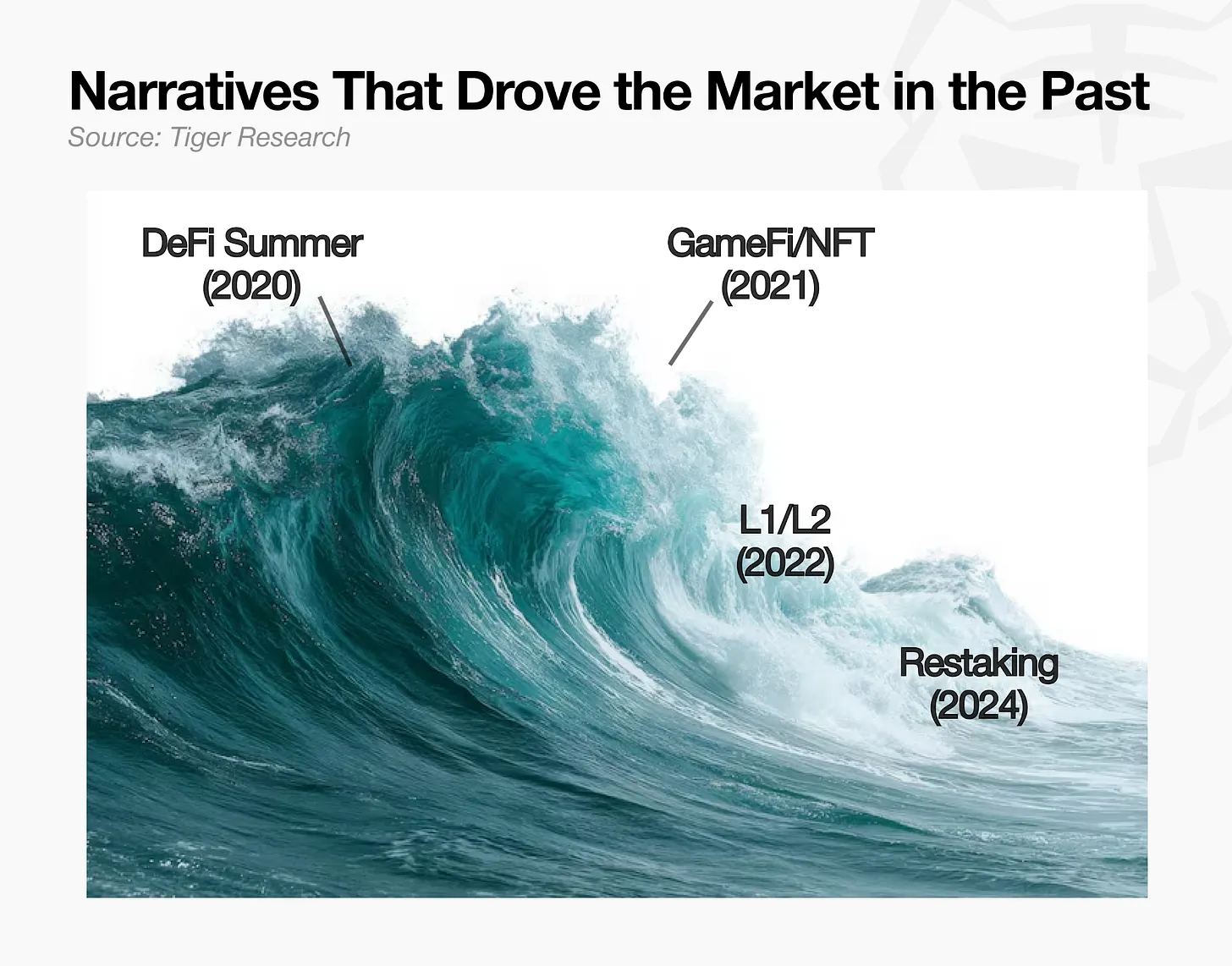
- 2020: DeFi
- 2021: NFT / P2E / GameFi
- 2022: L1/L2 Competition
- 2024: Restaking
Among these, the bubble of GameFi was the most extreme. Traditional gaming giants like Square Enix and Ubisoft entered the market, and in the first quarter of 2022, the gaming sector attracted $2.5 billion in funding. However, sectors lacking real product-market fit struggle to last. Axie Infinity, as the flagship project at the time, saw its monthly active players plummet by 99.7% from a peak of 2.8 million in January 2022 to about 8,000 by May 2026. This clearly demonstrates how fast a narrative built purely on concepts and capital can collapse.
2. The Rapid Consumption of Narratives Last Year
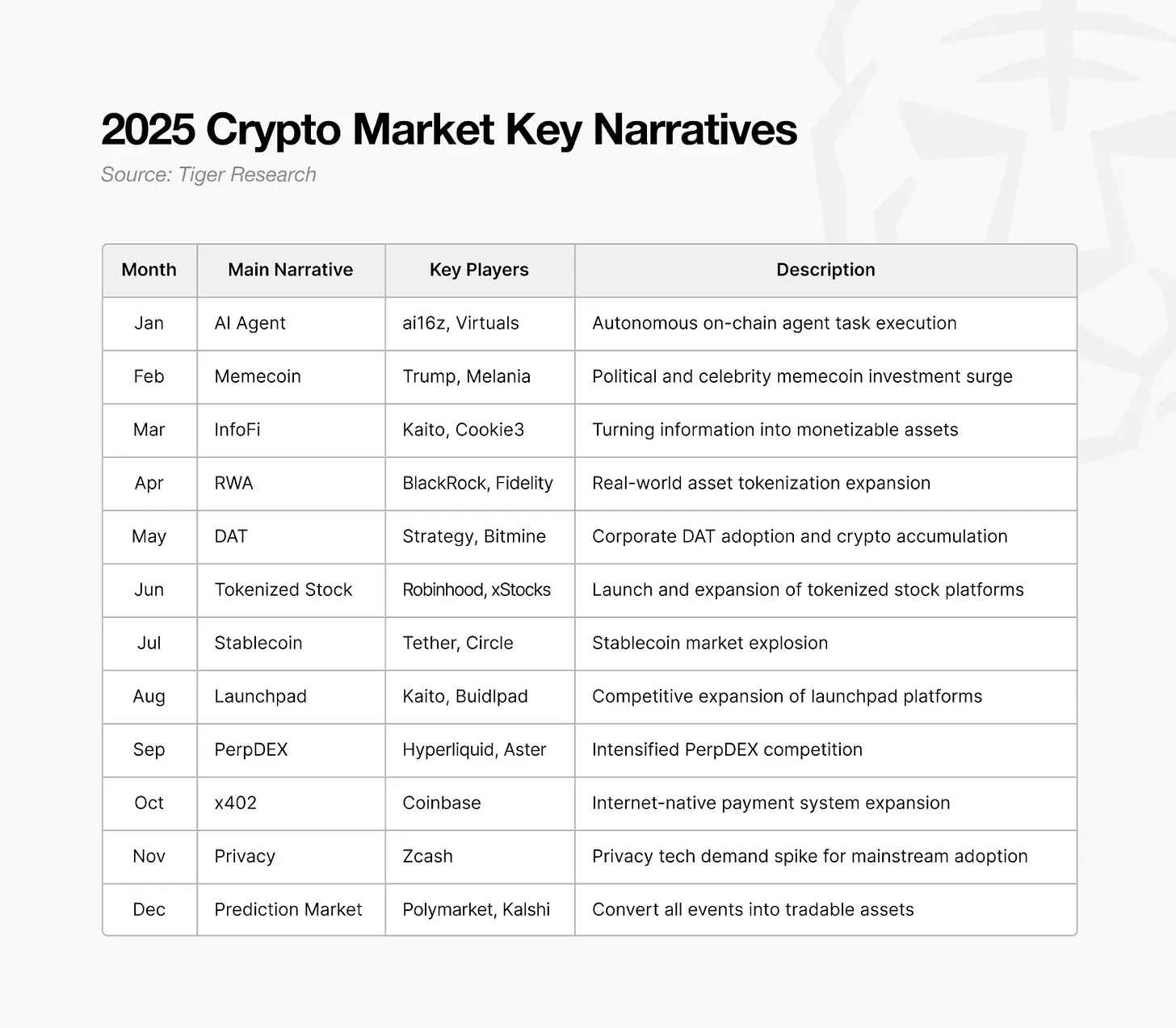
As we reported earlier, 2025 is the peak of the narrative consumption model. Following the AI Agent narrative, new narratives appeared almost every month, with the rotation speed increasing.
On the surface, this seems extremely wasteful, but it is undeniable that it is this rapid turnover of narratives that continuously attracts retail attention, becoming an important driving force for the market. However, the underlying demand of these narratives points more toward the tokens themselves rather than the real problems that products solve.
3. Supply-Side Innovation Lacks Demand
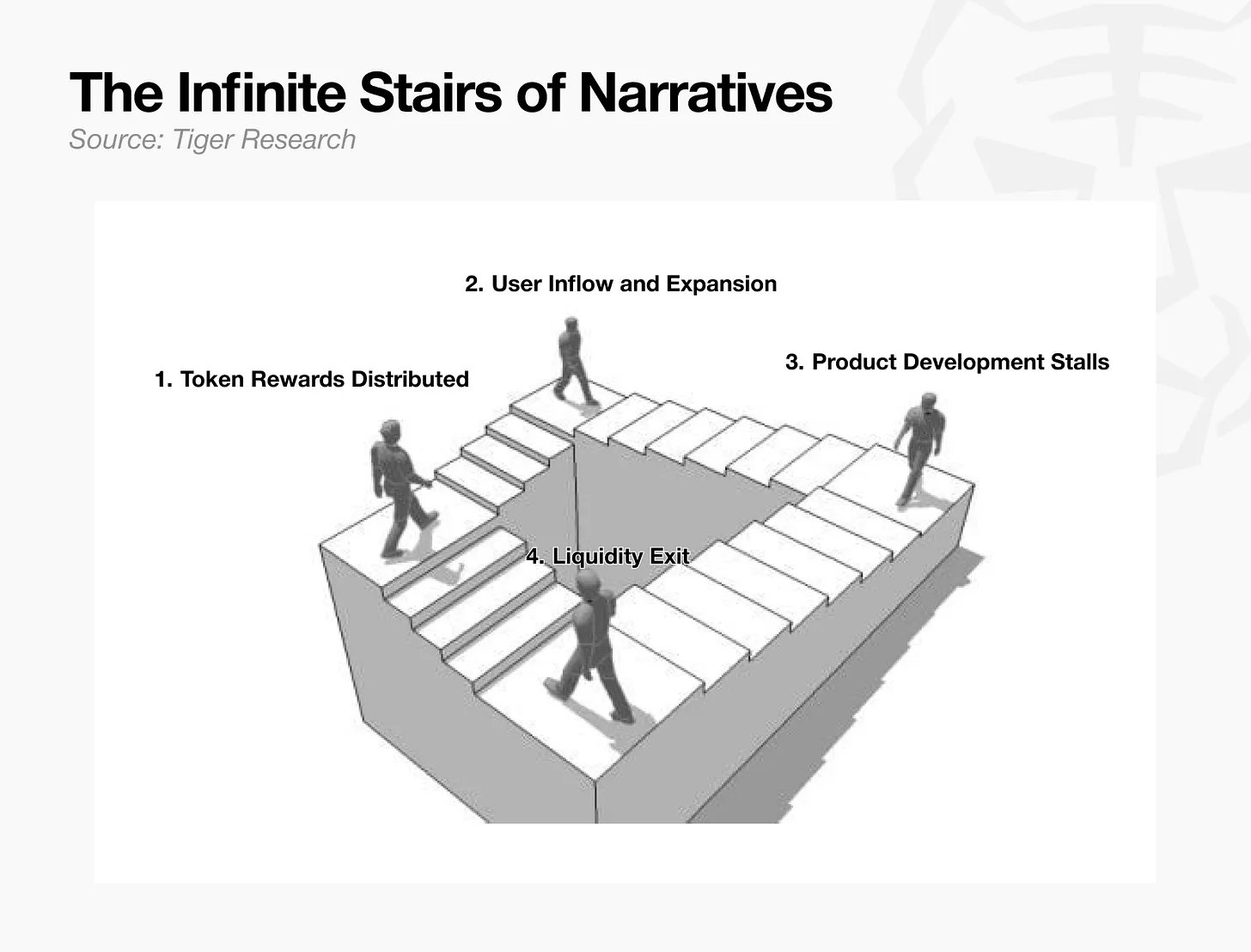
Most past narratives followed highly similar development paths; take decentralized social media projects as an example:
The project raises the issue of existing platforms monopolizing revenue and insufficient compensation for creators, painting a vision of lower fees, content ownership, and revenue returning to creators.
- Token Incentives: Early participants receive token rewards, and the story of making money while "lying down" spreads quickly, leading to high market interest.
- User Influx and Expansion: Similar projects follow up, attracting users through airdrops and liquidity incentives, leading to rapid inflation in ecosystem market value and trading volume.
- Product Development Stagnation: Token prices and reward scales far exceed the product itself. After fundraising and initial distribution, development and user growth stagnate, leaving the creator compensation problem unsolved.
- Liquidity Exit: The user base feeling the pain of this problem is insufficient; incoming capital chases price rather than the product, and after the narrative peaks, funds and users quickly dissipate.
This model has replayed in various narratives, leading the market to finally recognize that supply-side innovations without underlying demand are meaningless. Only projects that generate real income and have a stable user base are important; only projects that truly achieve product-market fit can survive.
4. 2026: The Era of Creating Demand through Product Fit
In the past, it was "first supply solutions, then create demand"; now, the PMF era does the opposite—first match existing real demand, then build products. The market is shifting towards real projects where user numbers and income grow alongside products and brands, rather than those relying solely on inflated token market value.
This report selects five sectors based on metrics for the first half of 2026 (transaction volume, revenue), trends of new players entering, and market cap growth. These metrics are difficult to artificially manufacture in the short term, thus providing the most valuable reference. The main problems each sector initially tried to solve, as well as the expansion directions of leading projects will be analyzed one by one.
Stablecoins: From Volatility-Free Payment Tools to Cross-Border Settlement Infrastructure
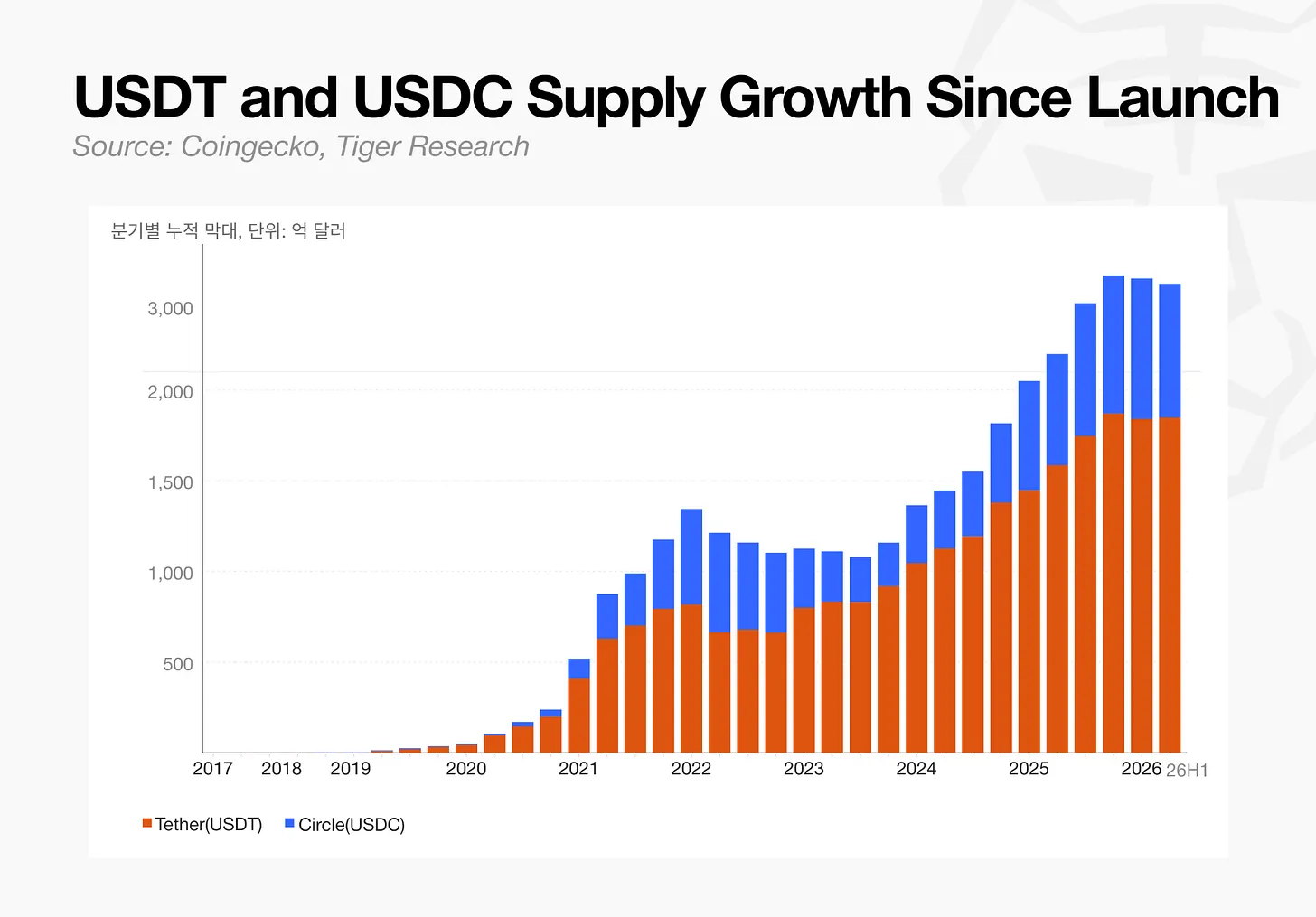
Stablecoins are tokens pegged to fiat currency values, used for payment and settlement. Currently, the total market cap reaches $304.2 billion, close to the historical high of $321 billion.
- Tether (USDT): Market cap $184.08 billion, monthly settlement volume $1.79 trillion (month-on-month +63%), cumulative settlement exceeding $10 trillion in the past 12 months, with net income over $10 billion in 2025, holding $141 billion in treasury bonds.
- Circle (USDC): Market cap $73.25 billion, the default stablecoin for mainstream exchanges and institutional settlement channels like Coinbase.
Stablecoins were initially trading mediums to avoid crypto volatility but have now expanded into cross-border remittance and on-chain payment infrastructures. In June 2026, over 140 traditional companies, including Visa, Mastercard, Stripe, Coinbase, and BlackRock, jointly launched the Open USD (OUSD) alliance. Despite only having a total market cap of $1.2 billion, non-dollar stablecoins (such as the Korean won, Japanese yen, euro, etc.) saw the number of holding wallets surge from 40,000 in January 2023 to 1.2 million by March 2026, a 30-fold increase.
Stablecoins are evolving from merely fixed-value payment tools into settlement infrastructures unrestricted by national borders and time zones.
DeFi: From Replacing Banks to Becoming Financial Infrastructure
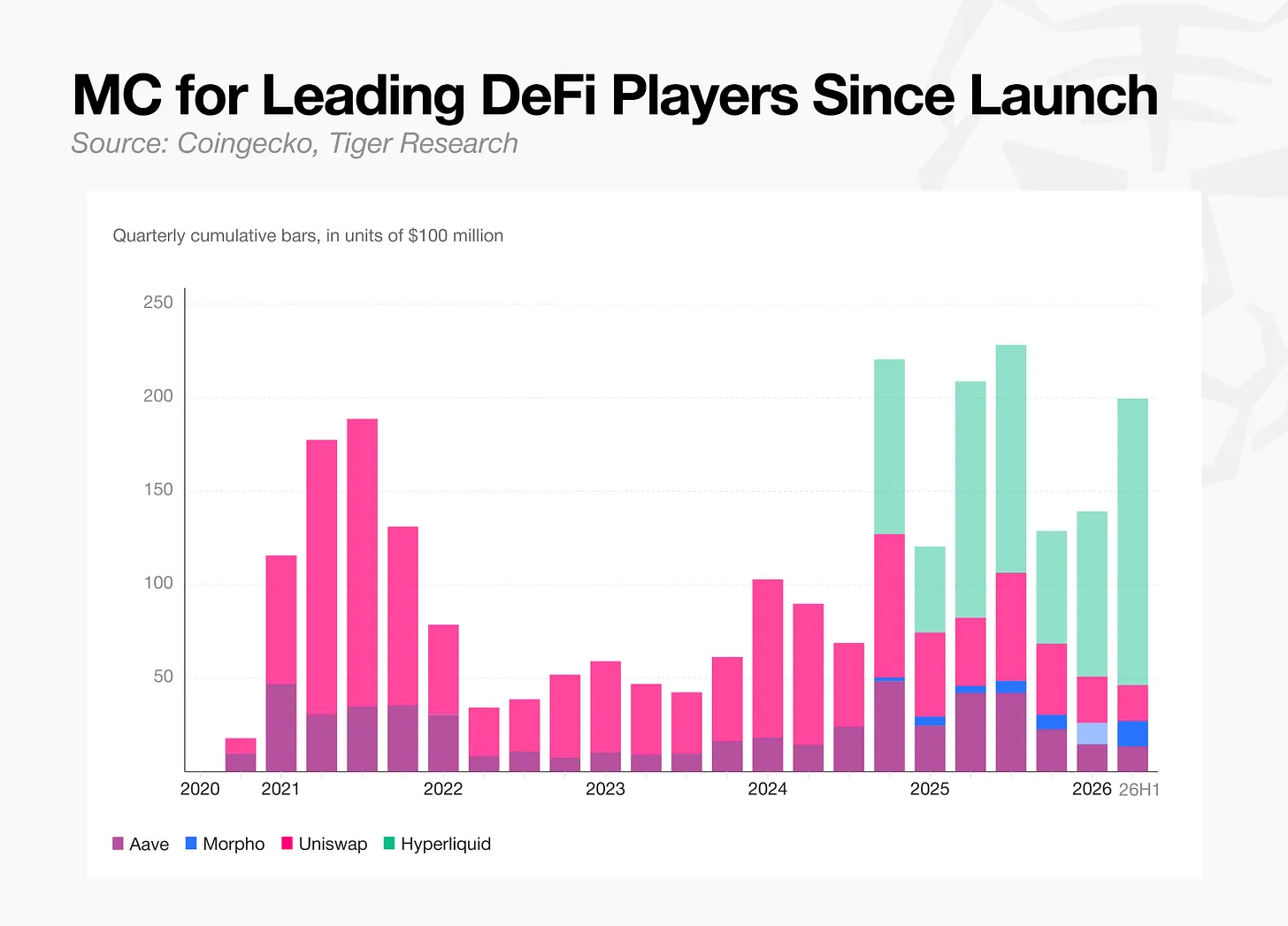
DeFi is financial services based on smart contracts, enabling lending, trading, and derivatives without centralized intermediaries.
- Aave: Market cap $1.397 billion, TVL $14.53 billion, annual revenue $119 million, leading lending protocol.
- Morpho: Market cap $1.302 billion, TVL $7.497 billion, annual revenue $0 (all $22.2 million annual fees distributed to lenders), briefly surpassed Aave in market cap from the end of May to June, overtaken in July.
- Uniswap: Market cap $2.287 billion, TVL $3.14 billion, annual revenue $850 million, leading decentralized exchange with a 24-hour trading volume of $2.66 billion.
- Hyperliquid: Market cap $13.47 billion, TVL $6.07 billion, annual revenue $874 million, accounting for about 76% of perpetual contract DEX market cap and about 20% of overall DeFi, with an on-chain perpetual market share peaking at 70%.
DeFi originated in 2020 from the decentralized ethos of "directly returning the profits of banks and other intermediaries to users.” Today, its survival relies more on the true demand from institutions for on-chain financial infrastructure. Morpho and Aave provide treasury risk management and lending infrastructure needed by institutions, Uniswap supports institutional asset trading, while Hyperliquid allows trading of traditional assets rather than being limited to crypto assets.
Although they have deviated from some of the founding ideals, it is this decisive turn toward real demand that has allowed these protocols to survive and thrive.
RWA: From Democratizing Traditional Assets to Increasing Efficiency
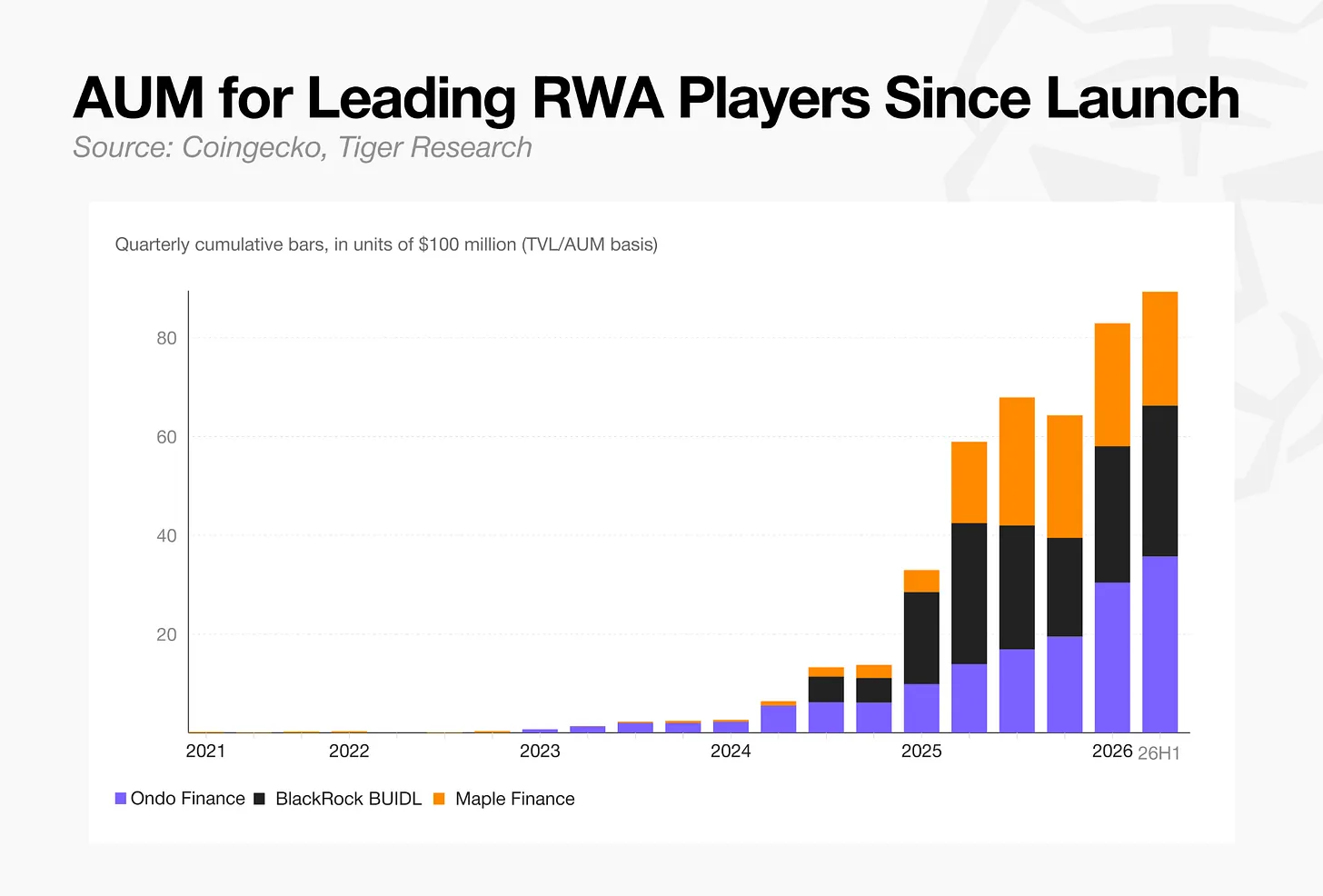
RWA (Real World Assets) refers to the tokenization of traditional assets such as government bonds and private credit on-chain. The total market cap is currently $65.2 billion, including $13.4 billion in tokenized government bonds.
- Ondo Finance: TVL $3.52 billion, ONDO market cap $1.75 billion, leading provider of tokenized government bond infrastructure.
- BlackRock BUIDL: AUM $2.4 billion (no traditional market cap, as it is linked to NAV), the largest single tokenized government bond fund.
- Maple Finance: SYRUP market cap $218 million, private credit AUM $4 billion, surpassing BlackRock BUIDL.
RWA initially aimed to bring traditional asset management on-chain, enhancing settlement speed and accessibility. Early users were not institutions but synthetic asset exchanges exploiting gaps in on-chain regulation. Today, institutions have become the largest user group.
Significant focus is on tokenized stocks. Adoption rates among traditional institutions like Securitize and DTCC are rising. In July 2026, DTCC began real trading of tokenized securities with over 50 institutions; Securitize listed its own stock SECZ on the NYSE while issuing tokenized shares on multiple chains like Avalanche and Solana. Centralized exchanges like Binance (bStocks) and Kraken (xStocks) are also expanding tokenized stock offerings in various countries. This sub-category's market cap reached $2.3 billion by mid-July 2026, nearly doubling since first exceeding $1 billion in March.
Currently, trading volume on DEX is still significantly lower than DeFi, and collateral usage mostly relies on permissioned whitelist structures. Achieving similar deep on-chain combinations as DeFi's "Lego blocks" may still take time, as it is still in a phase of proving the practicality of on-chain asset management.
Prediction Markets: From Simple Betting to Leading Market Trends
Prediction markets are platforms that allow betting on the outcomes of real-world events through on-chain contracts. The total market cap is $9.58 billion, making it the newest of the five sectors. Notably, the leading players in this field, Kalshi and Polymarket, have yet to issue tokens.
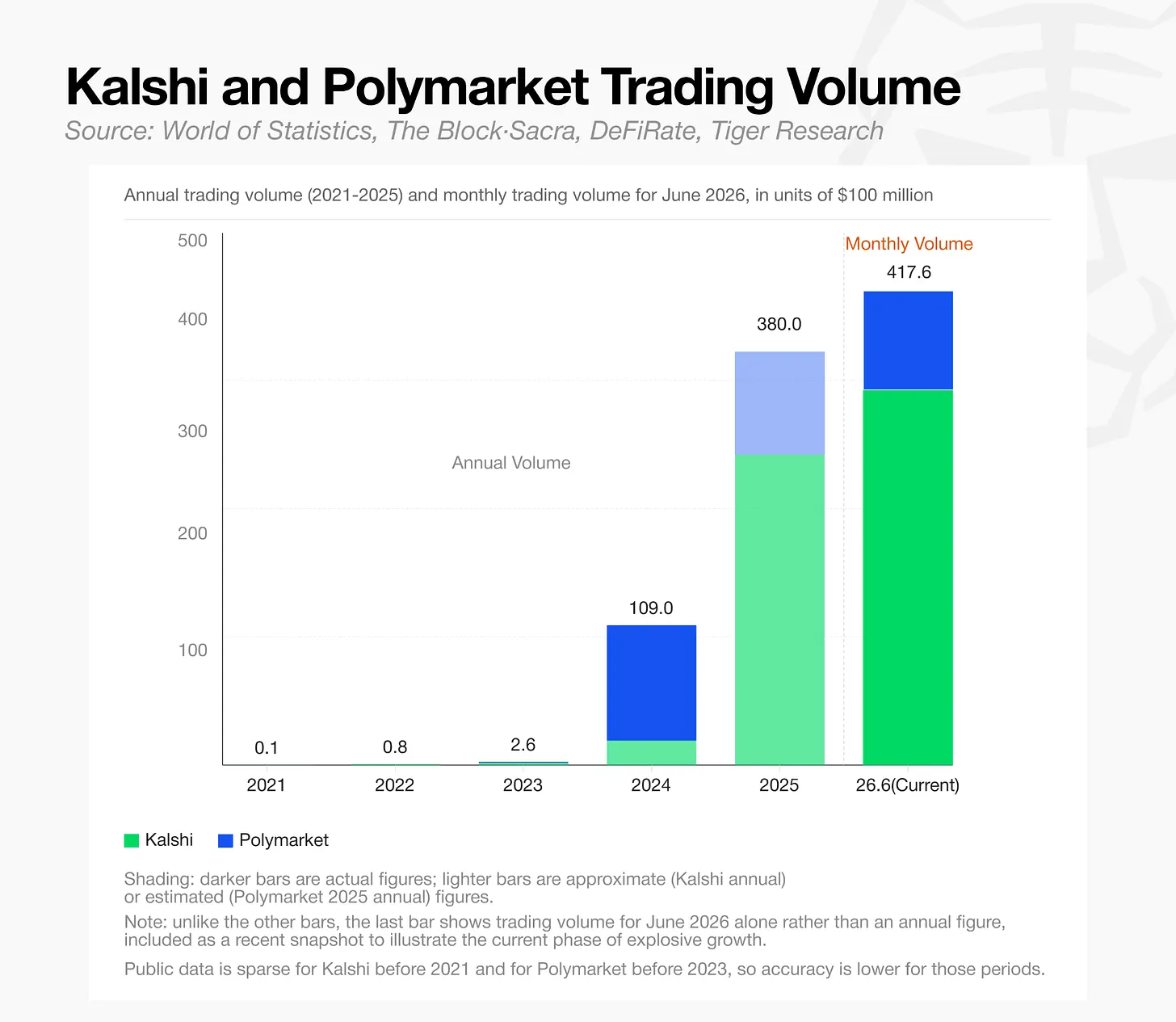
- Kalshi: Cumulative funding $2 billion, valuation $22 billion (funding multiple 11 times). June trading volume $31.5 billion (month-on-month +87.4%), exceeding its valuation.
- Polymarket: Cumulative funding about $1.6 billion, valuation $9 billion. June trading volume of $10.26 billion on the main platform outside the U.S. (month-on-month +45%), with annualized revenue exceeding $1 billion after receiving operating approval in the U.S.
The World Cup is both an opportunity and a challenge: June saw a surge in trading volume, but after the final on July 19, the total open interest across both platforms fell nearly 20% from a peak of about $2 billion in early July. Sports contracts accounted for approximately 80% of total trading volume during the event, so trading volume may remain sluggish ahead of the next major event (the U.S. midterm elections).
Regulatory risks remain. On July 21, 2026, a Washington State court issued a preliminary injunction preventing Kalshi from selling sports event contracts, citing illegal gambling under state law.
Prior to 2024, prediction markets were not even considered an independent sector, but now they are the fastest-growing area in the crypto market. Their growth relies not on token market value or TVL but instead on real trading volume and revenue, bringing off-chain users into the on-chain ecosystem. This is also one of the clearest cases of "everyday life" for blockchain technology to date.
Meme Coins: From Purely Speculative Assets to Liquidity Driving Strategy
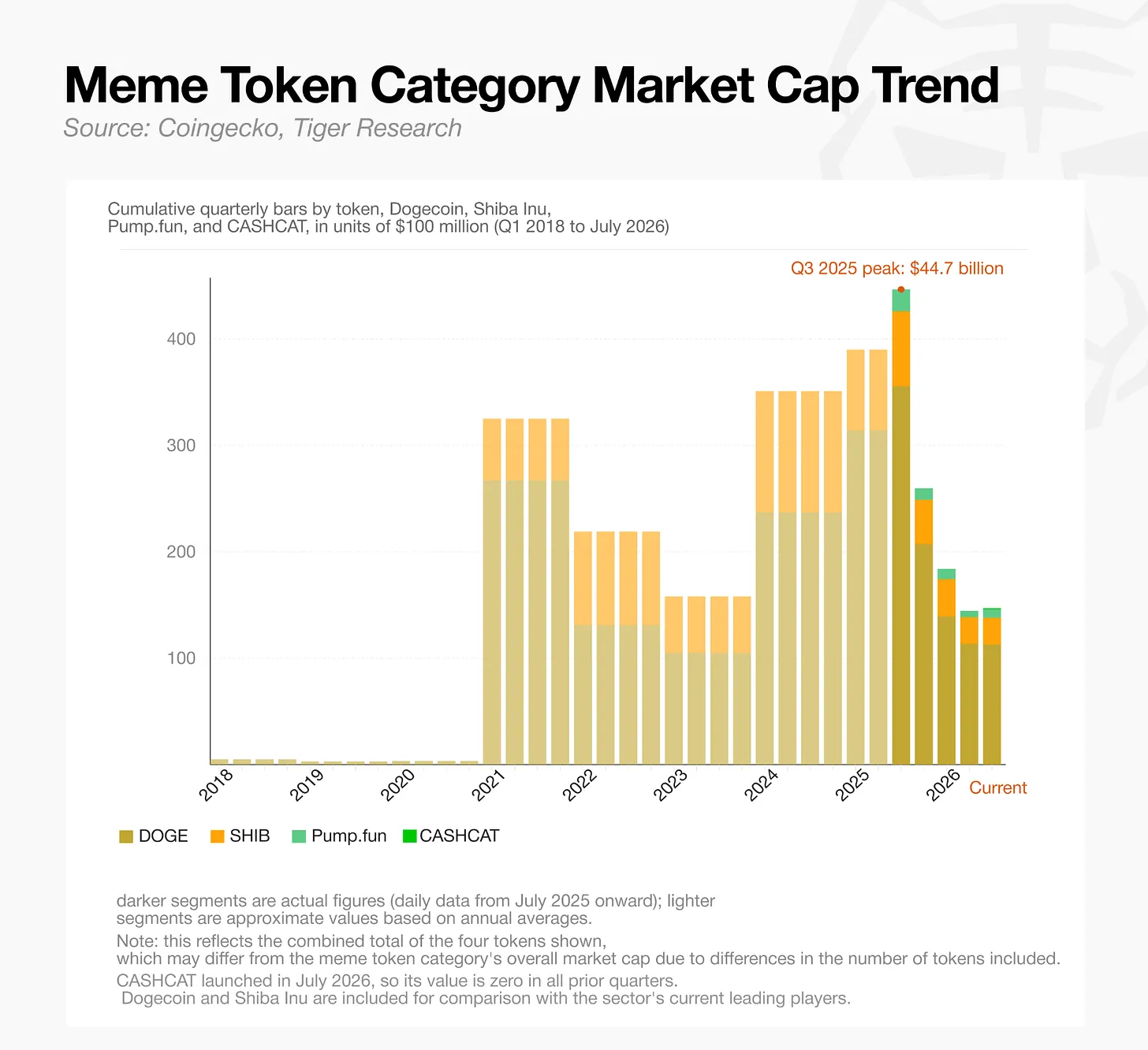
Unlike other sectors, meme coins have no clear utility; their value comes from community and attention. The total market cap is currently $25.68 billion, surpassing prediction markets.
Dogecoin leads with a market cap of $11.22 billion, and Shiba Inu at $2.5 billion, together accounting for 53.4% of the entire meme sector's market cap, demonstrating that once a symbolic position is occupied within the sector, it can sustain long-term even if loosely.
Pump.fun (market cap $806 million) and CASHCAT (Robinhood chain) attract attention due to their symbolic significance. The former raised $600 million within 12 minutes of public sale in July 2025; the latter saw its market cap soar over 2100% within a week of launch, peaking above $200 million, before retreating to about $59 million (down about 75% from peak).
The Robinhood chain case in July 2026 shows that meme coin narratives can still briefly drive liquidity across the entire chain: TVL soared from $17 million on July 3 to $312 million on July 13, with daily DEX trading volume reaching a high of $846.8 million, mainly driven by $CASHCAT.
The actual value of meme coins lies in their ability to quickly attract early users and guide incoming capital. New chains or applications can leverage meme coins to rapidly build communities, naturally encouraging users to bridge assets and engage in DEX trading. Some users will continue to use other DeFi services within the ecosystem and remain active. Therefore, meme coins serve more as efficient entry points and marketing channels rather than long-term held assets. Whether early attention can be converted into real product usage and ecological retention is the key to success or failure.
5. Essential Conditions for Project Survival
Projects that have survived to this day have captured the real demand that makes users return repeatedly and proven it through clear metrics like trading volume, TVL, and fee income.
The market demand in 2026 is concentrated at both ends of the spectrum:
- One end is the speculative demand for high volatility and instant returns—meme coins, perpetual contract DEXs, and prediction markets efficiently accommodate through rapid trading cycles and high capital turnover.
- The other end is the real financial demand for stable asset custody, transfer, and efficient management—stablecoins, RWA, and DeFi infrastructure take on core functions of payments, collateralization, yield generation, and risk management.
On this basis, adding sustainable income structures and network effects forms true product-market fit. Token prices can bring initial attention, but long-term survival hinges on usage frequency, retained funds, income levels, and operational capacity.
Korea Blockchain Week (KBW) at the end of September 2026 will provide an excellent window for closely observing this transformation. Key figures driving changes like Bo Hines, CEO of Tether US, Jeff Yan, co-founder of Hyperliquid, Johann Kerbrat, SVP of Robinhood Crypto, and Christine Moy of Apollo will appear together. Through dialogue with leaders in stablecoins, perpetual DEX, asset tokenization, and RWA sectors, participants will experience the industry shifts that currently manifest only in data.
免责声明:本文章仅代表作者个人观点,不代表本平台的立场和观点。本文章仅供信息分享,不构成对任何人的任何投资建议。用户与作者之间的任何争议,与本平台无关。如网页中刊载的文章或图片涉及侵权,请提供相关的权利证明和身份证明发送邮件到support@aicoin.com,本平台相关工作人员将会进行核查。


