Key Takeaways
- Bitcoin long-term holder supply hit a fresh all-time high on July 21, per Coinglass data.
- The cohort held 16.64 million BTC, about 83% of supply, worth roughly $1.07 trillion in June.
- Cryptoquant’s Ki Young Ju says Strategy and ETF buyers are absorbing old-whale selling.
Long-term holders (LTH), a category tracking wallets that have held bitcoin for at least 155 days, own more of the circulating BTC supply than at any point on record. The classification, based on Glassnode’s widely used methodology, treats coins that survive the 155-day threshold without moving as statistically unlikely to be sold soon, making the metric a proxy for conviction among bitcoin’s existing owners rather than new demand.
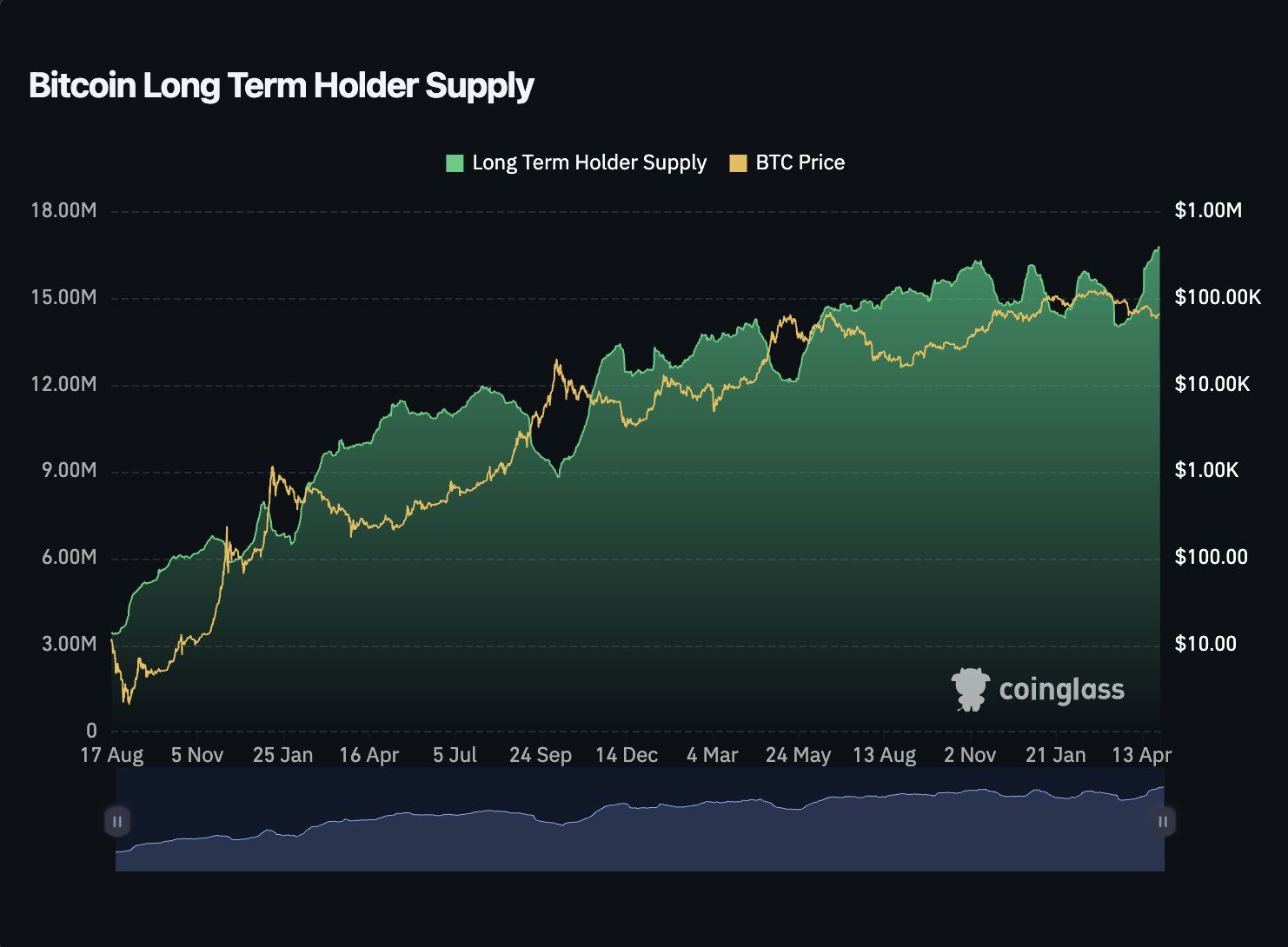
The current run has been building since early 2024 as long-term holder supply has largely fluctuated between 14 million and 16 million BTC since the January 2024 launch of spot bitcoin exchange-traded funds (ETFs), topping out near 16.4 million BTC before entering a roughly 2.5-year downtrend.
By May, the metric had broken out of that downtrend and climbed back to about 16.3 million BTC, adding more than 2 million coins during the broader bear market and rising at a pace of roughly 200,000 BTC a month. By June, it had cleared its old high to reach the fresh record of 16.64 million BTC, worth about $1.07 trillion with bitcoin trading near $64,100 at the time.
The composition of who is buying matters as much as the total, with Cryptoquant CEO Ki Young Ju recently pointing to a specific dynamic behind the climb, noting that “Strategy and ETF buyers absorbed large old-whale selling.” In other words, some of bitcoin’s earliest, largest holders have been distributing coins even as new long-term buyers, corporate treasuries like Strategy and spot ETF vehicles among them, step in to absorb that supply and hold it for the long run.
Bitcoin.com News has tracked a similar pattern building since mid-February, when long-term holders returned to accumulation mode and Binance data pointed to tightening supply conditions consistent with the early stages of a new market cycle.
A related shift has also shown up in wallet-size data, i.e. large whale wallets have added tens of thousands of BTC in recent months even as mid-tier holders sold, a redistribution that further concentrates supply among wallets less likely to sell into short-term price swings.
The behavior lines up with a pattern long-term holders have shown in past cycles. Coins held for more than 155 days tend to get accumulated during price weakness and distributed during price strength, a rhythm previously documented through HODL wave maps showing large shares of supply going untouched for years at a time. Similar buildups occurred during the 2015 and 2019 bear markets, both of which preceded periods of renewed price strength once demand returned.
The practical effect of rising LTH supply is a shrinking liquid float because as more BTC gets locked away by holders with no near-term intention to sell, the amount available for active trading on exchanges declines, a dynamic that has historically amplified price moves in either direction once demand shifts meaningfully.
Analysts caution the metric shouldn’t be read in isolation, however, since accumulation alone doesn’t guarantee a price reaction without a corresponding demand catalyst.
Crypto staking platform Everstake postured the record more cautiously, noting that “the price may move up and down, but the network keeps improving,” a reminder that supply-side metrics track investor behavior and network health rather than predicting near-term price direction on their own.
免责声明:本文章仅代表作者个人观点,不代表本平台的立场和观点。本文章仅供信息分享,不构成对任何人的任何投资建议。用户与作者之间的任何争议,与本平台无关。如网页中刊载的文章或图片涉及侵权,请提供相关的权利证明和身份证明发送邮件到support@aicoin.com,本平台相关工作人员将会进行核查。


