Buying clinical-stage weight loss drugs has become a new scenario for crypto payments, and at the current pace, the annual transaction volume is projected to exceed 100 million dollars.
Compiled by: angelilu, Foresight News
Original text from Bloomberg
A 49-year-old American marketing director, who previously thought Bitcoin had "no underlying value," spent a few days this year opening an account, buying coins, and transferring funds just to buy 20 bottles of weight loss drugs still in the clinical stage from a Chinese seller. Bloomberg reported on July 20 that these transactions are forming a crypto payment market, projecting that the annual transaction volume will exceed 100 million dollars—most buyers are ordinary consumers who have never previously engaged with cryptocurrency.
A transfer to save money
The buyer interviewed by Bloomberg is named Zach, who did not disclose his last name for privacy reasons, and hails from the Pacific Northwest of the United States. What he wanted was semaglutide—a weight loss drug being researched by Eli Lilly, classified as a triple receptor agonist targeting GIP, GLP-1, and glucagon, in simple terms, it hits one more target than the currently available drugs like semaglutide and tirzepatide. Eli Lilly released its phase three clinical data in March this year, indicating an 80-week weight loss of up to 28% at the highest dose, but this drug has not yet been approved by the U.S. Food and Drug Administration (FDA) and cannot be purchased through legitimate channels.
Zach searched for a few months and eventually found a Chinese seller willing to sell him 20 bottles of a product claiming to be that compound, roughly a year's supply, totaling 240 dollars. In comparison, buying from U.S. resellers would cost him 300 dollars a month, or 3600 dollars a year.
The only condition was: payment in Bitcoin only.
According to Bloomberg, Zach previously categorized Bitcoin as a pure speculative asset. But the tens-of-times price difference made him change his mind—"The price difference is too substantial; it feels worth the risk." The seller provided him with a tutorial on how to buy and transfer Bitcoin, and a few days later, he opened a Coinbase account, made his first purchase of Bitcoin, transferred it to the seller, and received the package a week later.
What peptides are and why they need crypto payments
Peptides are short chains of amino acids that participate in regulating various physiological processes in the human body. In the last couple of years, they have entered public consciousness due to the weight loss drug craze—semaglutide (Wegovy) and tirzepatide (Zepbound) are examples of injectable drugs that have undergone complete clinical validation and have been approved, which are peptides themselves.
However, besides these approved drugs, a large number of similar products that have not been adequately validated for human safety and efficacy are circulating online, typically sold under the name "research chemicals," with packaging clearly stating that they are not FDA approved and not intended for human or animal use. They are shipped directly from overseas laboratories, require no prescriptions, and are not covered by insurance.
Due to the unverified health benefits claimed by the products, the legal and regulatory risks are too high, and banks and credit card networks are often reluctant to provide services for such sellers. Excluded from the payment system, an increasing number of sellers only accept Bitcoin.
It should be noted that there is a hierarchy within crypto payments: data cited by Bloomberg indicates that among sellers with average single transaction amounts exceeding 1,000 dollars, stablecoins have surpassed Bitcoin as the preferred choice; whereas on the end catering to small, casual customers like Zach, Bitcoin remains mainstream.
Growth in scale, but still relatively small overall
Data from blockchain analysis company Chainalysis shows that in the first quarter of 2026, gray market peptide sellers received 32 million dollars in cryptocurrency payments, a year-on-year increase of 700% (a quarter-on-quarter increase of 159% from 12 million dollars). Based on recent months' activity, the annualized scale has already exceeded 100 million dollars.
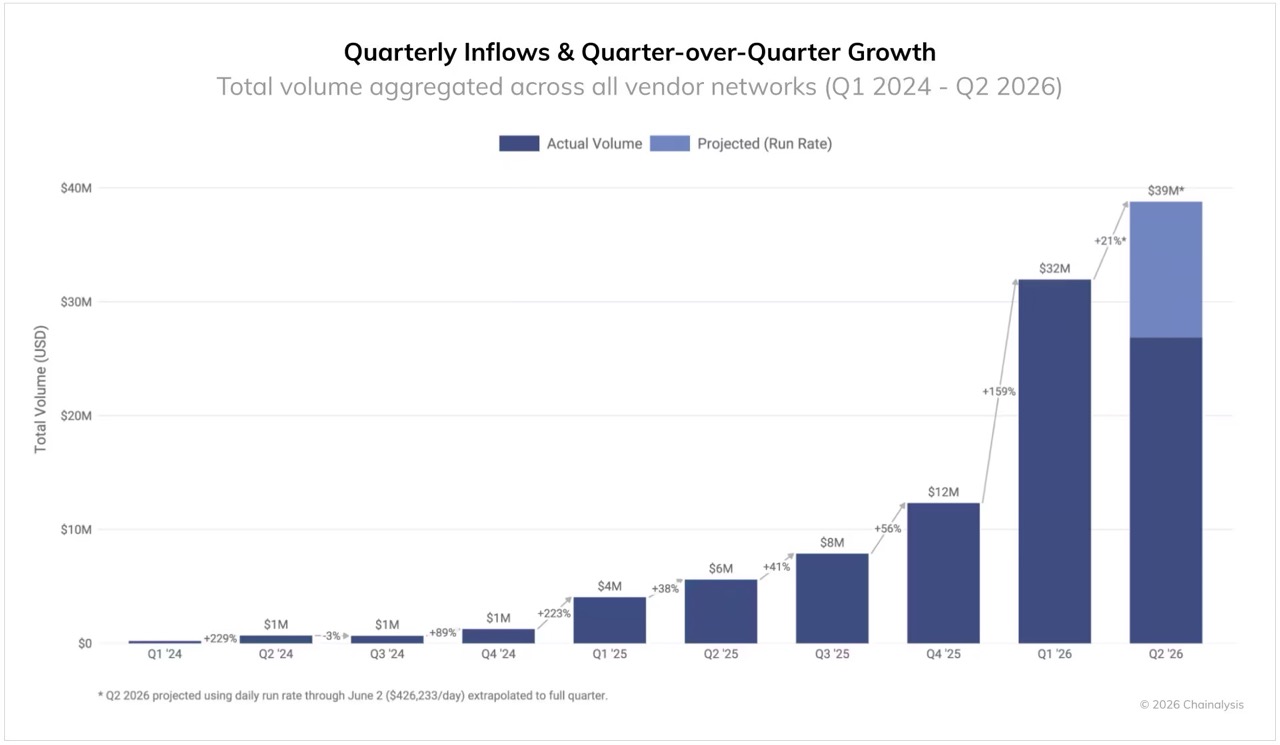
Security company TRM Labs used a different approach—combining on-chain analysis and public information inquiries about precursor drug manufacturers—to estimate that crypto inflow in this field would reach 41.4 million dollars in 2025, a year-on-year growth of 20%.
Ari Redbord, global policy director at TRM Labs, believes that "this market is huge and expanding; I am not sure if there is any other pharmaceutical market growing as fast as peptides."
This paints a somewhat dramatic picture: gym regulars, podcast listeners, and middle-aged individuals wanting to lose weight, this demographic profile connects with gray market buyers.
Although it is growing, industry investors estimate that the entire peptide black market is between 1 billion and 3 billion dollars. The volume using cryptocurrency as a payment method remains relatively small.
A bar decorated with crypto memorabilia
The most interesting scene in Bloomberg's report takes place in the corner of a bar in Manhattan—walls adorned with crypto memorabilia, over a hundred people squeezed into a stuffy room listening to a lecture about peptides.
The event is organized by DeSciNYC, a monthly offline gathering for science enthusiasts, with the slogan "Science Belongs to Everyone." Its past themes have included: longevity, CRISPR gene editing, AI and science, microbiomes, bioelectricity, tardigrades, cellular metabolism, academic publishing fraud, prediction markets, and more.
This peptide-themed event, named "Peptides 101," was presented by Julius Ritter, in his twenties, founder of the California Peptide Club, who also runs a longevity-themed meal delivery service and operates a hackathon house in San Francisco. He wrapped up a one-hour presentation on peptide chemistry, potential uses, some risks, and several specific products, finally rolling up his black T-shirt to inject himself, earning thunderous applause.

This scene illustrates more directly than payment data: the connection between crypto and this market is not just a payment channel but involves the same group of people. The circles of DeSci, longevity, biohacking, and fitness self-optimization are already highly overlapping, and the crypto community is a frequent guest within them.
Regulation is shifting, and this use case may disappear
It is notable that in the U.S., there is a movement towards "legalization."
The FDA is convening an advisory committee to discuss whether to allow some popular peptides to be legally produced within the United States. U.S. Department of Health and Human Services Secretary Robert F. Kennedy Jr. publicly supports this direction, arguing that legalization "helps to shift demand away from the black market." Lee Rosebush, president of the American Peptide Society advocating for regulation, described the current market state as "the Wild West," believing that stricter rules can weed out "for research use only" vendors and make it easier for patients to access safe drugs.
If this path succeeds, the position of crypto payments in this market will become awkward—its current share largely stems from the gaps left by traditional payment systems.
Zach himself intends to withdraw now. He said he has already reached his target weight.
免责声明:本文章仅代表作者个人观点,不代表本平台的立场和观点。本文章仅供信息分享,不构成对任何人的任何投资建议。用户与作者之间的任何争议,与本平台无关。如网页中刊载的文章或图片涉及侵权,请提供相关的权利证明和身份证明发送邮件到support@aicoin.com,本平台相关工作人员将会进行核查。


