Author: Nancy, PANews
No one expected that the traditionally rooted Robinhood Chain would become a fiercely contested platform for MEME launches.
In just three weeks, this rapidly growing Meme new trench quickly attracted 15 major Launchpads, and the competition surrounding asset issuance, user traffic, and on-chain liquidity is heating up quickly.
This launch war not only promotes rapid expansion of the Robinhood Chain ecosystem but is also reshaping the competitive landscape of the Meme sector, with several indicators even surpassing Solana, becoming the focus of a new round of on-chain traffic competition.
Launchpad Becomes Core Entry Point of Ecosystem, Meme Fever Still Unabated
The Launchpad on Robinhood Chain has become the most active application scenario in the current on-chain ecosystem.
Dune data shows that on July 20, the trading volume of tokens related to the Robinhood Chain Launchpad reached $137 million, accounting for 32.7% of the total on-chain DEX trading volume for the day. Meanwhile, the number of active addresses on the Launchpad reached about 142,000, making up 51.9% of the total active addresses on the chain.
The data indicates that the Launchpad has become the core entry point for driving growth in the Robinhood Chain ecosystem, not only contributing a large amount of on-chain trading activity but also serving as an important gateway for attracting users into the ecosystem.
After experiencing an initial wave of speculation, the heat of the Meme market on Robinhood Chain has cooled somewhat from its peak, but the trading volume and user engagement remain high, and the activity level of the ecosystem has not shown a significant decline.
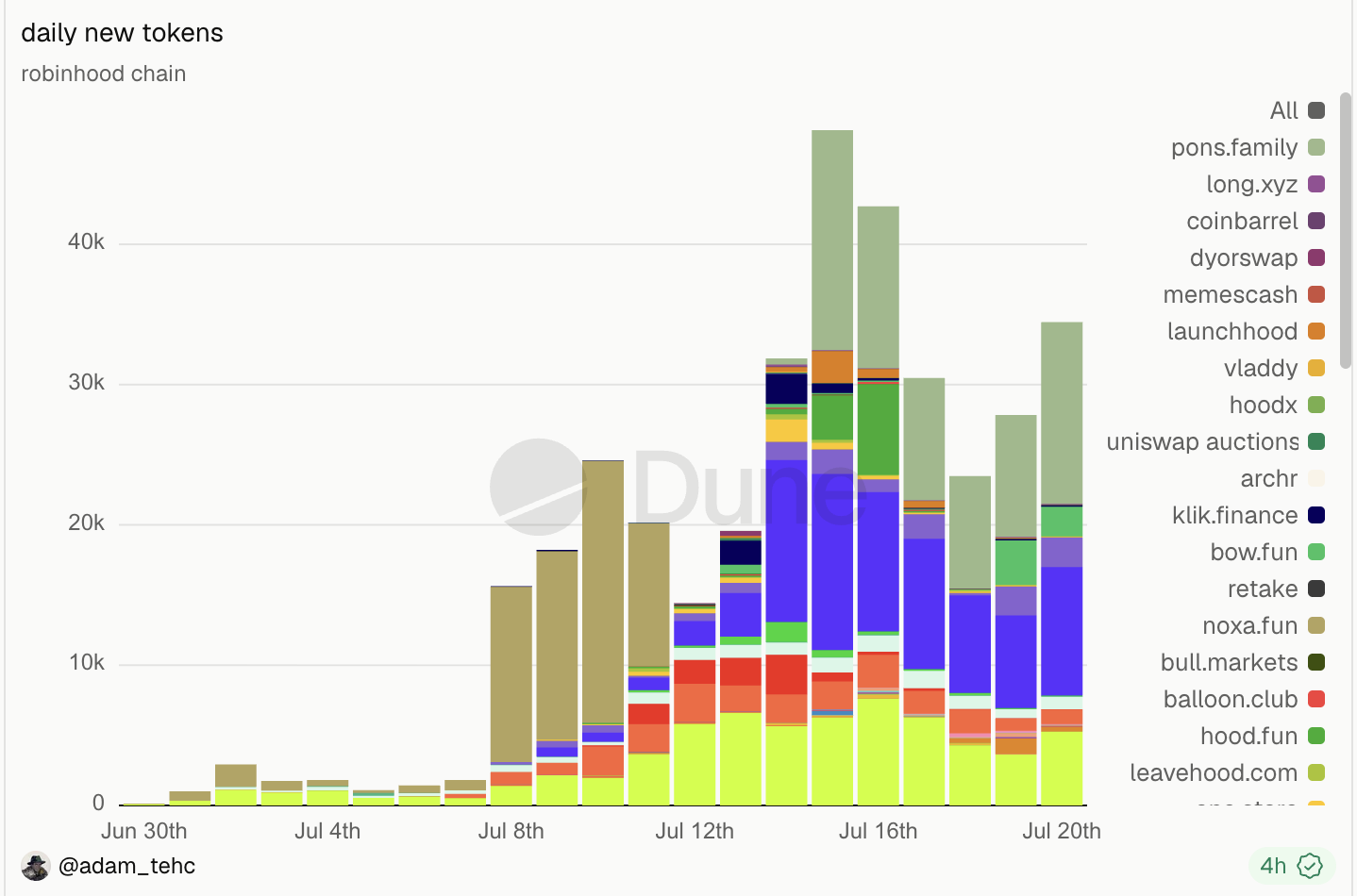
In terms of issuance scale, with the continuous increase of on-chain issuance entry points, the number of Meme tokens is experiencing rapid expansion. Dune data shows that the number of new tokens on Robinhood Chain has grown from 129 at the beginning to a peak of 48,000, then slightly adjusted, but is currently still over 34,000.
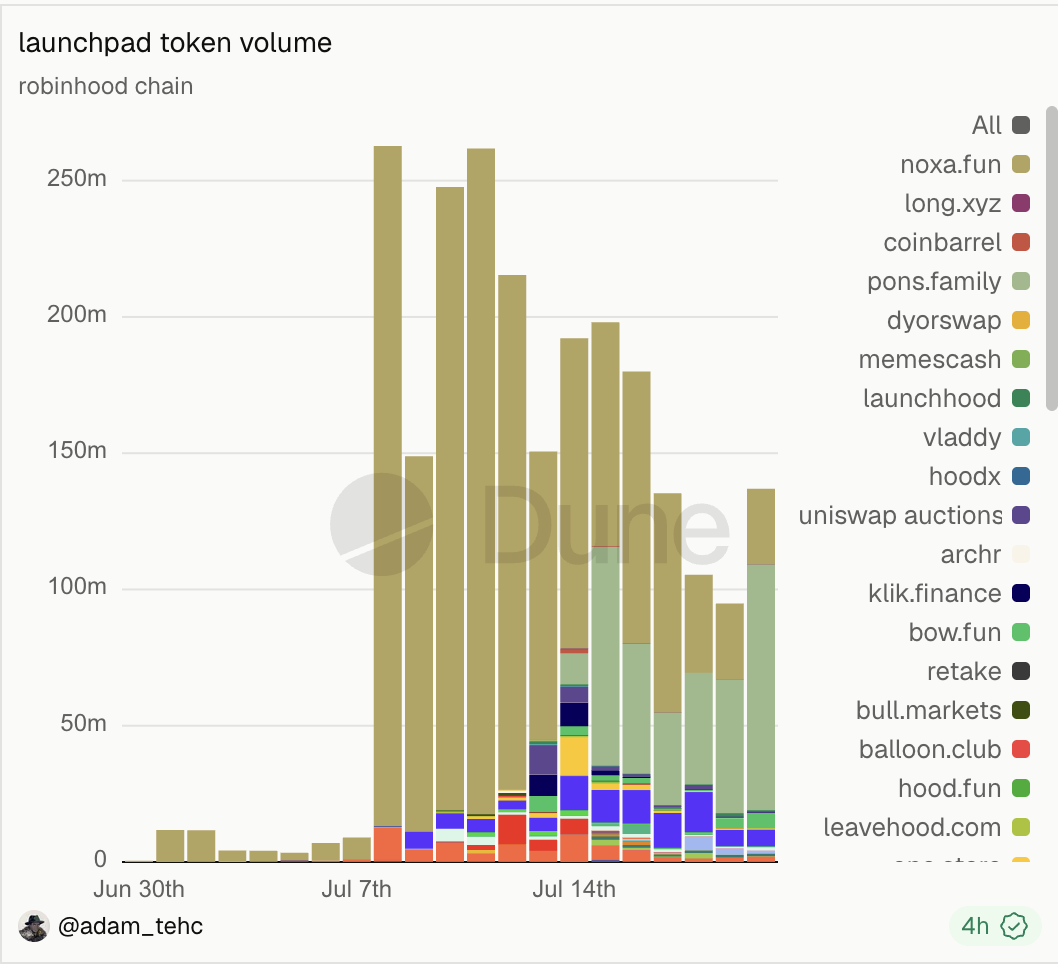
Regarding trading activity, Dune data shows that the daily trading volume of Robinhood Chain Launchpad has grown from about $480,000 on June 30 to the current $137 million, peaking at over $260 million during this period. Although the current trading volume has retreated from its peak, on-chain liquidity has initially formed and established a certain market foundation.
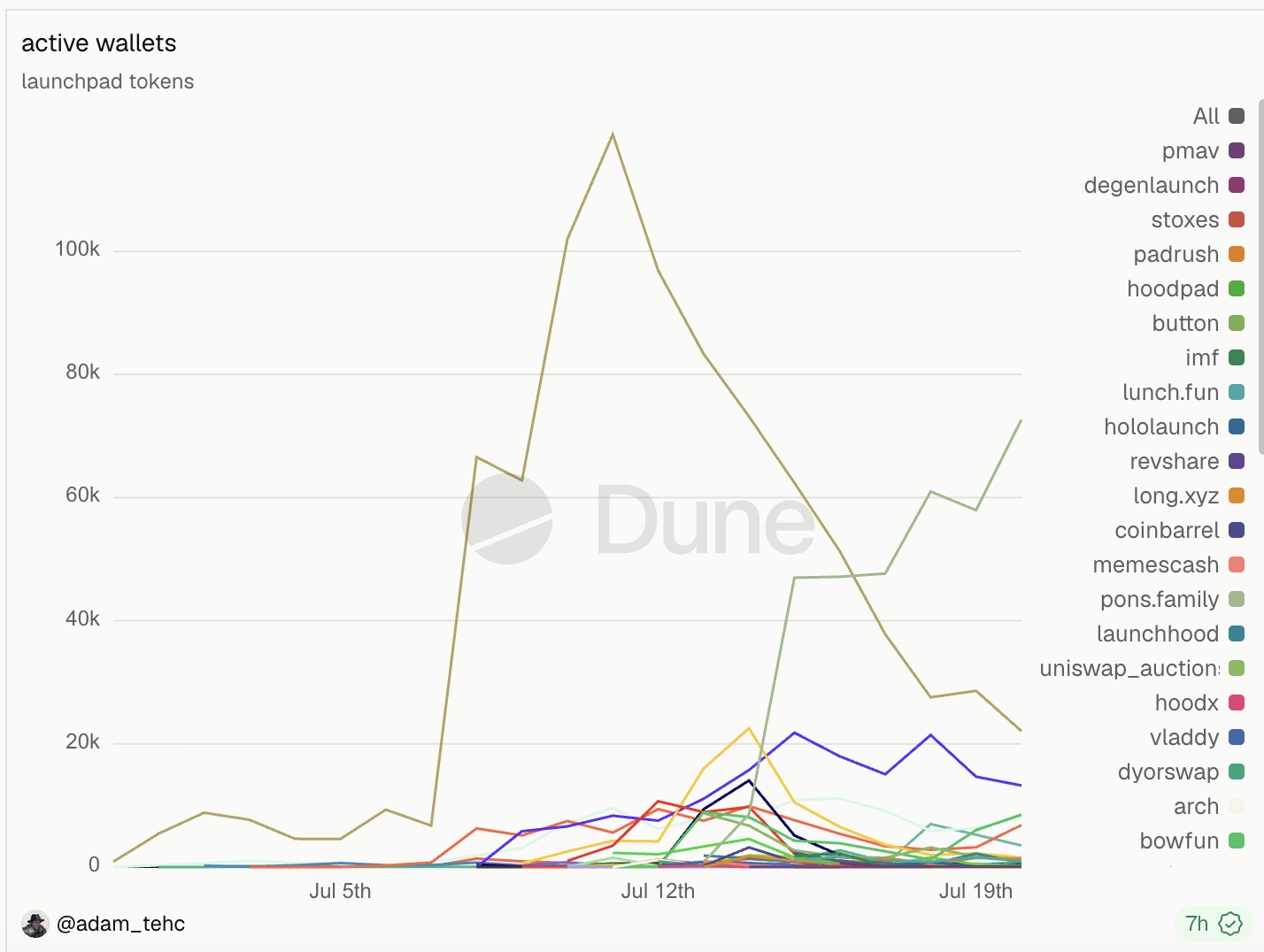
User engagement is also maintaining a growth trend. At the end of June, the number of active wallets related to Robinhood Chain Launchpad was less than 10,000, then quickly grew in July, reaching a peak of about 153,000 on July 11, and is currently maintaining around 142,000.
However, in terms of asset quality, among over 363,000 tokens issued on the Robinhood Chain, only three tokens have reached a market cap of ten million dollars, including $CASHCAT, $Pons, and $TENDIES, while only about 20 tokens have a market cap of one million dollars. Among them, the leading Meme coin $CASHCAT has seen its market cap drop from a peak of $230 million to around $80 million.
Overall, although some short-term speculative funds have gradually exited, there has not been a significant outflow of on-chain users, and overall participation in the ecosystem remains active.
Diverse Platforms Competing Together, Pons Replaces NOXA as New Traffic Center
Currently, the Launchpad ecosystem on Robinhood Chain is diversifying and expanding, mainly covering directions such as AI, infrastructure, modular issuance, fair launches, and RWA.
Dune data shows that initially, on June 30, there was only one Launchpad, NOXA, on Robinhood Chain, while the number of major on-chain launch platforms has now grown to 15.
These Launchpad platforms each have their own characteristics, forming differentiated competition. For example, platforms like Pons, Flap, and Bow.fun focus on modular issuance and high-performance asset creation; Virtuals Protocol, Bankr, and Clanker are focused on AI Agent and advanced infrastructure; while Coinbarrel V2, Degen Launch, and pmav lean more towards fair issuance and Degen ecology; Long.xyz seeks to explore a new model combining tokenized stock, RWA, and Meme assets. The diversified platform layout indicates that Robinhood Chain is gradually building a Launchpad ecosystem covering different projects and user needs.
However, as the number of platforms grows rapidly, the market competition landscape has also shown a clear head effect, with token issuance volume, trading scale, and user traffic continuously concentrating on leading platforms.
In terms of token issuance volume, NOXA initially occupied the main market share in the early days of the ecosystem thanks to its first-mover advantage. Before July 10, nearly all new token issuance on the chain came from NOXA, making it the primary asset issuance entry point for Robinhood Chain. As NOXA suspended token issuance, its market share was quickly eaten away by other platforms. According to data on July 20, Pons has emerged as the largest token issuance platform, with its issuance accounting for about 37.5% of the overall Launchpad market; Flap follows closely behind, accounting for about 26.6%.
In terms of trading performance, NOXA has long held a dominant position due to its first-mover advantage, with its trading volume share once exceeding 95%. However, as new platforms have emerged, the market landscape has gradually changed. Dune data shows that on July 20, the trading volume of tokens on the Pons platform accounted for about 61.7% of the overall Launchpad market, while NOXA accounted for about 22.5%, with the two accounting for over 80% of total trading volume.
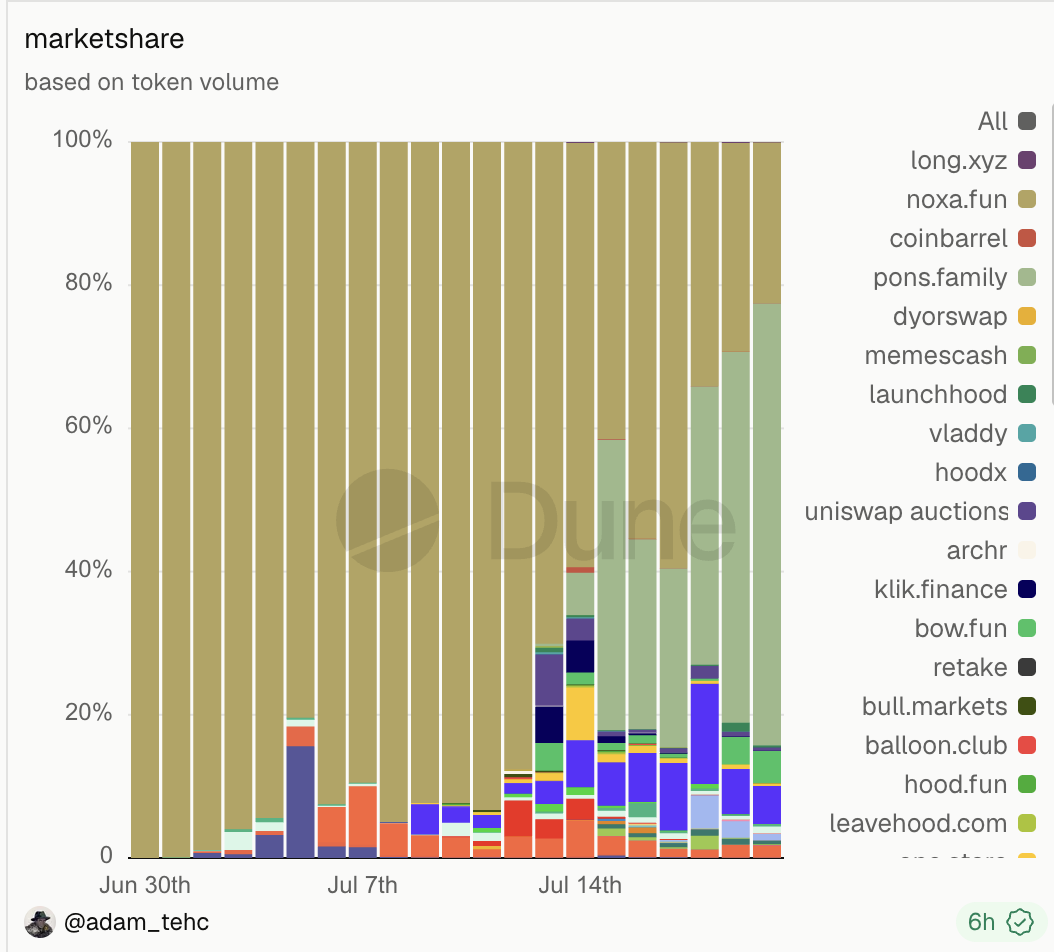
In terms of user distribution, the changes in platform competition dynamics are even more intuitive. At the peak of the ecosystem, NOXA attracted over 118,000 active addresses in a single day, accounting for about 78.2% of the Launchpad market for that day. As of July 20, Pons has become the largest Launchpad in terms of user scale, with the number of active wallets accounting for 51.2% of the total active wallets; NOXA's share has decreased to about 15.5%, and Flap's share is around 9.3%.
It is worth noting that although NOXA's market share has significantly dropped after suspending token issuance, its brand influence has not completely vanished. Currently, the NOXA domain has been acquired by Rain.fun and has been relaunched as a new Launchpad on Robinhood Chain. Whether it can regain market share by leveraging its existing brand and user base in the future remains to be seen.
Multiple Indicators Surpass Solana, Robinhood Chain Becomes New Traffic Battlefield
Robinhood Chain is becoming a new major battlefield in the Meme coin sector.
Compared to the mature ecosystem of the Solana Meme market, the Robinhood Chain Launchpad, despite its shorter development cycle, has shown strong competitiveness in terms of token issuance scale and user engagement, with some data even surpassing Solana's levels during the same period.
From the perspective of daily token issuance volume, Dune data shows that on July 20, the number of Meme coin issuances in the Solana ecosystem was about 23,000, while the Robinhood Chain issued over 34,000 during the same period, leading Solana by nearly half.
In terms of active users, Robinhood Chain is also showing higher activity. Dune data shows that the number of active addresses related to the Solana Launchpad exceeded 79,000, while Robinhood Chain reached about 142,000, nearly double that of Solana.
Regarding revenue capture ability, Dune data shows that on July 20, the Solana Launchpad generated revenue exceeding $317,000, while Robinhood Chain generated about $279,000. Considering that Solana has a more mature Meme ecosystem foundation, Robinhood Chain's ability to achieve close revenue performance further reflects the activity level of its Meme trading activities.
However, despite Robinhood Chain quickly catching up with Solana in several indicators, there are significant differences between the two ecosystems. Currently, Solana is highly reliant on Pump.fun, while Robinhood Chain shows a diversified competitive landscape.
Dune data indicates that on July 20, Pump.fun contributed approximately 99.3% of the token issuance on the Solana ecosystem, almost monopolizing the entire sector. Meanwhile, its token trading volume accounted for about 97.7% of the Solana Launchpad market, almost forming a platform pattern of dominance.
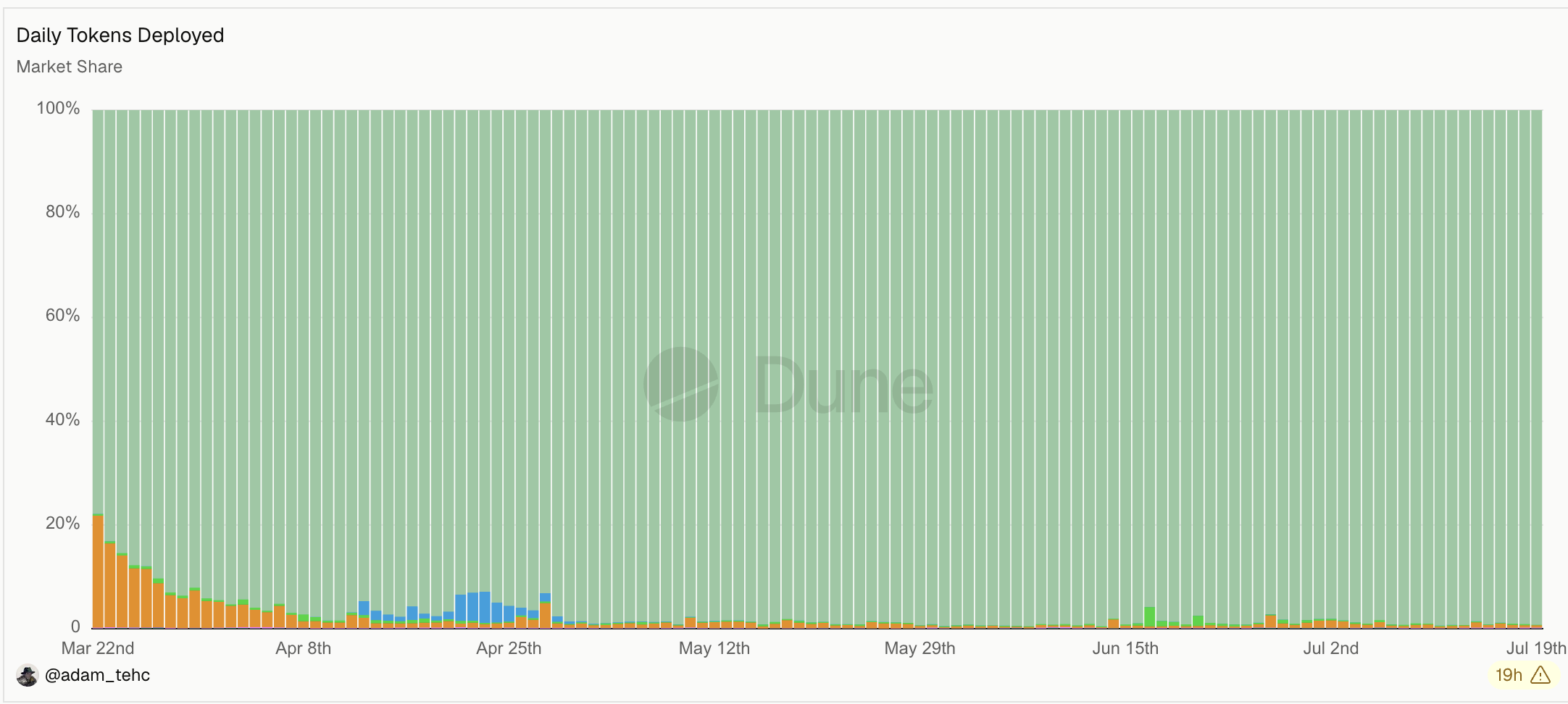
In contrast, Robinhood Chain is currently flourishing with a variety of platforms and has not formed an absolute monopoly platform like Pump.fun. Currently, token issuance is mainly contributed by multiple Launchpads, including Pons, Flap, Clanker, Bow.fun, Bankr, and Virtuals, with trading liquidity also mainly concentrated on multiple platforms such as Pons, NOXA, Flap, and Bow.fun. Of course, this is also related to Robinhood Chain still being in the early stages of its ecosystem.
As the ecosystem continues to heat up, more Launchpads from other chains are beginning to join the competition, including platforms such as Flap, Virtuals, Clanker, Bankr, and Circus Trade from BNB Chain, Base, and the Solana ecosystem, all trying to capture shares in Robinhood Chain's emerging Meme market.
However, in the long term, the success of the Launchpad ecosystem competition does not depend on the number of tokens issued, but on whether the platforms can improve asset quality, enhance user retention, and form sustainable developmental capabilities in the ecosystem.
免责声明:本文章仅代表作者个人观点,不代表本平台的立场和观点。本文章仅供信息分享,不构成对任何人的任何投资建议。用户与作者之间的任何争议,与本平台无关。如网页中刊载的文章或图片涉及侵权,请提供相关的权利证明和身份证明发送邮件到support@aicoin.com,本平台相关工作人员将会进行核查。


