Written by: Rita
Trend Guide
Micron's cumulative free cash flow over the next few years is expected to exceed $400 billion, and after the buyback ban is lifted, the theoretical buyback ratio could exceed 40%. This scale has yet to be fully priced by the market.
UBS recently released a SemiBytes report, with the core conclusion indicating that the semiconductor sector is transitioning from a broad uptrend to an intense differentiation phase. The Kimi K3 is driving the scale upgrade of open-source models, boosting demand for HBM and storage. The differentiation in the analog chip sector has intensified, with AI-exposed targets already achieving a 42 times price-to-earnings ratio premium, while companies with greater exposure to automotive and industrial sectors have valuations still around historical averages. Lam Research, Broadcom, Seagate, Micron, and AMD remain in a state of extreme long-position congestion.
Open-source Model Scale Upgrade Drives Storage Demand Upward
Moonshot AI released the Kimi K3 last week, with a parameter scale of 28 trillion, making it the world's largest open-source model, with the context window expanded to 1 million tokens, supporting persistent inference mode.
UBS judges that the core narrative of Kimi K3 is scale expansion—larger models, longer contexts, and greater memory demands. Open-source models, due to their lower profit margins, have lower unit costs than closed-source models, which is a natural difference in business models and does not constitute a technical breakthrough disruption.
A longer context window drives greater KV Cache demand, and the deployment of open-source models requires more HBM and storage resources. Nvidia's Nemotron occupies a core position in the open-source ecosystem, and UBS believes Nvidia is the biggest beneficiary in this round of open-source model discussions.
Micron's Free Cash Flow Potential Undervalued
UBS coverage shows that the valuation discount of Micron relative to SK Hynix is unreasonable.
Historically, Micron has had a valuation premium over SK Hynix, and the current discount has nearly disappeared, with a NTM EV/S of about 0.3 times. Micron has achieved aggressive density enhancements in DRAM 1-alpha and 1-beta nodes without EUV equipment, maintaining a lead on 2XX layer NAND products, and its market position in LP-DDR is solid, with outstanding power consumption and unit cost competitiveness.
Micron is expected to have cumulative free cash flow exceeding $400 billion over the next few years until 2028. The company is currently restricted by a buyback ban until December 9, 2026; once the ban is lifted, it could theoretically use all free cash flow for buybacks. Based on the current stock price, the cumulative buyback ratio could exceed 40% by the end of 2028.
This buyback potential is substantial and has yet to be fully priced by the market.
Position Congestion Has Not Fully Released
UBS uses the congestion factor to track the position concentration of various semiconductor sub-sectors and individual stocks, with indicators ranging from negative 30 for extreme short congestion to positive 30 for extreme long congestion.
The overall congestion of the semiconductor sector has retreated from historical highs at the end of June; among the 63 stocks covered by UBS, 12 are still in the extreme long-position congestion range above positive 24. The stocks with the highest congestion include Lam Research, Broadcom, Seagate, Micron, and AMD. While Micron is undervalued, it is also in a state of extreme long-position congestion, with sound fundamentals coexisting with concentrated positions.
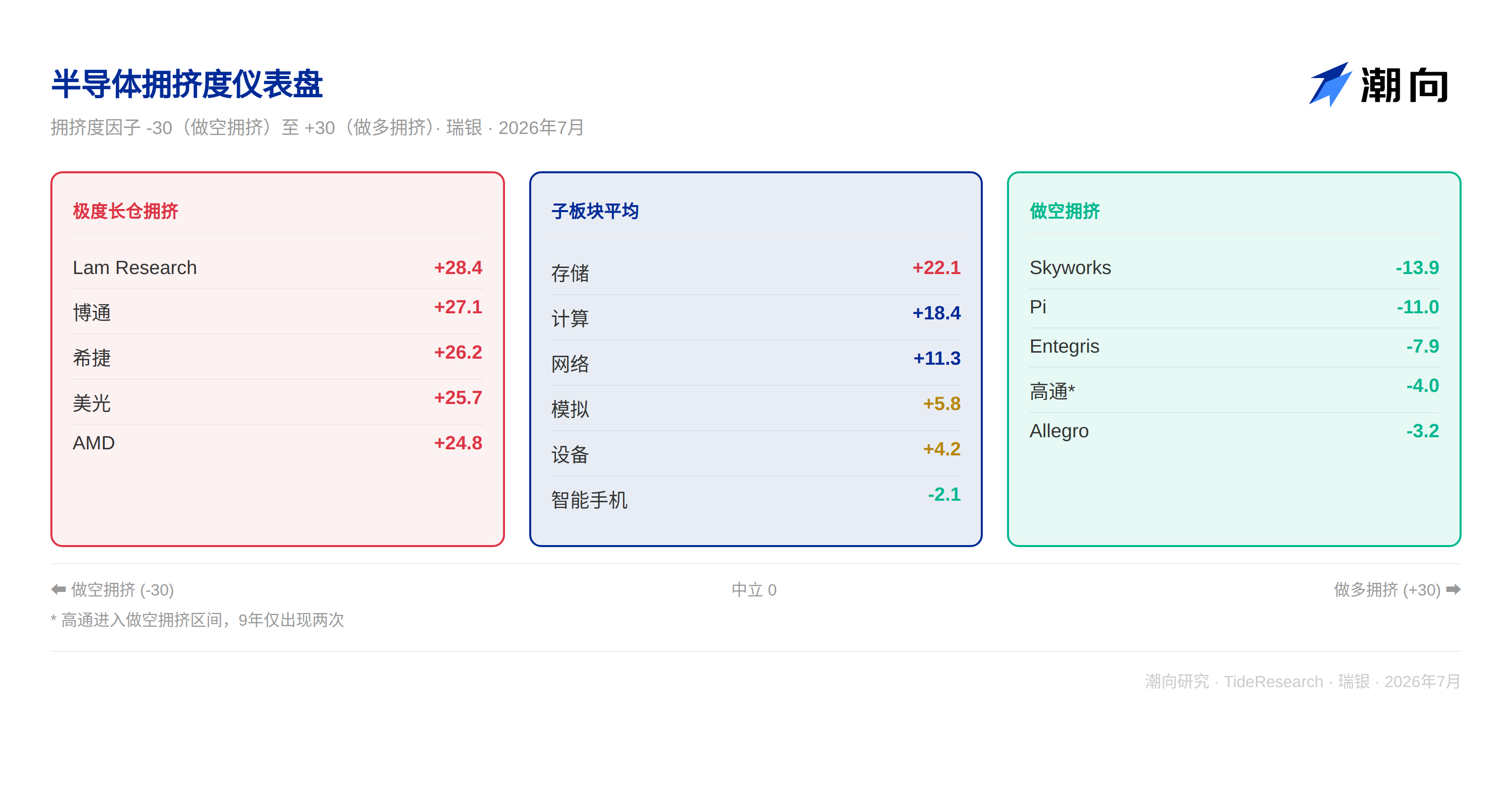
On the short congestion end, Skyworks is at negative 13.9, Pi is at negative 11.0, and Entegris is at negative 7.9. Qualcomm has also entered a short congestion range, which has only occurred twice in UBS's nine-year historical data. The smartphone sector is generally in a state of capital outflow.
Analog Chip Recovery Fully Priced, Internal Differentiation Intensifying
The analog chip industry has experienced four consecutive quarters of growth above seasonal levels, having previously undergone eight quarters of below-seasonal growth. UBS's historical data shows that during the 2009 to 2010 and 2020 to 2021 recovery cycles, the duration of growth above seasonal levels averaged 5 to 8 quarters.
Historically, the valuation multiples of analog chips typically peak around growth turning points and then continue to compress during quarters of above-seasonal growth. In this cycle, the market has pushed the valuation multiple to a new historical high, maintaining this for a full four quarters since the onset of recovery. UBS believes that if this is judged to be a more sustained upward cycle, the current high valuations have a solid supporting logic.
The internal differentiation within the sector is quite pronounced, with companies like Allegro, which have a high AI exposure, deriving about 20% of revenue from data centers, receiving a 42 times forward price-to-earnings ratio premium, while companies with more significant exposure to automotive and industrial sectors have valuations still around historical averages.
This differentiation reflects a strong consensus in the market regarding AI winners, and it also implies that if expectations fall short, there is considerable room for correction.
Free Cash Flow Panorama Scan
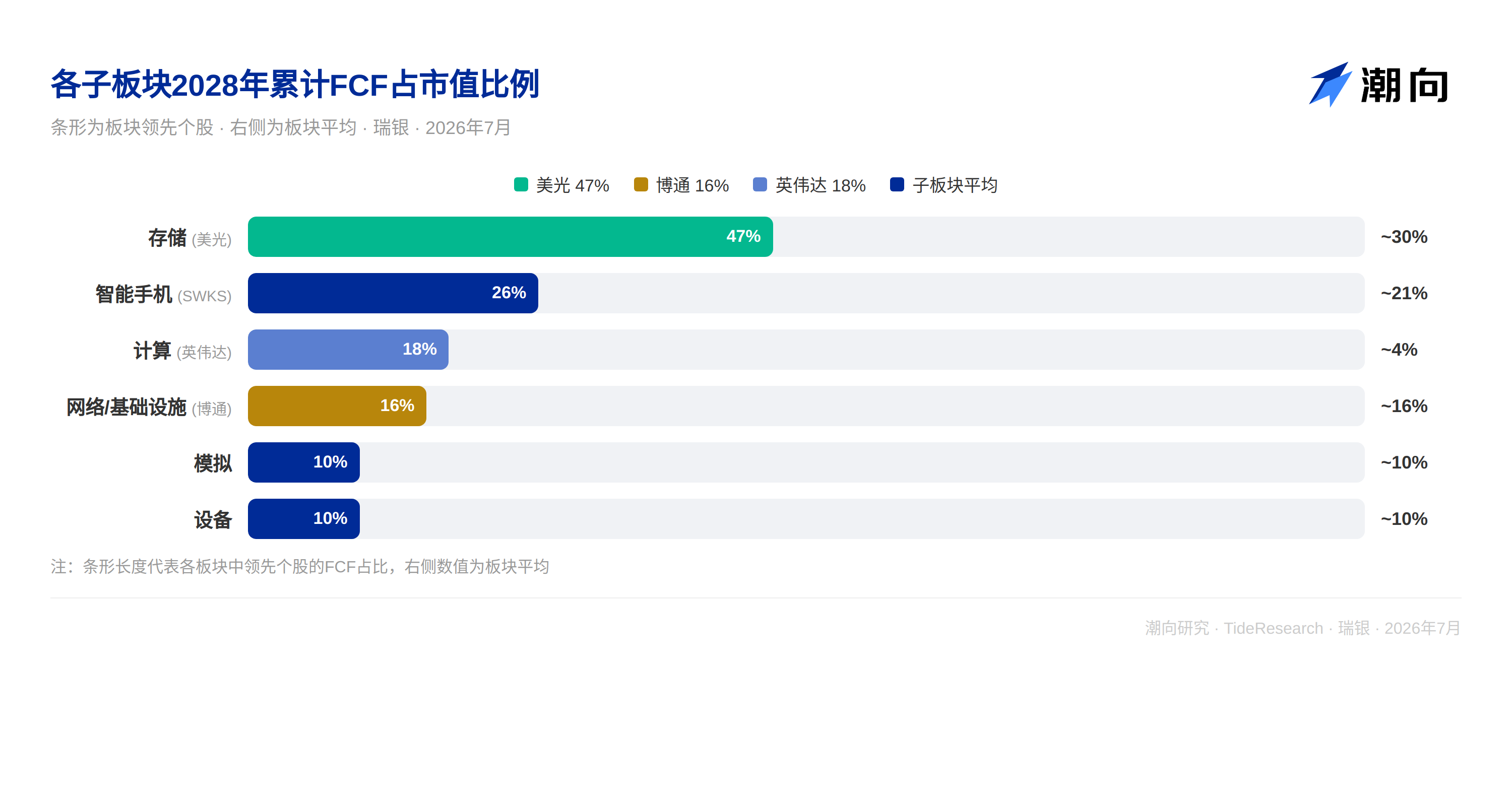
UBS has tallied the proportions of cumulative free cash flow to current market values for each sub-sector by 2028.
The storage sector accounts for about 30%, with Micron leading at 47%. The smartphone sector is around 21%, with Skyworks at 26% and Qorvo at 22%. The analog sector is about 10%, and the semiconductor equipment sector is about 10%. The computing sector is around 4%, with Nvidia at 18%, and Intel and AMD have relatively low proportions. In the network and infrastructure sector, Broadcom leads at 16%, with cumulative FCF reaching $278.8 billion, being the largest absolute cash source among UBS's covered targets besides Micron and Nvidia.
Trend Perspective
This report from UBS provides a clear pricing reference dimension for the current semiconductor market.
Micron's current valuation displays dual characteristics. The company's long-term free cash flow return can reach 47%, with ample long-term fundamental support, but the stock's position congestion is at a high level within the industry, with performance advantages and risks from excessive capital concentration manifesting simultaneously.
The company's buyback restrictions will be lifted in December, with nearly a six-month window from now; during this period, the trading sentiment in the sector and the institutional position structure are likely to continue fluctuating.
Allegro recorded a 42 times forward price-to-earnings ratio premium, primarily due to the market's concentrated pursuit of AI business increments. If the profitability of related businesses fails to meet expectations, the elevated valuation level will exert significant correction pressure.
In contrast, analog chip companies focusing on the automotive and industrial sectors may see substantial valuation repair potential as AI technology continues to penetrate the industrial side.
From the position congestion indicators, Qualcomm has released a strong industry signal. In the nine-year history recorded by institutions, such a level of short congestion has only occurred twice. Against the backdrop of continuous capital outflows from the smartphone sector, with steady progress in end-side AI technology iterations, if related applications achieve large-scale implementation, the current concentrated short position structure may experience a reverse correction trend.
In summary, UBS's overall view is that the semiconductor industry has already bid farewell to a comprehensive bull market, and the differentiation within the sector continues to intensify. Core AI segments continue to attract incremental capital, with many stocks reaching high levels of position congestion; conversely, sub-sectors with lower market attention may generate layout opportunities due to valuation mismatches.
Disclaimer
This article is a整理与解读 of third-party brokerage research reports (UBS, July 20, 2026) by Trend Research. The ratings, target prices, earning forecasts, and related judgments quoted in the text are opinions of the brokerage analysts and only represent the stance of their respective institutions, not representing the views of Trend Research, nor constituting any investment advice.
The market carries risks, and investment should be approached with caution. This article should not serve as a basis for buying or selling any securities. Investors should make their investment decisions based on their independent judgment.
免责声明:本文章仅代表作者个人观点,不代表本平台的立场和观点。本文章仅供信息分享,不构成对任何人的任何投资建议。用户与作者之间的任何争议,与本平台无关。如网页中刊载的文章或图片涉及侵权,请提供相关的权利证明和身份证明发送邮件到support@aicoin.com,本平台相关工作人员将会进行核查。


