Author:Fabric Foundation
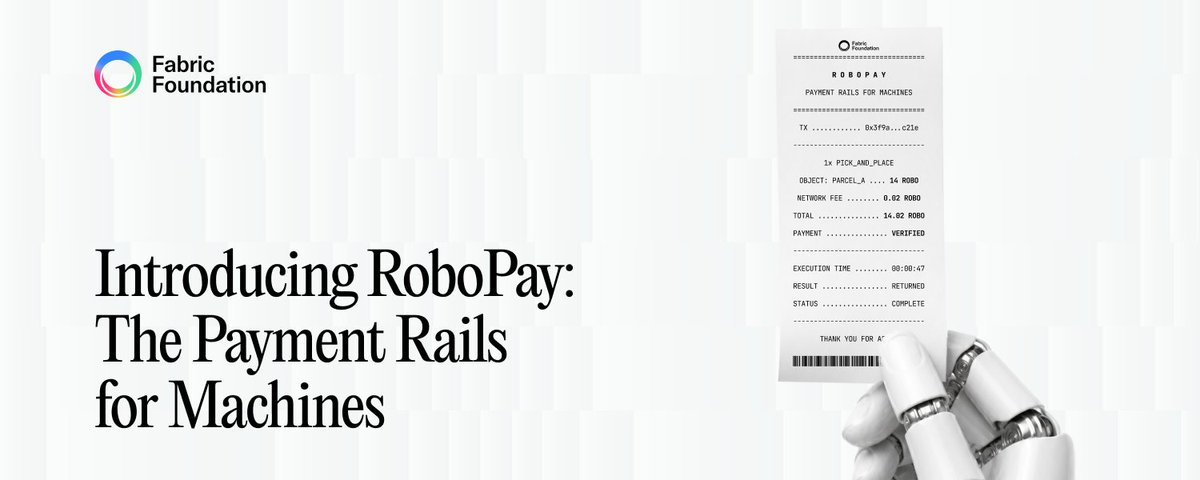
Transforming Robots’ Capabilities into Programmable, Payable Services
Robots are becoming increasingly powerful, but most of their capabilities remain locked within their respective SDKs, local control systems, and one-off integration solutions.
A robot may be able to handle item delivery, on-site inspections, image capture, object handling, and even perform various complex tasks, but developers still lack a standardized way to bind payment capabilities to these robotic actions, thus building truly autonomous economic applications around them.
To truly realize a machine economy, a robot's capabilities cannot merely stay at the technical functional level; they must also possess discoverability, callability, payment, and verifiable capabilities.
Therefore, we officially announce the launch of RoboPay: a payment infrastructure for machines.
Official website: https://robopay.fabric.foundation/
What is RoboPay?
RoboPay enables developers to expose robot functionalities in the form of paid operations.
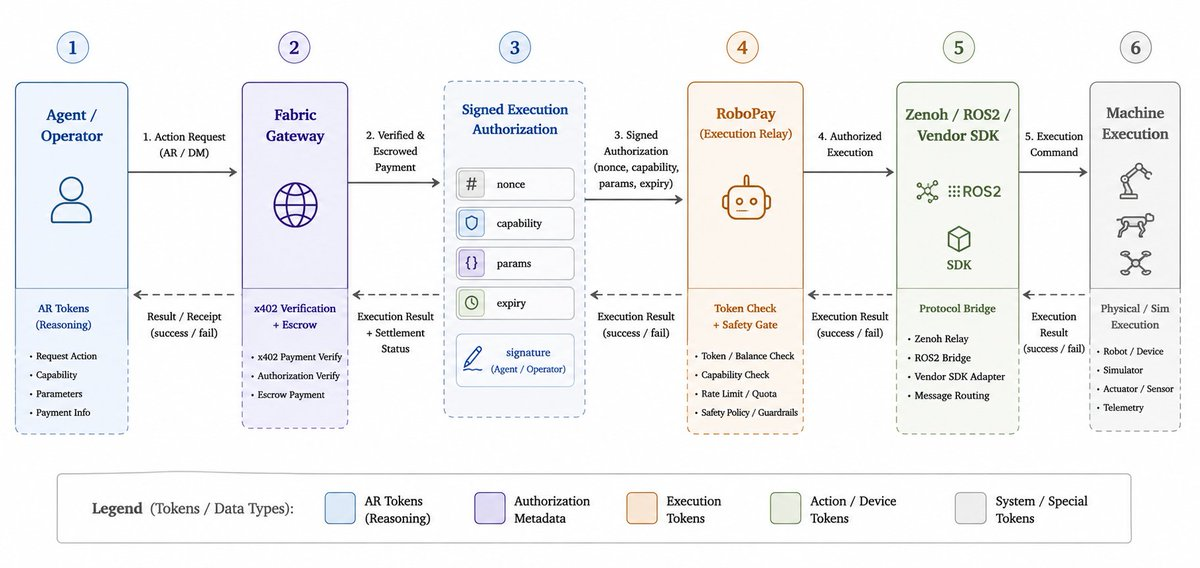
Developers can define robot skills, set pricing and execution rules, receive authorized payment requests, and return structured results after the robot completes or rejects an operation.
The entire process is quite simple:
Payment → Verify Payment → Execute Task → Return Result
We call this model Pay-to-Actuate, which can be applied to humanoid robots, robotic arms, mobile robots, drones, cameras, simulation systems, and other connected machine devices.
RoboPay is not limited to a single type of application or a single type of caller. Paid robotic operations can be triggered by web applications, marketplaces, enterprise workflows, other machines, or AI Agents.
Among them, the capabilities for AI Agents are provided by the RoboPay Agent Skill, which allows AI Agents to:
- Discover robot service interfaces
- Complete payments
- Initiate robot action requests
These components form a new economic infrastructure where AI Agents, humans, and machines collectively become economic participants.
Related introduction: https://x.com/FabricFND/status/2077176998368354568
Building Applications for the Machine Economy
The opportunities for RoboPay go far beyond allowing AI assistants to control robots.
For example:
- A logistics platform that can pay mobile robots per delivery;
- A property management platform that can pay robots per inspection;
- A robotic marketplace that can sell robotic arm access per task or per duration;
- A data platform that can pay to call cameras and robots to complete specified data collection;
- A robot operator that can open up idle robotic capabilities as on-demand services to generate revenue.
In these scenarios, robots are no longer just hardware devices but can become true economic participants, capable of providing various functions, receiving requests, executing specific tasks, and generating income.
RoboPay provides developers with a unified infrastructure, allowing them to quickly build relevant applications without redesigning payment and execution processes for each type of robot.
RoboPay Integration Bounty Officially Launched
To accelerate ecosystem development, we officially launch the RoboPay Integration Bounty Program.
This is a one-month developer program with a total prize pool of 1,000,000 ROBO.
Event official website: https://robopay.fabric.foundation/bounties
Prize Pool and Tasks
This bounty program covers 12 leading robot platforms, including humanoid robots, robotic arms, and robotic dogs. Each platform offers four integration tasks of increasing difficulty, allowing developers to choose different complexity levels according to their needs.
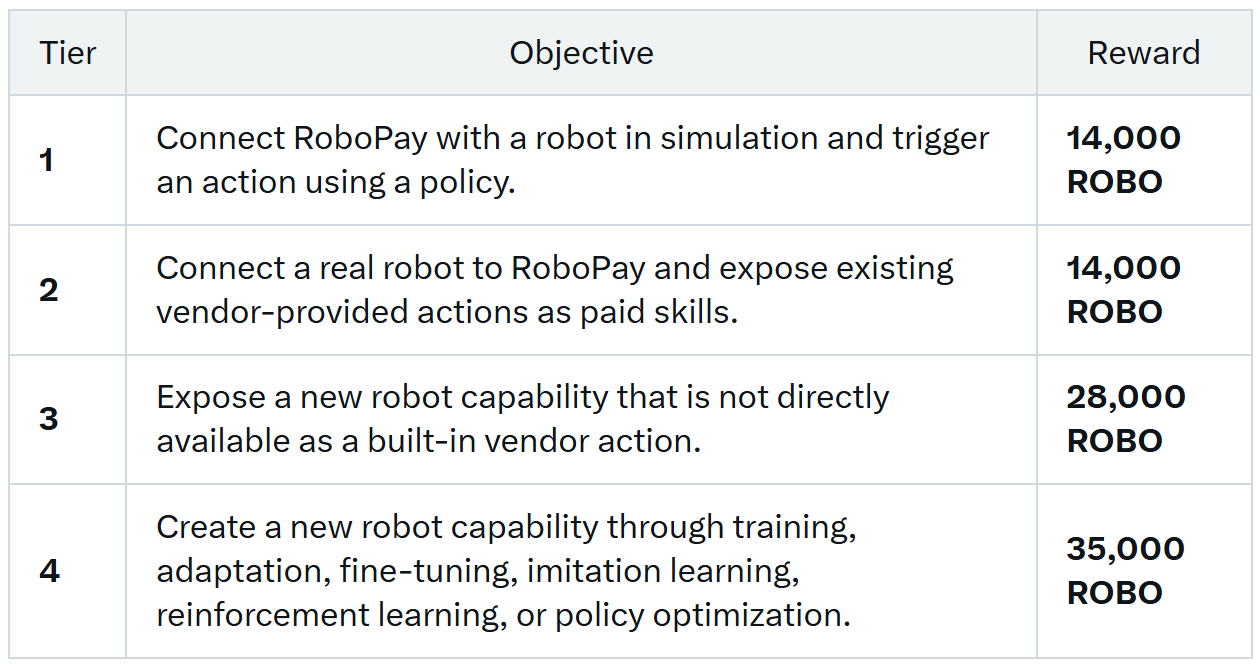
Each robot has its corresponding bounty tasks. All rewards follow the first-come, first-served principle, meaning that for a task, the first Pull Request (PR) that passes review and is successfully merged will receive the corresponding reward.
Success Criteria
We are looking for integration solutions that can be deployed in production environments, not just simple demos.
Each submission must fully demonstrate the entire Pay-to-Actuate workflow, including:
- Requests with completed payment authorization
- Request transmission via RoboPay and Zenoh
- Successfully driving the robot to execute the task
- Asynchronously returning execution results
Additionally, the submission must publicly disclose discoverable robot skills and their pricing, ensure payment security, include reproducible documentation, and provide sufficient evidence for reviewers to validate the implementation.
Detailed requirements: https://github.com/fabricfoundation/RoboPay/wiki
How to Participate?
The participation process is very simple:
Step 1: Choose a task in the Bounty Marketplace
Select the corresponding robot model and task tier, then click Apply.
Step 2: Redirect to GitHub
The official website will automatically guide you to the GitHub page to submit a Pull Request (PR) in the corresponding repository.
Step 3: Read the Success Criteria carefully before submission
Ensure your implementation meets all review requirements.
Step 4: Official review
The team will review the submissions based on the public Success Criteria.
If your Pull Request meets the requirements, you will receive the corresponding bounty reward.
Event Duration
Submission deadline: From now until August 21, 2026, 00:00:00 (PT)
Join the Machine Economy
The internet became programmable because developers worked based on open protocols. We believe robotic technology will follow the same path.
Every robot integrated with RoboPay will become another programmable participant in the machine economy. Every contribution will expand developers' capabilities for building, from AI Agents and robotic marketplaces to logistics, automation, and more newly emerging applications.
The bounty program is just the beginning; we can't wait to see your work.
免责声明:本文章仅代表作者个人观点,不代表本平台的立场和观点。本文章仅供信息分享,不构成对任何人的任何投资建议。用户与作者之间的任何争议,与本平台无关。如网页中刊载的文章或图片涉及侵权,请提供相关的权利证明和身份证明发送邮件到support@aicoin.com,本平台相关工作人员将会进行核查。


