Author: Liam 'Akiba' Wright
Translation: Deep Tide TechFlow
Deep Tide Introduction: An anonymous trader bought 20,000 call options with a strike price of $70,000 on Deribit while simultaneously selling 20,000 call options with a strike price of $72,000, for a total nominal value of $2.5 billion, with an expiration date set for July 31 – two days after the Federal Reserve's meeting. The current Bitcoin price is $64,289, indicating that he bets Bitcoin will surge 9% beyond the $70,000 mark in the next 10 days. However, ETF fund flows are volatile, and on-chain cost bases show that $69,000 remains a defense line for buyers. The realization of this gamble depends on whether the demand explosion after the Federal Reserve's decision can withstand these resistance levels.
Deribit's July 31 options board shows that over 20,000 Bitcoin call options contracts are concentrated at the $70,000 and $72,000 strike prices.
These two strike prices are the largest concentration points for call options on that expiration date. As of the time of writing, exchange data shows approximately 27,000 contracts at $70,000 and about 21,000 contracts at $72,000. The current price of Bitcoin is close to $64,289, about 8.9% higher than the lower strike price concerning the spot price.
Deribit's Chief Business Officer Jean-David Péquignot told CoinDesk that a significant trade involved buying 20,000 call options with a July 31 expiration and a $70,000 strike price, while selling an equal number of call options with a $72,000 strike price.
Exchange data concentration independently confirms that a large number of positions exist at these two strike prices, creating a bull call spread of 20,000 against 20,000.
Based on this structure, the total nominal value of the two legs, calculated at the current Bitcoin price, is approximately $2.5 billion. The premiums paid, capital invested, and net exposure are different metrics than this figure.
These options will expire two days after the next Federal Reserve policy decision. The concentration of strike prices, expiration dates, and the spot price differential collectively define Bitcoin's tactical test in the last few days of July.
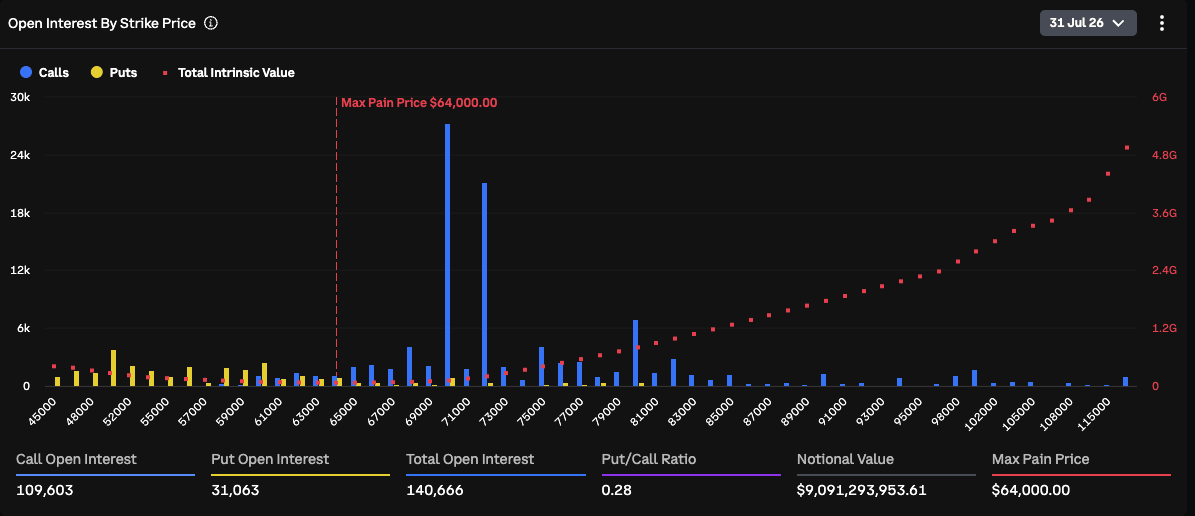
A Spread Trade in a Larger Options Concentration
In the reported structure, the $70,000 call options provide upside exposure beyond the lower strike price at expiration, while selling an equal amount of $72,000 call options reduces costs and caps further gains. The resulting bull call spread achieves maximum profit once Bitcoin reaches or exceeds the higher strike price at expiration.
This structure can express directional views, hedge another options position, or hedge a separate exposure. Deribit's open interest chart and the reported large trades did not identify broader portfolios of counterparties; thus, the position speaks most clearly through its capped profit and short-term expiration.
CryptoSlate's review of options positions on July 17 found approximately $4.5 billion in open contracts for call options between $70,000 and $80,000. Open contracts count the number of contracts that are still active; directional opinions depend on how the call options were bought, sold, and integrated with the rest of their portfolio. This concentration highlights price regions rather than turning each contract into the same bullish bet.
An independent forecast market snapshot from July 20 showed a 14.5% probability that Bitcoin would reach $70,000 this month and a 4.1% probability of reaching $72,500. The threshold at $67,500 is 34.5%, while a downward touch at $62,500 is 67.4%.
Each threshold is independent and non-exclusive binary events, so Bitcoin can trigger multiple events in a volatile month. These contracts measure whether a certain level is reached at any point in July.
The profits from the options spread are related to their July 31 expiration structure. Therefore, these percentages provide broader market context, but the questions they answer differ from those regarding the spread.
Federal Reserve Timeline Makes Demand July's Test
The Federal Reserve's official calendar sets the next Federal Open Market Committee meeting for July 28 and 29. The policy decision is due on July 29 at 2 PM Eastern Time, followed by a press conference at 2:30 PM. The call spread will expire on July 31.
The Federal Reserve's decision falls in the last stages of the trade. Based on Bitcoin's price on July 20, breaking into the $70,000 to $72,000 range still requires breaking past the $69,000 region, where recent buying and selling have concentrated.
CryptoSlate's on-chain analysis from July 19 set the recent buyers' cost basis testing point around $69,000, when Bitcoin was below that level. The same analysis identified $52,891 as a conditional lower pressure boundary if demand remains weak. These two levels change as the coin trades, making them moving reference points rather than fixed destinations.
U.S. spot Bitcoin ETF fund flows provide a second test of demand. Farside's daily charts show a net inflow of $197 million from July 6 to 10 and a net inflow of $75 million from July 13 to 17, totaling $272 million. One trading day generated outflows of $424 million, showing how quickly a brief positive run can reverse.
ETF buyers still added $272 million within two weeks, but the single-day outflow of $424 million shows how quickly that support can disappear. Continued breakthroughs in the $69,000 to $70,000 region and more stable inflows would give broader confirmation to the call spread. Continued failures in that region would leave the trade as an isolated tactical position before expiration.
Longer-Term Forecasts Run on a Different Clock
Digital asset financial services company NYDIG stated on July 10 that matching the duration of the last two major cycle corrections, coupled with about a 70% shallower decline, could suggest a potential low point around $38,000 to $39,000 in early October.
Coinbase's institutional division analysis from July 3 identified $58,000 to $59,000 as the first high-intensity support zone, followed by $48,000 to $50,000, about $42,000, and $39,000 to $40,000 (if higher levels fail). Its position report on July 6 described the end-of-June positions as washed out, with options skew leaning toward downside protection. Both articles provided earlier risk benchmarks before the July 18 call spread flow.
Citi lowered its 12-month Bitcoin target from $112,000 to $82,000 and set a bear market scenario at $53,000, contingent on economic recession and ongoing ETF outflows. Citi also cut its assumed 12-month ETF net inflow from $10 billion to zero. In two other outlooks, Standard Chartered retains a target of $100,000 by the end of 2026, while Bernstein maintains an explicitly ambitious end-of-year target of $150,000.
These figures cover the early October cycle scenario, conditional support zones, 12-month bank targets, and end-of-year targets.
The decision tree for July is shorter: the spot must cover the 8.9% gap to $70,000, absorb sell-offs near the recent buyers' cost basis, and do so against the backdrop of unbalanced ETF fund flows.
Bitcoin has risen 0.80% in the past 24 hours and currently ranks number 1 by market capitalization.
What Position is the Broader Market in Now?
Currently, the total value of the cryptocurrency market is $2.23 trillion, with a 24-hour trading volume of $69.65 billion. Bitcoin's dominance stands at 58.73%.
免责声明:本文章仅代表作者个人观点,不代表本平台的立场和观点。本文章仅供信息分享,不构成对任何人的任何投资建议。用户与作者之间的任何争议,与本平台无关。如网页中刊载的文章或图片涉及侵权,请提供相关的权利证明和身份证明发送邮件到support@aicoin.com,本平台相关工作人员将会进行核查。


