
Author: Nancy, PANews
The 2026 World Cup held in the United States, Canada, and Mexico has come to a close, with Spain defeating Argentina in extra time to lift the trophy after a 16-year hiatus. However, the impact of this global sports gala has extended beyond the football field. Outside the arena, the prediction market has emerged as the "invisible winner" of the World Cup.
During the World Cup, the prediction market attracted hundreds of billions of dollars in trading volume, significantly eroding the market share of traditional betting giants for the first time. Meanwhile, the competitive landscape within the prediction market is rapidly differentiating, with Kalshi repeatedly setting transaction records due to compliance advantages and capital backing, further widening its lead, while Polymarket, although experiencing rapid expansion, still struggles under multiple pressures of regulatory challenges, business model difficulties, and increasing competition.
The World Cup Catalyzes Hundreds of Billions of Dollars in Trading into the Prediction Market
The World Cup has become a crucial catalyst for the prediction market to reach the mainstream. As millions of users worldwide fixate on the match outcomes, predictive trading around events like team victories and championship titles has quickly heated up, attracting a large influx of funds and users into this emerging market.
According to Dune's data, from June 11 to July 19, 2026, during the World Cup, the total nominal trading volume of the prediction market reached hundreds of billions of dollars. Specifically, June's nominal trading volume exceeded 49.95 billion dollars, while by July, 36.37 billion dollars in trades had been completed. In contrast, the nominal trading volume in May was approximately 30 billion dollars.
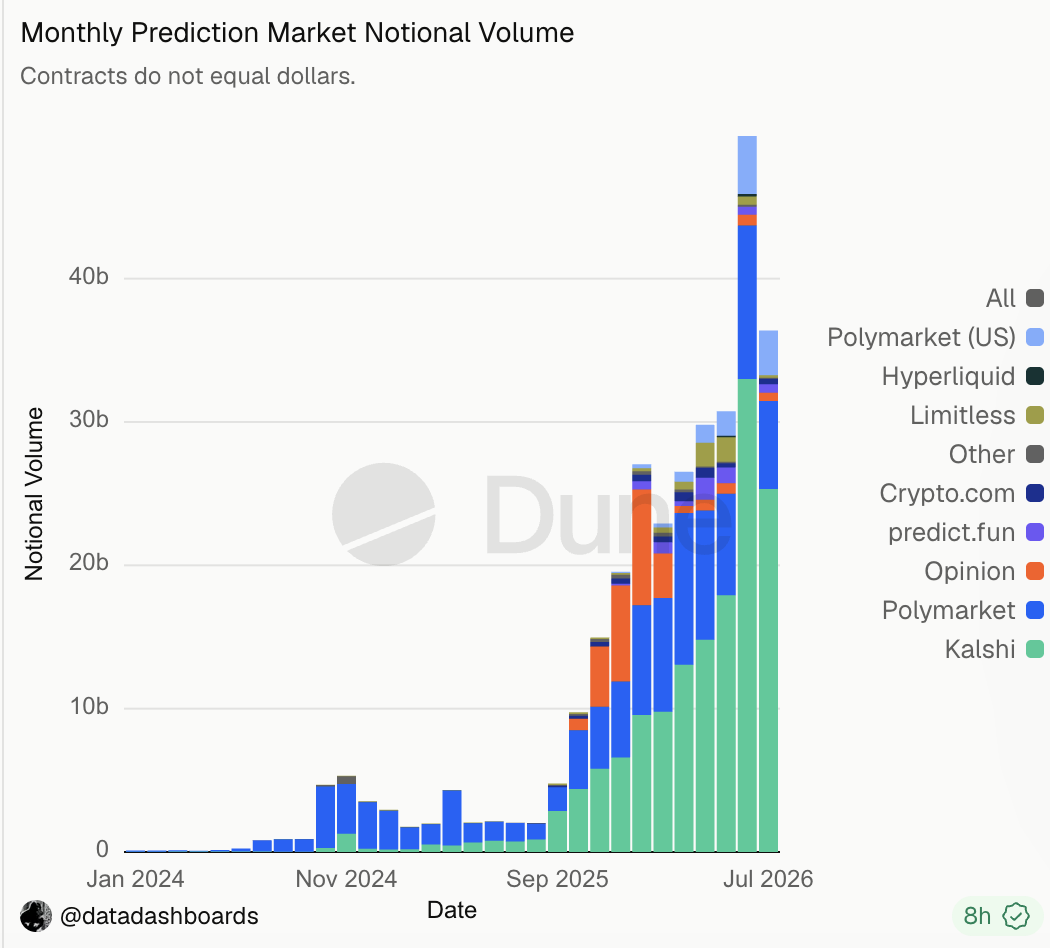
Without a doubt, the World Cup has become an essential influx channel for driving the growth of the prediction market, significantly accelerating the influx of market funds and users.
Taking the two core players, Kalshi and Polymarket, as examples, Dune's data shows that currently, Kalshi's sports section has reached a weekly nominal trading volume share of up to 80.7%; sports-related trades on Polymarket have also achieved a share of 46.3%. Among them, the predictive contract trading amount concerning "the World Cup champion" on the Kalshi platform alone has already surpassed 1.2 billion dollars, setting a new record for a single prediction market on that platform.
To some extent, the World Cup's global influence has allowed the prediction market to connect with mainstream sports consumers on a large scale for the first time, propelling it from the cryptocurrency and financial circles into the mass market.
Taking 27% Share from Traditional Sports Betting
The rise of the prediction market has also changed the competitive landscape of the sports betting industry.
For decades, sports betting has been dominated by traditional bookmakers. However, as the prediction market gained extensive exposure during a global event like the World Cup, its user growth and trading scale began to attract industry attention. U.S. sports betting platforms, including DraftKings and FanDuel, have begun exploring related businesses in the prediction market.
Meanwhile, the traditional betting industry is facing new growth pressure. According to data analytics company Apptopia, the daily active users of traditional betting platforms, such as DraftKings, FanDuel, BetMGM, and Caesars, peaked four days after the World Cup started, followed by a decline. By the end of June, daily active users for DraftKings and FanDuel dropped by 36% and 41% from their peaks, respectively.
In contrast, prediction market platforms Kalshi and Polymarket have maintained a growth trajectory. As of June 30, Kalshi's daily active users increased by 36% compared to June 15, while Polymarket grew by 12%. Throughout June, the two platforms contributed nearly half of the newly active users across six major betting applications, with Kalshi accounting for 38% of this growth.
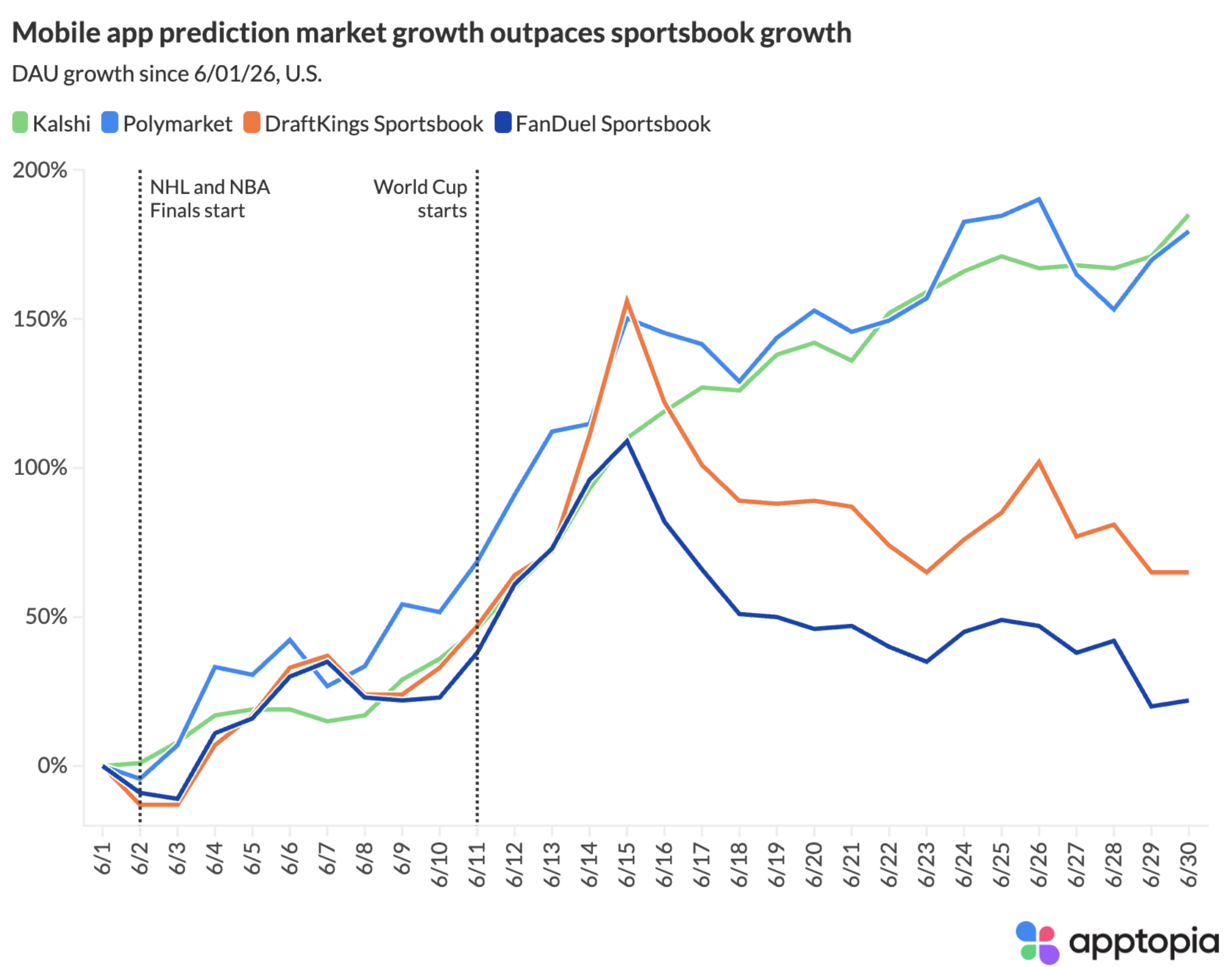
Download data also shows significant differences. Apptopia indicates that in June, Kalshi and Polymarket combined accounted for 78.5% of the total installations among six sports betting platforms, meaning that new users are increasingly choosing the prediction market as their entry point for first-time bets. More notably, the proportion of users who used both DraftKings and Kalshi during the World Cup has risen, but the number of users shifting from Kalshi to traditional sports betting platforms has not increased simultaneously. This implies that traditional betting users are trying the prediction market, while users from the prediction market have not significantly shifted towards traditional betting.
Changes in market share also corroborate this trend. According to estimates from research firm H2 Gambling Capital based on publicly available data from the first month of the World Cup, the trading volume of the prediction market has accounted for about 27% of the total legal sports betting trading volume in the United States, a significant increase from about 9% at the beginning of the year.
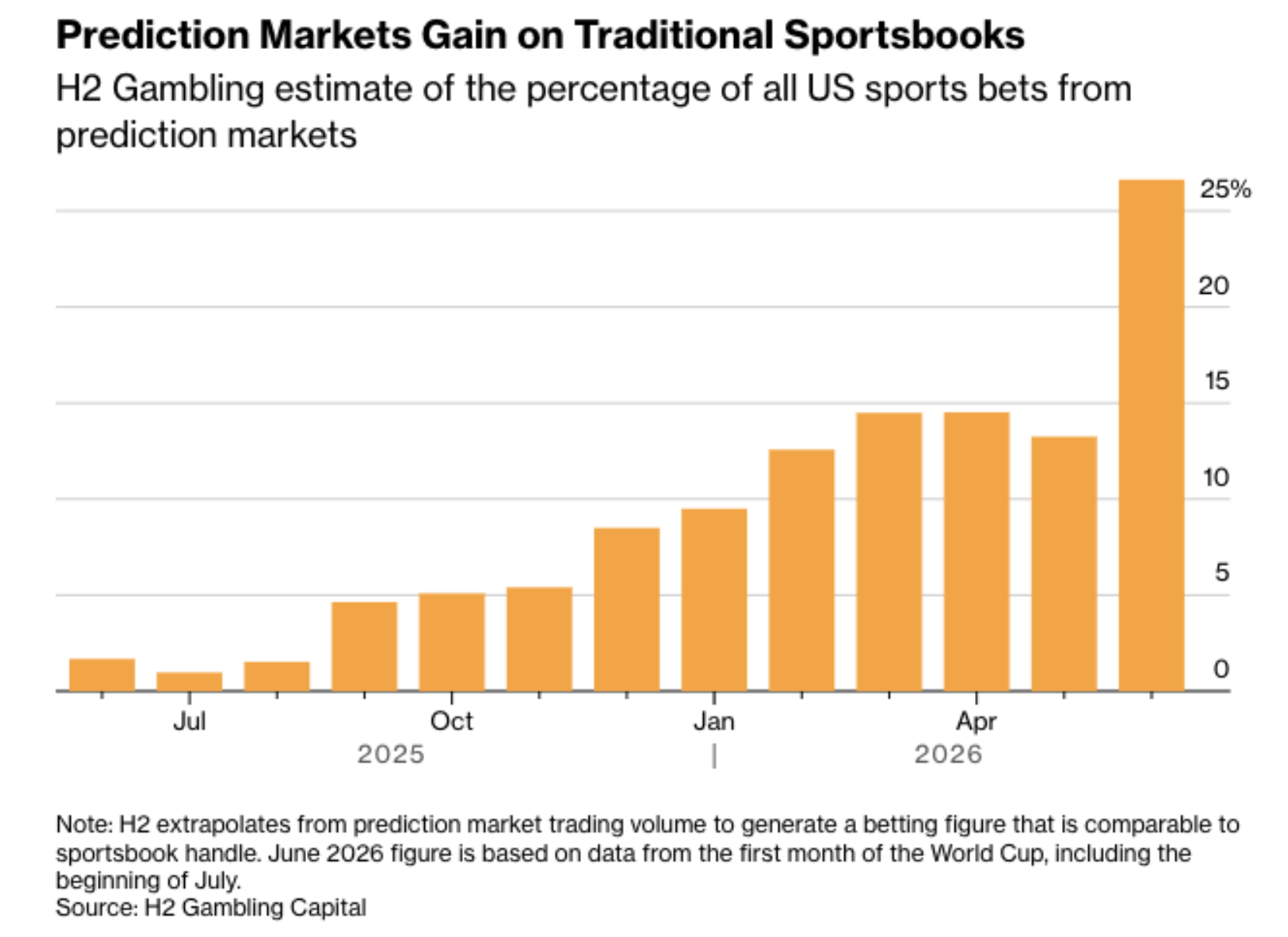
It is important to note that because the prediction market and traditional sports betting adopt different trading statistical measurements, and traditional bookmakers have yet to release the latest internal data during the World Cup, a completely equivalent comparison cannot be drawn between the two.
However, it is undeniable that the World Cup is becoming a pivotal turning point in the development of the prediction market. It has not only aided the prediction platforms in executing large-scale user education but is also propelling the sports betting industry into a new competitive stage. Nonetheless, whether the influx of traffic brought by the World Cup can be converted into long-term user assets remains a core challenge facing the prediction market.
Kalshi Expands Market Share, Polymarket Faces Internal and External Dilemmas
Behind the battle for World Cup traffic, the landscape of the prediction market is quietly changing.
Using July data as an example, based on monthly trading volume, The Block reports that the combined trading volume of Kalshi and Polymarket (including Polymarket US) reached approximately 257.6 billion dollars in June, a 25.4% increase compared to 205.4 billion dollars in May. Among them, Kalshi surpassed 147.05 billion dollars, while the cumulative trading volume of Polymarket and Polymarket US is 110.55 billion dollars, with Kalshi's trading scale exceeding that of Polymarket by 1.3 times.
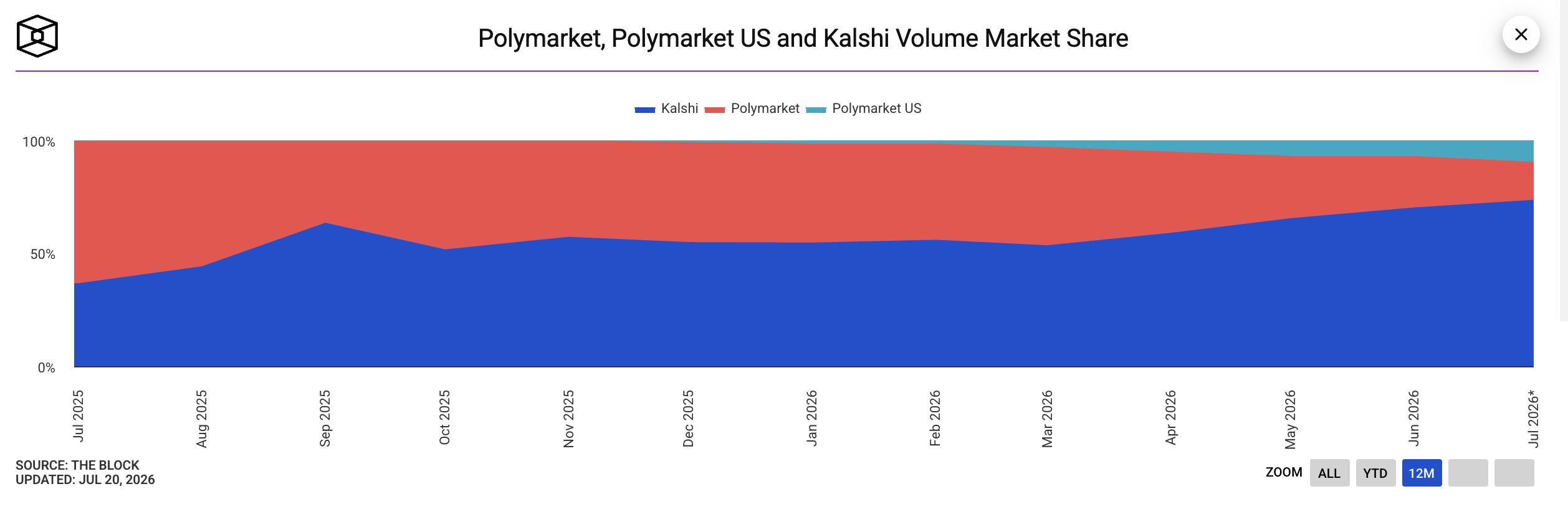
Simultaneously, concerning market share, Kalshi currently occupies about 73.2% of the prediction market trading share, while Polymarket and its U.S. operations combined account for about 26.8%. In contrast, Polymarket's market share had once reached 36.7% in July last year, but it has significantly been squeezed over the past year.
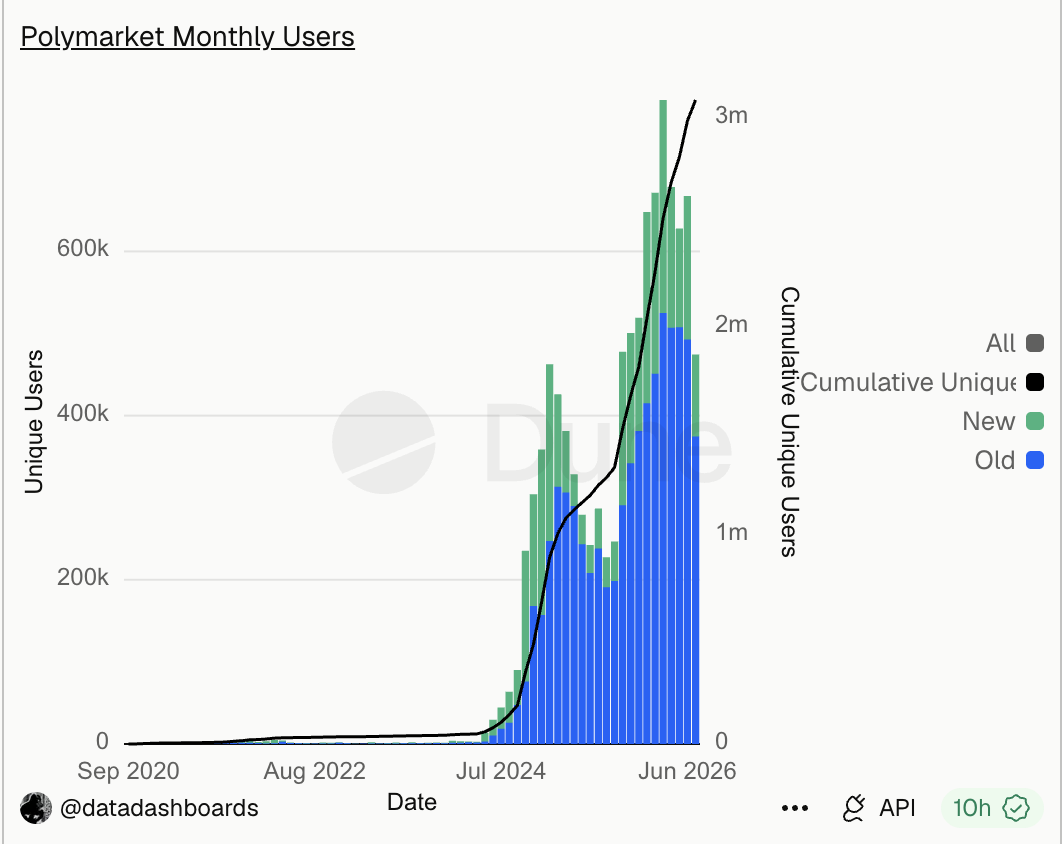
In terms of user growth, the gap between the two platforms is also widening. Kalshi revealed to CNBC that during the entire period of the World Cup, its new users reached 3 million. In contrast, based on data tracking from Dune, although Polymarket's cumulative independent user count has exceeded 3.09 million, the new users in June and July only numbered approximately 274,000.
On the capital market front, the valuation gap between the two is likewise widening. In June, the Financial Times reported that Kalshi is seeking a new round of financing, with the company's valuation possibly rising to 40 billion dollars, with financing expected to be completed by the third quarter of this year. In comparison, Polymarket currently has a valuation of about 15 billion dollars.
This series of data indicates a reversal in the competitive landscape of the prediction market. With compliance advantages, institutional cooperation, and layouts in mainstream market channels, Kalshi is gradually establishing a leading position; whereas Polymarket, having rapidly risen based on its crypto-native model and global user base, is now facing multiple challenges in regulation, business model, and user trust as the industry enters a phase of scaled competition.
For the first time, regulatory pressure is becoming a thick wall hindering Polymarket's global expansion. Recently, markets including France, the Czech Republic, and South Korea have scrutinized Polymarket, with some regions even imposing bans. In the U.S. market, Polymarket has recently applied for a futures license in hopes of re-expanding its U.S. business through a compliance path, but uncertainties remain.
Additionally, brand trust issues have also emerged as a new challenge. According to a recent report by The Wall Street Journal, Polymarket has been accused of hiring paid content creators to record trading videos on fake websites and spreading misleading "profit cases" through social media, with some videos showcasing high returns being questioned as not representing real profit results.
Recently, Polymarket raised its transaction fee rate for sports markets from 3% to 5%, while lowering the market maker rebate ratio from 25% to 15%. Since this adjustment was not announced in advance, but rather updated directly on the fee page and related documents, it has sparked dissatisfaction among some users, particularly sports traders and high-frequency players.
Greater controversy surrounds the POLY token. For a long time, some community users have been expecting Polymarket to launch a platform token, seeing the airdrop as an important reward for early participants. Previously, Polymarket had hinted that it would introduce tokens and conduct an airdrop after restarting its U.S. operations, and its parent company Blockratize Inc. had also submitted trademark applications related to "POLY" and "$POLY", further strengthening market expectations.
However, recently, former members of the Polymarket team indicated that the official token will not be launched in the short term and may take a long time to arrive. This news has further raised community skepticism. Some users believe that Polymarket attracted early users and boosted transaction activity through token expectations, but its prolonged delay in fulfillment has weakened community trust.
From a capital path perspective, the community believes that Polymarket's development direction may be gradually aligning with traditional financial models. Since 2025, Polymarket has completed several rounds of large-scale equity financing, including a 2 billion dollar strategic investment from ICE. In contrast to crypto projects relying on community incentives and token economies, Polymarket is more likely to lean towards an IPO for value realization in the future.
However, on a longer time horizon, the competition within the prediction market is far from over. As more platforms, such as Robinhood, Charles Schwab, and Hyperliquid, enter this field, the future competition among prediction markets will revolve around user entry points, regulatory capabilities, financial infrastructure, and ecosystem development.
The World Cup has already crowned its champion, but the new round of competition in the prediction market has only just begun.
免责声明:本文章仅代表作者个人观点,不代表本平台的立场和观点。本文章仅供信息分享,不构成对任何人的任何投资建议。用户与作者之间的任何争议,与本平台无关。如网页中刊载的文章或图片涉及侵权,请提供相关的权利证明和身份证明发送邮件到support@aicoin.com,本平台相关工作人员将会进行核查。


