

This article is co-produced by PANews and BIT US Stocks. BIT US Stocks offers over 16,000 U.S. listed stocks and ETFs, supports deposits and withdrawals in stablecoins and traditional U.S. dollar wire transfers, and allows full shareholder rights and dividend voting rights.
Short-term support for Bitcoin looks at $63,500, Ethereum faces pressure at $1,940
Bitcoin closed the weekend at $64,722, up 1.48% for the week, but by Monday the price had dropped below $64,000, indicating that the rebound is still unstable. What the market is currently most concerned about is: is this just a fluctuating pullback, or is it the beginning of a new round of decline?
Traders generally consider $65,000—$66,000 as a key resistance level. CryptoFrog believes that BTC can only be considered to have truly turned strong if it closes above $65,700—$66,000 on a weekly basis; Minga also pointed out that in the past month, BTC has mainly oscillated between $59,800—$65,700, and if it breaks above $65,700, the next target could be $74,400; if it falls below $59,800, it could return to around $54,500.
Daniel YU, head of BIT Asset Management, believes that short-term support initially looks at $63,500, and if it breaks below, it looks next to $62,500, followed by around $58,000. Resistance then focuses on $65,000—$65,500. The current market is not suitable for betting only on one direction, especially since this week is the last full trading week before the FOMC decision and is approaching the options expiration on July 31, so volatility may be amplified.
On-chain data shows that Glassnode indicates the cost of short-term holders of BTC is about $69,000, with an achievement price below of approximately $52,900. If demand continues to be weak, there is still a risk of a downturn. Regarding the future market, BIT Asset Management head Daniel Yu suggests using a phased accumulation strategy; you can first increase BTC positions to about 50% of the target position, and if the price drops below $50,000, then complete the remaining position. BIT believes that in the coming weeks to months, if the market’s previously priced interest rate hike expectations gradually fade, it could serve as an important catalyst for the end of the Bitcoin bear market.
Recently, Ethereum has shown resilience stronger than Bitcoin, continuously fluctuating between $1,840—$1,870.
Daniel Yu points out that the short-term support level for ETH is at $1,810, with a key resistance level near the 100-day moving average at $1,940. If it can effectively break through, it is expected to open up space for development above $2,000.
Analyst Michaël van de Poppe holds an optimistic attitude, believing that ETH has successfully broken through the $1,820 resistance level and completed a pullback. As long as BTC does not experience a sustained major drop, ETH is expected to strengthen further, with the next stage target potentially looking towards $2,500.
Highlights of Today:
The cross-chain institutional revenue infrastructure TownSquare launches public sale of the TOWN token
The decentralized contract exchange Grvt will launch its GRVT token on July 21
KAITO will unlock approximately 17.6 million tokens, valued at about $10.13 million on July 20
Layerzero (ZRO) will unlock approximately 25.72 million tokens, valued at about $19.76 million on July 20
Upbit 24-hour trading volume rankings: BTC, XRP, TRAC, ETH, BONK
Bitcoin spot ETF: Net inflow of $75.67 million last week, BlackRock's IBIT net inflow of $204 million leads
Ethereum spot ETF: Net inflow of $105 million last week, BlackRock's ETHA net inflow of $135 million leads
XRP spot ETF saw a net inflow of $6.7847 million last week
HYPE spot ETF saw a net outflow of $7.26 million last week
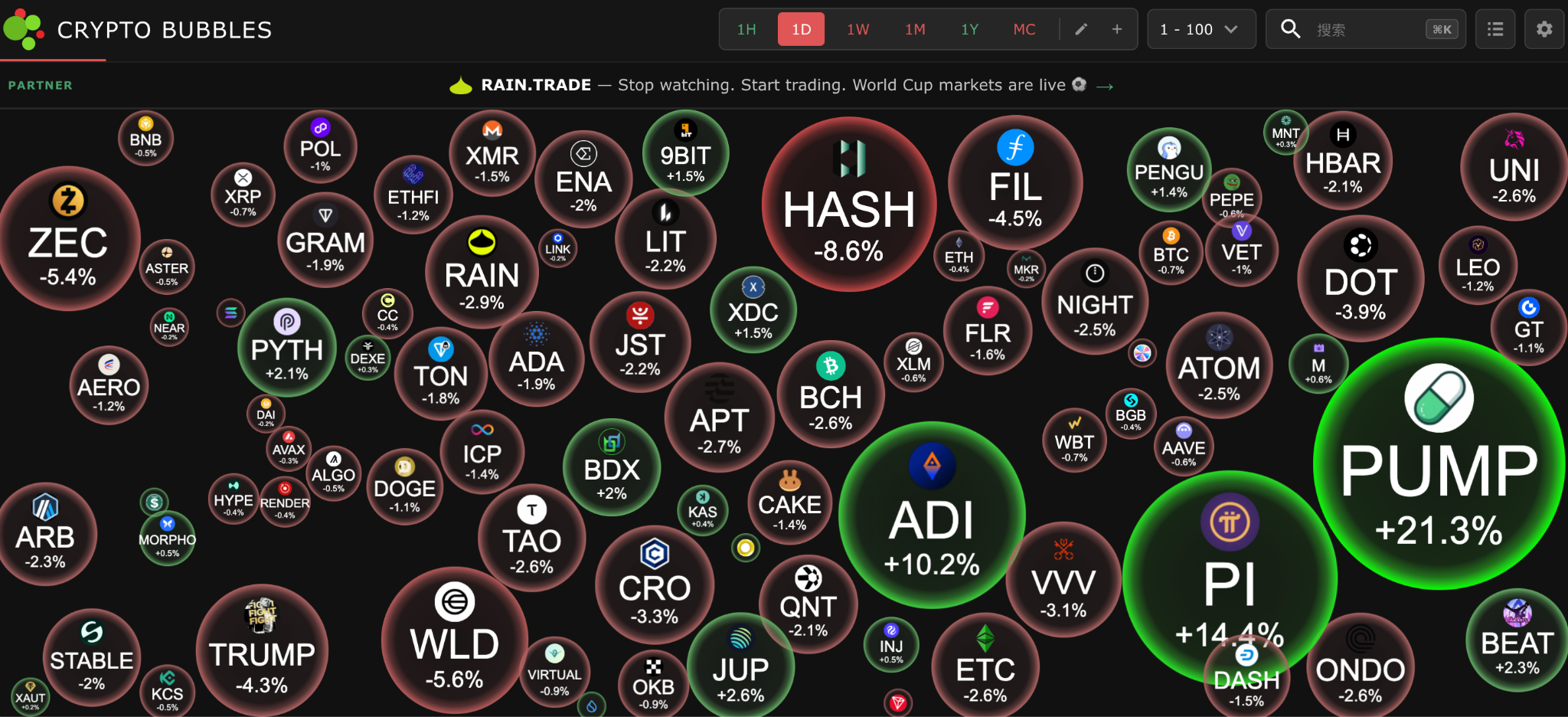
Today's top gainers among the top 100 cryptocurrencies by market cap: PUMP up 21.3%, PI up 14.4%, ADI up 10.2%, JUP up 2.6%, BEAT up 2.3%.
Nasdaq futures and the storage sector see slight rebounds, semiconductor sector continues to face slight pressure

On Monday, U.S. stock futures briefly stabilized, with Nasdaq 100 futures rebounding about 0.09%, but pre-market sentiment remained unstable, with Nasdaq futures down 0.12%.
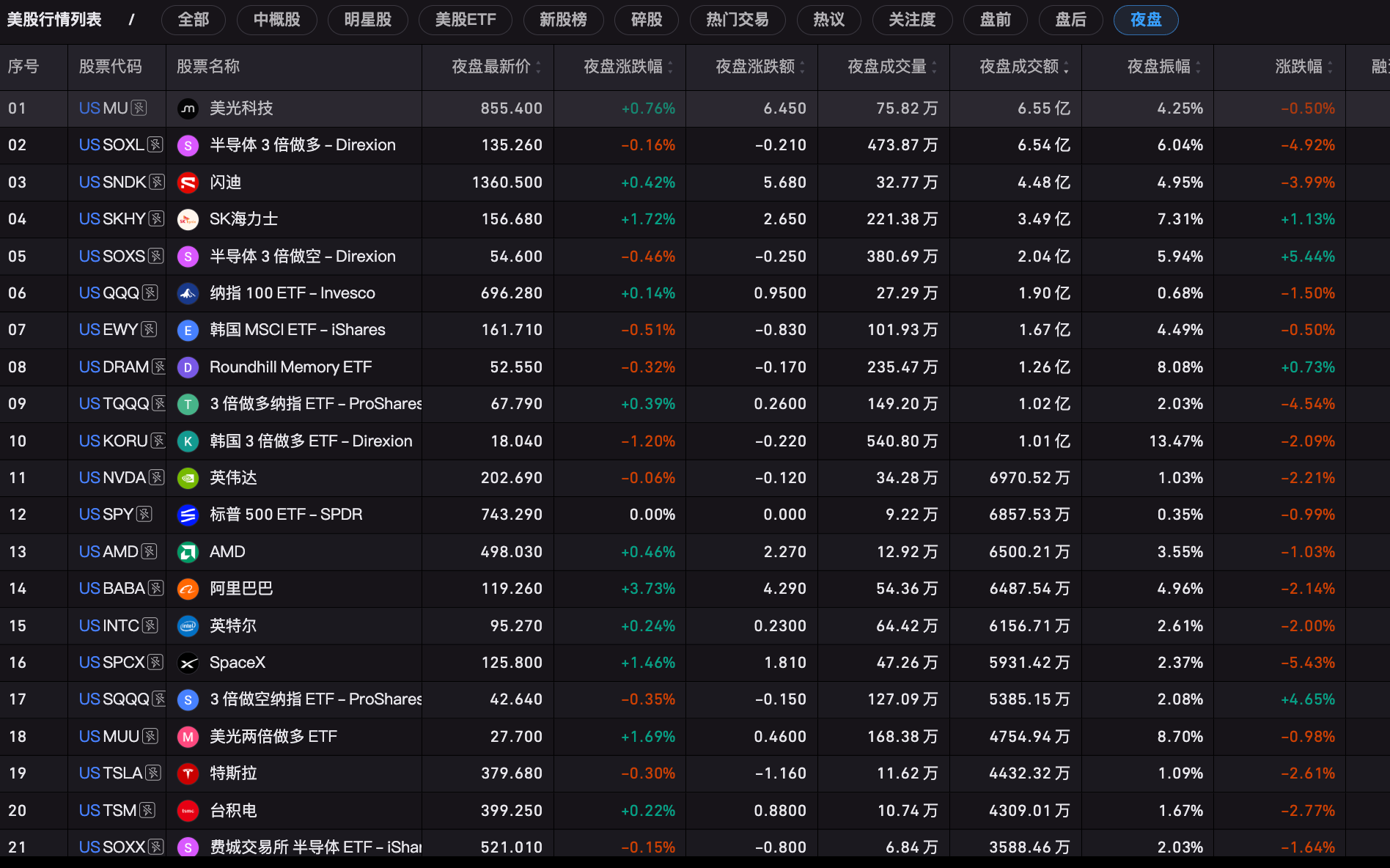
BIT night market data shows that in the U.S. stock night market, the storage sector saw a slight rebound, with Micron and SanDisk increasing by 0.76% and 0.42%, respectively, and SK Hynix rising by 1.72%. The semiconductor sector continues to face slight pressure, with the triple-leveraged semiconductor down 0.16% and the Philadelphia Semiconductor ETF down 0.15%.
SpaceX rose 1.42% in night trading, with Morgan Stanley analyst Adam Jonas setting a base target price for SpaceX at $300, representing more than a double upside from the current price of about $125; Morgan Stanley expects SpaceX revenue will increase from $18.7 billion in 2025 to $319 billion in 2030, with a projected $33 trillion by 2040, based on the core assumption that SpaceX will provide orbital infrastructure for global connectivity and AI through its Starmind satellite constellation.
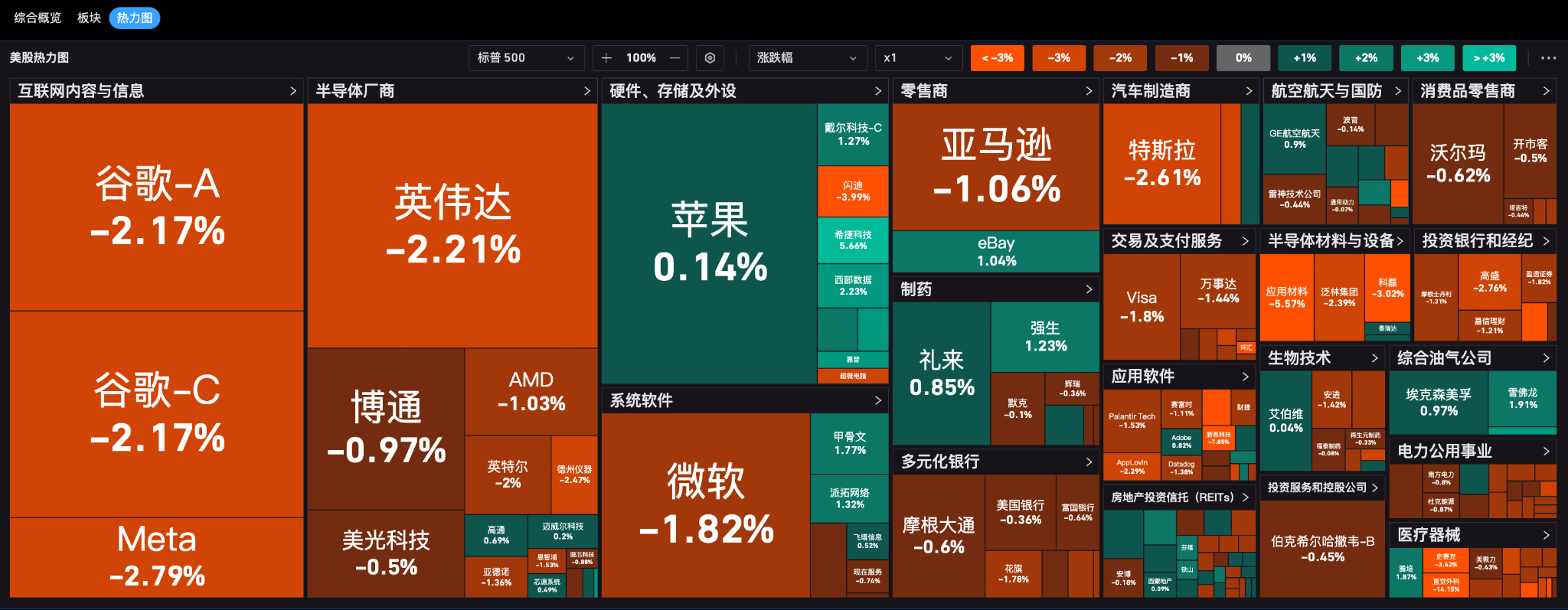
Last Friday, the semiconductor sector was the main battleground for sell-offs. Daniel, head of BIT Asset Management, pointed out that the Philadelphia Semiconductor Index retraced more than 23% from its recent peak last Friday, briefly entering a technical bear market; Nvidia was the largest drag on the market that day, with the VanEck Semiconductor ETF (SMH) falling nearly 9% during the week, marking the third weekly decline in the last four weeks. The Kobeissi Letter also noted that Micron has fallen over 30% since its historic peak on June 22, with selling pressure on tech stocks forcing the market to reassess the sustainability of AI capital expenditures.
On a macro level, the market narrative has shifted from "inflation cooling" to "oil price shock." Goldman Sachs' chief economist Jan Hatzius believes that the June core PCE and core CPI have effectively eliminated the possibility of a July FOMC interest rate hike; however, BIT emphasizes that the fall in June CPI that exceeded expectations was primarily due to energy contributions, and with U.S. gasoline prices falling about 10% in June, the ongoing military strikes on Iran have now reached the tenth night, causing oil prices to breach $90 again, leading to clear inflationary pressures in July.
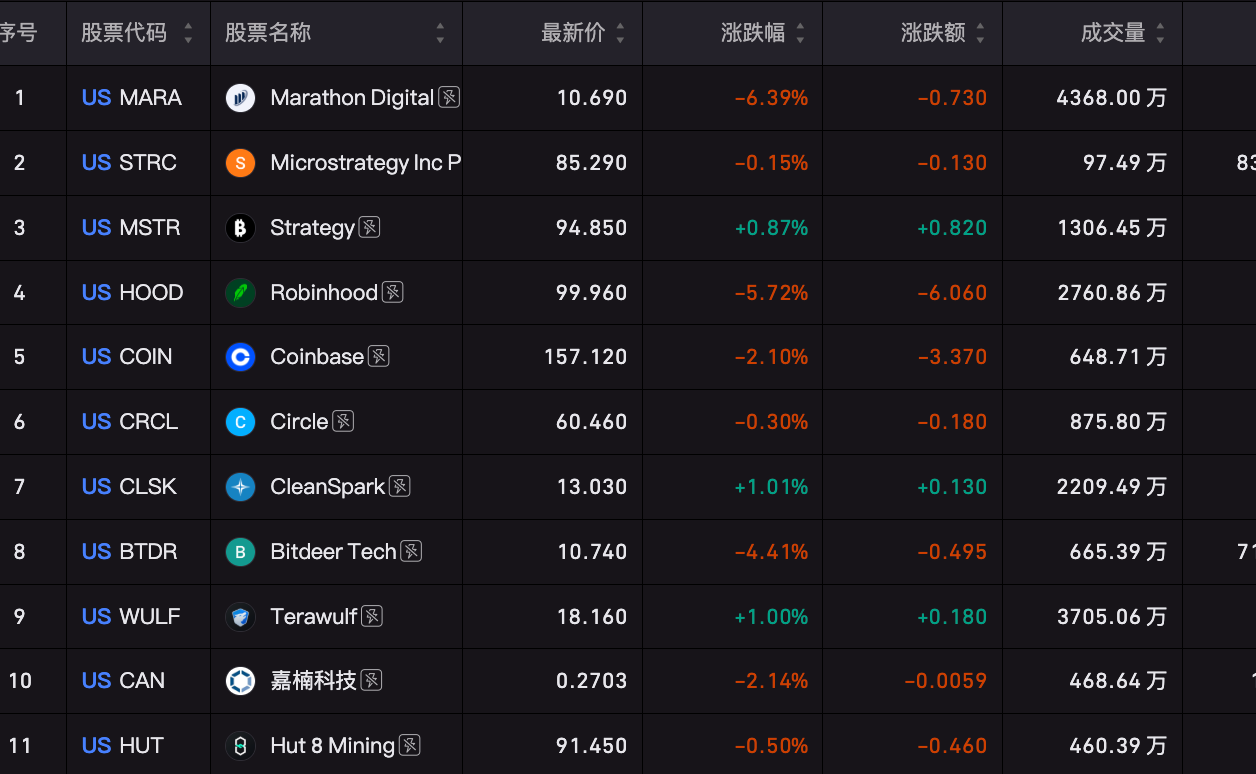
According to BIT US Stocks data, cryptocurrency stocks are generally showing a downward trend, with Strategy up 0.87%, STRC down 0.15%, Robinhood down 5.72%, Coinbase down 2.1%, and Circle down 0.3%. Analyst Khing Oei believes STRC is undervalued and that if BTC rebounds to $80,000, STRC is likely to return to near par. Additionally, Circle faces dual pressures from executive sell-offs and rating downgrades. Circle President Heath Tarbert has cashed out approximately $30.77 million since June 2025, and Mizuho has downgraded its rating to "underperform" with a target price cut to $50.
In the mining sector, MARA fell 6.39%, Cannan Technology fell 2.14%, and Bitdeer fell 4.41%. Bitdeer's latest data shows that as of the week ending July 17, the company mined 244.3 BTC and simultaneously sold 244.3 BTC, currently maintaining a zero Bitcoin position.
Japanese stock market closed, AI leverage liquidation heavily impacts Korean stocks
Due to the retreat of U.S. tech stocks and the deleveraging impact of AI chip leveraged trading, the Korean KOSPI index plunged 5% during trading, ultimately closing down 4.46%, extending a four-week losing streak, and falling about 28% from its historic peak on June 22. (Note: Today, the Japanese stock market is closed, and trading of the Nikkei 225 index is suspended.)
SK Hynix dropped 4.23%, Samsung Electronics fell 4.31%. Because the Korean market previously carried a large amount of leveraged ETF funds related to semiconductors, storage, and single stocks, once the AI chain retreated, index volatility significantly increased. Citigroup downgraded the Korean stock market from "overweight" to "neutral," citing the dramatic volatility of chip stocks in recent weeks and seeking to reduce exposure to AI themes; however, Citigroup maintains a target of 10,000 points for the KOSPI index. Goldman Sachs takes a more valuation-oriented view, pointing out that even if earnings per share face a 41% downgrade, the KOSPI's corresponding level based on 13 times the 2008 EPS trough is still around 8,965 points, above current levels.
To squeeze out leveraged bubbles, Korean regulators announced a substantial increase in cash margin requirements for single stock leveraged ETFs starting August 5 and will restrict the marketing of related products.
The three major indices of A-shares declined across the board, the People's Bank of China maintained the one-year LPR at 3% and the five-year LPR at 3.5%, in line with market expectations. To stabilize expectations, China National New has used over 50 billion yuan in special funds to maintain the market, and China Chengtong has recently purchased nearly 10 billion yuan in stock assets, while the Securities Regulatory Commission will hold a symposium to hear market opinions.
Hong Kong stocks showed divergent performance in AI applications, with China Software International seeing its stock price rise over 37% due to signing a “moon landing plan” token sharing and joint innovation agreement with "the Dark Side of the Moon" (Kimi), targeting commercial use in the energy and finance sectors; while model stocks like Zhipu and MINIMAX retraced by 13% and 4%, respectively.
Additionally, A-share semiconductor sector focuses on expectations for the listing of Changxin Technology. Changxin Technology plans to list on the Science and Technology Innovation Board on July 27, with an initial market value of about 580 billion yuan. Several organizations are optimistic about the prospects of the storage industry, with UBS and CITIC Securities both expecting the DRAM shortage to persist until 2027 or 2028. After the listing of Changxin Technology, the expected market value is generally between 1.6 trillion to 3 trillion yuan, with some optimists even projecting up to 4 trillion to 5 trillion yuan.
免责声明:本文章仅代表作者个人观点,不代表本平台的立场和观点。本文章仅供信息分享,不构成对任何人的任何投资建议。用户与作者之间的任何争议,与本平台无关。如网页中刊载的文章或图片涉及侵权,请提供相关的权利证明和身份证明发送邮件到support@aicoin.com,本平台相关工作人员将会进行核查。


