Author: Claude, Deep Tide TechFlow
Deep Tide Introduction: An AMD executive listed Anthropic as a "customer" in a YAML code file uploaded to GitHub, granting it the highest priority equal to Meta. Jefferies had previously noted that Anthropic was hiring ROCm engineers. If AMD formally announces the collaboration at the Advancing AI conference on July 22, it will become the third top AI lab client acquired by AMD after OpenAI and Meta, and it might not have to sacrifice 10% of the company’s equity. Nvidia still holds 80% to 90% of the AI accelerator market, but supply chain diversification has shifted from "strategic vision" to "actual procurement."
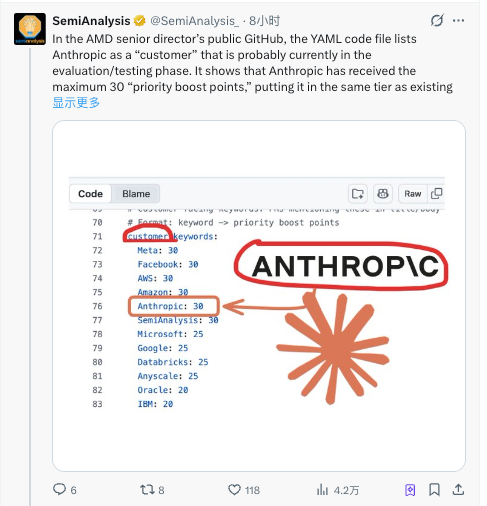
A YAML code file on GitHub has brought the undisclosed client relationship between AMD and Anthropic to the forefront.
According to Stocktwits on July 19, the semiconductor research firm SemiAnalysis found that AMD's Vice President of AI Software Anush Elangovan listed Anthropic as a "customer" in a code file submitted on GitHub, granting it a maximum of 30 "priority boost points," treating it similarly to other publicly known large-scale clients like Meta.
AMD's stock price rose 1.3% in after-hours trading as a result.
SemiAnalysis also pointed out that Anthropic is currently still in the evaluation stage. "If AMD fails to announce Anthropic at the upcoming Advancing AI conference, it means that Elangovan's on-site engineering team has not yet addressed all of Anthropic’s software quality concerns."
The AMD Advancing AI 2026 conference is scheduled to take place from July 22 to 23 at the Moscone Center in San Francisco, just two days after the code exposure.
Multiple clues point in the same direction
The GitHub code is not an isolated signal.
As early as April this year, SDxCentral reported that Anthropic had posted a job advertisement for engineers for its reinforcement learning team, clearly stating that candidates must have experience with ROCm (AMD’s AI software stack) and the ability to migrate workloads across different types of accelerators. The starting salary is $350,000.
Jefferies analyst Blayne Curtis further pointed out in a report on July 17 that Anthropic has been hiring engineers with ROCm experience, indicating that the company is preparing to further diversify its computing infrastructure. Curtis views this as a key signal for a possible customer announcement at the AMD Advancing AI conference.
Anthropic's current public computing architecture consists of three legs: Nvidia GPUs, Amazon's self-developed Trainium chips, and Google TPUs. In October 2025, Anthropic reached an agreement with Google to gain access to up to 1 million seventh-generation TPUs. In November 2025, Nvidia and Microsoft invested $15 billion in Anthropic, which in turn committed to procure $30 billion in Nvidia computing power from Microsoft Azure.
If AMD becomes the fourth leg, Anthropic will have the most diversified sources of computing power among AI labs in the industry.
AMD's "Equity for Orders" model is at a crossroads
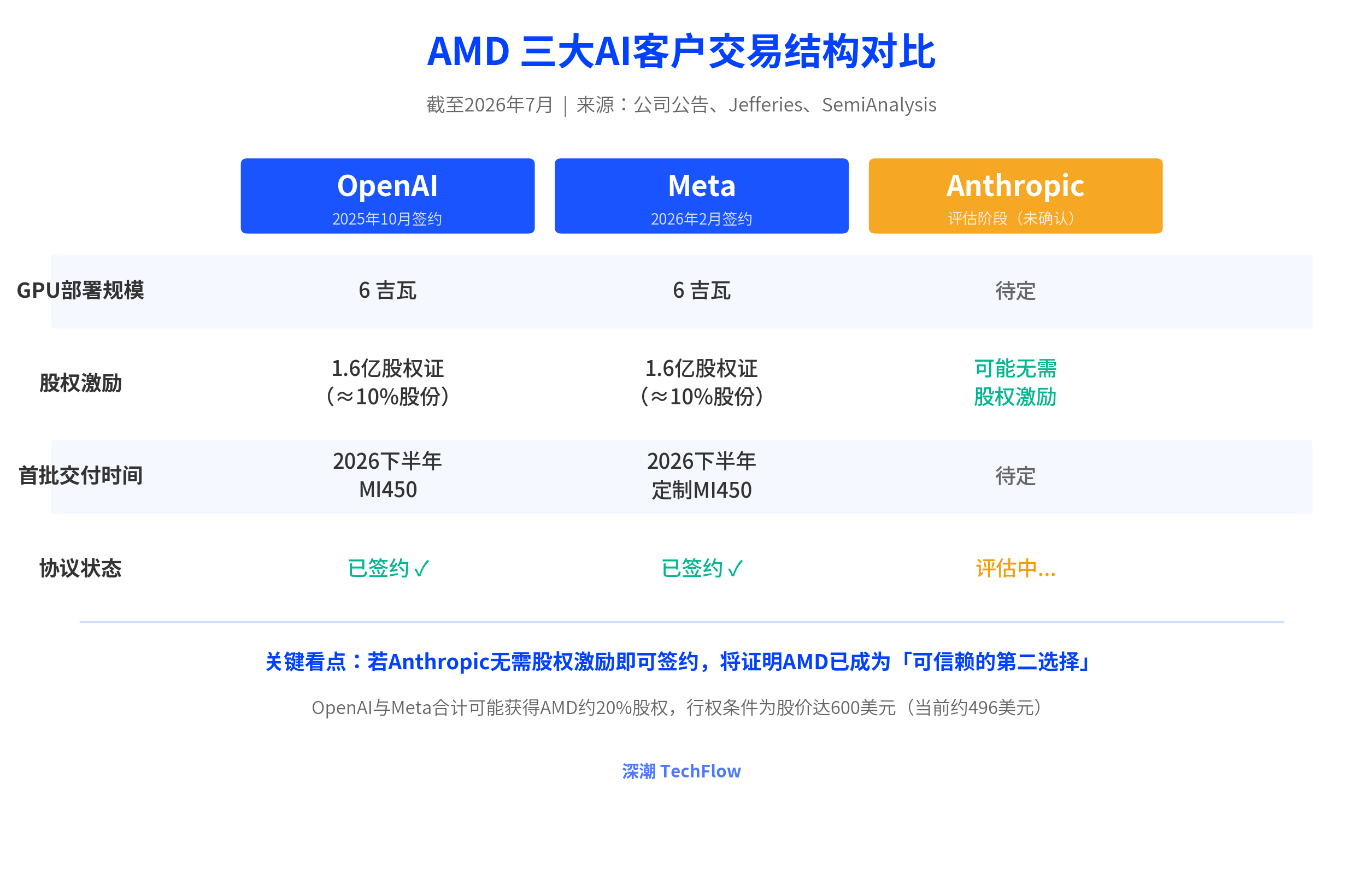
AMD previously secured OpenAI and Meta as two major clients through an aggressive equity incentive program.
In October 2025, AMD signed a 6-gigawatt GPU deployment agreement with OpenAI, issuing up to 160 million stock warrants at an exercise price of just 1 cent, but only vesting once AMD's share price reached $600 (about $210 at the time) and delivery milestones were met. In February 2026, AMD signed a nearly identical agreement with Meta: also 6 gigawatts, also 160 million warrants, and the same $600 stock price threshold.
The two deals combined mean AMD is likely to forfeit about 20% of the company's equity in exchange for 12 gigawatts of GPU orders. Based on Nvidia GPU pricing, each gigawatt is valued at around $35 billion, making the potential revenue from 12 gigawatts far exceed AMD's expected revenue of $34.6 billion for the entire year of 2025.
Jefferies' report on July 17 specifically stated that since AMD has already committed 20% of its company equity to OpenAI and Meta, any future transactions will require a smaller incentive package. A more traditional Anthropic agreement (one that does not include substantial equity) would enhance market confidence, demonstrating that AMD can win top clients without diluting shareholder equity.
As of the market close on July 18, AMD’s stock price was reported at $495.76, about 21% away from the $600 warrant vesting threshold.
Nvidia remains the absolute leader, but the "second place" is closing in
For AMD, securing Anthropic holds strategic significance beyond just revenue.
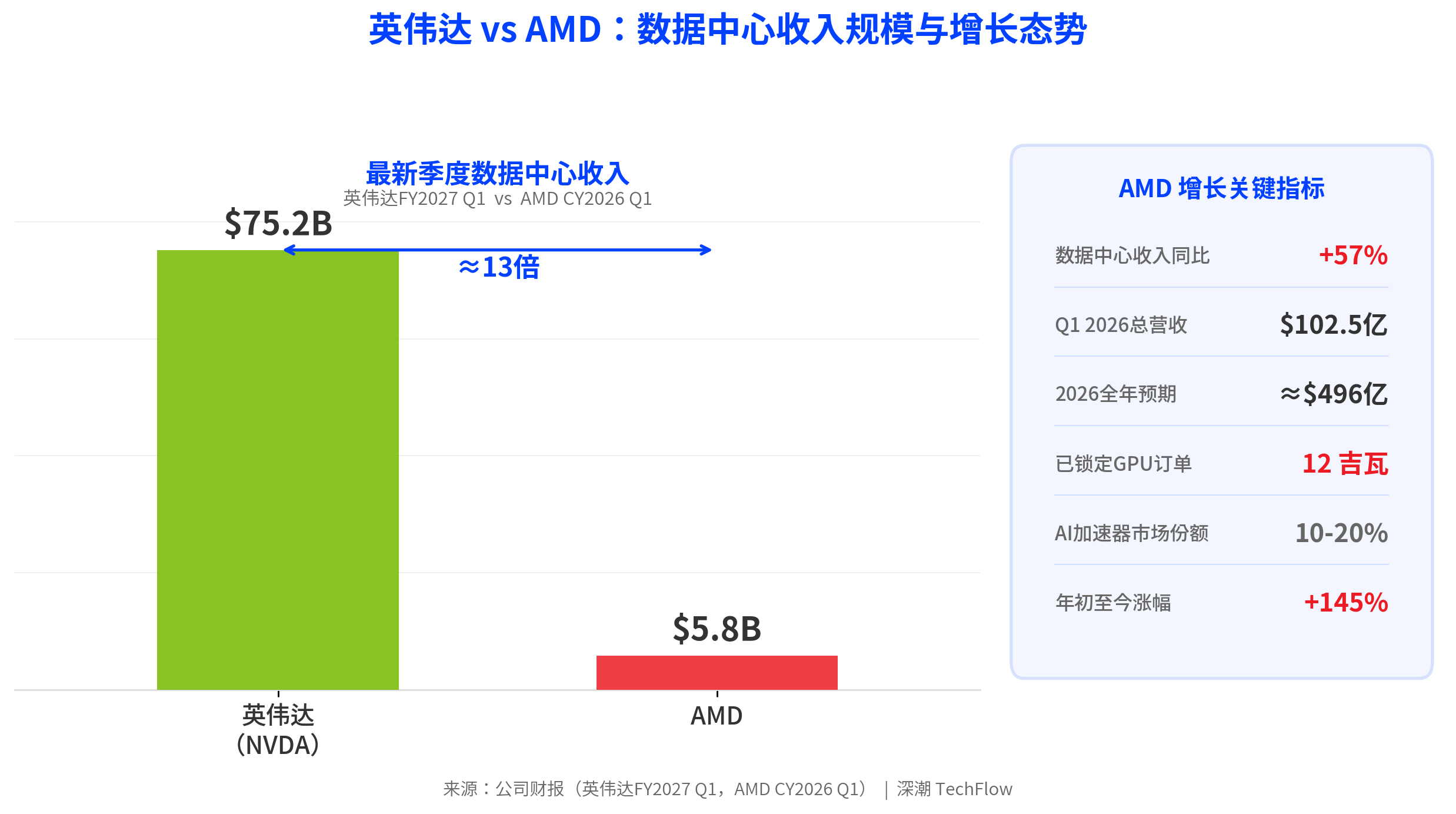
Nvidia's data center revenue for the first quarter of fiscal year 2027 reached $75.2 billion, a 92% year-over-year increase, which is approximately 13 times AMD's data center revenue of $5.8 billion during the same period. Nvidia's market share in AI accelerators remains as high as 80% to 90%.
The gap is still huge. But AMD's growth curve is steepening. In the first quarter of 2026, AMD's data center revenue grew by 57% year-on-year, with annual revenue consensus expectations around $49.6 billion, a roughly 43% increase from 2025. The 6 gigawatt GPU orders from OpenAI and Meta have secured a multi-year visible revenue pipeline for AMD. Microsoft has also become a customer of AMD's MI400 series.
SemiAnalysis previously pointed out that the AMD MI355X offers competitive cost performance in small to medium model inference scenarios. The total cost of ownership of the MI355X is about 33% lower than that of Nvidia's HGX B200, providing a larger HBM memory capacity. However, in frontier model training and rack-level inference scenarios, the MI355X still cannot compete with Nvidia's GB200 NVL72.
AMD plans to begin mass production of the MI450 series GPUs in the second half of 2026, based on the CDNA 5 architecture. The next generation MI500 series is expected to launch in 2027 based on 2nm process and HBM4E memory.
The real battlefield is in software, not just chips
SemiAnalysis's analysis released on July 13 shifted the competitive focus back to the software level. In the performance tests of the open-source inference engine vLLM, Nvidia's GB200 NVL72 significantly outperformed AMD's MI355X, with the gap particularly pronounced in large model scenarios.
This conclusion contrasts with SemiAnalysis's analysis from two weeks prior, which indicated that Anthropic's Claude model training heavily relies on Google TPUs, and Claude Code inference is increasingly being deployed on Amazon Trainium, with Nvidia GPUs at Anthropic slowly being encroached upon by self-developed chips.
AMD's Vice President of AI Software Elangovan previously told SDxCentral that after a series of updates, ROCm has "almost caught up" with Nvidia, and is even leading in FP4 (four-bit floating point) scenarios. The performance of ROCm 7 improved 3.5 times compared to ROCm 6 and now supports all mainstream AI frameworks.
However, there is still a gap between "almost caught up" and "production environment ready." The core bottleneck mentioned by SemiAnalysis during Anthropic's evaluation phase likely resides in whether the ROCm software stack can meet its production workload stability and performance requirements.
For investors, the AMD Advancing AI conference on July 22 serves as a recent validation point. If Anthropic is announced as a formal customer, AMD will demonstrate its ability to become a "trustworthy second choice" without diluting equity. If not announced, it implies that the software gap remains, and the parameter advantages on GPU hardware have not yet translated into actual orders.
免责声明:本文章仅代表作者个人观点,不代表本平台的立场和观点。本文章仅供信息分享,不构成对任何人的任何投资建议。用户与作者之间的任何争议,与本平台无关。如网页中刊载的文章或图片涉及侵权,请提供相关的权利证明和身份证明发送邮件到support@aicoin.com,本平台相关工作人员将会进行核查。


