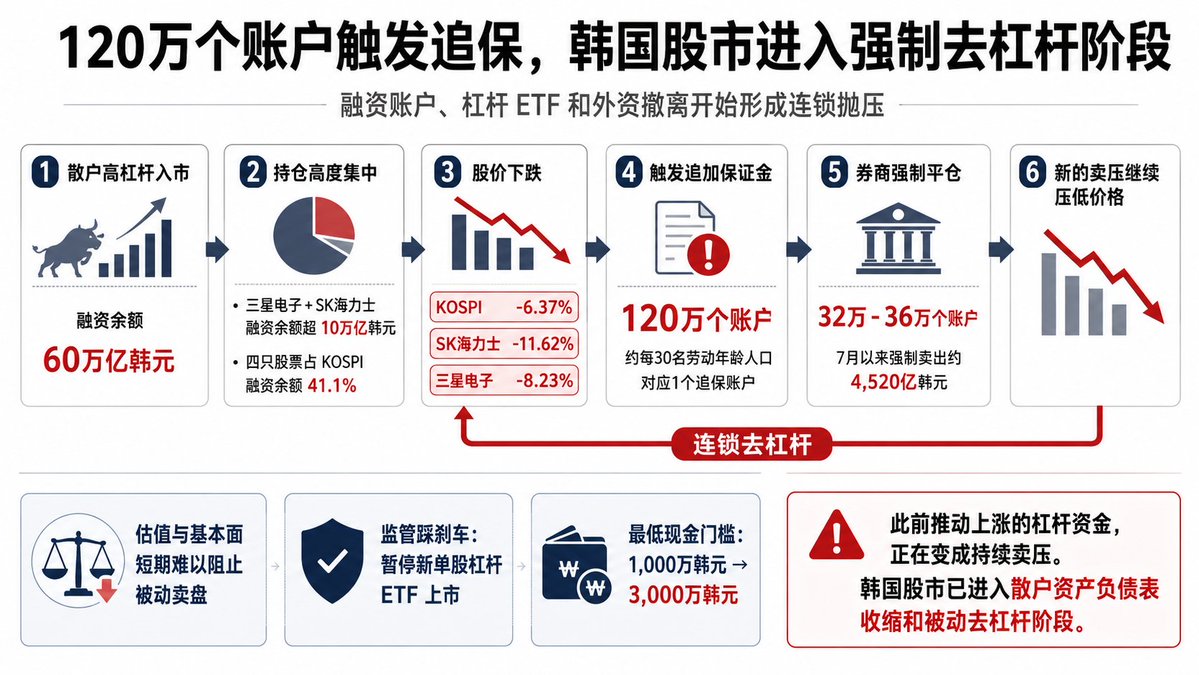
1.2 million accounts triggered margin calls, and the South Korean stock market has entered a phase of forced deleveraging.
I mentioned earlier that the biggest trouble in this round of decline in the South Korean stock market is the simultaneous emergence of financed accounts, leveraged ETFs, and foreign capital withdrawal. Now that retail financing accounts are being forcibly liquidated by brokerage firms, it means that the negative effects caused by high leverage are starting to explode.
As of July 13, over 1.2 million retail leveraged accounts in the South Korean market have triggered margin calls, among which about 320,000 to 360,000 accounts have been forcibly closed by brokerage firms. Roughly corresponding to the number of accounts and the working-age population in South Korea, it translates to one account being involved in margin calls for every 30 people.
The scale of retail borrowing to enter the market in South Korea reached a record 60 trillion won by the end of May. Funds are also highly concentrated in Samsung Electronics and SK Hynix, with the financing balance for just these two stocks exceeding 10 trillion won, and along with Samsung Electronics' preferred shares and SK Square, the four stocks account for 41.1% of the KOSPI financing balance.
This means that if Hynix and Samsung both decline simultaneously, the impact will quickly transmit from stock prices to the entire financing system. A drop in stock prices leads to a reduction in collateral for accounts, brokerages demand additional margin, and accounts that cannot make up the margin are forcibly sold, creating new sell orders that continue to push down stock prices, subsequently triggering the next round of margin calls.
On July 16, the KOSPI fell again by 6.37%, SK Hynix dropped by 11.62%, and Samsung Electronics declined by 8.23%. Since July, forced selling due to the failure to timely supplement funds has reached about 452 billion won, averaging over 50 billion won per day, nearly double the average level of the first half of the year.
At this stage, company valuations and long-term fundamentals are unlikely to halt the selling pressure in the short term. Brokerages will not consider whether Hynix is a long-term beneficiary of AI and HBM when handling financing defaults; they will only sell liquid assets in accounts to cover margin shortfalls.
South Korean regulatory authorities have now suspended the listing of new single-stock leveraged ETFs and raised the minimum cash balance required for investing in such products from 10 million won to 30 million won. However, when regulation begins to apply brakes, leverage has long entered the market; the policies themselves may even stimulate some investors to exit prematurely, further increasing short-term volatility.
The leveraged funds that previously drove up the South Korean stock market have now turned into persistent selling pressure. The South Korean stock market has officially transitioned from a highly volatile situation into a phase of retail asset balance sheet contraction and passive deleveraging.
This is also the main reason why I chose to short SK Hynix, because it is like a chain reaction of explosions in DeFi; the more it falls, the more leveraged funds will blow up, retreating into the price drop.
@Gate Crypto, US stocks, Hong Kong stocks, Korean stocks, gold, CFDs, prediction market one-stop trading
免责声明:本文章仅代表作者个人观点,不代表本平台的立场和观点。本文章仅供信息分享,不构成对任何人的任何投资建议。用户与作者之间的任何争议,与本平台无关。如网页中刊载的文章或图片涉及侵权,请提供相关的权利证明和身份证明发送邮件到support@aicoin.com,本平台相关工作人员将会进行核查。


