Author| Wu Says Blockchain
TL;DR:
Bitcoin entered a downward cycle after reaching an all-time high of approximately $126,000 in October 2025. On July 1, 2026, BTC temporarily dropped to around $57,800, representing a maximum retracement of about 54% from its historic high; as of July 14, the price rebounded to around $62,000.
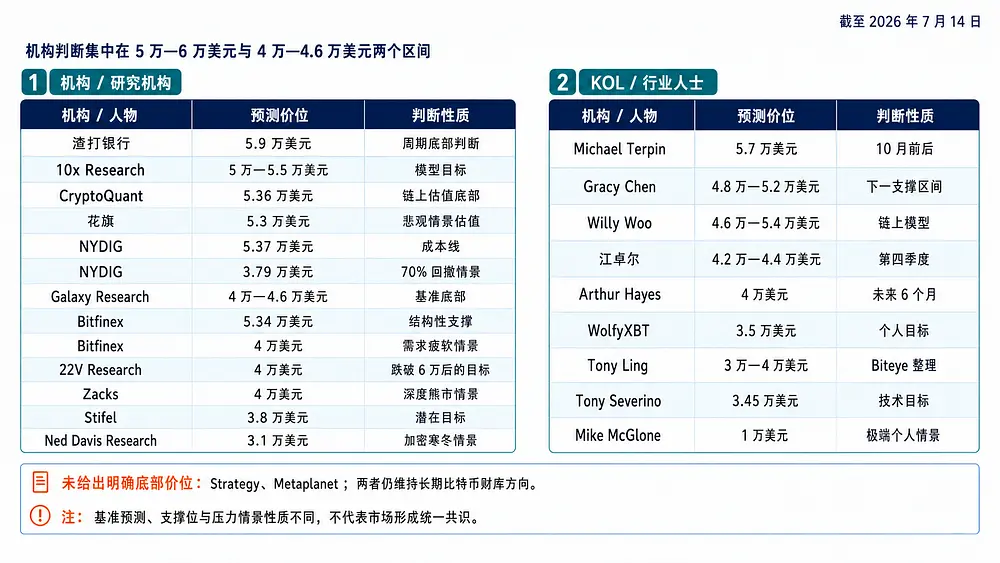
As the market entered a phase of searching for the bottom, institutions including Standard Chartered, Galaxy Research, CryptoQuant, NYDIG, 10x Research, and others provided their judgments. However, the nature of predictions varied: some institutions provided a baseline bottom, some merely indicated key support levels or pessimistic scenarios, while others reflected technical targets after breaking specific price levels.
Currently, the public opinions suggest that institutional predictions mainly center around two ranges: $50,000 — $60,000 and $40,000 — $46,000; KOLs' judgments are more dispersed, extending below $30,000.
Standard Chartered: $59,000 Could Be the Bottom of This Cycle
On June 12, Standard Chartered's head of digital asset research, Geoffrey Kendrick, stated that Bitcoin might have formed a cyclical bottom around $59,000 and believed that the current "crypto winter" has ended.
Kendrick attributed the previous market decline to outflows from spot ETFs, decreased purchasing capacity of digital asset treasury companies such as Strategy, and the shift of investor funds towards AI-related assets. At that time, Standard Chartered still maintained its target of Bitcoin reaching $100,000 by the end of 2026.
However, Bitcoin subsequently fell to about $57,800 on July 1, briefly breaking the $59,000 bottom indicated by Standard Chartered. Its prediction was relatively close to the actual low, but it is not sufficient to confirm that the market has completed its final bottoming.
10x Research: Further Downgraded from $55,000 to Around $50,000
On June 24, 10x Research founder Markus Thielen stated that Bitcoin might have formed a low after dropping to around $55,000. He believes that a stronger dollar, tightening liquidity, and seasonal market factors could still exert pressure on BTC.
On July 1, 10x Research further updated its Elliott wave model. The institution previously anticipated that Bitcoin would complete the A wave decline at around $63,000, followed by a rebound to the $80,000 — $90,000 range, before declining to about $50,000 through the C wave. The latest model provides a potential price range of approximately $46,628–$50,732.
Thus, 10x Research's judgment has been progressively downgraded from the initial $55,000 to around $50,000, but the institution also believes that once Bitcoin falls below $55,000, the long-term investment value will begin to emerge.
CryptoQuant: $53,600 May Constitute a Valuation Bottom
CryptoQuant’s research director, Julio Moreno, noted in a report released in June that Bitcoin had entered the on-chain valuation range at that time, but the demand side was still weak, and the market had not yet shown a complete capitulation signal.
The report indicated that Bitcoin's realized price at that time was approximately $53,600. The realized price reflects the average cost of all BTC at the last on-chain transfer and is often considered an essential valuation floor during bear markets.
CryptoQuant also combined indicators such as the MVRV Z-Score and saw the $55,000 — $60,000 range as a key area to watch for potential bottom formation. However, the institution emphasized that only with improvements in spot demand, ETF fund flows, and stablecoin liquidity could the cyclical bottom be further confirmed.
Citi: $53,000 in a Pessimistic Scenario
On July 1, Citi lowered its 12-month target price for Bitcoin from $112,000 to $82,000, primarily due to continuous outflows from spot ETFs, stagnation in U.S. crypto legislation progress, and weakened investor demand.
In the pessimistic scenario of a recession and continued ETF outflows, Citi estimated Bitcoin’s valuation at around $53,000.
It is important to note that $53,000 is not a clear prediction of a cyclical bottom from Citi, but rather a 12-month pessimistic scenario valuation based on the assumptions of a recession and ongoing capital outflows.
NYDIG: $53,700 as Cost Line, Extreme Retracement Scenario at $37,900
In a report released on June 5, NYDIG stated that Bitcoin was not far from the historical bear market bottom, but the market evidence remained complex and insufficient to confirm the final bottom.
The report regarded the 1x MVRV level of approximately $53,700 as an important cost line, meaning that Bitcoin's market price was close to the average on-chain cost of holders across the network.
NYDIG also calculated that if Bitcoin retraced about 70% from the $126,000 high, the price would fall to around $37,900. However, this figure is based on historical bear market retracement levels and is not NYDIG's baseline prediction.
Galaxy Research: Baseline Bottom at $40,000 — $46,000
Galaxy Research provided a relatively clear and low baseline prediction among institutions. Its June report suggested that Bitcoin might form a cyclical bottom in the $40,000 — $46,000 range between now and the fourth quarter of 2026.
Galaxy established a Bitcoin bottom monitoring framework containing 13 indicators, covering price retracement, holder losses, realized prices, miner pressure, behavior of long-term holders, and market timing cycles. As of the report release, only 4 indicators had fully triggered, indicating that while Bitcoin had entered the second half of its bear market, the market may not yet have sufficiently cleared in terms of decline and duration.
Therefore, Galaxy listed the $40,000 — $46,000 range as the baseline bottom while also warning that if the macro environment or digital asset treasury companies worsen further, the market might face deeper tail risks.
Bitfinex: $53,400 as Structural Support, Insufficient Demand May Lead to $40,000
Bitfinex Alpha in a report on June 29 regarded the realized price of approximately $53,400 as an important structural support for Bitcoin.
The report stated that if ETF outflows slow down and spot buying resumes, Bitcoin might complete bottom formation in this area; however, if demand continues to be weak, the market could further test near $40,000 in the fourth quarter.
On July 1, Bitcoin dropped to about $57,800 before quickly recovering. Bitfinex pointed out in subsequent reports that this movement might belong to a "false breakdown," but at that time, it was still insufficient to confirm that the final bottom had formed.
22V Research: Breaking Below $60,000 May Lead to Technical Target of $40,000
22V Research technical strategist John Roque stated that Bitcoin is testing the first downward target of $60,000. If the price effectively breaks below this level, it may further probe towards $40,000.
Thus, $40,000 is a conditional target after breaking a key technical level and not an unconditional prediction of the bottom from 22V Research.
Other Institutions: $31,000 — $40,000 Mainly Reflects Deep Bear Market Scenario
Zacks Investment Research chief equity strategist John Blank stated in February that if this crypto winter lasts 12–18 months, Bitcoin might drop to around $40,000 in the next 6–8 months. His judgment is primarily based on technical patterns, decreased liquidity, and historical bear market cycles.
Stifel previously provided a potential target of around $38,000; Ned Davis Research believed that if the market enters a complete "crypto winter," Bitcoin might drop to around $31,000. These figures are more aligned with a protracted bear market or extreme pressure scenarios and do not reflect the current unified baseline judgments of these institutions.
Strategy and Metaplanet: No Clear Prediction of Bottom, but Long-term Treasury Strategies Continue
Strategy and Metaplanet did not provide a specific Bitcoin bottom price, but both institutions' treasury activities are significant variables in assessing market demand.
Michael Saylor stated that about $4 billion had flowed out of Bitcoin ETFs recently, reflecting a rotation of capital towards the AI sector rather than damage to Bitcoin itself; in his view, volatility continues to create opportunities.
However, Strategy has begun to manage its balance sheet more flexibly. Between June 29 and July 5, the company sold 3,588 BTC, cashing out approximately $216 million, mainly to pay preferred stock distributions. In the latest week, the company did not continue to buy or sell BTC but raised about $467 million by selling common stock, increasing its dollar reserves to approximately $3 billion. As of the disclosure, Strategy held 843,775 BTC.
Metaplanet continues to maintain a long-term direction of expanding BTC reserves, targeting holding 100,000 BTC by the end of 2026 and 210,000 BTC by the end of 2027. The positions of both companies are more suitable for long-term treasury allocations rather than short-term bottom predictions.
KOL Predictions: From $57,000 to Below $30,000
In addition to institutions, on-chain analysts, traders, and industry insiders have also provided differing judgments on this bottom.
Michael Terpin stated in April that Bitcoin had not yet touched its final bottom and anticipated the price might drop to around $57,000 by around October. The $57,800 low observed on July 1 is already close to his prediction, but whether it represents the final bottom remains to be confirmed.
Bitget CEO Gracy Chen mentioned in June that $59,000 was the first support to pay attention to; if it breaks down, the next significant area would be $48,000 — $52,000. Hence, Biteye summarized its bottom judgment as around $50,000.
On-chain analyst Willy Woo placed the potential bottom range at $46,000 — $54,000 in March based on conventional on-chain models like CVDD. At that time, the CVDD lower bound was around $45,500 and would gradually rise over time. He also warned that these models have only experienced four complete bear markets, and if the macro environment deteriorates significantly, actual prices could fall even deeper.
LaiBit founder Jiang Zhuoer predicted that Bitcoin might fall to $42,000 — $44,000 in the fourth quarter of 2026. He based his judgment on the market cap to Bitcoin net asset value ratio of Strategy, along with the four-year cycle and the gradually decreasing volatility of Bitcoin.
BitMEX co-founder Arthur Hayes believes that Bitcoin could drop to around $40,000 in the next 6 months. He has hedged downward through options structures but still identifies as a long-term net long holder of Bitcoin. Thus, $40,000 represents a medium-term risk judgment rather than a long-term bearish target.
KOL WolfyXBT stated he is still waiting for Bitcoin at $35,000, representing a more pessimistic judgment from some traders regarding this retracement.
According to Biteye's compilation, crypto investor Tony Ling predicts that Bitcoin might enter the $30,000 — $40,000 range in the fourth quarter of 2026 and believes the market may also be affected by Nasdaq's long-term bear market and the bursting of the AI bubble afterward. Since his complete original post has not been found, this viewpoint should be reserved as "according to Biteye's compilation" for source limitation.
Technical analyst Tony Severino maintained a long-term target of about $34,500, corresponding to approximately a 72% retracement from Bitcoin’s historical high. He expects the cycle low may appear around October.
Bloomberg Intelligence senior commodity strategist Mike McGlone provided the most pessimistic assessment. He believes that if Bitcoin fails to regain the $75,000 level, it could drop to as low as $10,000 in extreme cases. It should be emphasized that this is McGlone's personal analysis view and not an official institutional forecast from Bloomberg, nor does it belong to the current mainstream market expectations.
No Unified Consensus at $44,000 — $46,000
In summary, a conclusion cannot yet be drawn that "institutions generally believe that this cycle's bottom is around $44,000 — $46,000."
Standard Chartered believes that $59,000 may have already constituted a cyclical bottom; the key areas of CryptoQuant, NYDIG, Citi, and 10x Research mainly concentrate on $50,000 — $55,000; Galaxy Research, Bitfinex, and Arthur Hayes place a deeper risk range at $40,000 — $46,000. Predictions below $30,000 — $40,000 are mostly based on assumptions of deep bear markets, macro recessions, or continued deterioration of technical structures.
The core of the predictive divergence is not only due to the different models used but also the differing assumptions about the future macro environment. Whether spot ETFs can resume inflows, whether treasury companies like Strategy will continue to sell BTC, the Federal Reserve's policies and dollar trends, and whether investor funds will continue to shift towards AI assets all may affect the final bottom.
Thus, the $40,000 — $46,000 range can be viewed as a currently emphasized second-level support and baseline bottom range for some institutions but cannot be described as a unified consensus reached by the market.
免责声明:本文章仅代表作者个人观点,不代表本平台的立场和观点。本文章仅供信息分享,不构成对任何人的任何投资建议。用户与作者之间的任何争议,与本平台无关。如网页中刊载的文章或图片涉及侵权,请提供相关的权利证明和身份证明发送邮件到support@aicoin.com,本平台相关工作人员将会进行核查。


