
Source: "The Rollup"
Compiled by: Felix, PANews
Hanson Birringer, co-founder and chief revenue officer of Hyperdash, a trading data analysis platform based on Hyperliquid, recently guest-starred on the podcast "The Rollup," where he elaborated on how Hyperliquid is building an efficient and decentralized liquidity layer by integrating three major trends: perpetual contracts, RWA, and stablecoins. The interview also mentioned the related ETF products launched by Grayscale, believing that this provides institutional investors with a compliant channel to enter the ecosystem; and expressed high optimism regarding the value capture mechanism achieved through token buybacks by the protocol.
PANews has compiled the highlights of the interview.
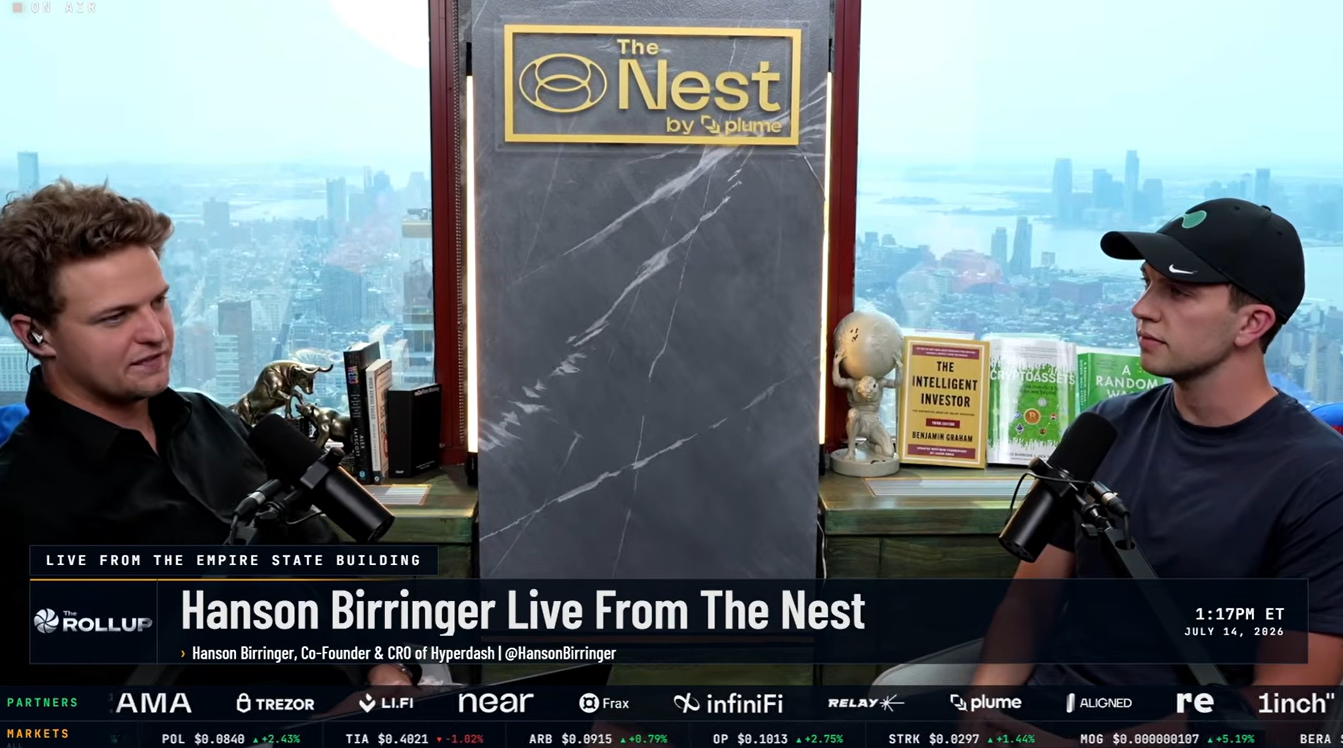
Host: How has this month been for you?
Hanson: It's been a fantastic month. We have made a lot of announcements. For instance, I officially joined HyperDEX full-time and announced the acquisition of Imperator, so we are now launching a complete data and node infrastructure validator business. I'm really looking forward to the Hyperliquid summit later this week. Overall, it's an exciting time to be building within the Hyperliquid ecosystem.
Host: I feel that in the past few years, with the evolution of products and the development of tokenization and trading, the investment logic surrounding Hyperliquid has changed significantly. Perhaps you could share your current investment logic regarding Hyperliquid? When raising funds for the Grayscale ETF SPV and talking to high-net-worth individuals and institutional allocators, what is the logic that truly resonates with them?
Hanson: This is one of my favorite topics. We can talk about why Hyperliquid is not only important for the crypto capital markets but also for the broader traditional financial markets that are evolving alongside it. Ultimately, there are multiple core reasons why investors, researchers, traders, and market participants are so excited about what Hyperliquid is building and want to be part of it. Firstly, it is open-source, permissionless, and decentralized. It has the same rules for every participant on the platform. Furthermore, it not only embodies the spirit of cryptocurrency but also combines it with high-performance financial systems and applications, allowing real institutional capital to engage in this decentralized world, something we haven't seen before. In my decade-long career in the crypto industry, it is truly the only project that allows these two worlds to evolve together rather than separately.
Host: How do you view Hyperliquid as a way to express a bullish trend on perpetual contracts, tokenization, and stablecoins? How do you see the combination of these three mega-trends that are destined for exponential growth over the next decade? Is Hyperliquid a good vehicle to express all three?
Hanson: Absolutely, it is the purest embodiment of these trends. Regarding perpetual contracts, the answer is clear; Hypercore is the leading perpetual DEX, competing with centralized exchanges. In terms of market share from open interest (OI) and trading volume, or from a liquidity standpoint, it has already become one of the top-ranking markets for certain trading pairs, even among the top two. It is also a category leader when it comes to listing new asset types. We see that the launch of HIP-3 has introduced RWA perpetual contracts. So you are effectively combining these larger trends into a very impressive product. In terms of trading commodities and stock perpetual contracts, today's Hyperliquid is already the de facto category leader among crypto exchanges. What they are doing is truly open-sourcing the builder layer rather than outsourcing it. This is the essence of Hyperliquid's spirit, which is to bring in other high-quality, capable builders to start adding value to the ecosystem.
As for stablecoins, USDC has now become a core pricing asset, and I believe the market hasn't truly realized how significant this move is. Because these stablecoins have never engaged in such trades since their inception. They willingly gave up 90% of their revenue just to become a part of the Hyperliquid narrative, which I think is very important for people to genuinely digest and understand, not only from a narrative perspective but also from a revenue perspective. Considering the trading volume of the exchanges and what is happening, currently, Hyperliquid, HyperEVM, and Hypercore together have around $10 billion in stablecoin supply. Assuming this $10 billion can earn a 4% net interest margin in backend U.S. Treasuries, 90% of the returns will flow into the aid fund and programmatically buy back Hype tokens on-chain. Beyond transaction fees, this creates several hundred million dollars of buying pressure for the protocol.
So, to summarize your question, Hype, as a token and an ecosystem, truly represents the purest form of the three mega trends of perpetual contracts, RWA, and stablecoins, and over time, they will jointly generate a compounding effect.
Host: Jeff once mentioned that Hyperliquid is like the AWS of the liquidity domain, where liquidity will foster more liquidity. However, there is currently a headwind: consumer-grade fronts like Robinhood and Kalshi, which are strictly regulated, find it difficult to directly access this system. How do you view this regulatory headwind?
Hanson: This is a global challenge, but Hyperliquid is proactively addressing it. The Hyperliquid policy center is actively lobbying U.S. regulators (like the CFTC) for a clear regulatory positioning for decentralized trading venues. Once this is achieved, traditional regulated brokerage fronts will be able to route orders directly to Hyperliquid for execution. Moreover, traditional brokerages revolutionized the industry with "zero commissions," and now Hyperliquid offers extremely competitive low-cost underlying liquidity, which is a massive market.
Host: Recently, HLP 3 (RWA market) open interest (OI) hit an all-time high. Combining stablecoin earnings and priority fees, how do you expect Hyperliquid's revenue growth story over the next year or two?
Hanson: The traditional financial market is incredibly large, with certain options and ETFs having nominal trading volumes in the trillions or even quadrillions. If RWA perpetual contracts can capture even a small portion of global trading volume, Hyperliquid's revenue could grow by 100 times over the next decade. As trading volume increases, the scale of margin on the protocol will also surge, further amplifying the scale of stablecoin earnings and token buybacks.
Host: You established Hyper Holdings and helped facilitate the launch of the Grayscale Hyperliquid ETF. What was the consideration behind this?
Hanson: Hyper Holdings Global is a special purpose vehicle (SPV), and we set up the SPV to provide seed funding to the Grayscale ETF in physical form. Traditional institutional investors usually do not have Coinbase accounts and face strict risk compliance friction. The ETF provides them with a one-click investment avenue, while our funding support ensures the product's initial assets under management (AUM) and liquidity, allowing large funds to enter and exit with confidence. Institutional investors highly value Hyperliquid's clear "cash flow + token buyback" business model, which is much easier to evaluate than other public chains.
Host: HyperDash has currently processed over $35 billion in trading volume. You recently acquired the institutional-grade data company Imperator. What value can this bring to the platform?
Hanson: HyperDash is essentially a global brokerage and trading data terminal, providing more advanced tools than the official front end. After acquiring Imperator, we became an active validating node for Hyperliquid, enabling us to process on-chain data at the fastest speed. This not only enhances the trading experience for retail users but also allows us to offer enterprise-level data packages to traditional asset management firms, assisting them in investment underwriting and decision-making evaluations.
Host: Regarding Hyperliquid, what is your optimistic versus pessimistic prediction? Not necessarily in terms of price, but from your perspective, what must go right for Hyper Dash, Hyper Holdings, and the entire Hyperliquid ecosystem to achieve the most optimistic results over the next 18 months? And what do you see as a moderate or bearish scenario?
Hanson: The logic for optimism is very clear; the unblocking of stablecoins and local fiat funding channels allows people who have been excluded from the dollar capital markets globally to now access global liquidity with just a few clicks on their phones, something that has never happened in human history. As for the logic for pessimism, I find it hard to identify. Unless there is a reversal of the long-term trends of global internet proliferation and financial inclusion, we have plenty of reasons to remain extremely optimistic.
Related reading: After supporting half of Hyperliquid's market, Trade.XYZ's token issuance speculation has startled the community...
免责声明:本文章仅代表作者个人观点,不代表本平台的立场和观点。本文章仅供信息分享,不构成对任何人的任何投资建议。用户与作者之间的任何争议,与本平台无关。如网页中刊载的文章或图片涉及侵权,请提供相关的权利证明和身份证明发送邮件到support@aicoin.com,本平台相关工作人员将会进行核查。


