
The US stock market has become a battleground for CEXs. As market competition heats up, I have roughly compiled the transaction volume of the order books for US stock exposure products on mainstream platforms over the past 7 days, covering five exchanges: Binance, Bybit, Gate, Kraken, and Bitget.
The data is based on the actual transaction volume attributable to CEX order books from the publicly available APIs of each platform (the statistical period is from July 8 to July 14, 2026, UTC full calendar days).
To enhance comparability, I selected several common underlying assets:
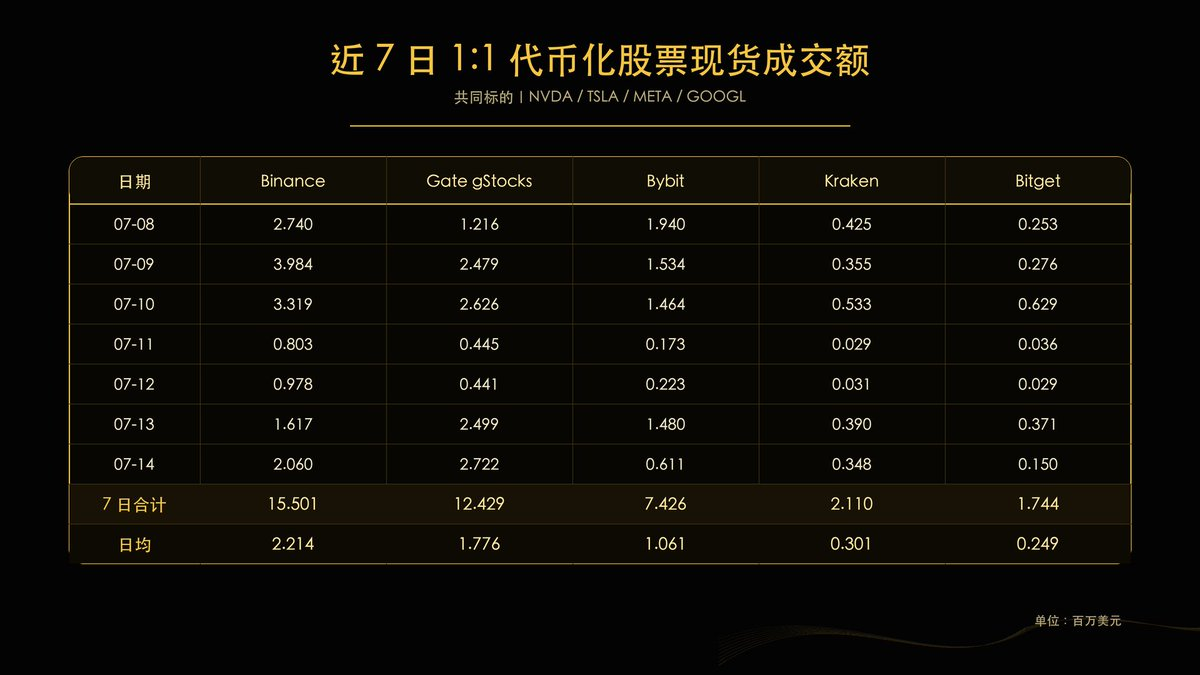
1:1 tokenized stock spot: NVDA, TSLA, META, GOOGL
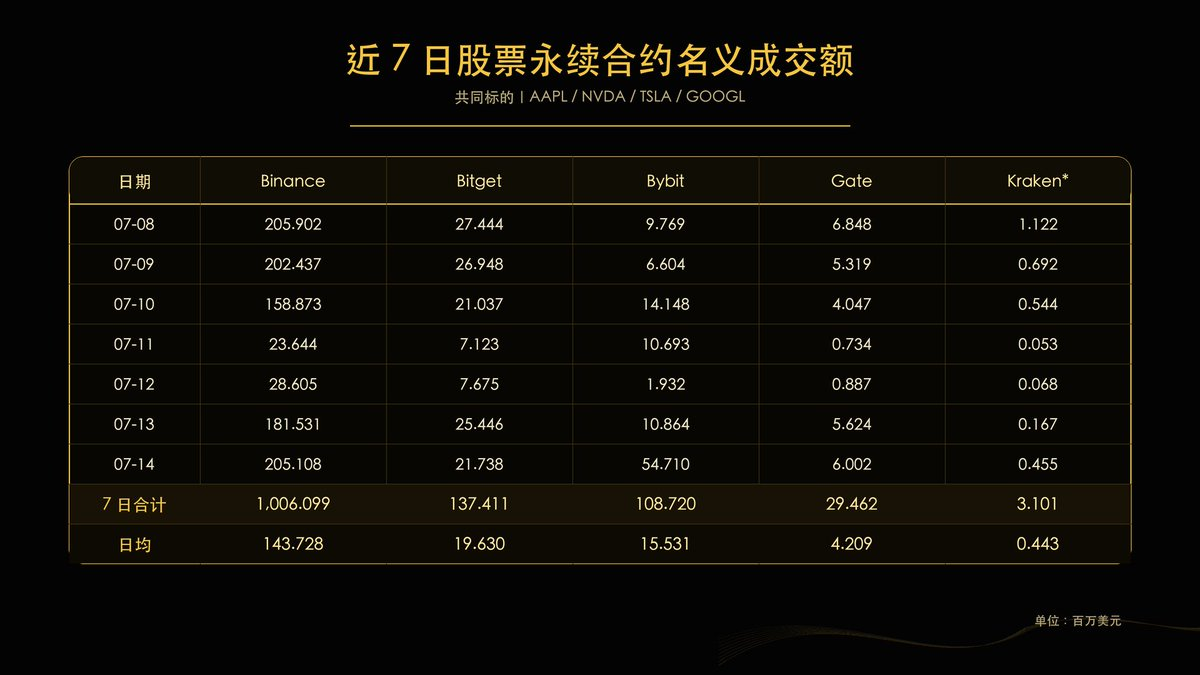
Stock perpetual contracts: AAPL, NVDA, TSLA, GOOGL
Among them, the perpetual contracts statistic refers to the nominal transaction volume, which does not represent net purchases, open positions, or platform revenue.
1. Binance
Past 7 days:
1:1 tokenized stock spot: approximately $15.50 million
Stock perpetual contracts: approximately $1.006 billion
Binance is the platform with the highest transaction volume among the five, whether for tokenized spot or stock perpetual contracts.
During the statistics, the spot volume included the CEX order book transaction volume of the four common underlying assets NVDA, TSLA, META, GOOGL in Binance bStocks; the perpetual statistics accounted for the order book of the four stock perpetuals AAPL, NVDA, TSLA, GOOGL.
This does not include transaction volumes generated from the Binance Wallet or on-chain aggregated trading.
2. Bybit
Past 7 days:
1:1 tokenized stock spot: approximately $7.4257 million
Stock perpetual contracts: approximately $109 million
Bybit's spot statistics account for the order book transaction volume of the four common underlying assets in the xStocks product line, while the perpetual statistics refer to the nominal transaction volume of the corresponding stock perpetual order books.
This also does not include Bybit Wallet, on-chain DEX, or other third-party liquidity sources in the platform's transaction volume.
3. Kraken
Past 7 days:
1:1 tokenized stock spot: approximately $2.1096 million
Stock perpetual contracts: approximately $3.101 million
Kraken's spot statistics account for the common underlying assets in the xStocks order book.
It should be noted that some of Kraken's public K-line data only returns the transaction volume of the underlying assets without directly returning the dollar transaction volume. Therefore, day VWAP or OHLC average prices multiplied by the underlying asset transaction volume is used for estimation.
Thus, Kraken's data is in the same dollar nominal transaction volume dimension as other platforms, but the accuracy may be slightly lower than platforms that provide quote turnover directly.
4. Bitget
Past 7 days:
1:1 tokenized stock spot: approximately $1.7438 million
Stock perpetual contracts: approximately $137 million
Bitget's spot only counts the NVDAON, TSLAON, METAON, GOOGLON in the Ondo Stock Token product line and does not include rToken issued by Reality Protocol.
Why not include rToken?
Because the transaction volume shown in Bitget's rToken public market is closer to the underlying US stocks or direct connections to brokerage liquidity measures, it cannot be clearly attributed to actual transactions of Bitget customers within the CEX.
For instance, when checking, the 24-hour transaction volume of rNVDA once exceeded $25 billion, nearing the total market scale of NVIDIA's underlying stock. Counting this figure directly as Bitget's platform transaction volume would significantly overestimate Bitget's actual business scale.
Therefore, for Bitget, I only counted the Ondo spot order books that can be confirmed from the public API, along with the platform's stock perpetual order books.
5. Gate
Past 7 days:
gStocks spot: approximately $12.4290 million
Stock perpetual contracts: approximately $29.4617 million
Gate's situation is quite special.
Gate has three sets of tokenized stock spot order books:
gStocks: approximately $12.4290 million
xStocks: approximately $2.1444 million
Ondo: approximately $4.5283 million
The total for the three spot product lines is about $19.1017 million.
However, to maintain a horizontal comparison standard of a representative spot product line for one platform, the main ranking only includes Gate's branded product gStocks without aggregating the three order books for comparison with other platforms' single product lines.
If we observe the visible spot order books for all four underlying assets on the Gate platform, the total would be approximately $19.1017 million; when added to the stock perpetual, the total would be around $48.5634 million.
Gate's perpetual statistics account for the order book transaction volume of the four USDT-based stock perpetual contracts AAPLX, NVDAX, TSLAX, GOOGLX.
Conclusion
This statistic measures the actual transaction volume attributable to CEX order books from the publicly available APIs of the platforms.
It does not include:
The overall market transaction volume of underlying US stocks
Wallet aggregation trades that cannot be attributed to specific platforms
On-chain tokens' transaction volume in the entire DeFi ecosystem
Platform customer transaction volumes executed through brokerage channels but not disclosed
Market data from which platform customer execution volumes cannot be separated
Thus, according to the main ranking standard of one representative spot product line per platform, the ranking for tokenized stock spots over the past 7 days is:
Binance: approximately $15.50 million
Gate gStocks: approximately $12.43 million
Bybit: approximately $7.43 million
Kraken: approximately $2.11 million
Bitget: approximately $1.74 million
The ranking for stock perpetuals is:
Binance: approximately $1.006 billion
Bitget: approximately $137 million
Bybit: approximately $109 million
Gate: approximately $29.4617 million
Kraken: approximately $3.101 million
Similarly, under the current common underlying asset standard across these five platforms, the transaction volume for stock perpetuals is approximately 32.8 times that of tokenized stock spots. Therefore, when CEX users trade US stock asset exposure, the primary demand is still concentrated on perpetual contracts rather than 1:1 tokenized stock spots. After all, perpetuals allow for both long and short positions and leverage, providing higher capital efficiency and aligning more with the trading habits of crypto users.
Another noticeable phenomenon is that although many tokenized stocks and stock perpetuals advertise 24/7 trading support, transaction volumes still significantly decrease over the weekend.
This indicates that while products can be traded around the clock, liquidity has not completely decoupled from the US stock market. At this stage, US stock trading hours, underlying market price discovery, and market maker activity times still greatly impact the liquidity of CEX US stock products.
免责声明:本文章仅代表作者个人观点,不代表本平台的立场和观点。本文章仅供信息分享,不构成对任何人的任何投资建议。用户与作者之间的任何争议,与本平台无关。如网页中刊载的文章或图片涉及侵权,请提供相关的权利证明和身份证明发送邮件到support@aicoin.com,本平台相关工作人员将会进行核查。


