Circle and Coinbase face new challenges in the distribution game.
Written by: @G_Gyeomm
Translated by: AididiaoJP, Foresight News
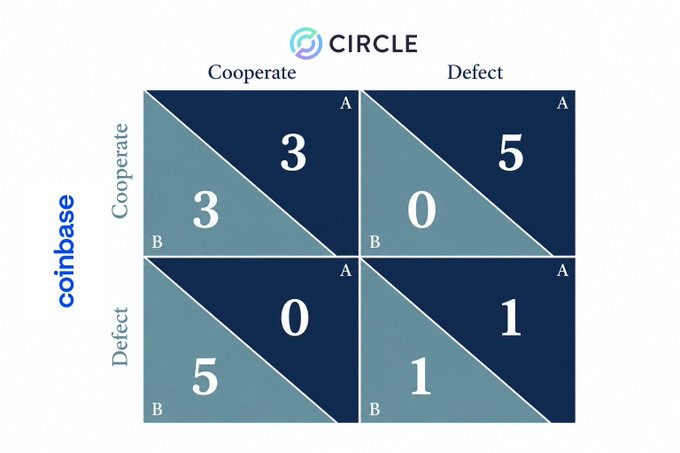
On July 14, JPMorgan lowered its earnings forecast for Circle. Analysts believe that the partnership agreement between Circle and Hyperliquid reached in May is undermining the revenue structure of USDC and creating a "prisoner's dilemma" competition between Circle and Coinbase. JPMorgan judges that this agreement poses a greater long-term threat to Circle than it does to Coinbase.
Looking back at the events that took place in Circle over the past two months, the context is gradually becoming clear:
May 14: Hyperliquid stops using its own stablecoin USDH and instead adopts USDC as its aligned quote asset (AQA). Coinbase is responsible for reserve deployment while Circle is responsible for cross-chain infrastructure. Both parties stake 500,000 HYPE and surrender about 90% of reserve income to Hyperliquid.
June 30: The Open Standard Alliance, composed of around 140 companies, launches OUSD. This stablecoin has no fees and no limits on minting and redemption, with most of the reserve income distributed to distribution partners. On the same day, the CRCL stock price dropped 13% to $16.
July 10: The Office of the Comptroller of the Currency (OCC) finally approves Circle to establish a federal chartered trust bank (Circle National Trust). The stock price then rebounded 14%.
July 14: JPMorgan lowers the earnings forecast for Circle and Coinbase. The USDC held by Hyperliquid is approximately $6 billion, accounting for about 8% of the total USDC circulation.
During this period, the CRCL stock price fell from a 52-week high of $263 all the way down to the $63 range, with a cumulative decline of 44.6% in June alone. This has been viewed as a result of OUSD announcing a reevaluation of USDC's long-term profitability, compounded by the passive selling from index funds after CRCL was removed from growth indices.
The fundamental reason for the downgrade of CRCL's valuation is simple: The bargaining power of the issuer has completely shifted to the distribution channels.
Reserve management is essentially standardized short-term treasury management; the issuance of stablecoins has itself become commoditized, and maintaining the peg is already a mature problem. The only remaining variable is distribution, and the changes in this quarter confirm the shift in this rule.
How the negotiating table for stablecoins tilts
The issuance rights have never been without a moat. USDC was initially managed by a consortium jointly established by Circle and Coinbase in 2018. When the consortium dissolved in 2023, Circle paid approximately $200 million in equity value to Coinbase, monopolizing the issuance rights. At that time, the issuance rights were indeed worth that price.
Since then, the tilting of the negotiating table has undergone three phases:
First Phase (2018-2024): Revenue Sharing
The issuer and distributor share reserve management income. In 2024, the distribution cost paid by Circle to Coinbase was about $900 million, accounting for 90% of its total distribution costs. In the same year's cooperation with Binance, Circle also prepaid $60 million. At this point, distribution costs were already heavy, but at least Circle could secure distribution channels by paying for the consideration.
Second Phase (2025.9-2026.5): Commoditization of Issuance
Multiple institutions launched stablecoin issuance services (Paxos USDG, Agora, M0, etc.), making stablecoin issuance a purchasable service. Substitution did not happen immediately—Hyperliquid self-issued USDH, but due to liquidity and insufficient trading pairs, its supply stagnated at around $100 million for a long time while USDC remained at $5 billion.
However, Hyperliquid eventually abandoned USDH and instead took about 90% of the reserve income from USDC. Self-issuance underperformed, but the conditions obtained through distribution were better. This indicates: substitutes do not necessarily have to succeed; as long as the distribution channel is solid, its very existence can enhance bargaining power. Both sides actually acknowledge—distribution determines everything.
Third Phase (2026.6): Economic Model of Issuers Showing Cracks
Simply providing a single service for stablecoin issuance can no longer support the business. OUSD incurs zero fees and has zero limits on minting and redemption, returning most of the reserve income to partners, with the issuer only collecting a small management fee. Originally, negotiation was about revenue sharing between issuers and distributors, but the current structure has become "there's nothing to split." Issuance has downgraded from a high-margin business to a public infrastructure maintained by distribution partners.
The key point is that a clear precedent has been established: a distributor holding 8% of the circulation has taken 90% of the reserve income. Compass Point estimates that this single transaction from Hyperliquid will wipe out a combined annual EBITDA of $6 to $8 million for Circle and Coinbase. Other channels holding the remaining 92% of circulation—centralized exchanges, perpetual contract DEXs, lending protocols, wallets, brokerages, etc.—have no reason not to gradually make the same demands.
Is the Independent Issuer Model Coming to an End? Where is the Market Heading Next?
If issuance has been commoditized, then companies that only focus on issuance must re-prove their existence value. Everything happening in the stablecoin market right now is either an attempt to prove this point or actions taken by parties that no longer need to prove it.
Fragmented market with no negotiations: Tether holds 59% of the stablecoin market with a USDT supply of $186.7 billion, but no single distributor holds such a large quantity. USDT accounts for 88.5% of stablecoin activities in Nigeria and 90.2% of Binance P2P listings in Venezuela, with over $600 billion in monthly flow in Asia, Africa, and Latin America, primarily through small transactions under $1,000. In a market where millions of users each hold less than $1,000, there is no negotiating counterpart available at the negotiating table.
Local license moat: Local licenses follow a different logic—eliminating alternatives for distributors through legal means. SBI is the only operator in Japan authorized to handle USDC, while also integrating exchange, lending, RLUSD distribution, and JPYSC, forming a group structure that integrates issuance and distribution. Singapore's StraitsX similarly occupies over 70% of the Southeast Asian non-USD stablecoin market with XSGD (the only Singapore dollar stablecoin recognized by MAS); its market value is only $13 million, but the safety space provided by local regulation is quite narrow.
Issuers entering distribution: Circle is expanding its distribution channels, including Arc, CPN, and trust banks. Compared to sharing revenue with external distributors, it is attempting to secure new revenue streams through gas fees, transaction fees, etc., running parallel to reserve management income. Circle's CFO mentioned validator operations on Arc as an alternative income source, which also follows the same logic. However, the more distribution control one commands, the more likely it is to create competitive dilemmas with existing partners.
Distributors entering issuance: Distribution operators are jointly constructing issuance infrastructure (like OUSD) or further launching their own stablecoins. Western Union is integrating USDPT into its global remittance network, Fidelity is advancing FIDD, and U.S. Bancorp is also promoting its own stablecoin. Companies with distribution channels have no reason not to issue stablecoins in their own name.
Outsourcing issuance: The actual entity issuing USDPT is not Western Union but the federally chartered bank Anchorage Digital Bank. Agora, M0, and Bridge are also engaging in similar businesses, and Circle itself offers white-label issuance services, allowing other distributors to issue stablecoins based on USDC.
The issuance rights have been downgraded from the "whole" of the stablecoin business to a "single function." Accompanying this is a decline in market valuation of the issuance rights, and an increased probability that the independent issuer model is merely a transitional model. The liquidity performance of OUSD in the early half of the year, changes in distribution costs between Coinbase and Circle, and the progress of local stablecoins expanding distribution networks will all attest to this direction sequentially.
免责声明:本文章仅代表作者个人观点,不代表本平台的立场和观点。本文章仅供信息分享,不构成对任何人的任何投资建议。用户与作者之间的任何争议,与本平台无关。如网页中刊载的文章或图片涉及侵权,请提供相关的权利证明和身份证明发送邮件到support@aicoin.com,本平台相关工作人员将会进行核查。


