The way forward for crypto platforms is not to compete with DTCC in issuance but to become distribution channels.
Written by: Demir
On July 15, DTCC (Depository Trust & Clearing Corporation) completed the first real production environment transaction of tokenized securities.
DTCC is the most "invisible" institution in the U.S. capital markets, holding more than $114 trillion in securities. Almost every stock and bond trade in the U.S. is cleared through it, making it the clearing and settlement hub of the U.S. securities market.
Previously, all blockchain pilots remained in testing environments; this marks the first time real custodied assets are moved and legal effectiveness is generated.
First, let’s take a look at how the transaction process of tokenized securities works (many familiar crypto projects are involved):
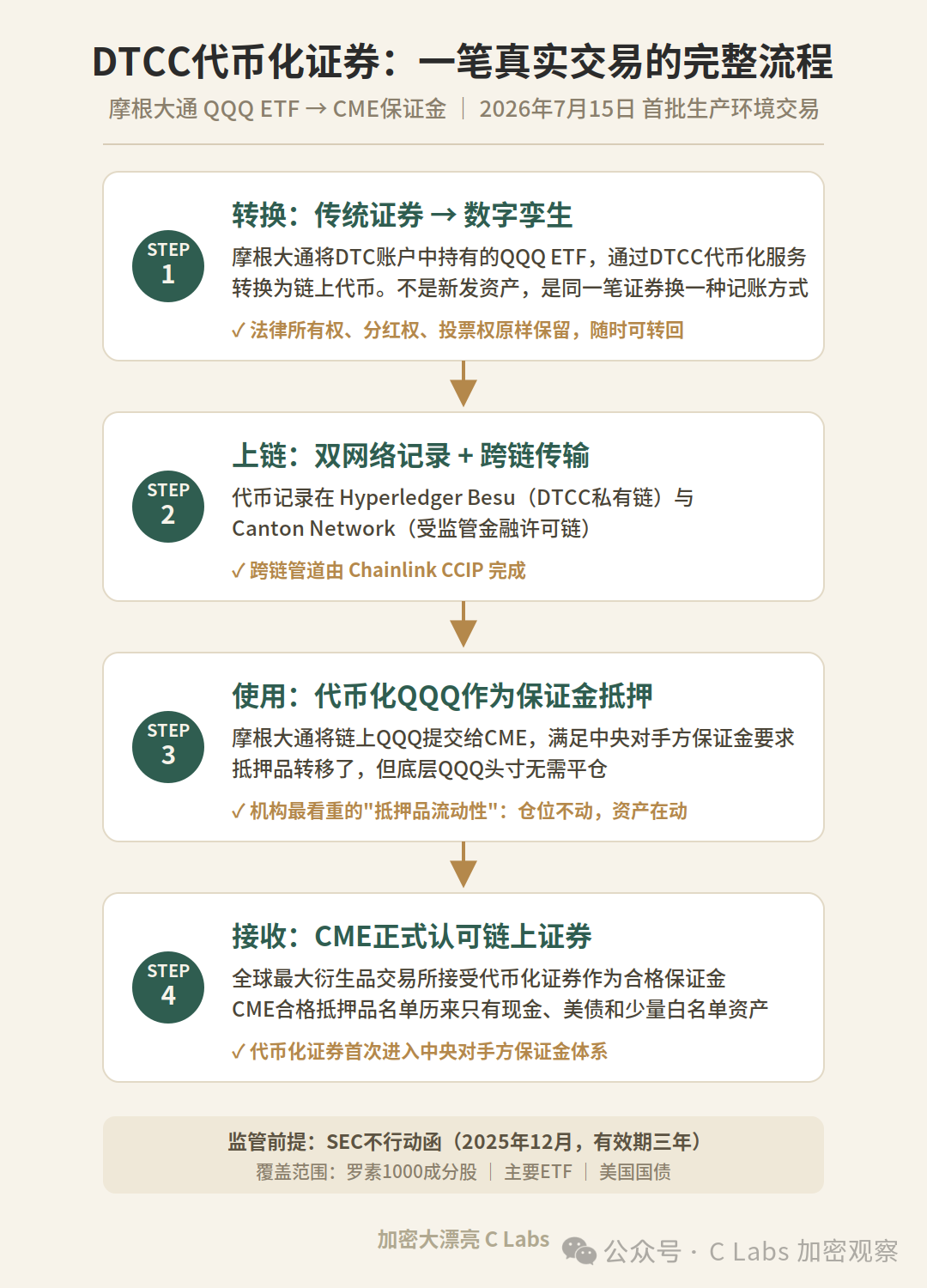
The first step is conversion; JPMorgan takes a portion of the QQQ ETF held in its DTC account and converts it into an on-chain token through DTCC's tokenization services. This does not create a new asset, but switches the same security from traditional electronic bookkeeping to blockchain bookkeeping, with legal ownership, dividend rights, and voting rights unchanged and can be reverted at any time.
DTCC refers to this as "digital twin."
The second step is on-chain; the tokens are recorded on two types of networks—DTCC’s own Hyperledger Besu private chain and the Canton Network aimed at regulated financial institutions. Cross-chain transfer is completed by Chainlink's CCIP.
The third step is use: JPMorgan uses the tokenized QQQ as collateral to submit to CME to meet central counterparty margin requirements.
The key point is that the collateral is transferred, but the underlying QQQ position does not need to be liquidated—this is what institutions value most, "collateral liquidity."
The fourth step is reception: CME, as the largest derivatives exchange globally, officially accepted tokenized securities as qualified margin. CME's list of qualified collateral has traditionally included only cash, U.S. Treasuries, and a small number of whitelist assets; this is the first time tokenized securities have entered this system.
On that day, other institutions executed more scenarios: Société Générale collateralized tokenized U.S. Treasuries to Citadel; Citadel completed securities lending with Crédit Agricole; additionally, there were U.S. Treasury repo DVP, stock DVP, stock token transfers, and other transaction types.
The core business processes of Wall Street's backend can be said to have now all been tested on-chain.
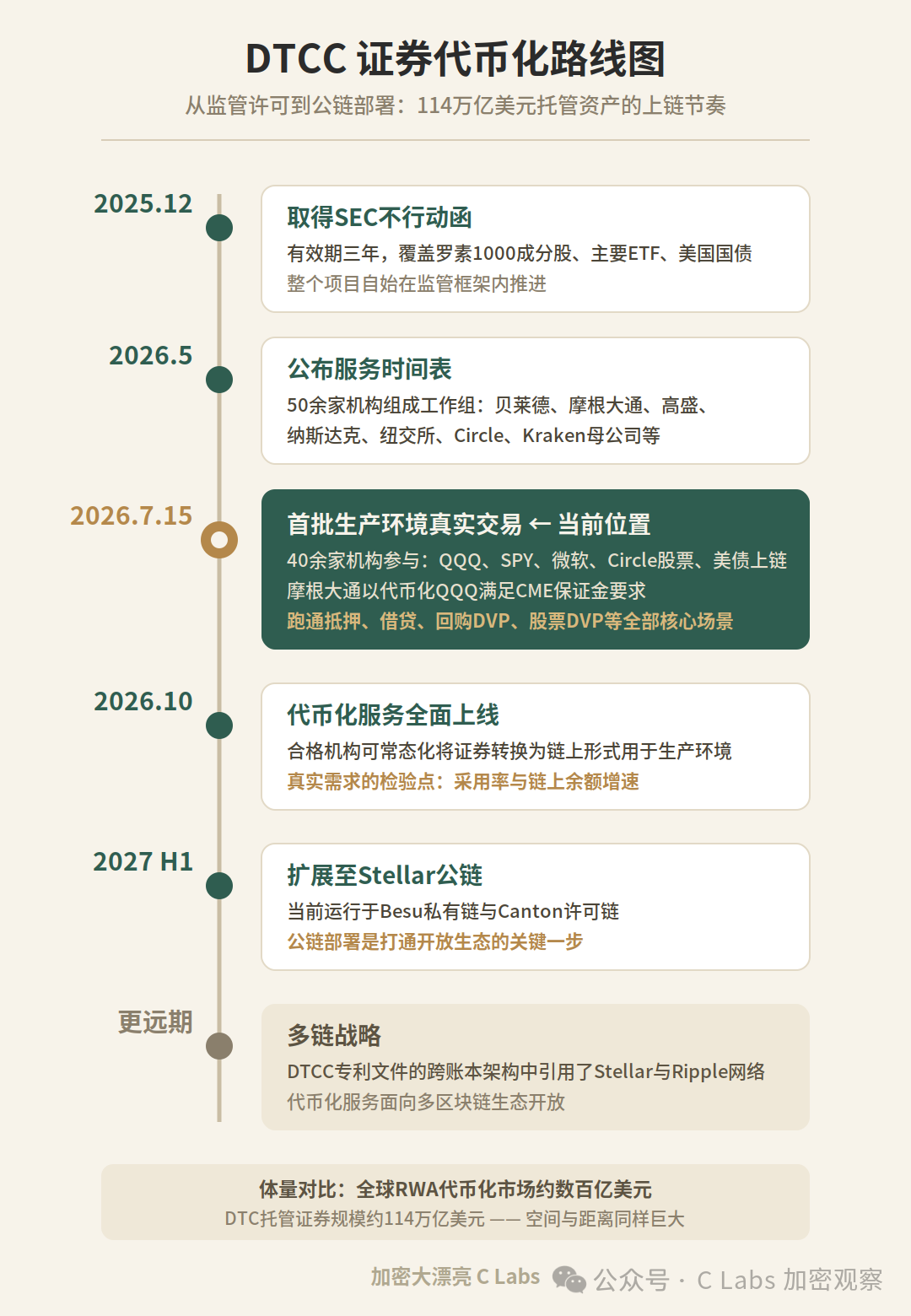
There is no need to worry about regulation; DTC has obtained an SEC no-action letter effective for three years since December 2025, covering Russell 1000 component stocks, major ETFs, and U.S. Treasuries. The whole project has been within the regulatory framework since its design.
According to the timetable published by DTCC:
Tokenization services will officially fully launch in October 2026.
By then, qualified participating institutions will be able to routinely convert Russell 1000 component stocks, major ETFs, and U.S. Treasuries into on-chain forms for production environments. The transaction in July essentially served as a real-world validation before the launch.
In the first half of 2027, in cooperation with the Stellar Development Foundation, the tokenization of DTC custodied assets will be expanded to public chains.
Currently, Besu and Canton are both private or permissioned chains; deploying public chains is truly a step toward an open ecosystem.
DTCC's patent documents show that its cross-ledger architecture also references the Ripple network, making a multi-chain strategy a clear direction for the future.
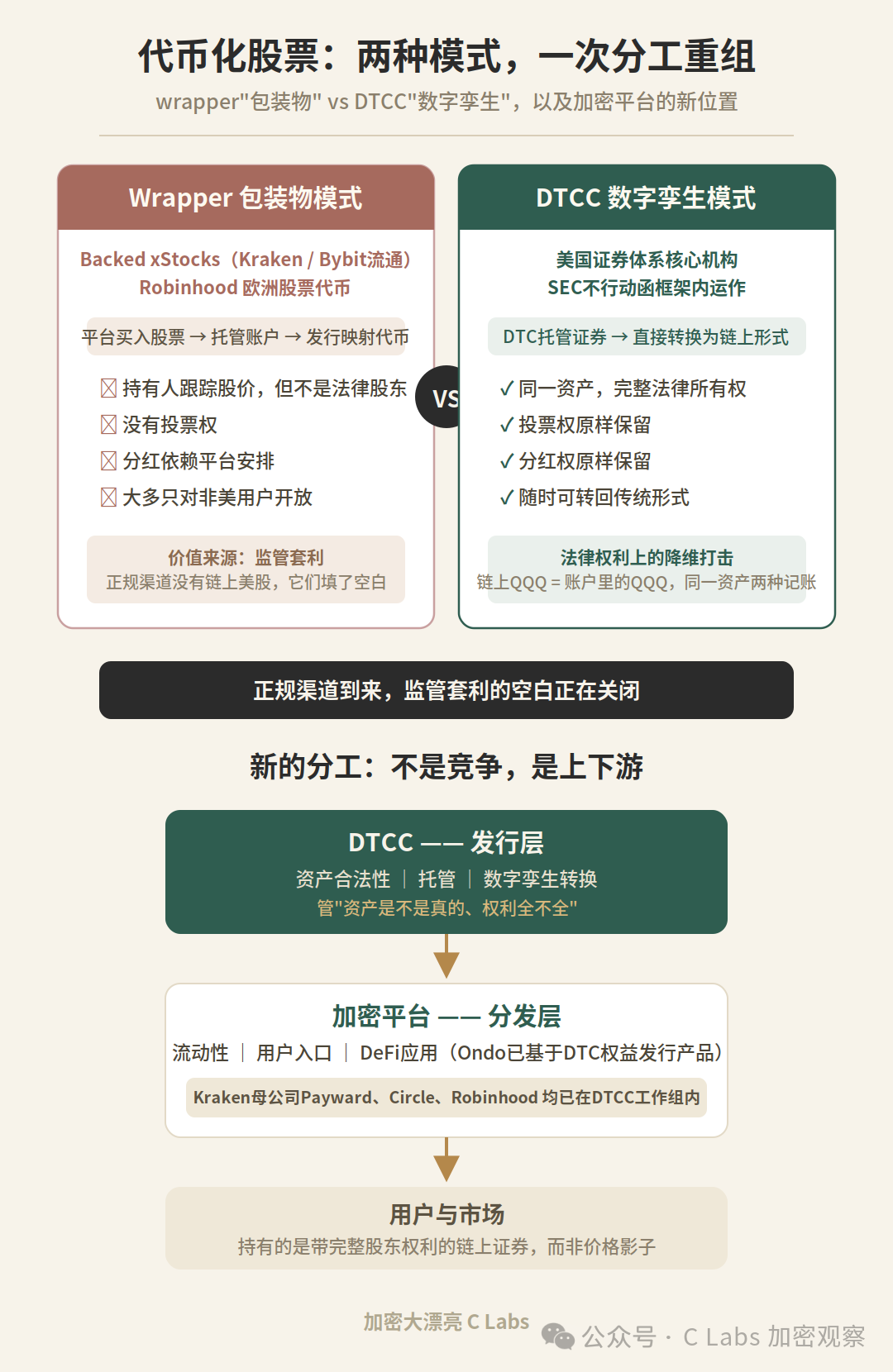
Currently, the tokenized stocks available in the market, such as Backed’s xStocks (circulating on Kraken and Bybit), and stock tokens released by Robinhood in Europe, follow a "wrapper" model: the platform buys stocks and holds them in custodial accounts, then issues a mapped token.
Holders track stock prices but are not legal shareholders, lack voting rights, and dividends depend on the platform's arrangements; and are mostly only available to non-U.S. users.
DTCC's digital twin model provides a dimensional advantage in legal rights—same assets, complete shareholder rights, emerging from the core institution of the U.S. securities system.
The value of the wrapper model previously lay in regulatory arbitrage: legitimate channels lacked on-chain U.S. stocks, filling a gap. Now that legitimate channels have emerged, this gap is closing.
Kraken’s parent company Payward is already listed among DTCC’s 50 working group members; Circle and Robinhood are also participants.
This indicates that the way forward for crypto platforms is not to compete with DTCC in issuance but to become distribution channels—DTCC manages asset legality, while exchanges handle liquidity and user access.
免责声明:本文章仅代表作者个人观点,不代表本平台的立场和观点。本文章仅供信息分享,不构成对任何人的任何投资建议。用户与作者之间的任何争议,与本平台无关。如网页中刊载的文章或图片涉及侵权,请提供相关的权利证明和身份证明发送邮件到support@aicoin.com,本平台相关工作人员将会进行核查。


