In the past, cryptocurrency could only create substitutes for stocks outside the system; this time, Wall Street has personally moved the real assets onto the chain.
Written by: Sanqing, Foresight News
On July 15, the American securities clearing giant DTCC (The Depository Trust & Clearing Corporation) completed its first real transaction, converting stocks, ETFs, and U.S. government bonds held at DTC (The Depository Trust Company) into on-chain tokens. It achieved a series of operations including bond repurchase, collateral pledge, securities lending, and stock delivery within one day. About 40 institutions participated, and DTCC stated this was its largest tokenization production test, paving the way for the launch of the DTCC Tokenization Service in October.
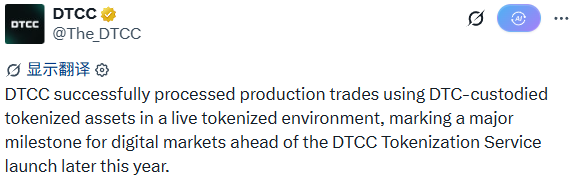
Among them, JPMorgan was the first to tokenize the Invesco QQQ Trust and deposit the tokenized assets as CCP margin to CME Group; State Street's SPDR S&P 500 ETF (SPY) completed tokenization; Citadel Securities and DriveWealth completed equity token conversion; DriveWealth and Vanguard completed the DVD delivery of tokenized equities; Societe Generale completed the conversion of government bonds to tokens; Societe Generale and Citadel Securities jointly completed collateral pledge settlement; Marex completed real-time collateral transfer, repurchase, and equity trading of tokenized U.S. government bonds, stocks, and ETFs.
DTCC is the clearing and settlement hub of the U.S. securities market, operating for over 50 years, owned and governed by the industry, with business shared among three core subsidiaries: DTC (Depository Trust Company) responsible for securities registration, custody, and delivery, NSCC (National Securities Clearing Corporation) acting as the central counterparty for trades such as stocks, providing trade guarantees and net clearing, and FICC (Fixed Income Clearing Corporation) handling the clearing of U.S. government bonds and mortgage-backed securities. Almost every U.S. securities transaction ultimately passes through this system. In 2025, the total amount of securities transactions handled by DTCC's subsidiaries was approximately $47 trillion; the securities held by just DTC came from over 150 countries and regions, valued at over $114 trillion.
In the past, they circumvented Wall Street; this time, Wall Street opened the door itself
To understand the significance of this day, one must first see how tokenized U.S. stocks came to be in the past.
The real stocks are stored in DTC's accounts, and the world on-chain has always been out of reach. Thus, various substitutes emerged: derivative contracts, speculating on the underlying prices; SPVs buying stocks, with tokens representing claims on the shell company; licensed brokers holding real stocks at a 1:1 ratio, with tokens serving as benefit certificates for these stocks, akin to on-chain deposit certificates...
These practices vary in how close they are to "real stocks," but share a common point: they circumvent the securities themselves. The real stocks are locked inside DTC; external parties cannot access them, which is why substitutes have to be created outside the system.
This time, DTCC actively opened the door, issuing an on-chain identity card. It has minted a one-to-one corresponding "digital twin" token for the securities already held in DTC, sharing the same CUSIP and code with the underlying securities. DTCC emphasizes that these tokens enjoy "the same level of investor protection, rights, and ownership as traditional securities."
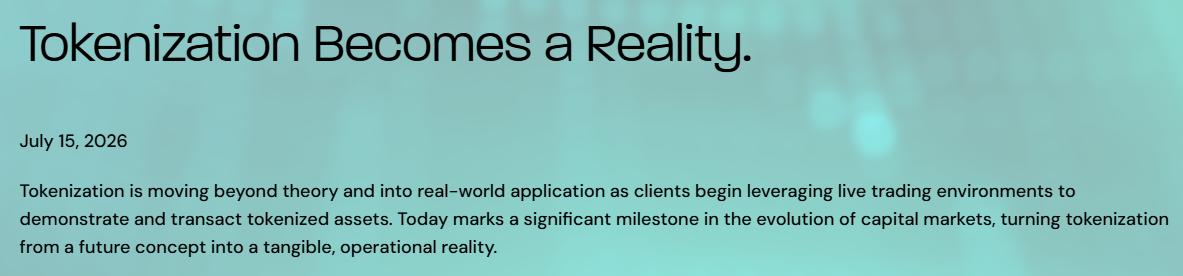
Source of the image:DTCC Official Website
Among the approximately 40 participating institutions, besides the well-known traditional institutions, there are many crypto-native companies.
Circle uses stablecoins for cash settlements, and its own stock CRCL was also among the tokenized assets this time; Chainlink is responsible for oracles and cross-chain; Fireblocks, BitGo, Blockdaemon, and Kaleido provide custody, wallets, and nodes; Talos provides institutional trading technology; the two chains behind Canton and Besu, Digital Asset and LF Decentralized Trust, were also present.
Directly engaged in tokenized securities business are Ondo and Prometheum. Ondo issues tokenized stocks for blockchain and DeFi, while Prometheum is a licensed digital asset securities institution that integrates brokerage, trading platform, custody, and clearing, legally safeguarding and trading tokenized securities.
Four years of groundwork, two chains in position
DTCC has long-standing ties with blockchain, and this was not a spur-of-the-moment decision.
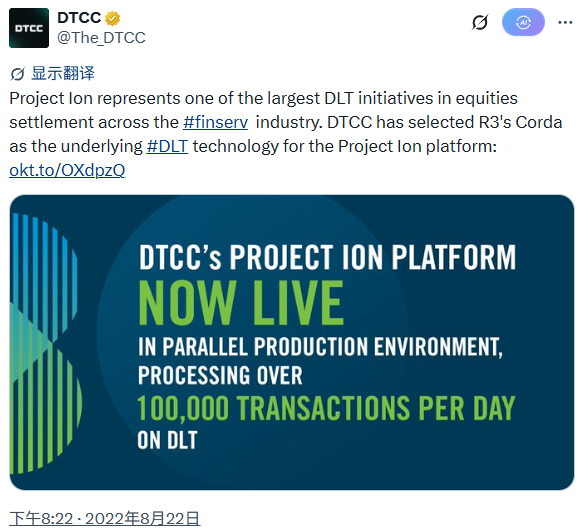
In 2022, it launched Project Ion based on R3 Corda, a stock settlement platform running parallel to the old system, processing over 100,000 transactions daily at its peak; this was its first time integrating distributed ledger technology into real settlement.
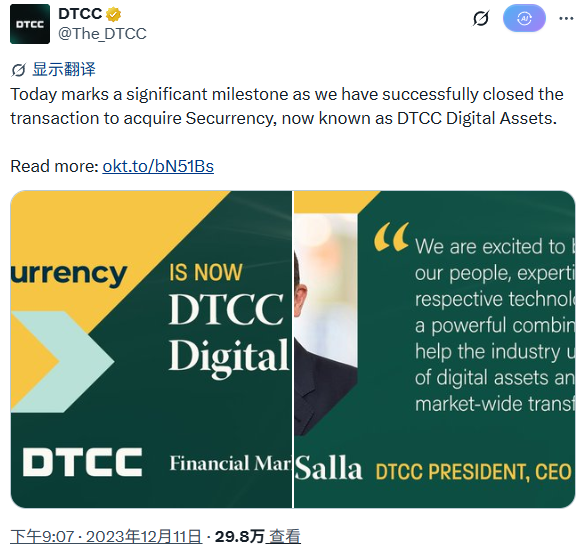
In October 2023, it acquired the blockchain company Securrency, establishing the DTCC Digital Assets department, headed by Nadine Chakar, former head of digital assets at State Street. Securrency's technology was later integrated into its multi-chain tool ComposerX.
Starting in 2024, DTCC shifted its focus to Hyperledger Besu, launching the blockchain platform Digital Launchpad and collateral management platform Collateral AppChain in succession.
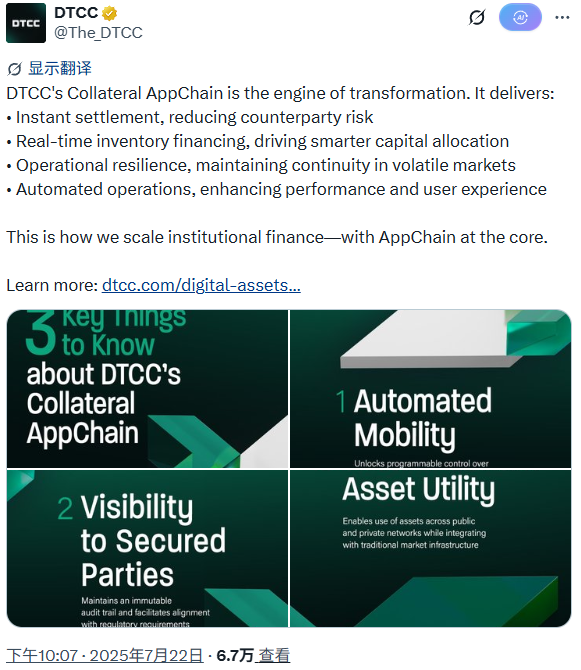
Besu is a private chain built by it, originally called Pantheon developed by ConsenSys in 2018, renamed after being donated to Hyperledger in 2019. It excels in strict permission control and compatibility with Ethereum's development tools. Internal accounting, settlement, and collateral management at DTCC all operate on this chain, inaccessible to external parties.
In 2025, another chain is set to debut. DTCC invested in a $135 million financing round for Digital Asset, the developer of Canton, alongside Goldman Sachs, BNP Paribas, Circle, Citadel, and DRW; by the end of the year, DTC received an SEC no-action letter, allowing for the legal operation of tokenized services within three years, subsequently migrating government bonds to Canton and jointly chairing the Canton Foundation with the European clearing company Euroclear.
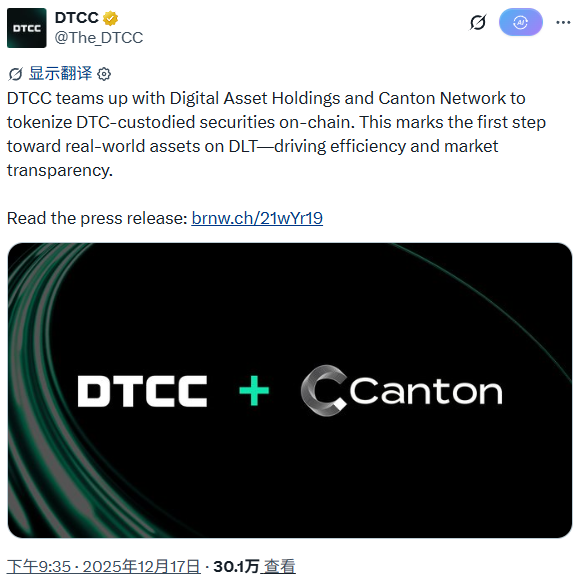
Canton, built by Digital Asset using Daml language, is a public network but features "sub-transaction privacy" not available in ordinary public chains: in the same transaction, each party can only see the part relevant to themselves. For example, in a bond repurchase, the bank handling the cash side cannot see the transfer of the underlying securities. Previously, Goldman Sachs' GS DAP, HSBC's Orion, and Broadridge's monthly repurchase platform DLR, which involves trillions of dollars, were all built on it, with almost 400 participating institutions.
One chain maintains internal control, while the other connects to external liquidity. By July of this year, the industry working group behind DTCC had expanded from dozens to over a hundred. Capital, regulation, allies, technology… four years carefully prepared, indicating that this is not a spur-of-the-moment technology demonstration, but DTCC making a grand entrance at its own pace and under its own conditions.
The issuance rights are centralized, while others retreat to the access end
First, let's look at what DTCC wants. What it seeks is not proof of concept, but the liquidity of collateral.
On the day JPMorgan tokenized Invesco's QQQ ETF, it was directly applied as margin for CME, marking the first time a central counterparty accepted on-chain tokens generated from traditional securities.
The significance lies in the fact that an asset which could originally only remain in a specific account can now be mobilized across venues 24/7, releasing capital that was frozen during settlement. This also explains why clearing giant DTCC wants to drive this transformation, as the reward will be a substantial enhancement in its own capital efficiency, leading to subsequent profit growth.
Those projects engaged in tokenizing U.S. stocks may need to reconsider their positioning. In recent years, their core task has been to prove to users that "there are real stocks behind the tokens"; however, with custodial institutions personally issuing standard tokens, that responsibility has now been taken over at the source. But DTCC does not involve itself in distribution, liquidity, cross-chain, and DeFi combinations.
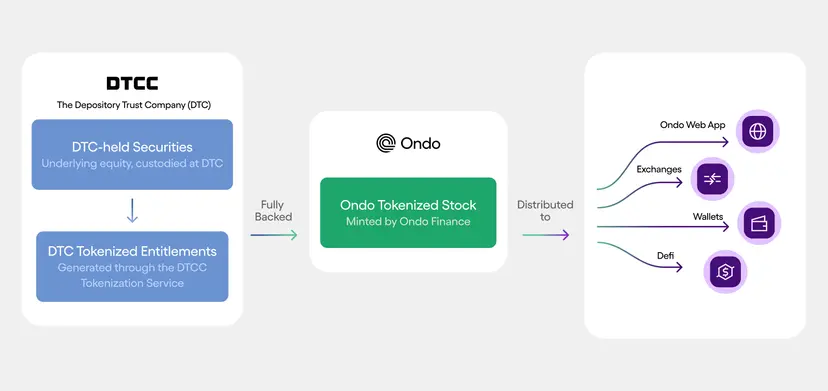
For all such projects, the intuitive experience of the products does not change significantly. They still do not directly connect to DTC, but rather through participating parties, and users continue to hold the tokens issued by the projects themselves. What changes is the underlying system, supporting the tokens which can now shift from SPV claims or synthetic positions to rights certificates generated by DTCC that share the same CUSIP with the underlying securities, interchangeable with traditional forms.
It also becomes more transparent, as the twin certificates record at the custody layer, and reserve proof becomes a native capability. Anyone can verify on-chain whether the token corresponds 1:1 to a real DTC interest, while in the traditional system, DTC's ledger has always been invisible to end investors. These projects lose the issuance premium but can leverage DTCC's credibility.
Take Ondo as an example. In this production-grade test, it accessed DTC's participant network through Alpaca Markets, issuing CRCLon corresponding to Circle's stock CRCL and SPYon corresponding to the S&P 500. Users still hold Ondo's tokens, but the underlying assets are rights certificates with the same CUSIP as DTC.
Source of the image:Ondo Finance Blog
Moreover, Ondo has the unique advantage that no one else has; it is the only member focused on on-chain stock tokenization within the working group. The DTCC Tokenization Service will not officially launch until October, but Ondo has already been able to preemptively launch multiple tokens under the same model following the production-grade test.
The tokenization battle ignited by cryptocurrency seems poised to win. However, the one at the wheel is DTCC, which has always been seated at the center of clearing and has now opened the door at the right moment.
免责声明:本文章仅代表作者个人观点,不代表本平台的立场和观点。本文章仅供信息分享,不构成对任何人的任何投资建议。用户与作者之间的任何争议,与本平台无关。如网页中刊载的文章或图片涉及侵权,请提供相关的权利证明和身份证明发送邮件到support@aicoin.com,本平台相关工作人员将会进行核查。


