Cryptocurrency concept stocks have risen sharply, yet the prices of mainstream cryptocurrencies have overall declined.
Written by: Ryan Rasmussen, Head of Research at Bitwise
Translated by: Luffy, Foresight News
Every quarter we release the "Bitwise Cryptocurrency Market Overview," which contains more than 50 charts covering market performance, on-chain fundamentals, institutional adoption, and other dimensional data.
Data always sketches a full picture of the industry. Sometimes it provides pure bullish or bearish signals, but more often than not, bullish and bearish information intertwines, with highlights and negatives existing simultaneously, warranting in-depth dissection. The second quarter was such a case, with positive fundamentals like crypto business revenue, real asset implementations, and institutional layouts, leading to a significant rise in cryptocurrency concept stocks while the prices of mainstream cryptocurrencies fell overall. How should we understand this differentiated market?
If you want to quickly grasp the core conclusions, here are what I believe are the five most important charts.
Severe Divergence Between Cryptocurrency Concept Stocks and Cryptocurrency Prices
In the first half of 2026, the overall cryptocurrency market fell by 36%; during the same period, only gold experienced a synchronous decline, dropping 7%, while all other major asset classes rose across the board. This is also the reason why this round of the cryptocurrency bear market is particularly hard to endure: only the crypto track is under solo pressure.
In stark contrast, cryptocurrency concept stocks surged by 23% in the first half of the year, outperforming all major asset classes except emerging market stocks. The Bitwise Crypto Innovators 30 Index tracks 30 top crypto listed companies, achieving a return over twice that of the S&P 500.
This set of data conveys a key message: even in a bear market, the cryptocurrency industry is still filled with investment opportunities. Bitcoin mining companies benefit from the boom in the artificial intelligence industry; stablecoin issuers and asset tokenization platforms continue to engage in Wall Street business; the degree of integration between traditional finance and the cryptocurrency market is deepening. I anticipate that the cryptocurrency market will see a recovery in the second half of the year, but the trend in the first half has already confirmed one fact: cryptocurrency is not a single category of asset; the landscape is diverse and the development dynamics require examination from a broader perspective.
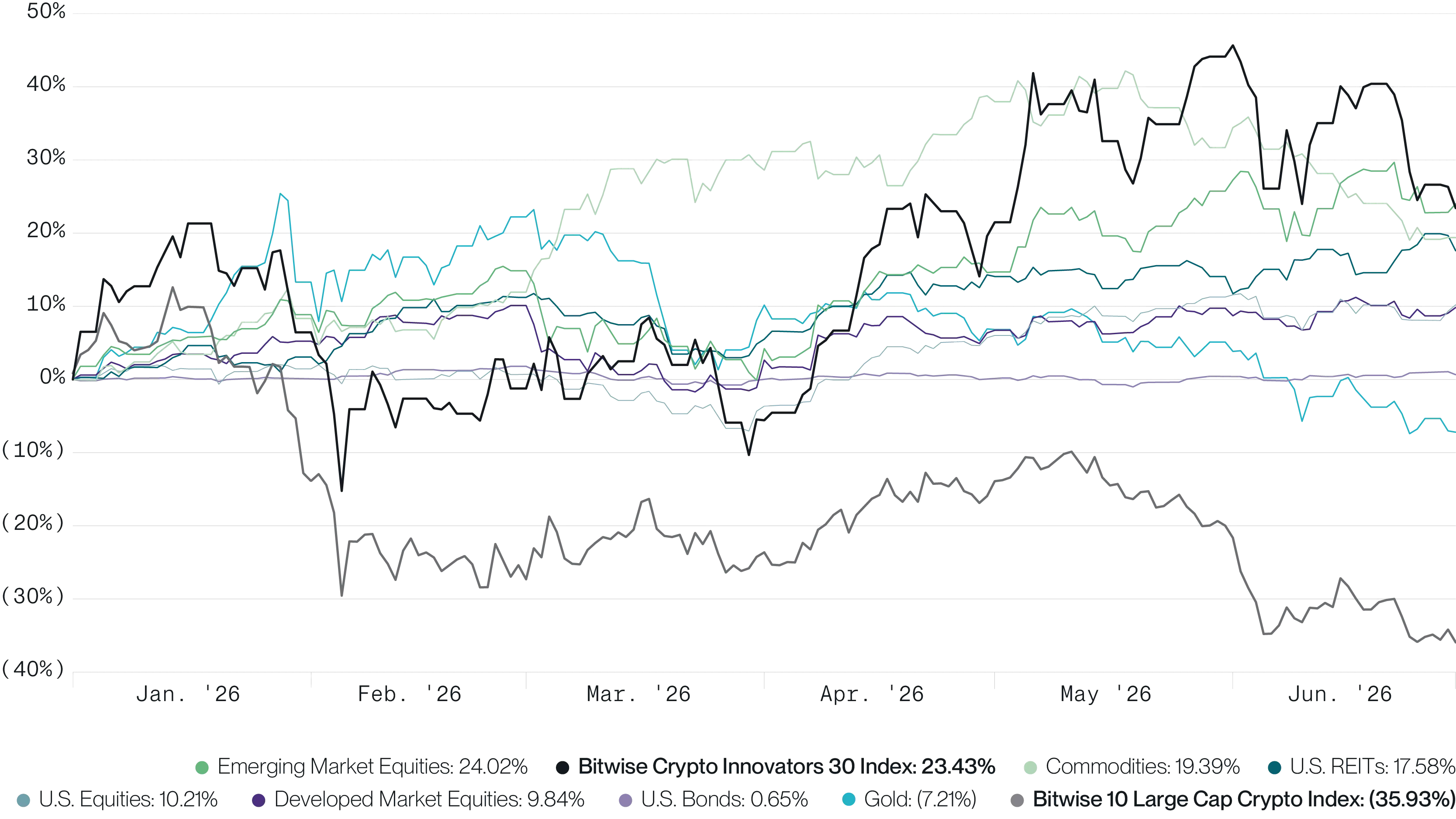
Comparison of cryptocurrency performance and major asset classes, data source: Bitwise, Bloomberg; statistics as of June 30, 2026
Impressive Revenue Scale in Cryptocurrency Applications
In the past 12 months, the top ten global cryptocurrency applications generated a total of $5.9 billion in revenue; the top three, PancakeSwap, Hyperliquid, and Aave, each approached $1 billion in revenue.
Even in a bear market, these products remain stable cash flow business entities, with income from transaction fees, lending interest, and staking rewards. Whenever someone questions the existence of real fundamentals in the cryptocurrency industry, I always present this chart.
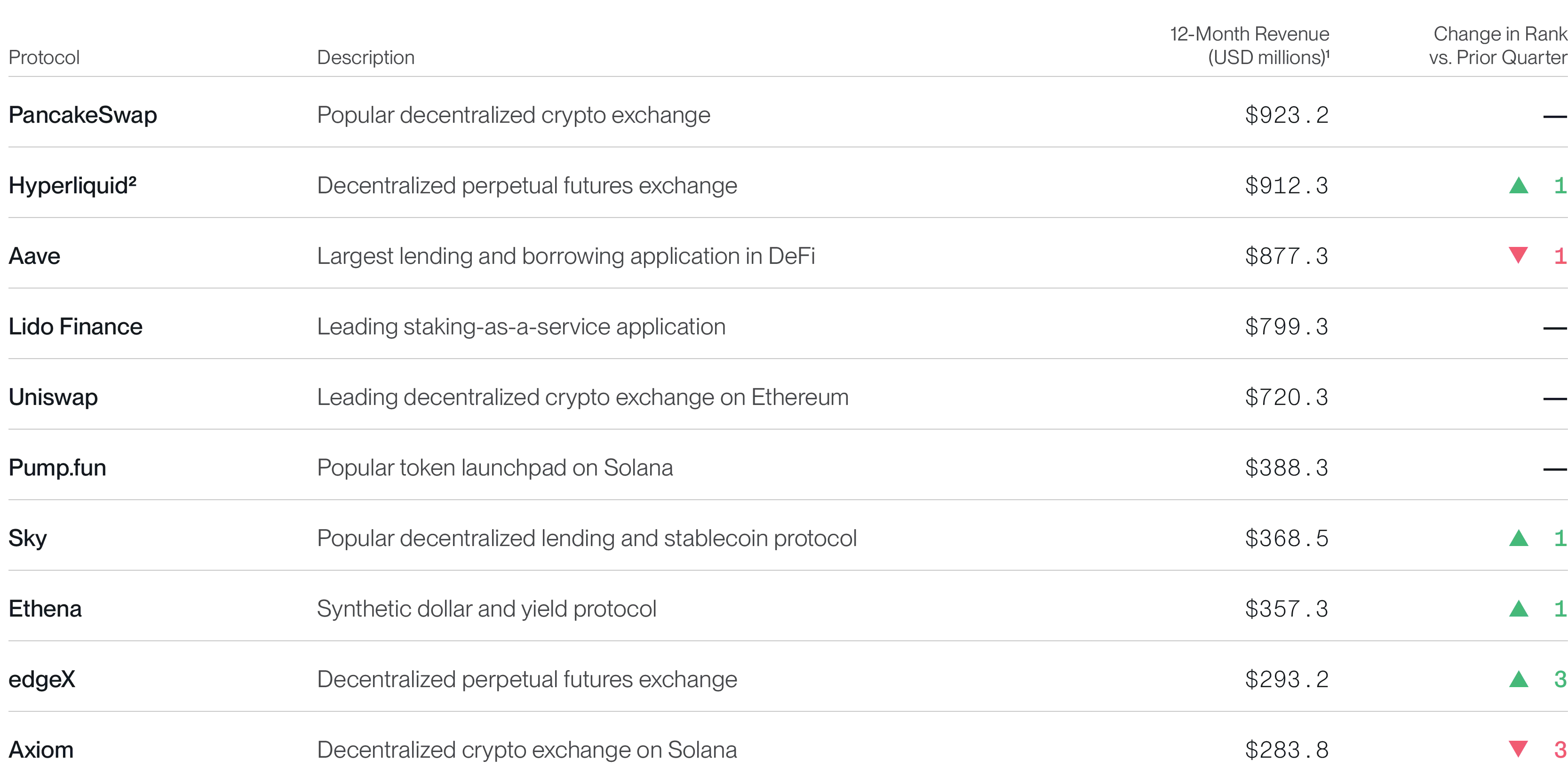
Top ten cryptocurrency applications ranked by revenue, data source: Bitwise, Token Terminal; reporting period from January 1, 2025, to June 30, 2026
Tokenization of Real World Assets (RWA) Welcomes a Bull Market
U.S. Treasury Secretary Scott Baker stated publicly a few weeks ago: "Digital assets, stablecoins, asset tokenization, and new payment systems will together shape the future of the monetary system."
In a sense, the future he described has already arrived. In the second quarter, the total scale of tokenized real-world assets reached a historic high of $33 billion, up 12% quarter-on-quarter and 45% year-to-date; the main growth drivers are tokenized U.S. treasuries, corporate loans, stocks, and venture capital shares.
This chart clearly shows that leading global asset management institutions are massively migrating real assets onto the blockchain, a trend worth continuing to monitor.
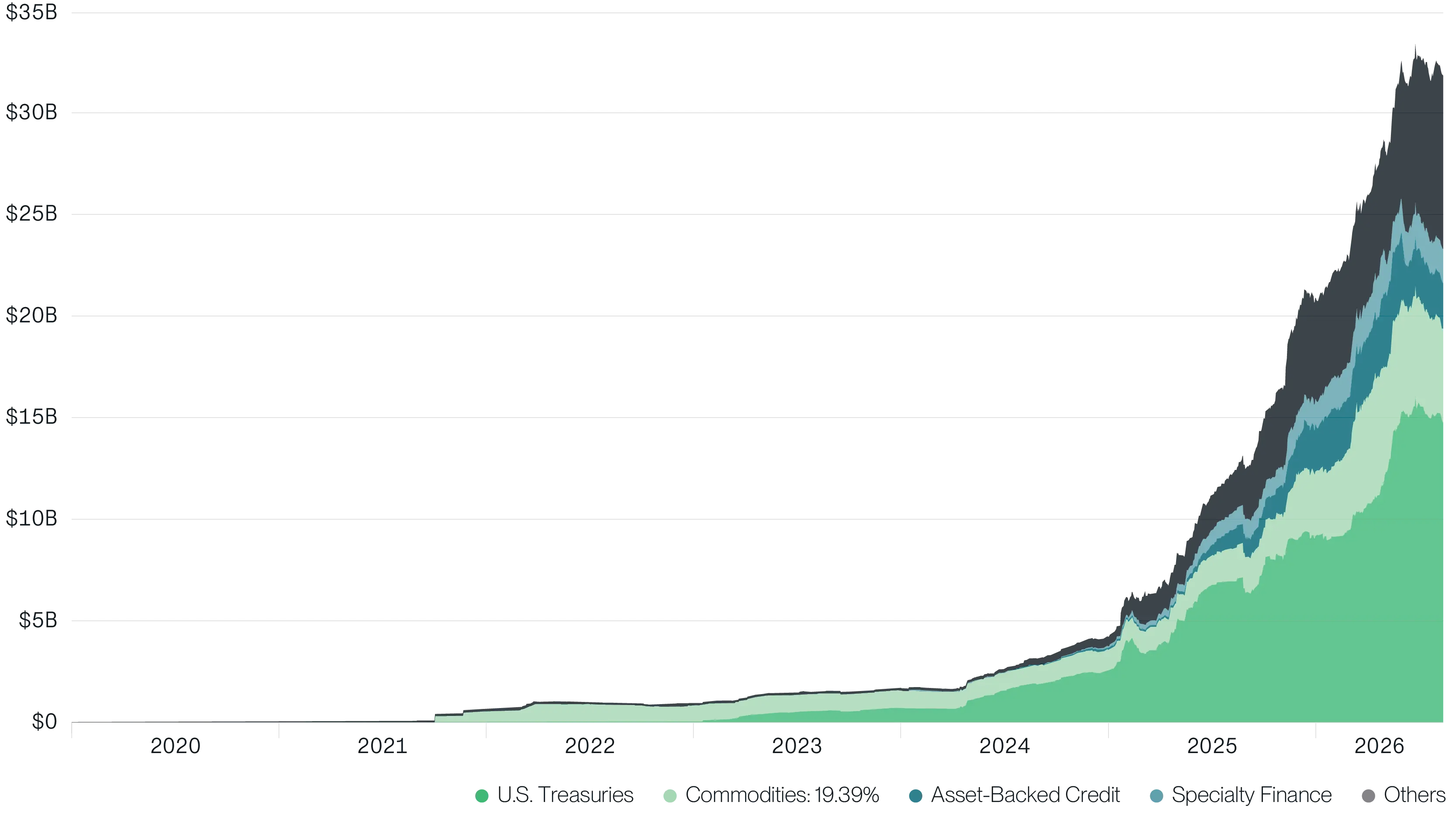
Value of tokenized real-world assets (RWA), data source: Bitwise Asset Management, RWA.xyz; reporting period from January 1, 2020, to June 30, 2026
Predicted Market Scale Continues to Expand
In the second quarter, the open positions in the prediction market reached a historic high of $1.8 billion, with sports events becoming the core trading category; total quarterly transaction volume also set a record, reaching $43 billion.
Platforms like Polymarket reflect a hidden side of crypto retail adoption: millions of users leverage crypto underlying tools to bet on real-world event outcomes, but the vast majority of users are unaware of, or indifferent to, the blockchain technology underpinning it.
As the U.S. midterm elections approach, I predict that this year's prediction market transaction volume and open positions will repeatedly hit historical highs. The 2024 election themes brought the prediction markets into the public eye, after which the industry scale tripled directly.
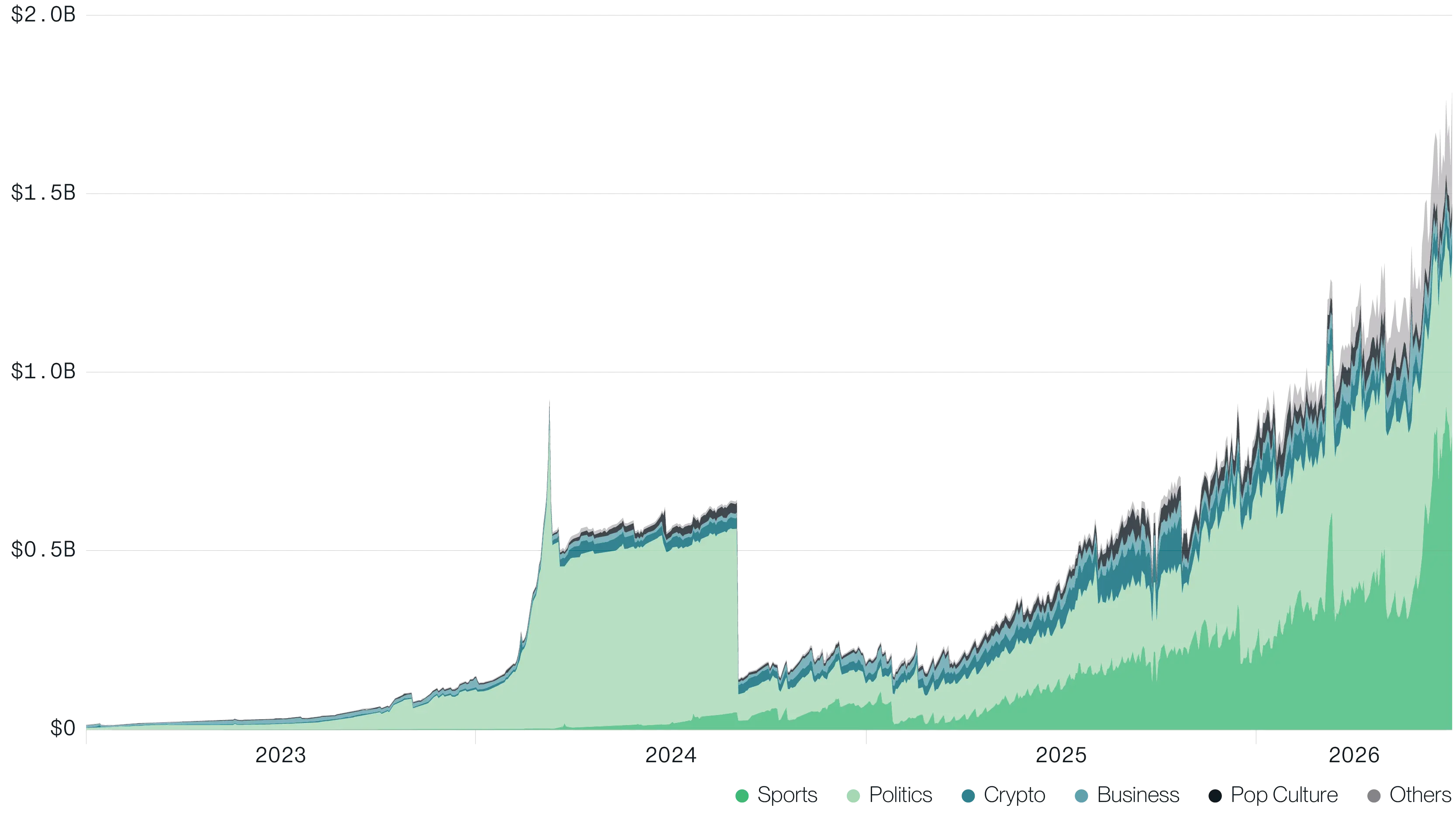
Changes in open positions in the prediction market, data source: Bitwise, Blockworks; reporting period from January 1, 2023, to June 30, 2026
Low Correlation of Cryptocurrency Concept Stocks with Mainstream Assets
Returning to cryptocurrency concept stocks, the most valuable chart showcases the 90-day rolling correlation between the Bitwise Crypto Innovators 30 Index and major assets. The core highlight is that compared to the major U.S. stock market, this index has lower correlation with most assets—developed market stocks, emerging market stocks, U.S. REITs, U.S. treasuries, and gold all reflect this. The only exception is commodities, whose correlations are all negative.
In short, the returns of cryptocurrency concept stocks in the first half of 2026 are twice that of the U.S. stock market, while being weakly correlated with most assets in the investment portfolio. This characteristic of high returns combined with risk diversification is precisely what institutional investors favor in their asset allocation.
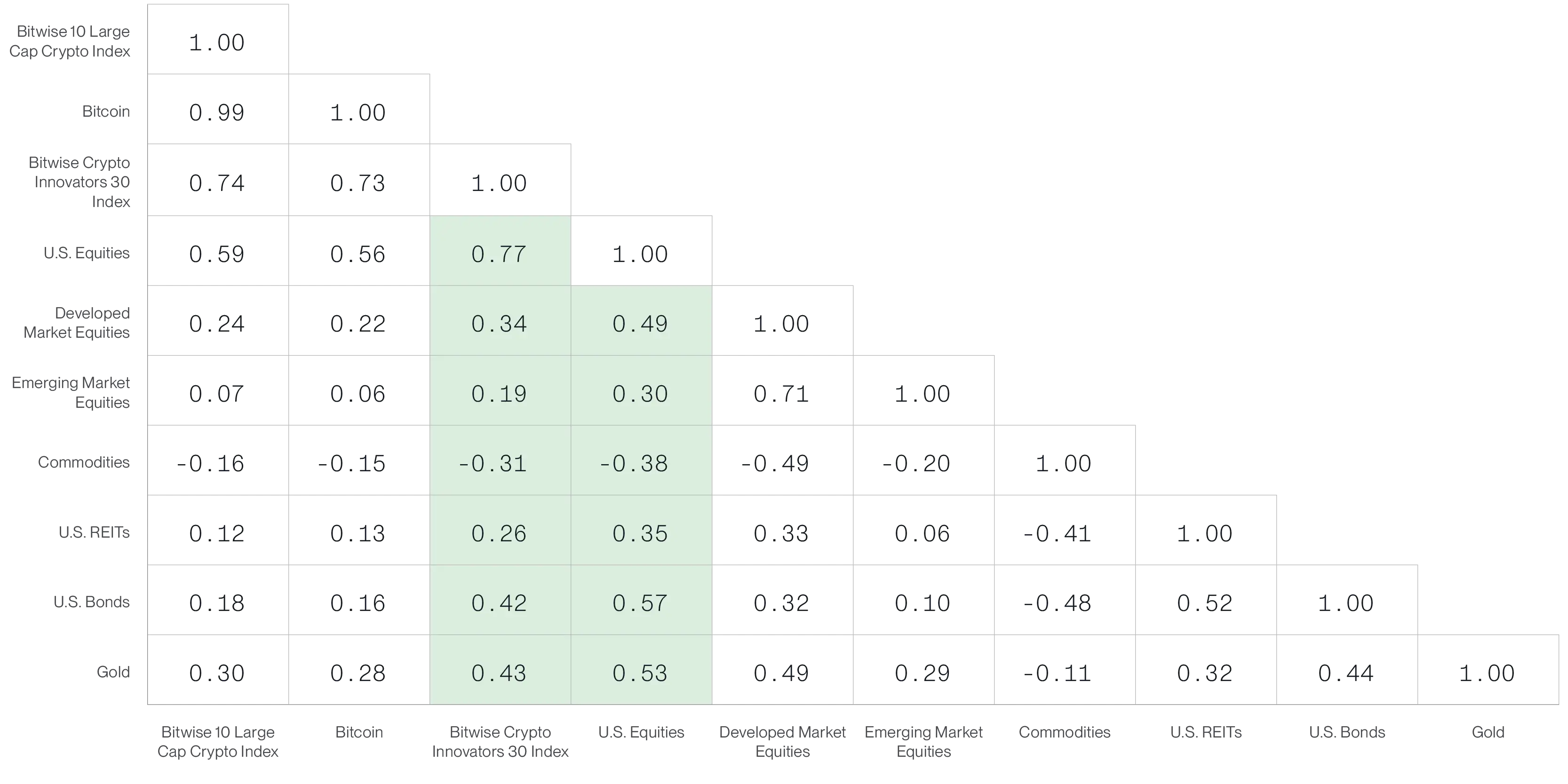
Comparison of the 90-day rolling correlations across various assets, data source: Bitwise, Bloomberg; statistics as of June 30, 2026
Conclusion
This concludes my complete analysis of the market in the second quarter. The more than 50 charts in the report cannot directly answer the most pressing question in the current market: have cryptocurrency prices bottomed out? But all the data collectively proves that the fundamentals of the cryptocurrency industry are remarkably resilient; even in a bear cycle, user scale, business revenue, and institutional adoption continue to grow.
The current stage of the industry is highly valuable for research and serves as the underlying foundation for the next bull market.
免责声明:本文章仅代表作者个人观点,不代表本平台的立场和观点。本文章仅供信息分享,不构成对任何人的任何投资建议。用户与作者之间的任何争议,与本平台无关。如网页中刊载的文章或图片涉及侵权,请提供相关的权利证明和身份证明发送邮件到support@aicoin.com,本平台相关工作人员将会进行核查。


