Compiled & Edited by: Deep Tide TechFlow
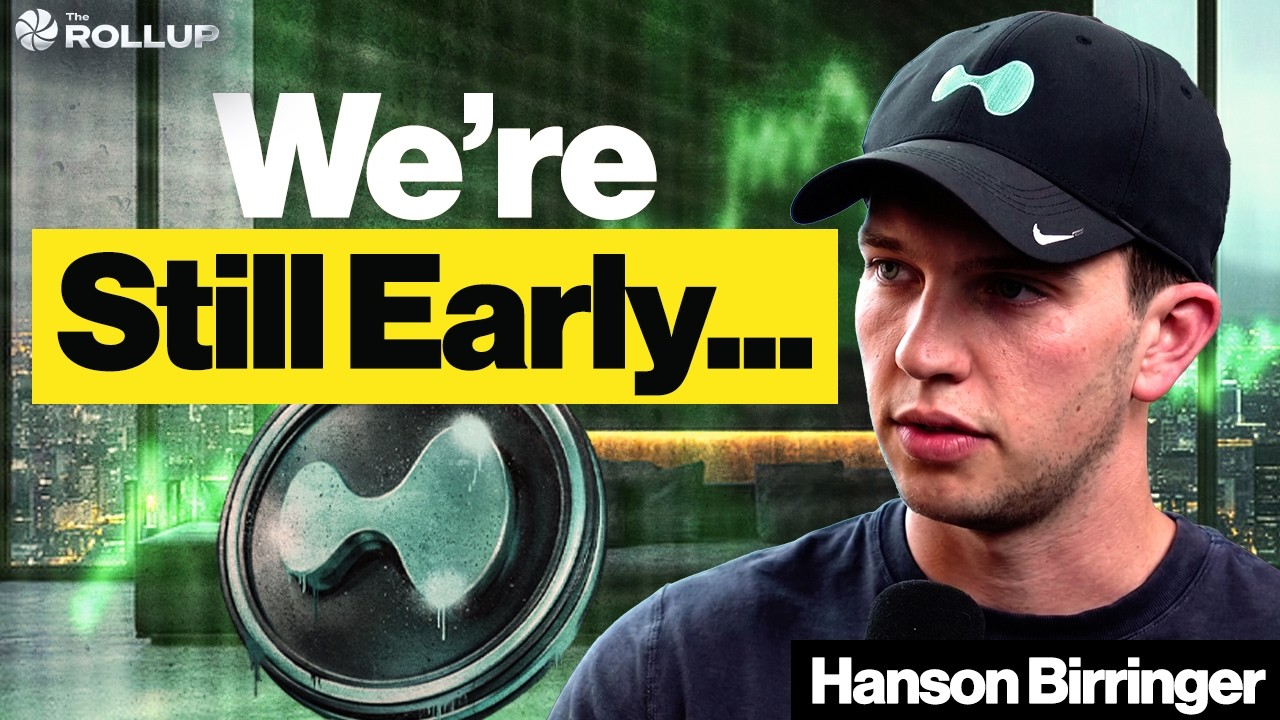
Guest: Hanson Birringer, Co-founder and Chief Revenue Officer of Hyperdash (Hyperliquid ecosystem data analysis and trading platform), Core Contributor of Hyper Holdings Global (Seed investment institution for Grayscale Hyperliquid ETF)
Hosts: Rob (Robbie Klages) & Andy, The Rollup
Podcast Source: The Rollup
Original Title: Hyperdash Co-founder: Hyperliquid Bull Thesis for 2026 (Updated View)
Broadcast Date: July 14, 2026
Conflict of Interest Statement: The guest has deep financial ties to Hyperliquid through Hyperdash (whose business fully relies on the Hyperliquid ecosystem) and Hyper Holdings Global (SPV for fundraising for Grayscale HYPE ETF). The following content should be understood as a statement of views from an insider of the ecosystem rather than an independent third-party analysis.
Key Takeaways
Hanson Birringer previously worked in OTC institutional business at Flowdesk and officially joined Hyperdash full-time this year, a trading data analysis platform entirely built on Hyperliquid (its business revenue is directly linked to the growth of the Hyperliquid ecosystem). He also provides seed funding for Grayscale Hyperliquid Staking ETF through Hyper Holdings Global, which currently is the lowest fee HYPE staking product in the market.
Birringer's core argument can be summarized as follows: the trillion-dollar tracks of perpetual contracts, tokenization, and stablecoins are accelerating simultaneously, and Hyperliquid is the only asset that he sees capable of packaging and expressing all three. He believes that the revenue from the HIP-3 RWA perpetual contracts alone could grow 100 times within ten years, as global derivatives nominal trading volume is measured in trillions of dollars. After USDC became the alignment quote asset for Hyperliquid, the issuer voluntarily relinquished 90% of the interest income, automatically repurchasing HYPE through an aid fund, creating billions of dollars of buying pressure each year. It is worth emphasizing again that Birringer's company and investment entities are deeply tied to the Hyperliquid ecosystem, and his “hard to find bearish reasons” need to be read in this context.
Highlights
On the Intersection of Three Major Trends
- "Hyperliquid is a pure expression of the three ten-year trends of perpetual contracts, tokenization, and stablecoins. It's hard to find another asset that covers all three directions simultaneously."
- "In my ten years in crypto, Hyperliquid is the only thing that allows institutional capital and the decentralized world to truly grow together, rather than separately."
On Stablecoin Revenue Giving
- "USDC did something that has never been done in crypto history: voluntarily giving up 90% of its revenue just to join Hyperliquid."
- "There is now about $10 billion of stablecoin supply on Hyperliquid, with 90% of the interest income going to the aid fund, programmatically repurchasing HYPE on-chain. This adds hundreds of millions in buying pressure to the protocol each year."
On Revenue Growth Potential
- "If you've worked in traditional finance, you'd know that the market is so large that your brain can hardly comprehend it. The nominal trading volume for options is in the trillions."
- "This revenue should grow 100 times over the next ten years. If trading volume increases 100 times, margin and collateral will also increase 100 times, then the buyback pressure from USDC V2 will also rise 100 times."
On Institutional Adoption
- "Zach Pandl (Grayscale Research Director) told me that investors view Hyperliquid as a long-term holding of 5 to 10 years. Their mindset is: We can't go back and tell LPs that we missed the three biggest exits in the digital asset industry."
- "Hyperliquid is one of the fastest-growing companies in the world with only 10 to 11 employees. Everyone in crypto knows it, but crypto is just a small part of the global economy."
On Token Economics
- "Hyperliquid breaks the old models of the crypto circle. In the past, those tokens earned $500 in revenue per month and were valued at $2 billion. HYPE is different; it’s a real growth company with real cash flow, 99% of which goes to token holders."
- "Zach says Hyperliquid sells better than their other ETFs because there is revenue and buyback narrative. You can value this like a stock."
Main Text
Chapter One: Pure Expression of Three Trends
Rob: The investment thesis for Hyperliquid has evolved significantly over the past two years. When you go on roadshows to high-net-worth clients and institutional allocators, what arguments resonate the most with them?
I think there are several levels to address this. The core reasons investors, researchers, and traders are excited about Hyperliquid are a few. First, it is open-source, permissionless, and decentralized, treating all participants equally. Second, it combines the native spirit of crypto with a truly high-performance financial system, allowing institutional capital to actually participate in this decentralized world, which has never happened before. In my ten years in crypto, Hyperliquid is the only thing that allows institutional capital and the decentralized world to truly grow together, rather than separately.
Andy: We’ve been discussing the three major trends of perpetual contracts, tokenization, and stablecoins. For communities and capital looking to express a bullish view, why is Hyperliquid the best asset?
I think Hyperliquid is a pure expression of these three trends. In terms of perpetual contracts, Hypercore is the leading perp DEX and can now compete with centralized exchanges in OI and trading volume. From a liquidity perspective, it is already the best or second-best market for certain trading pairs. HIP-3 introduced RWA perpetual contracts, effectively synthesizing two major trends into one product. Hyperliquid is currently the undisputed category leader in the RWA and stock perpetual contract space.
In terms of stablecoins, USDC recently became the alignment quote asset V2, and the market may not have fully grasped the significance of this. USDC did something that has never been done in crypto history: voluntarily giving up 90% of its revenue just to join Hyperliquid. There is now about $10 billion of stablecoin supply on Hyperliquid, assuming the underlying T-bill earns a net interest margin of 4%, 90% goes to the aid fund for programmatic buybacks of HYPE on-chain. This adds hundreds of millions in buying pressure to the protocol each year, not including transaction fee revenue.
Thus, HYPE, as a token and ecosystem, truly encompasses the three trends of perpetual contracts, RWA, and stablecoins, and there are compounding effects among them.
Chapter Two: Builder Codes: Hyperliquid's AWS Moment
Andy: Jeff (Founder of Hyperliquid) mentioned in Valor's podcast that Hyperliquid now resembles AWS, providing underlying infrastructure for perps, RWA, and trading. How does this positive feedback loop of liquidity work?
Every time a new frontend connects to Hyperliquid's Builder Codes, such as Phantom, MetaMask, or Valor Exchange, all users of the ecosystem benefit. More frontends mean more market makers entering, OI grows, spreads narrow, and user experience improves. This positive loop accelerates as more frontends connect.
However, a practical issue is that regulated frontends like Kalshi cannot directly use Builder Codes. Kalshi has built its perp products, but OI for all trading pairs is low because they must go through KYC and CFTC compliance processes. Robinhood is in a similar situation; Light has deployed a completely independent instance on the Robinhood Chain, and liquidity cannot compare to the Hyperliquid mainnet.
Chapter Three: Regulatory Game: Can Decentralized Venues Enter the U.S. Market
Andy: What regulatory resistance does Hyperliquid face? How can HIP-3 and Builder Codes reach regulated consumer frontends like Robinhood, Revolut, and eToro?
The world is vast, and each country has its own rules. Hyperliquid, as an L1, is open-source and permissionless, so anyone can participate. Hyperliquid Policy Center has been doing a lot of work recently in Washington, and Phantom has also submitted comments to the CFTC, advocating for decentralized venues to gain regulatory clarity. If the CFTC ultimately allows regulated brokerage frontends to execute orders through Hyperliquid's backend, it will be a huge tailwind.
Hyperliquid is proactive in regulatory matters, not reactive. Jeff personally went to D.C. to speak with regulators a few months ago. The U.S. is the largest capital market, and these conversations are heading in the right direction.
Chapter Four: Revenue Outlook: Trillion-Dollar Market for RWA Perpetual Contracts
Andy: The total OI for the HIP-3 market reached $3.6 billion yesterday, setting a new record. With preferential fees and the income from USDC V2 starting on August 26 and the first distribution on October 3, how do you view Hyperliquid's revenue growth over the next one to two years?
I believe forward revenues will be completely crushed by HIP-3 RWA perpetual contracts. The market is too large. If you haven't worked in traditional finance, you might not realize what you don’t know. Global nominal trading volume for options is in the trillions. Some ETFs have nominal trading volumes of tens of trillions daily. Perpetual contracts also have leverage, and if Hyperliquid can capture a small portion of global trading volume, this revenue should grow 100 times over the next ten years.
When trading volume increases 100 times, margin and collateral will also increase 100 times. Currently, there is $5 billion to $10 billion in margin; if it increases to $50 billion or $100 billion, the buyback pressure from USDC V2 will also rise 100 times. Looking at these numbers together, they are substantial.
Chapter Five: Grayscale ETF and Hyper Holdings: Connecting Institutional Entry
Rob: How does Hyper Holdings collaborate with Grayscale ETF? What is happening behind the scenes?
Hyper Holdings Global is a special fund specifically set up to seed the Grayscale Hyperliquid Staking ETF. All information is publicly available in SEC filings. We are injecting funds into the Grayscale ETF in a physical manner, and this ETF is currently the lowest fee staking product offered by Hyperliquid.
There are several reasons for choosing to collaborate with Grayscale. They are the largest crypto asset management company globally, with AUM close to $20 billion, and they were among the first to win cases against the SEC to obtain approvals for crypto ETPs. They are also advancing regulatory work together with Hyperliquid Policy Center.
For institutional investors, the significance of an ETF is to reduce friction. An institutional client wanting to buy HYPE can't go directly to Hyperliquid without a Coinbase account. They may have to go through OTC brokers like Flowdesk, but the compliance approval process is long. Now, they can just open a brokerage account and buy the ETF at the click of a button. Of course, liquidity is an issue; if the ETF has only $2 million AUM, it wouldn't be realistic for a client who wants to build a $10 million position. Therefore, diversifying the seed-stage holders is crucial to allow incoming institutions to achieve sufficient scale.
Our investor mix includes some of the largest hedge funds and VCs in crypto, as well as the largest on-chain HYPE holders globally. Next, we will conduct institutional roadshows and investor education in collaboration with Grayscale.
Chapter Six: Token Holders as First-Class Citizens
Andy: Zach Pandl mentioned that Hyperliquid sells better than their other ETFs because there are revenue and buyback stories. What old models did HYPE break in token economics?
Hyperliquid has broken the traditional valuation models of the crypto sector. In the cycles of 2017, 2021, and 2024, many tokens relied on imagined premiums of "What if we do XYZ on the blockchain." A project that earns $500 in revenue per month could be valued at $2 billion, which is not right.
HYPE is different. It is a real growth company that captures multiple major trends, has real cash flow, of which 99% goes to token holders. You can value HYPE like a stock: it has transaction fee revenue, stablecoin interest income, and preferential fee income, all returned to holders through on-chain buybacks. Holders can also stake HYPE to earn staking rewards, and traders holding HYPE can enjoy discounted fees. HYPE is a productive asset.
This also explains why Grayscale finds it easy to sell. Once you step outside the "belief pricing" framework of Bitcoin and Ethereum, investors start demanding real cash flow and value attribution. Hyperliquid conveniently fills this gap.
Chapter Seven: Hyperdash Business Model and Imperator Acquisition
Rob: Hyperdash has handled over $35 billion in trading volume. What is your business model? Why acquire Imperator?
Hyperdash is a global brokerage and trading data analysis platform. Simply put, you can trade through our terminal, and we provide advanced tools and execution capabilities that other platforms lack, like private TWAPs and advanced algorithms. We also match this with a data-rich experience, helping users improve their trading decisions. Users can discover top traders to formulate strategies and also find poorly performing traders to avoid pitfalls.
Hyperliquid is open-source, and every trade is visible in real-time; however, cleaning this data into clean, formatted information is quite challenging. That is our value. After acquiring Imperator, we become the top validator node for Hyperliquid, processing data faster than anyone else. Currently, we can also provide data packages to enterprise clients, serving those who want to understand Hyperliquid but are not yet ready to trade.
Chapter Eight: Bear Market Test: The Inability to Find Bearish Reasons
Rob: Lastly, let's discuss the bullish and bearish cases for Hyperliquid. What needs to materialize in the next 18 months for the most bullish outcome? What might change your judgment?
On the bullish side, Birringer believes several significant trends are accelerating and mutually reinforcing. AI and the internet allow more people worldwide to access capital markets, converting local fiat into USDC and navigating to Hyperliquid in a few steps, which was unimaginable before.
However, when asked about bearish scenarios, Birringer's response was quite frank: "If my arguments start to fail, it should be when these trends stop or even reverse, but I don't see any signs of that at the moment." He also mentioned that this is precisely why he transitioned from Flowdesk to Hyperdash full-time. This part is worth noting: when one dedicates their career and company capital entirely to one ecosystem, "finding no bearish reasons" is both an expression of conviction and a natural outcome of one’s vested interests.
免责声明:本文章仅代表作者个人观点,不代表本平台的立场和观点。本文章仅供信息分享,不构成对任何人的任何投资建议。用户与作者之间的任何争议,与本平台无关。如网页中刊载的文章或图片涉及侵权,请提供相关的权利证明和身份证明发送邮件到support@aicoin.com,本平台相关工作人员将会进行核查。


