Author: Claude, Shenchao TechFlow
Introduction by Shenchao: The crypto communication agency Chainstory audited the Wikipedia coverage of the top 10,000 tokens by market cap on CoinGecko and found that only 67 of the top 1,000 have entries. Wikipedia is the most cited single source by ChatGPT (accounting for about 7.8% of total citations), which means that AI tools have a systematic blind spot regarding the vast majority of crypto projects. The $15 billion Hyperliquid and the $5 billion Sui both lack Wikipedia pages.
The crypto industry hardly exists on Wikipedia.
According to a report by CoinDesk on July 14, a research report released by the crypto communication agency Chainstory shows that among the top 1,000 crypto projects ranked by market cap on CoinGecko, only 67 have Wikipedia entries, resulting in a coverage rate of less than 7%. As AI tools increasingly become the main channel for users to obtain information, this gap is systematically affecting the understanding and presentation of the crypto industry by models like ChatGPT.
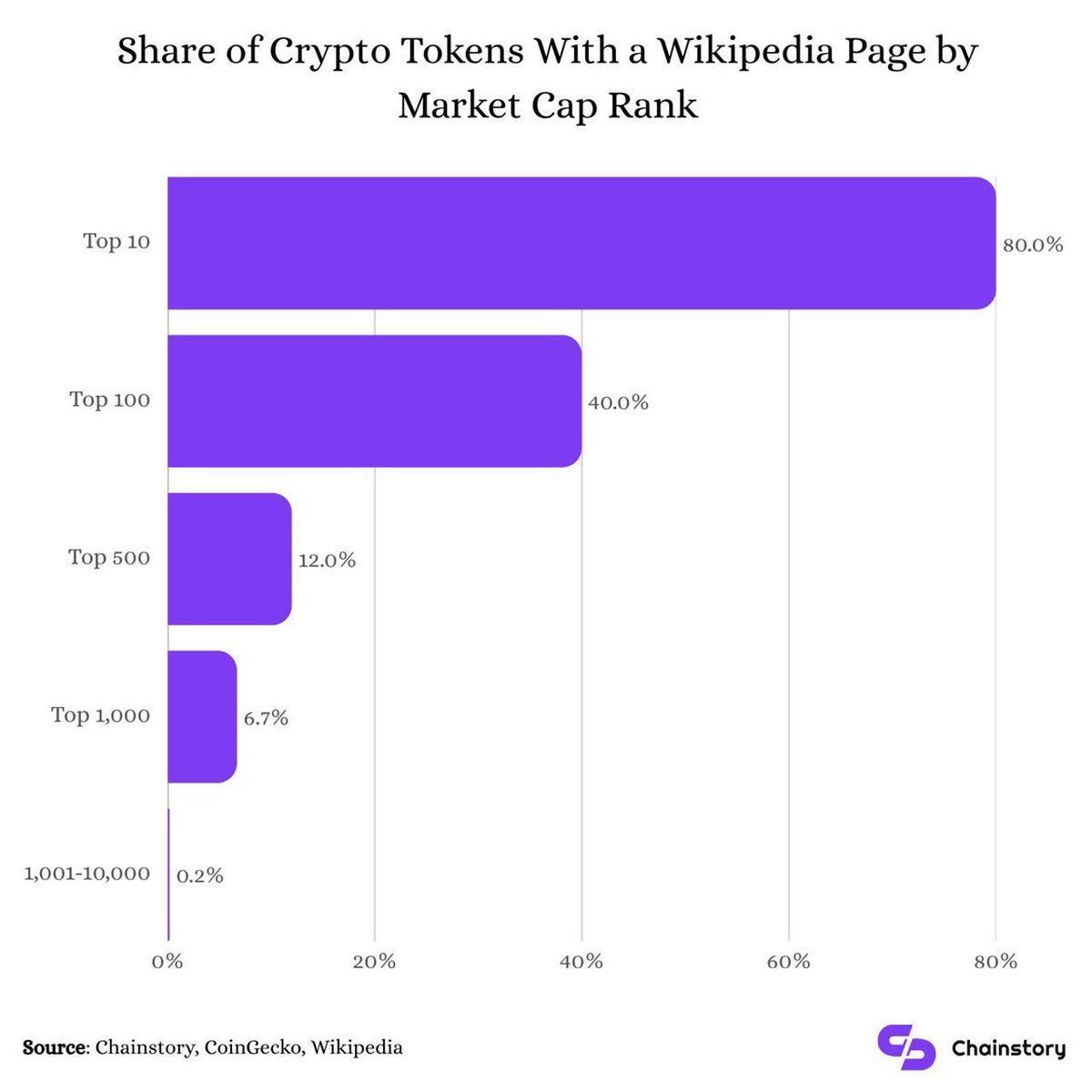
Coverage rate drops sharply with market cap ranking; $15 billion project has no entry
From June 1 to 4, 2026, Chainstory audited the top 10,000 tokens by market cap on CoinGecko, verifying the existence of entries one by one through the Wikipedia API. The results showed an extreme long-tail distribution:
The top 10 tokens by market cap have a coverage rate of 80%, the top 100 drop to 40%, the top 500 only have 12%, the top 1,000 fall to 6.7%, and the coverage rate for tokens ranked 1,001 to 10,000 is only 0.2%. Out of the entire top 10,000, only 84 tokens have Wikipedia entries.
The list of absences includes some large projects. The perpetual contract platform Hyperliquid, with a market cap of about $15 billion, has no Wikipedia page; the Layer-1 network Sui, with a market cap of about $5 billion and ranked 22nd, is also absent; Monad Labs, led by Paradigm (valuation $3 billion), Berachain, co-led by Brevan Howard Digital (valuation $1.5 billion), and EigenLayer, which received a $100 million investment from a16z, have all not left a record on Wikipedia.
The smallest project with an entry is Firo, ranked 959th with a market cap of $15 million.
In comparison, Wikipedia includes about 640 fintech companies and over 7,000 software companies, but only about 80 companies in the crypto and Bitcoin category.
Wikipedia is the most cited single source in ChatGPT, accounting for nearly 8%
This coverage gap is important because Wikipedia's position in the AI information chain far exceeds general perception.
Chainstory cited the audit data from the AI tracking platform Profound in the report: among all citation links by ChatGPT, approximately 7.8% point to Wikipedia, far ahead of Reddit (1.8%) and Forbes (1.1%), which rank second and third. Among the top 10 domains most cited by ChatGPT, Wikipedia accounts for about 47.9% of the share.
Another research agency, Trakkr, analyzed 3.29 million citation links and found that as of May 2026, Wikipedia accounted for 36.1% of the top 10 citation sources in ChatGPT and 25.3% of the top 100 citation sources.
Muck Rack's research in May 2026 further confirms that Wikipedia is not only the top citation source for ChatGPT but also the second largest source for Claude (only behind PubMed Central) and the fourth largest source for Gemini.
The report points out that Wikipedia primarily provides conceptual information to AI models, but when users ask questions about specific projects, Wikipedia entries become the core basis for the model's reasoning. Projects with entries have clear definitions and descriptions in AI responses; for projects without entries, AI can only piece together information from fragmented second-hand mentions, leading to errors in basic facts such as founders, founding dates, and headquarters locations.
Wikipedia classifies crypto media as "generally unreliable" sources
The low coverage rate of crypto projects on Wikipedia stems from the special review thresholds set by Wikipedia for the crypto industry.
Wikipedia has specifically established guidelines for the notability of cryptocurrencies, requiring that a project's notability must come from "mainstream" news sources, explicitly stating that media primarily reporting on the crypto industry "do not sufficiently prove notability." The guidelines even name CoinDesk and Bitcoin Magazine as "generally unreliable" crypto media. The same logic applies to crypto-native media like Cointelegraph, Decrypt, and The Block.
Recognized reliable sources by Wikipedia include Reuters, Bloomberg, CNBC, the Financial Times, and other mainstream business media. However, these media give little attention to niche areas of crypto such as liquid staking and perpetual contract DEX.
Chainstory pointed out this contradiction in the report: media that truly report on the dynamics of the crypto industry do not hold source value in Wikipedia's eyes, while the mainstream media recognized by Wikipedia do not cover the majority of crypto projects.
The process of creating new entries also constitutes an obstacle. New articles need to pass volunteer reviews that check for notability, verifiability, and reliable sources, among other criteria. Even if they pass the review, administrators can unilaterally delete them or put them to a community vote of 7 days for decision, with the entry's subject having no right to participate or appeal.
免责声明:本文章仅代表作者个人观点,不代表本平台的立场和观点。本文章仅供信息分享,不构成对任何人的任何投资建议。用户与作者之间的任何争议,与本平台无关。如网页中刊载的文章或图片涉及侵权,请提供相关的权利证明和身份证明发送邮件到support@aicoin.com,本平台相关工作人员将会进行核查。


