Claude, Deep Tide TechFlow
Deep Tide Reading Guide:
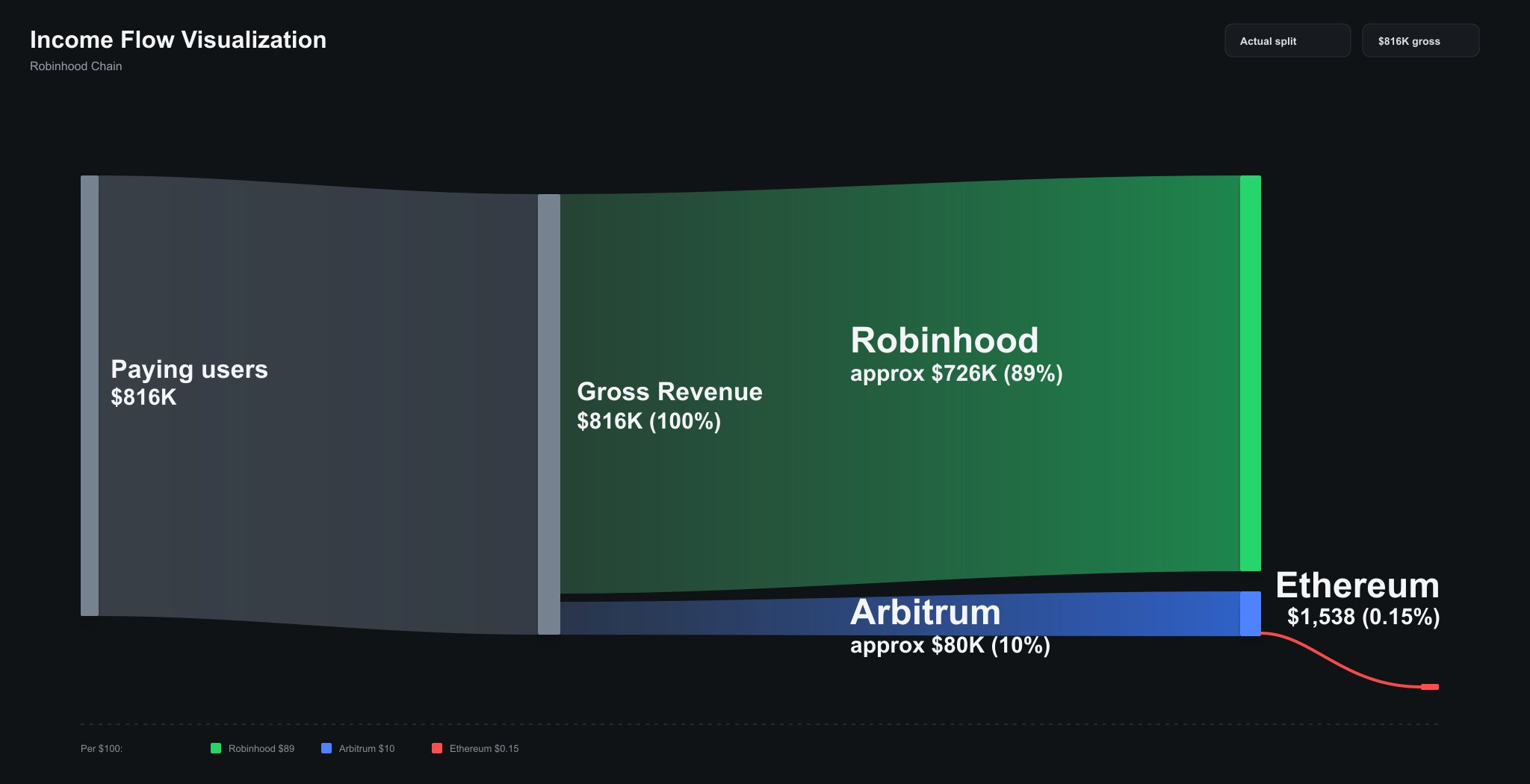
Lorenzo Valente, the crypto research director at ARK Invest, breaks down the revenue distribution since the launch of Robinhood Chain: total revenue is approximately $816,000, with Robinhood taking 89%, middleware Arbitrum taking 10% (about $80,000), and the underlying settlement layer Ethereum receiving $1,538, accounting for 0.15%. He described this as the "cleanest case" of the transition in the ETH economic model, prompting Ethereum co-founder Joe Lubin to personally defend it.
Two weeks after its launch, Robinhood Chain submitted a report card that left the Ethereum community with mixed feelings.
According to DefiLlama data, as of July 13, Robinhood Chain's 24-hour DEX trading volume was approximately $791 million, ranking third in the entire network, only behind Solana and BNB Chain, with TVL breaking $160 million, and more than 82,000 ETH (about $147 million) bridged to the network. An L2 chain built by a traditional brokerage reached on-chain trading volumes comparable to or even surpassing Hyperliquid and the Ethereum mainnet in less than half a month.
However, ARK Invest's crypto research director Lorenzo Valente posted on platform X on July 13, flipping this report card over. He analyzed the revenue stream of Robinhood Chain since its launch on July 1, and the conclusion is striking: total revenue is approximately $816,000, with Robinhood keeping 89%, Arbitrum taking 10% (about $80,000), while Ethereum, as the bottom settlement layer, received $1,538, accounting for 0.15% of total revenue.
Valente stated that Robinhood Chain is "the cleanest case of the transition in the ETH economic model."
89% against 0.15%: two narratives, two conclusions
Valente did not simply label this account as bearish or bullish, but rather split it into two investment narratives.
If your argument is "ETH is a currency," Robinhood's choice to build a chain on Ethereum is an extremely positive signal. More activity means more ETH is used as collateral and gas tokens, enhancing the network effect of ETH as a currency. From the beginning, Robinhood did not consider Solana, Sui, or any single L1. Valente's original statement was: "They want to be landlords, not tenants." Robinhood wants to control the entire tech stack, and Ethereum's modular architecture just allows for this.
But if your argument is "ETH is an asset that generates income," this is an extremely bearish case. Ethereum provides the most valuable settlement layer in the crypto world, yet charges are close to zero. Valente suggested a healthier distribution ratio should be: Robinhood 75%, Arbitrum 10%, Ethereum 15%. He ended his post with a call to the Ethereum ecosystem: "Things need to change."
Lubin's Defense: Low fees are a strategy, not a flaw
This post drew one of the most substantial responses from the Ethereum ecosystem. ConsenSys founder Joe Lubin directly commented, asserting that L1 fees should remain low, as this is a strategy to attract developers and enterprises.
According to CryptoTimes, Lubin predicts that in the next two to three years, tens of thousands of companies will deploy applications on Ethereum L1, various L2s, and private permissioned EVM chains, with interoperability protocols enabling connections between these chains. His logic is that once scale is achieved, ETH's currency premium will increase, and staking and locking mechanisms will continue to reduce circulating supply, along with Ethereum Improvement Proposal EIP-1559's burning mechanism, allowing ETH's value to be reflected through supply and demand rather than settlement fees.
Valente himself does not buy this argument. In his reply, he questioned whether the premise of "tens of thousands of companies at Robinhood's level" holds. Robinhood has a market cap close to $50 billion, and such large companies are few and far between globally.
Multicoin Capital managing partner Kyle Samani also joined the discussion, reiterating his consistent stance: L2 is "parasitic" to L1. HashKey Capital, on the other hand, holds the opposing view, stating in a previous research report that Ethereum is the "ultimate settlement layer."
Data supported by a 90-day subsidy period, sustainability to be verified
It should be noted that the current active data of Robinhood Chain has an important background: Robinhood is covering all gas fees for users during a subsidy period of 90 days after launch, expected to expire by the end of September.
According to a report by Bernstein analyst Gautam Chhugani's team, Robinhood Chain's DEX trading volume reached $3.1 billion in its first week, with approximately 65,000 users holding about $300 million in stablecoins and $13 million in tokenized stocks. However, Bernstein also pointed out that the activity in the first week was primarily speculative trading. On July 9, the single-day trading volume reached as high as $568 million, directly driving a 19% single-day increase in ARB tokens.
FalconX estimated in its April report that Robinhood Chain's fee revenue within six months would be about $1.1 million, but this prediction is based on the assumption of a gradual exit from the subsidy. The institution also provided a longer-term forecast: by 2030, Robinhood Chain's annualized revenue could reach $60 million, provided users expand from tokenized stocks to DeFi and other on-chain applications.
The user retention rate after the subsidy expires will determine whether Robinhood Chain is a truly vital L2 or just a brief spike in traffic.
The old problem of ETH: won the bidding, lost the pricing
The account broken down by Valente touches on the core anxiety that the Ethereum community has faced for two years: after the L2 boom, how much value can ETH really capture?
After the Dencun upgrade introducing EIP-4844 (blob transactions) in March 2024, the data availability fees paid to Ethereum L1 will significantly decrease, leading to a simultaneous shrinkage in Ethereum's fee revenue and ETH's burning amount. The data from Robinhood Chain only showcases this trend through a specific case: Coinbase's Base, various application chains on Arbitrum, and now Robinhood, each L2 is proving the same point. The security of Ethereum as a settlement layer attracts the largest players, but the settlement fees are too low to be almost negligible.
As of the time of publication, the trading price of ETH is approximately $1,780.
免责声明:本文章仅代表作者个人观点,不代表本平台的立场和观点。本文章仅供信息分享,不构成对任何人的任何投资建议。用户与作者之间的任何争议,与本平台无关。如网页中刊载的文章或图片涉及侵权,请提供相关的权利证明和身份证明发送邮件到support@aicoin.com,本平台相关工作人员将会进行核查。


