From organizational division of labor, underlying agreements to staking yield models, Ethereum is "subtracting" for the next decade.
Written by: imToken
In the past few years, most of Ethereum's upgrades can be explained with a relatively clear goal: scaling.
From Rollup, Blob, data availability, to continuously increasing Gas Limit, the discussions have all been about how to enable Ethereum to handle more transactions and lower costs. Thus, even if ordinary users do not understand every EIP, they can intuitively grasp that these upgrades are ultimately aimed at making the chain faster and cheaper.
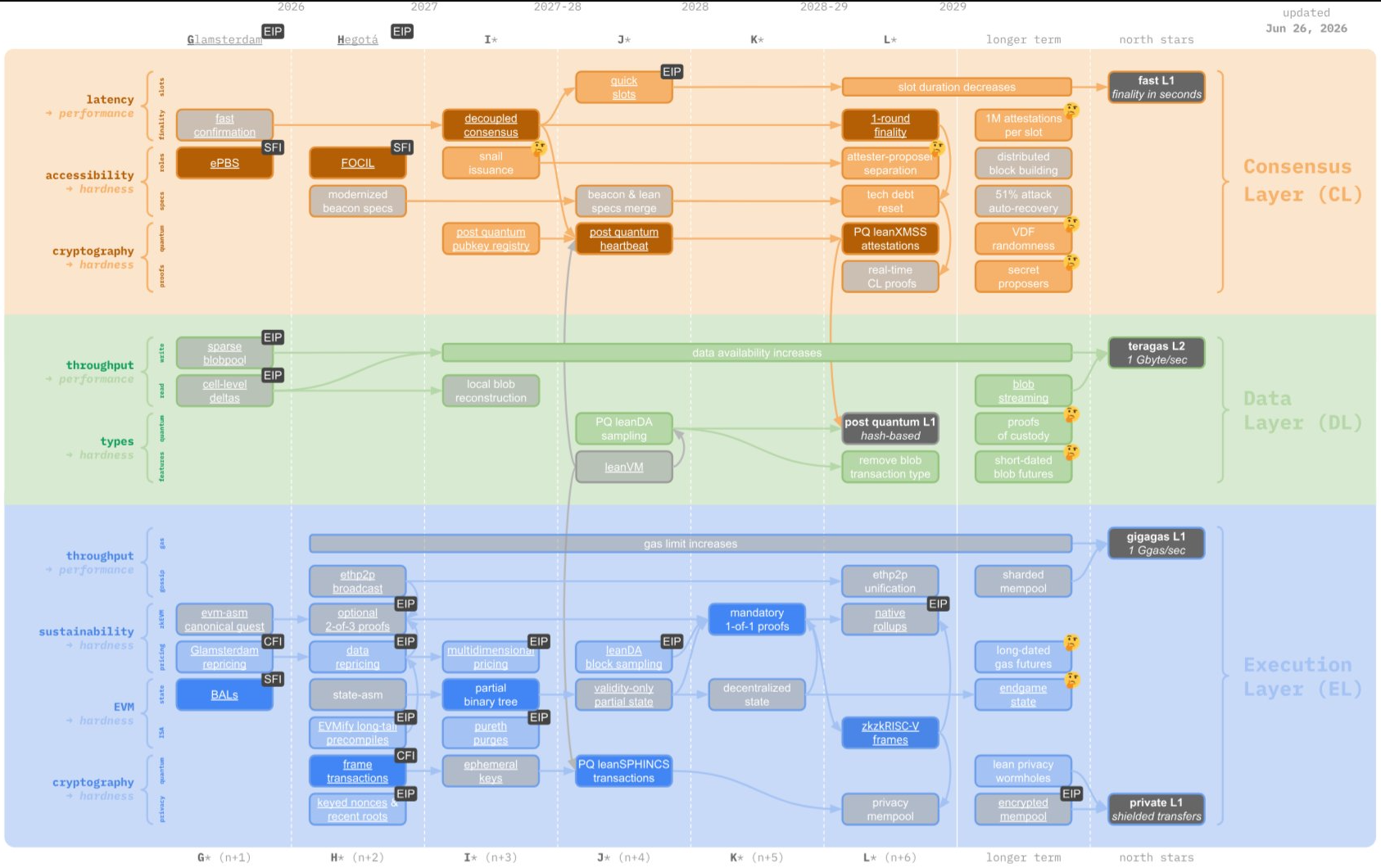
However, recently, Ethereum has begun to frequently discuss some issues that are not so easily priced by the market. In particular, on July 4th, Vitalik Buterin summarized the core direction of Lean Ethereum based on the updated long-term roadmap for Ethereum, referring to it as Ethereum's "third major iteration" following The Merge.
At the same time, another study on 0x02 compounding validators also provided a supplementary clue from the perspective of staking yield, suggesting that for smaller stakers, the native compounding mechanism could bring about a relative increase of around 5% in consensus layer APR.
On the surface, these seem like different topics, but when put together, it becomes evident that Ethereum may be undergoing a deeper narrative reconstruction: it is starting to rethink how to support the operation of the next decade or even longer through a more decentralized organizational structure, more easily verifiable underlying protocols, and more sustainable yield models.
1. From "a foundation" to multiple responsible nodes
For a long time, the outside world was accustomed to equating the Ethereum Foundation (EF) with Ethereum itself.
Whether it was protocol upgrades, research directions, ecological funding, or external communication, many issues inevitably boiled down to one question: What is EF prepared to do?
However, it is well known that the Ethereum Foundation is not an ordinary company. It does not have shareholders in the traditional sense, does not aim for market share and quarterly profits, nor does it "actually own" the Ethereum network, which has always put EF in a state of intrinsic tension.
On one hand, Ethereum needs someone to invest long-term in protocol development, organizational upgrades, and public goods construction; on the other hand, if research, funding, talent, and decision-making become increasingly centralized within the foundation, then EF itself becomes the largest source of centralization risk for Ethereum.
However, recent organizational changes are intentionally breaking this perception. In the latest round of adjustments, EF has reduced its personnel size by about 20% while refocusing internal work on different levels such as protocols, users, and institutions. According to EF's self-description, this aims to become "more streamlined, more focused," prioritizing core tasks that only the foundation can and must undertake.
At the same time, some capabilities that were originally concentrated within EF are beginning to shift to independent external organizations, as mentioned in the previous article (extended reading: From "a foundation" to "multi-node governance": Is Ethereum undergoing a silent power restructuring?):
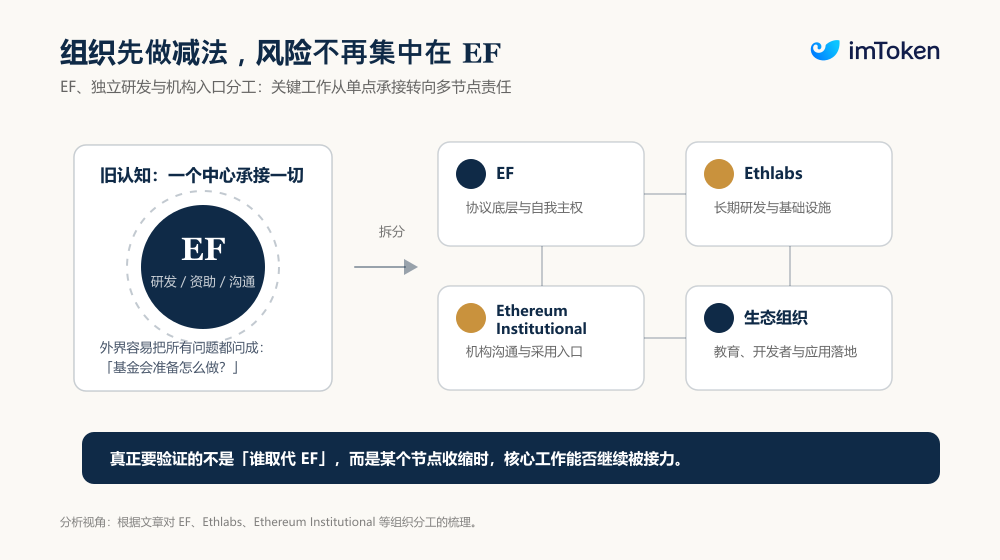
- On June 22, five former core research staff of the Ethereum Foundation announced the establishment of Ethlabs, an independently operated non-profit research laboratory to undertake protocol research, infrastructure, and institutional-level technical needs;
- On July 1, another independent non-profit organization, Ethereum Institutional, was officially launched, taking over the institutional partnership work previously handled by EF's market expansion team, becoming an independent interface for traditional financial institutions to enter the Ethereum ecosystem;
The former corresponds to technical research and the latter to institutional adoption, forming a new specialized division of labor, which also signifies that Ethereum is attempting to break down the research, ecosystem, and market functions that were previously concentrated in one organization into multiple relatively independent responsible nodes—with EF focusing more on the protocol layer and self-sovereignty, Ethlabs promoting long-term research, Ethereum Institutional handling institutional communication, while other organizations continue to undertake education, developer support, and application implementation.
From an organizational structure perspective, this model undoubtedly increases coordination costs. After all, the funding sources, priorities, and execution rhythms of different organizations are not entirely the same, and there may be route divergences or even resource competition in the future.
On the other hand, if a decentralized protocol relies long-term on a single foundation to accomplish nearly all key work, that itself is a form of structural risk.
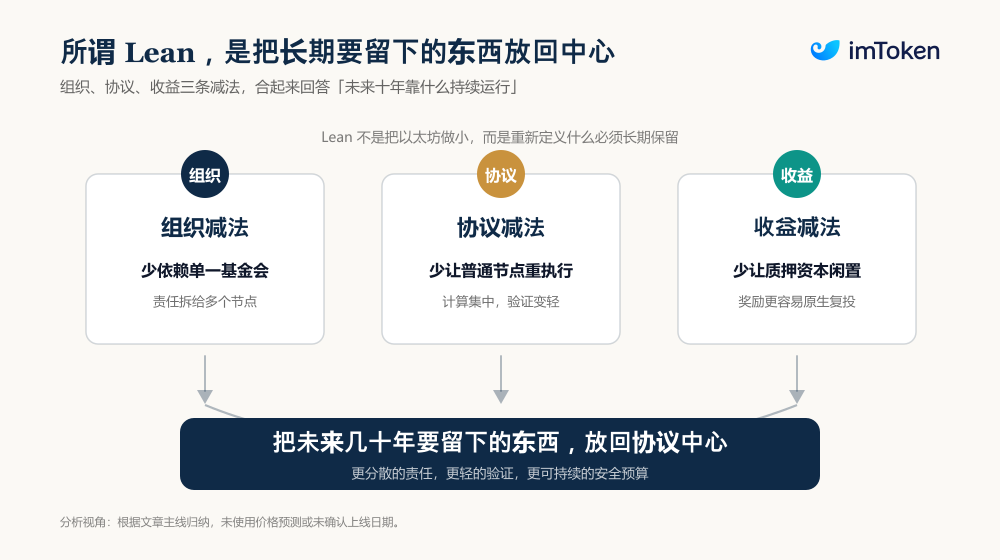
Therefore, the changes at the organizational level in Ethereum really address not "who will replace EF," but whether Ethereum can establish a collaborative structure such that even if a certain organization reduces its size, shifts direction, or even disappears, core work can still be continued by other nodes.
This "subtraction at the organizational level" also lays the groundwork for the upcoming protocol shift.
2. A shift in technical narrative: What does Lean Ethereum aim to achieve?
Strictly speaking, Lean Ethereum is not a concept that emerged for the first time last week.
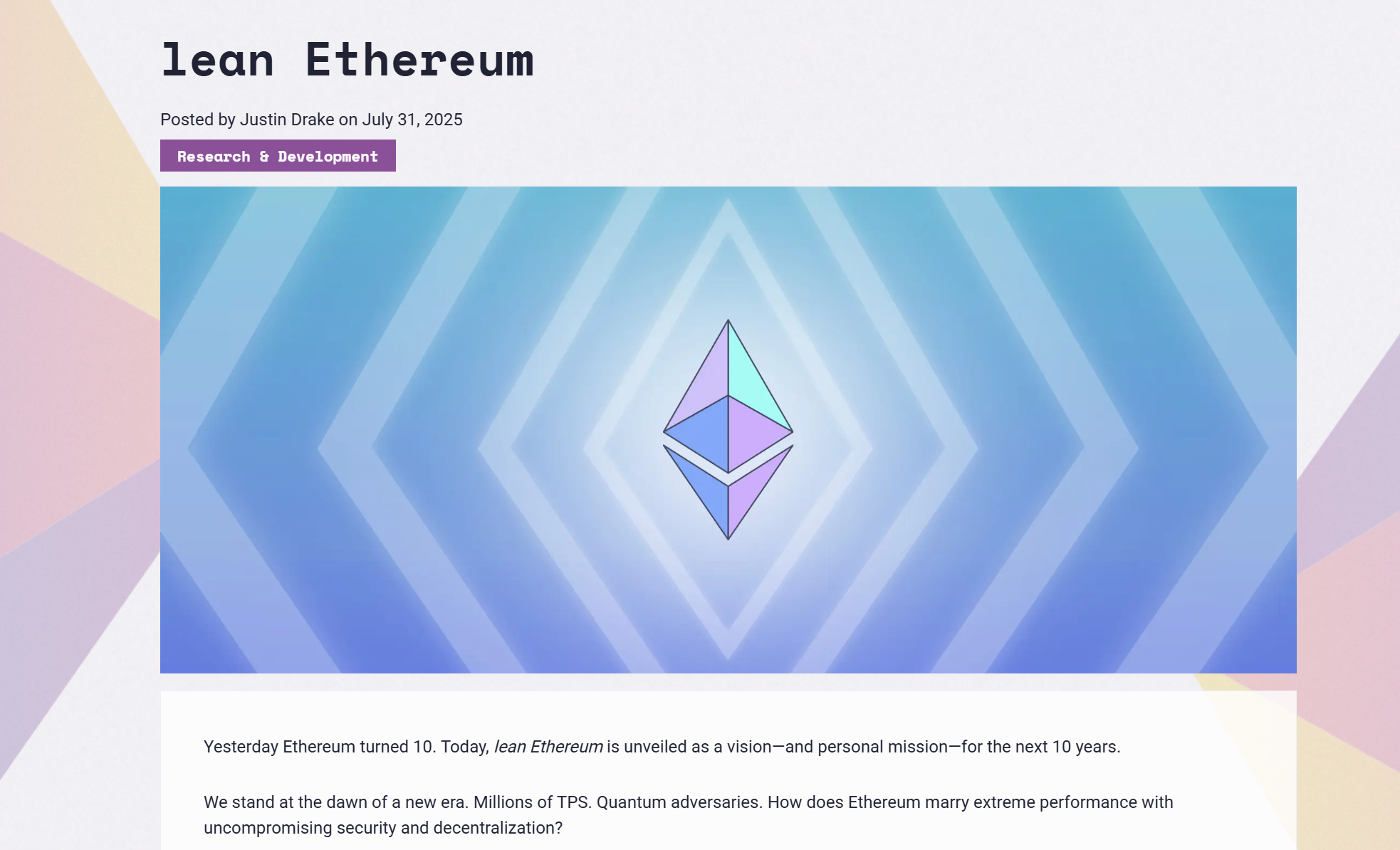
As early as July 2025, Ethereum Foundation (EF) researcher Justin Drake presented the vision for "lean Ethereum" development over the next decade, proposing directions such as Lean Consensus, Lean Execution, and Lean Data. The main goals include expanding the base layer TPS to 10,000 per second, scaling the L2 network to 10 million, while maintaining decentralization and 100% uptime.
It was then already clear that Ethereum would undergo significant upgrades at the consensus layer, data layer, and execution layer, including upgrading the beacon chain to version 2.0, introducing blobs 2.0 for the post-quantum era, and possibly building an EVM 2.0 based on open-source RISC-V instruction sets; in terms of cryptography, the system would rely entirely on hash-based signatures, hash root data commitments, and native hash zero-knowledge virtual machines to achieve resistance to quantum computing.
Thus, the truly significant change this week lies in Vitalik elevating these scattered research directions to a more defined position based on the latest strawmap—Lean Ethereum is not a one-time hard fork but rather a series of transformations that will be gradually rolled out over the next three to four years, which he defines as Ethereum's "third major iteration."
According to Vitalik's summary, Lean Ethereum encompasses almost all core parts of the protocol, reflected in several directions:
- Protocol simplification, shifting from "heavy execution" to "light verification": using recursive STARK as a core native component, replacing direct transaction heavy execution with proof verification, while adjustments will be made to client architecture, state models, and multidimensional gas aiming to make the protocol itself leaner and more formally verifiable;
- Quantum resistance as a priority: Quantum security has been significantly advanced from "long-term consideration," and existing cryptographic components that are vulnerable to quantum computing threats will gradually be replaced with quantum-resistant solutions, making the quantum security design of blobs an urgent matter;
- Privacy is no longer viewed as an additional function needing to be supplemented at the application layer, but will become a primary goal in protocol design: it will no longer be an afterthought but rather a native capability of the protocol. New designs for Frames, mempool, and state trees will support quantum-safe, intermediary-free private transactions;
- The consensus layer will attempt to decouple block availability from finality: the goal is to achieve second-level finality (1–2 rounds of voting), while redesigning states (dynamic states coexists with new scalable state types) to significantly reduce the burden on validators and light clients;
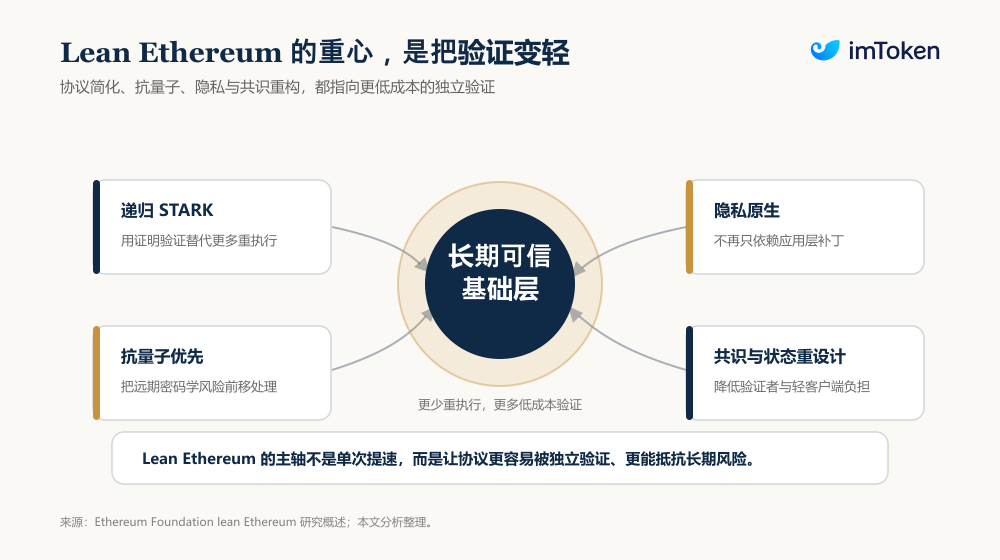
These directions may seem very extensive, but they share a common logic behind them: concentrating computation and complexity on a small number of nodes responsible for generating proofs, allowing more participants to validate results at a lower cost.
Ultimately, Ethereum no longer makes "short-term TPS" or "L2 compatibility" the sole narrative axis, but instead emphasizes the underlying attributes of the protocol as "long-term trusted infrastructure." This naturally includes verifiability, resistance to censorship, quantum resistance, privacy-friendliness, and lightweight verification, marking Ethereum's significant shift from "engineering iteration" to "returning to principles" in the next decade.
In this context, the 0x02 compounding validators also reflect a similar long-term perspective.
In the past, discussions around ETH Staking primarily focused on APR and DeFi compounding yields, but under the traditional 0x01 model, each validator's effective balance ceiling is set at 32 ETH, and any rewards exceeding 32 ETH will be periodically withdrawn from the consensus layer, thus no longer participating in staking.
So for small stakers with only one or a few validators, they need to wait until rewards accumulate back to 32 ETH to start a new validator and regain staking yields, which naturally puts them at a disadvantage in terms of compounding efficiency; while larger service providers can aggregate rewards from many validators and quickly start new nodes.
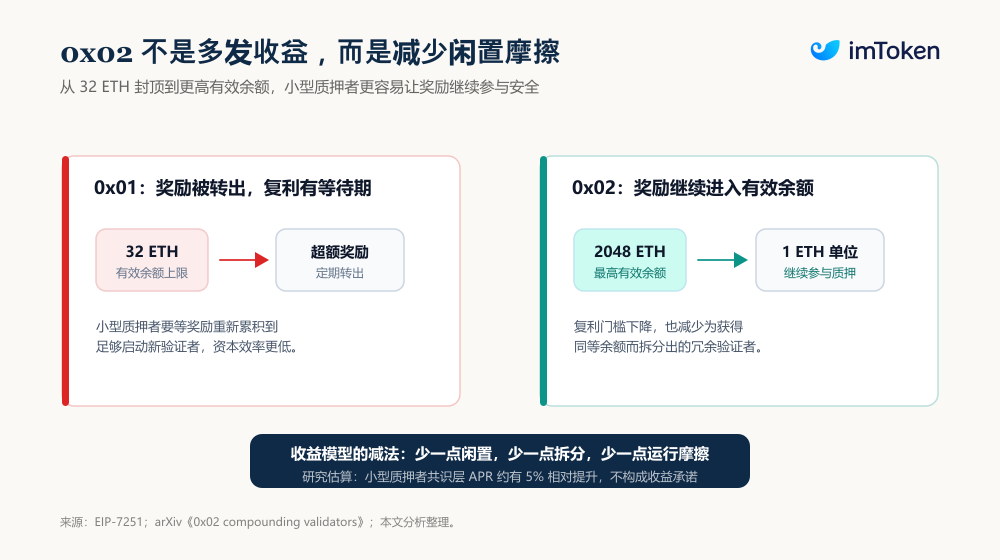
Therefore, Pectra's introduction of the 0x02 model raises the maximum effective balance per validator to 2048 ETH, allowing rewards to continue participating in staking in units of 1 ETH, thus lowering the barrier for small stakers to achieve compounding, reducing the capital efficiency gap between participants of different scales, while also lessening redundant validators and network operational burden.
Of course, this cannot simply equate to "more dispersed validator numbers." More accurately, 0x02 simultaneously improves the operational efficiency of validator sets at the protocol level and also enhances the capital efficiency and relative positioning of small stakers, allowing participants of different sizes to obtain protocol-native yields with lower friction.
And this aligns with the direction of Lean Ethereum; both emphasize the same thing—to maintain a long-term sustainable Ethereum with less redundancy and friction.
3. What kind of Ethereum should we expect in the next decade?
From EF scaling down to the emergence of independent organizations like Ethlabs and Ethereum Institutional; from prioritizing scaling to Lean Ethereum reemphasizing protocol simplification, quantum resistance, privacy, and light verification; to 0x02 validators transforming staking yields from periodic withdrawals to sustainably reinvestable native income—these changes are not isolated from each other.
They all involve similar subtractions, such as reducing Ethereum's reliance on a single organization, decreasing the costs ordinary participants bear to validate the protocol, and reducing idle and redundant expenses of staking capital during operation.
Correspondingly, Ethereum hopes to achieve a more decentralized responsibility system, a more easily independently verifiable underlying protocol, and a yield structure more suited for long-term holders and network security participants.
These changes are unlikely to immediately serve as a price catalyst.
After all, Lean Ethereum will need three to four years or even longer to gradually substantiate; the new organizational structure will need to prove that multi-node cooperation will not lead to directional splits; and the compounding advantages of 0x02 validators will also require a complete cycle to fully manifest.
However, what Ethereum truly needs to prove in the next phase may not just be how many more upgrades it can execute.
More importantly, as the value carried by the protocol becomes higher and the external environment becomes more complex, it needs to show whether it can become less dependent on any single organization and easier to verify with ordinary devices, thereby providing more stable and sustainable long-term returns for capital engaged in network security.
The notion of Lean is not about making Ethereum smaller, but about putting back at the center of the protocol what truly needs to be preserved for the decades to come.
免责声明:本文章仅代表作者个人观点,不代表本平台的立场和观点。本文章仅供信息分享,不构成对任何人的任何投资建议。用户与作者之间的任何争议,与本平台无关。如网页中刊载的文章或图片涉及侵权,请提供相关的权利证明和身份证明发送邮件到support@aicoin.com,本平台相关工作人员将会进行核查。

