Samsung Electronics is reassessing the possibility of entering the American capital market.
On July 14, Bloomberg cited informed sources stating that Samsung Electronics has had preliminary contacts with several investment banks regarding a potential American Depository Receipt (ADR) issuance, but the discussions are still in the early assessment stage. The company has yet to decide whether to proceed with the transaction and has not entered substantive stages such as underwriter selection. Subsequently, Samsung Electronics clarified that it is currently not considering the possibility of issuing ADRs.
SK Hynix recently completed a $26.5 billion listing in the United States, setting a record for the scale of foreign companies' IPOs in the U.S., demonstrating the strong financing attractiveness of core companies in the AI industry chain. However, Samsung still needs to weigh multiple factors, including stock price fluctuations in the memory chip sector, complex business structure, and future changes in industry supply and demand.
SK Hynix's Record IPO Prompts Samsung to Restart Assessment
Reports cite informed sources stating that Samsung has previously studied the feasibility of issuing ADRs multiple times but has not implemented it. This restart of assessment is largely driven by SK Hynix's successful listing.
As two of the world's largest memory chip manufacturers, both Samsung and SK Hynix directly benefit from the investment boom in AI infrastructure. SK Hynix's record IPO has not only refreshed the scale record for foreign companies listing in the U.S., but also reaffirms the global capital market's demand for core supply chain companies in AI, despite ongoing disputes about high valuations for AI assets.
Since the beginning of this year, Samsung's stock price has risen by approximately 105%; SK Hynix's stock price has increased by about 183% during the same period. However, informed sources emphasize that internal discussions at Samsung are still at the feasibility assessment stage, and no decision has been made on whether to initiate an issuance or confirm a specific transaction plan. 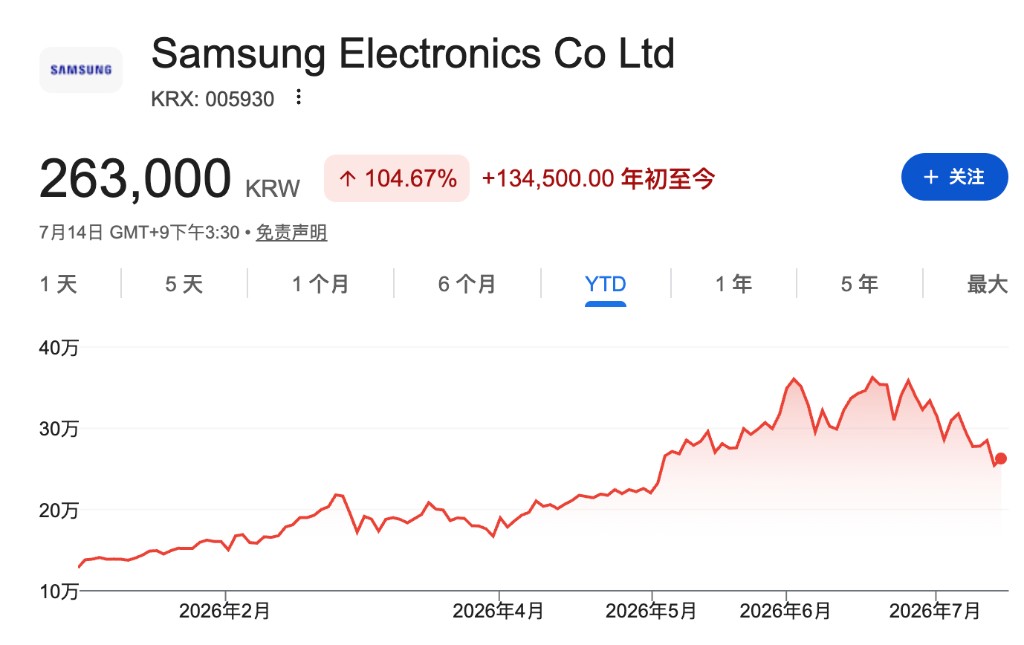
Diverse Business Structure Increases Listing Difficulty
Compared to SK Hynix, Samsung faces significantly greater challenges in its attempt to list in the U.S.
Reports indicate that Samsung's business covers multiple fields including memory chips, logic chips, smartphones, consumer electronics, and display panels, making its business structure much more complex than that of SK Hynix, which focuses on memory business, complicating the valuation and transaction structure design for investors.
Additionally, the recurrent labor disputes within the company in recent years may also become a risk factor of concern for investors.
On the other hand, Samsung's stock price has risen significantly, and the market has high expectations for its profit improvement, which means the difficulty of continuing to exceed investors’ expectations in the future is increasing. This has already been reflected in the latest financial report. Although Samsung's preliminary results overall exceeded market expectations, the company's stock price still experienced a noticeable decline afterward, reflecting the current high valuations and sensitive market sentiment around AI chips.
In the Midst of AI Expansion, Supply Risks Become New Variables
In addition to the capital market environment, changes in industry supply and demand are also important factors that Samsung needs to consider.
With the continued growth of AI demand, global memory manufacturers are accelerating production expansion. Last month, Samsung Group and SK Group announced the construction of two new chip manufacturing plants, with a total investment scale of approximately 800 trillion Korean won (about $536 billion), further expanding advanced chip production capacity.
At the same time, the South Korean government also announced an AI infrastructure investment plan with a total scale of 550 trillion Korean won, collaborating with companies including Naver, aiming to establish 8.4 gigawatts of AI data center capacity by 2029.
It cannot be ignored that capacity expansion is laying the groundwork for future oversupply. Once the supply-demand relationship shifts from a tight balance to a loose one, chip prices and profit margins will be squeezed, and the valuation logic of semiconductor companies will also be affected. Although Samsung Electronics has clearly stated that it is not considering the issuance of ADRs at present, the evolution of the memory chip industry cycle will still be a key factor influencing the company's future capital operation decisions.
免责声明:本文章仅代表作者个人观点,不代表本平台的立场和观点。本文章仅供信息分享,不构成对任何人的任何投资建议。用户与作者之间的任何争议,与本平台无关。如网页中刊载的文章或图片涉及侵权,请提供相关的权利证明和身份证明发送邮件到support@aicoin.com,本平台相关工作人员将会进行核查。


