The personal feud between Musk and Altman has lasted for many years. This quarrel is given a new meaning.
Written by: Li Hailun
Edited by: Xu Qingyang
Musk and Altman have quarreled again on X. Musk bluntly called Altman a "fraudster."
This time, the spark was lit by Apple.
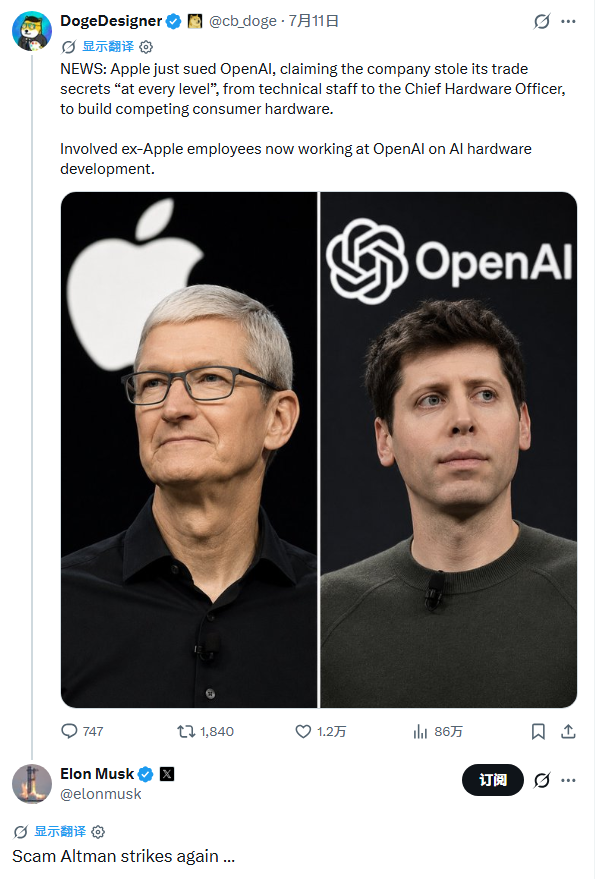
On July 10, local time in the U.S., Apple sued OpenAI, OpenAI's hardware company io Products, and two former Apple employees in a federal court in California, accusing them of stealing trade secrets to assist OpenAI in developing consumer-grade AI hardware.
OpenAI responded by stating that the company is still reviewing the lawsuit documents, has no interest in the trade secrets of other companies, and will continue to focus on developing innovative technology. Apple stated that it would continue to protect the achievements of its employees and the company's innovative assets.
The case has not yet entered substantive proceedings, but Musk has already jumped into the fray.
01 Apple Sued OpenAI, Musk Took the Opportunity to Fire
Apple described in the lawsuit a situation far more serious than an ordinary job change and specifically mentioned two former Apple employees who have joined OpenAI.
One of them is Tang Tan. He was involved in the design of products such as the iPhone, Apple Watch, and iPod for a long time, and after leaving Apple, he joined io Products, founded by former Apple Chief Design Officer Jony Ive, where he currently serves as OpenAI's Chief Hardware Officer.
The other is former Apple electrical engineer Chang Liu. Apple claimed he participated in highly confidential product development projects and continued to access and download hardware-related files using an Apple device that he had not returned after leaving for OpenAI.
Apple also made more serious accusations in the lawsuit: During the recruitment of Apple employees, OpenAI allegedly asked candidates to discuss Apple’s internal projects, display physical components, and guided some employees to avoid exit reviews.
This case quickly attracted Musk's attention.
He retweeted related news on X, stating: "Fraudster Altman is at it again..." He subsequently posted multiple times claiming that Altman "has taken fraud to a whole new level" and even "loves fraud more than anyone else."
Musk also released a photo of Altman with the caption "I'm doing this because I love it." Musk added that what Altman loves "is fraud."
Here, "it" refers to AI. In May 2023, Altman participated in a Senate hearing in the U.S. When asked about his salary, he replied that he only earned enough to pay for health insurance, did not have any equity in OpenAI, and stated: "I'm doing this because I love it."
"Scam Altman," has become a nickname Musk repeatedly uses to attack Altman.
Then, Altman quickly struck back.
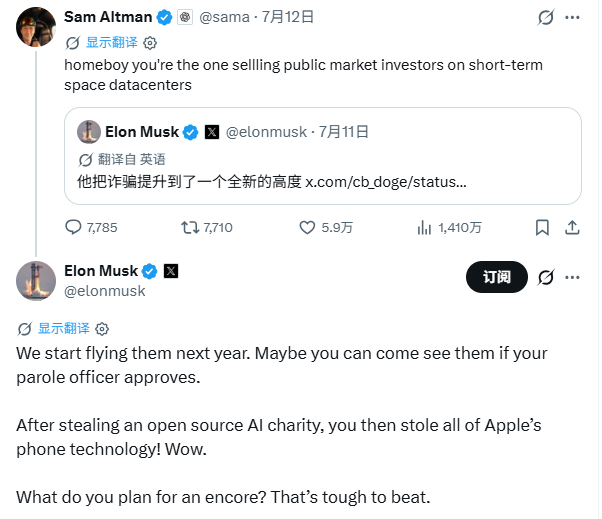
He pointed out that Musk is promoting the space data center project to investors: "Dude, you're the one marketing the short-term space data center to public market investors."
Musk responded by stating that SpaceX would start launching related facilities next year and mocked Altman: "If your parole officer approves, maybe you can come and take a look."
The implication of Musk’s remark is to liken Altman to a criminal serving time or on parole. Because he "stole" from an open-source AI charity and then "stole" Apple’s mobile technology, he should be imprisoned.
Altman then connected this quarrel to the GPT-5.6 Sol recently released by OpenAI.
He wrote that many benchmark tests show GPT-5.6 Sol may be the strongest performing model in the world, "but the most reliable way to judge is that Elon is once again obsessed with attacking me."
OpenAI describes GPT-5.6 Sol as its most capable model to date, emphasizing enhancements in programming, long-chain intelligent agent tasks, biological research, and cybersecurity; Musk's SpaceXAI also released Grok 4.5 around the same time, focusing on programming, agent tasks, and knowledge work.
A legal dispute over trade secrets eventually evolved into a model release battle and personal attacks between the heads of two AI companies.
This scene seems absurd, yet it fits perfectly with the way Musk and Altman have interacted in recent years.
The two co-founded OpenAI in 2015. As OpenAI expanded its funding needs and established a profit-oriented structure, disagreements emerged over control, funding, and development direction. Musk resigned from OpenAI in 2018 and later founded xAI, directly competing with OpenAI.
Since then, their conflict has moved from boardrooms to courtrooms and has spread from court to X.
In May 2026, a jury ruled against Musk in a lawsuit he filed against OpenAI and Altman. Musk stated he would appeal.
Apple's lawsuit against OpenAI provides him with an opportunity to attack Altman again.
02 A War of Words Revealing Three New Battlegrounds in AI Competition
The personal feud between Musk and Altman has lasted for many years. This quarrel is given a new meaning.
Apple, OpenAI, and SpaceXAI are competing for the same resources: top engineers, consumer-grade entry points, developer ecosystems, computing infrastructure, and the capital market's trust in the next-generation AI platform.
This war of words also highlights the three "new battlegrounds" forming in the AI industry:
The first battleground is AI hardware.
In the past few years, OpenAI mainly relied on ChatGPT and API to reach users, but the software entry has always been constrained by platform companies such as Apple, Google, and Microsoft.
On mobile phones, OpenAI needs to go through Apple and Google's app stores; in the office and enterprise markets, OpenAI is highly dependent on Microsoft products and cloud computing systems; when entering personal life scenarios, ChatGPT still runs on mobile phones, computers, and operating systems produced by others.
This is also a direct motivation for OpenAI to enter the hardware field.
In July 2025, OpenAI acquired io Products, founded by Ive, for nearly $6.5 billion, hoping to create a new type of AI device distinct from smartphones and traditional screens. OpenAI's CFO Sarah Friar stated in April this year that the company plans to launch consumer-grade hardware by the end of 2026.
Apple and OpenAI were originally partners.
At Apple's Global Developers Conference in June 2024, Apple announced it would integrate ChatGPT into iPhones. When Siri could not complete certain complex requests, users could invoke OpenAI's model for answers.
As OpenAI began recruiting hardware executives and engineers from Apple and openly promoted AI devices, the relationship rapidly changed. The partner who once helped Apple bolster its large model capabilities is now attempting to manufacture a product that could change the way we use smartphones.
Apple's lawsuit at this moment serves as a direct cause to protect trade secrets and prevent competitors from quickly replicating its accumulated hardware capabilities, which also relates to control over the next generation of computing entry points.
OpenAI wants to transform AI from an application on a mobile phone into an independent device that can accompany users at any time. Once such a product scales, the status of smartphones as the core entry point to the Internet could be affected.
The second battleground is capital narrative.
Musk attacks Altman as a "fraud," and Altman retaliates with the "space data center," a choice that is not coincidental.
SpaceX completed its IPO in June this year. Data quoted by CNBC shows that the company raised $75 billion, with a market value close to $2 trillion after the first-day close. As xAI is integrated into SpaceX, investors are purchasing a business narrative composed of rockets, satellite internet, AI models, social platforms, and computing infrastructure.
The space data center is the most imaginative and controversial part of this narrative.
Musk hopes to leverage SpaceX's low-cost launch capabilities and Starlink network to deploy AI computing facilities in orbit, alleviating the power, land, and cooling constraints faced by ground data centers. SpaceX proposed to deploy up to 1 million computing satellites, with the first batch of AI1 satellites potentially achieving a peak power of up to 150 kilowatts per satellite.
This plan currently lacks large-scale engineering verification. Orbital heat dissipation, equipment maintenance, chip lifespan, launch costs, and data transmission efficiency might all affect its commercial feasibility.
Altman's choice to attack the space data center is essentially questioning the most critical new growth story after SpaceX’s IPO: how much of a company valued close to $2 trillion actually derives value from its mature rocket and satellite business, and how much is it betting on yet-to-be-validated AI infrastructure?
OpenAI faces similar issues.
As the company explores going public, its valuation needs to be based on the continued growth of ChatGPT, expansion in the enterprise market, leading model capabilities, and the success of new hardware. Apple’s lawsuit could affect the launch timing of OpenAI's hardware products and potentially raise new concerns for investors regarding intellectual property, corporate governance, and team stability.
Thus, their mutual attacks target each other's weakest points.
Musk questions OpenAI's business ethics and transformation process; Altman questions whether SpaceX's commitment to future technologies can be fulfilled.
The third battleground is the boundaries of AI companies.
Early competition among large models mainly revolved around parameter scale, training computing power, and evaluation results. Now, the scope of expansion among leading companies has clearly widened.
OpenAI is simultaneously entering search, browsers, programming tools, office collaboration, enterprise agents, and consumer hardware. Musk is gradually integrating models, the X platform, the Cursor ecosystem, Starlink, and SpaceX's infrastructure.
Large models are becoming foundational capabilities, while what truly determines a company's long-term position also includes how many products the model can enter, how many user relationships it can master, how much computing power it can access, and whether it can establish a platform independent of Apple and Google.
The protections sought in Apple’s lawsuit far exceed a few hardware blueprints.
Over the past two decades, Apple has built a complete consumer electronics system based on chips, industrial design, operating systems, supply chains, and app stores. OpenAI is attempting to turn natural language and intelligent agents into a new operating interface, reducing users' reliance on traditional screens, app icons, and touch operations.
Musk hopes to embed AI models into social platforms, cars, robots, satellite networks, and space infrastructure.
The three companies have chosen different paths but are competing for the answer to the same question: In the AI era, who can control the first layer of entry between users and the digital world?
Apple’s answer remains devices and operating systems, OpenAI is betting on models and new types of AI terminals, and Musk aims to establish a vertical system from chips, data centers to networks, models, and applications.
In this context, the insults exchanged between Musk and Altman carry a special communicative value.
They can help both mobilize their supporters, amplify attention on new models, and reduce the complex technological competition to a personal conflict between the two entrepreneurs.
However, a war of words cannot ultimately answer the real questions.
Apple needs to prove that it can maintain its position in the consumer electronics entry point during the AI era; OpenAI needs to demonstrate that its hardware products possess independent value and that the development process can withstand legal scrutiny; Musk also needs to prove that grand plans like the space data center can transition from market narrative to real engineering.
The next round of their quarrel could start at any time.
免责声明:本文章仅代表作者个人观点,不代表本平台的立场和观点。本文章仅供信息分享,不构成对任何人的任何投资建议。用户与作者之间的任何争议,与本平台无关。如网页中刊载的文章或图片涉及侵权,请提供相关的权利证明和身份证明发送邮件到support@aicoin.com,本平台相关工作人员将会进行核查。


