Information aggregation or result manipulation? Polymarket's short-term contracts expose structural risks in prediction markets.
Written by: @Steve_4P
Translated by: AididiaoJP, Foresight News
The father of modern management, Peter Drucker, once said: "The best way to predict the future is to create it." If a person can turn the imagined future into reality through their own efforts, this may be the most certain form of prediction. However, in prediction markets, this phrase takes on a completely different meaning. When participants can change the outcome through their own actions, a market that injects capital into possible futures may evolve into a mechanism that actively creates those futures.
Recently, prediction markets seem to have transcended mere information aggregation, with instances of participants attempting to directly influence settlement outcomes. This article will explore the structural vulnerabilities of prediction markets and the duality of their technology through specific cases.
Polymarket's 5 Minute BTC Contract Mechanism
To understand this phenomenon, we must first grasp how Polymarket's 5-minute Bitcoin contract operates. This contract asks: at the end of a 5-minute window, is the price of Bitcoin higher than the price at the start of the window? Participants can trade on two outcomes: "up" or "down." If the "up" position settles at a price above the opening price, it pays $1; otherwise, it pays $0. This contract is essentially a binary bet, with its value entirely dependent on the price direction of Bitcoin over a fixed short period.
This design creates a sharp settlement threshold. It does not primarily capture Bitcoin's long-term trend but is determined by a single reference point at a specific moment. When Bitcoin approaches the opening price as settlement nears, even slight fluctuations can decide the entire contract's win or loss.
Polymarket uses external oracles rather than its own order book to settle these contracts. This means the final outcome depends on the price reported by the oracle at the time of settlement. When traders participate in the prediction market while also engaging in the spot Bitcoin market, if activities in the spot market can influence the price reflected by the oracle, traders have the incentive to intervene in the settlement conditions rather than simply predict.
Signs of Manipulation During Settlement
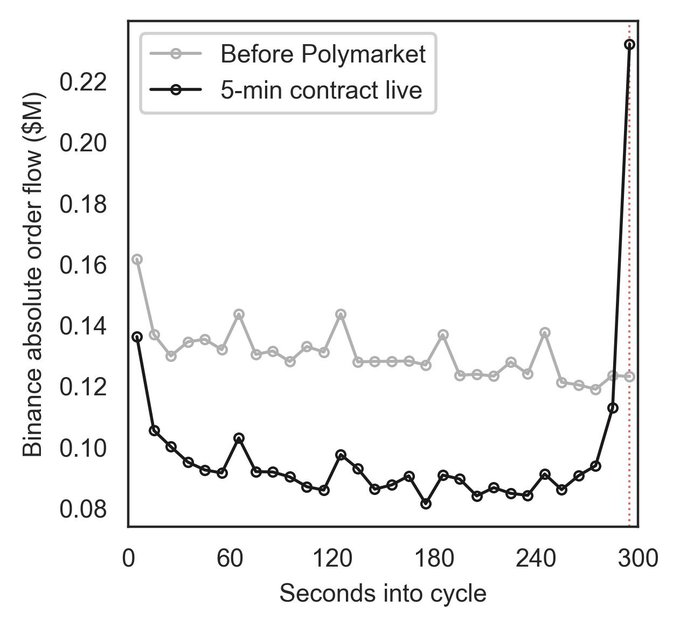
A recent study found that after Polymarket launched the 5-minute BTC contract, a unique pattern emerged: in the final seconds before settlement, Binance's spot order flow surged sharply, and prices often reversed rapidly after the contract ended. The brief price fluctuations alone do not prove manipulation, but they do not align with information-based trading, which typically has lasting effects and resembles concentrated trading activity around the settlement clock.
The study proposed a simple mechanism: traders could first buy "up" contracts on Polymarket and then place orders in the spot market at the end of the settlement window. If the resulting price movements are captured by the oracle price, the "up" contract could settle in a favorable manner. Conversely, the same applies. The key is that the profits from the prediction market positions may far exceed the costs of creating brief price fluctuations in the underlying market.
The study estimated that a small number of accounts made about $8.2 million in profits during the period categorized as potential manipulation, while ordinary participants lost around $7.6 million. These figures must be interpreted cautiously—the study did not directly observe individual intentions or legally establish the fact of manipulation, but rather based on empirical patterns such as timing of trades, price reversals post-settlement, and concentration of profits. These clues collectively strongly support the hypothesis of settlement manipulation.
Distorted Intent: Is There a Solution?
Prediction markets are often valued for their ability to aggregate dispersed information and form a collective view of the future. However, when participants can influence the outcomes they are trading, this function is significantly diminished. Elections, sporting events, public opinion, public statements, and even weather readings all carry similar risks. When traders can directly or indirectly influence outcomes, a market that should answer "what could happen" may reward those who ask "how to make this outcome happen."
Reducing this risk requires more cautious market design.
First, markets settling over extremely short time frames should be approached with caution. The 5-minute Bitcoin contract, despite its underlying price information being useful, is susceptible to manipulation. When settlements occur within a narrow window, slight temporary fluctuations at the end of the contract can determine the outcome. Longer-period contracts are not completely immune, but since the outcomes reflect a broader price discovery process, they typically expose a lower risk to short-term interventions. Therefore, prediction market platforms should set clear minimum contract durations based on market characteristics and underlying asset liquidity.
Secondly, platforms need to reassess which types of information are worth translating into markets. Polymarket and Kalshi have drawn attention for being able to reflect societal and economic information faster than traditional media or polls. In principle, markets related to inflation, elections, or policy decisions can provide useful signals by aggregating the viewpoints of different information participants.
However, some markets appear to be driven more by trading volume and attention rather than information value. For example, Polymarket once launched a market on whether Federal Reserve Chairman Jerome Powell would say "Good Morning" in his Jackson Hole speech. This contract generated about $80,000 in trading volume but offered limited insights into monetary policy or broader economic prospects.
If prediction markets are to prove their value by generating socially useful information, platforms need clearer listing standards. Not every event or piece of information needs to be turned into a tradable product. While blockchain and tokenization can make a wide range of assets and outcomes tradable, the technical feasibility of this alone does not create social value.
Finally, oracle design must be considered a core part of market integrity. The 5-minute BTC contract settles using Chainlink price data. Chainlink states that its price feeds aggregate information from multiple exchanges and data providers. However, it is difficult to easily verify which specific exchanges are included and how each source's weight is determined.
The close relationship between Binance prices and Chainlink settlement prices raises important questions. This does not prove that Binance directly determines the settlement outcomes, but it indeed complicates assessing the extent of a single exchange's influence on results and the actual diversification of oracle inputs. In prediction markets, oracles are not merely technical data sources; they determine which outcome wins and how funds are allocated. If users cannot assess the methodology, source composition, and anti-manipulation capability of oracles, the transparency and fairness of the market itself may be called into question.
Conclusion
Drucker's idea that "the best way to predict the future is to create it" captures the value of innovation and execution. However, in prediction markets, the same idea can become tricky—when participants are rewarded for influencing outcomes rather than predicting them.
The issue is not whether prediction markets should exist. The more important questions are: who can influence the outcomes? How is settlement determined? Does market design provide sufficient protections against manipulation?
Prediction markets should not be viewed with blind optimism or blanket skepticism. Like any emerging technology, they need to be evaluated through their potential and limitations. Their long-term value will depend on whether platforms can maintain the market's role as an information discovery tool rather than allowing them to devolve into mechanisms for strategic intervention.
免责声明:本文章仅代表作者个人观点,不代表本平台的立场和观点。本文章仅供信息分享,不构成对任何人的任何投资建议。用户与作者之间的任何争议,与本平台无关。如网页中刊载的文章或图片涉及侵权,请提供相关的权利证明和身份证明发送邮件到support@aicoin.com,本平台相关工作人员将会进行核查。


