Since late June, the U.S. stock market's storage chip sector has experienced a brutal correction. According to Caixin, the stock prices of leading companies like SanDisk, Micron Technology, Seagate Technology, and Western Digital have all dropped over 20% in the past few weeks. The direct trigger for this plunge was a report by Bloomberg stating that Meta plans to establish a cloud infrastructure business to sell excess AI computing power externally. This news hit the market's fragile nerves regarding "excess computing power" and "peak capital expenditure," leading to indiscriminate selling in the semiconductor sector. Amidst the spread of panic, funds flowed out of hardware manufacturing at any cost, and storage chips, as the core components of AI infrastructure, became the hardest hit by the sell-off. However, the sharp decline is not only a release of short-term emotions; the long-standing cyclical characteristics of the storage chip industry are facing a reassessment of their underlying logic. When the supply-demand relationship for computing power undergoes subtle changes, the underlying logic of storage chips and their transmission effects on other sectors of the AI industry chain become core issues that investors and industry observers must confront.
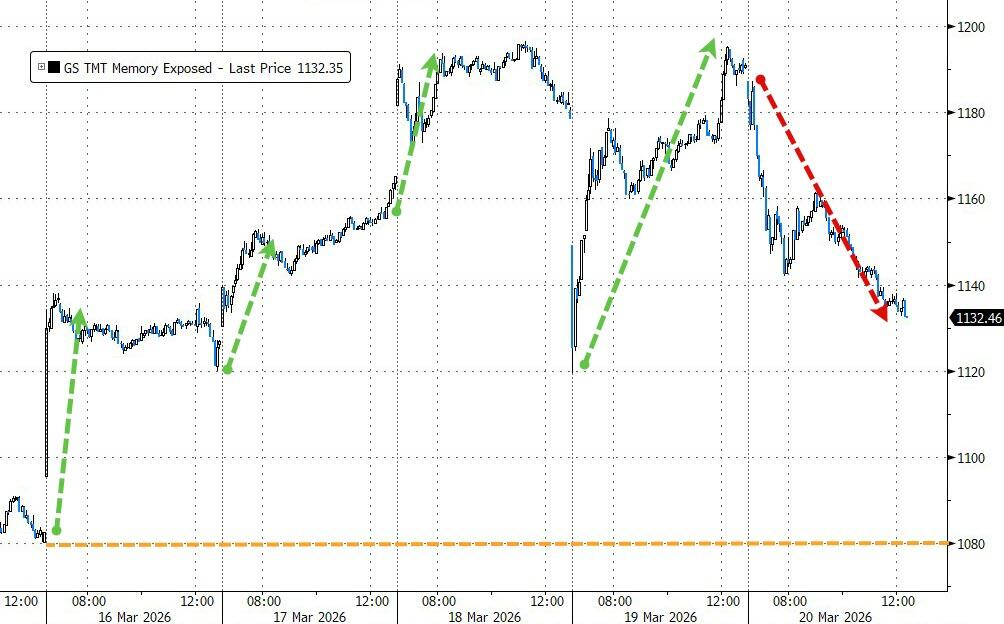
Recent overall performance of U.S. memory stocks (Source: Wall Street News)
Meta's Sale of Computing Power Triggers Semiconductor Panic
What does Meta's sale of computing power really mean? Panic in the market believes that as the tech giants begin to sell off idle computing power, it indicates that AI infrastructure investment has peaked, leading to a cliff-like decline in semiconductor demand. Bloomberg reports that Meta plans to launch a cloud business called Meta Compute to sell excess AI computing power to external companies. This action has been interpreted by the market as a signal of poor internal digestion of computing power within the giant, leading to doubts about the authenticity of the entire AI industry chain's demand. However, industry rationalists provide a completely different explanation. Zuckerberg publicly denied the existence of excess computing power on July 10, stating that he does not know anyone in the industry who thinks there is excess computing power, and that developing a cloud business has commercial potential. From a business logic perspective, Meta's sale of computing power resembles a normal expansion aimed at improving GPU cluster utilization, akin to the approaches of SpaceX and xAI. Meta itself has not revised its capital expenditure plan downward, and its stock price actually surged 9% after the news was announced. This attempt to transform internal computing power into external cloud services is essentially a necessary choice for the giant to seek cash flow recovery after heavy asset investment, rather than a white flag signaling a halt to all expansion.
The real state of the computing power market is not one of overall contraction, but rather a significant structural differentiation. According to reports from Titanium Media, market monitoring data indicates that rental prices for training-type computing power such as NVIDIA's B200 have recently seen a phased retreat, but AI inference computing power rental prices in the government and enterprise sectors and traditional industries remain stable. What the market is really concerned about is the phased supply release of general training computing power, rather than the disappearance of all-scenario AI demand. This differentiation has significant differences in the demand transmission for different product lines of storage chips. High Bandwidth Memory (HBM), used for training large models, was once in short supply due to a computing power arms race, but with the retreat in training computing power rental prices, the growth rate of marginal demand for HBM may face slowing pressures. Conversely, general DRAM and enterprise SSDs supporting inference applications remain strong in demand due to widespread implementation in government, enterprise, and traditional industry scenarios. The core variable supporting storage chip demand lies in whether the technological gap between AI large models will continue to narrow. If the gap between leading models and their followers converges rapidly, the reckless logic of the computing power and storage arms race will face fundamental challenges, directly undermining the high growth expectations for storage chips. As model capabilities become homogenized, the marginal returns on computing power investments will diminish, leading to a natural reassessment of the demand growth rate for storage chips.
The Cyclical Fate of Storage Chips and Business Model Reconstruction
The storage chip industry has always struggled to escape the cyclical fate of "prosperity—expansion—price collapse—contraction—recovery." In past cycles, storage was more like a commodity, with prices fluctuating with the market, and contracts typically based on quarterly or annual terms. This model led to rampant capacity expansion during prosperous times; once demand fell short of expectations, prices would quickly collapse. Today, this underlying logic is being rewritten. Cloud vendors and AI data centers, to ensure key supply, are increasingly signing long-term supply agreements with manufacturers for three to five years, including price ranges, minimum purchase quantities, and customer guarantee deposits.
This long-term agreement model is reshaping the industry's commercial ecosystem. Micron has disclosed its first five-year strategic customer agreement; according to Wall Street News, Samsung Electronics is negotiating long-term supply agreements with Google and Microsoft, discussing over $10 billion in advance payment arrangements; in the domestic market, Reuters reports that Tencent has signed a long-term supply contract worth over 20 billion yuan with Changxin Memory. The high advance payment mechanism and long-term demand visibility are expected to curb significant price drops for storage, supporting manufacturers to maintain stable profit margins. Institutions like Goldman Sachs believe that storage chips are transitioning from standardized commodities to highly customized products, facing a structural rewriting of traditional cycle rules.
The widespread implementation of long-term agreements directly alters the cash flow and supply chain management logic of purchasing enterprises. In the past, purchasers could supplement inventory via the spot market during price lows, enjoying cost benefits from the cycle downturn. However, under the long-term agreement framework, purchasers need to lock in massive funds as deposits or advance payments in advance, posing a severe test to their cash flow. Additionally, the minimum purchase quantity constraint means that even if end-user demand fluctuates, purchasers must still accept predetermined capacity to avoid penalties. In cycles of dramatic price fluctuations, the profit and loss differences between spot purchases and long-term locked-in agreements are vast: during price uptrends, long-term agreements can effectively secure low-cost advantages; but during price downtrends, long-term purchasers may have to acquire goods at prices higher than the spot market, leading to significant booked losses. Although this model ensures supply security, it also weakens the purchasing power's elasticity during price downtrends. For small and medium-sized cloud service providers or AI startups, the high barriers of long-term agreements may further exacerbate the difficulty of obtaining quality storage resources, resulting in a concentration of industry chain resources towards leading players.
The sharp decline in storage chips is not an isolated event; it is a microcosm of the entire AI industry chain entering the "profit verification period." In June, the combined market value of the seven tech giants in the U.S. evaporated by about $3 trillion, with Microsoft seeing a cumulative drop of 21.64% for the month. Wall Street has begun to rigorously question the return on investment for hundreds of billions in capital expenditures. Cloud service providers are facing pressure regarding the monetization pace of AI, while computing power chips face direct impacts from falling rental prices. For example, Microsoft's massive investment in AI infrastructure needs to be validated through revenue growth from Azure cloud services. If AI computing power rental prices continue to decline, the gross margins of cloud service providers will be squeezed, subsequently affecting their willingness and pace for future capital expenditures. Computing power chip manufacturers are similarly being tested; the phased slowdown in demand for training computing power may lengthen delivery cycles for high-end chip orders or reduce order scales. Once cloud service providers slow their procurement pace, the risk of inventory buildup for computing power chip manufacturers will significantly rise, and the market's expectations for their performance in the coming quarters will also be downgraded. Funds are searching for valuation undervalues across various segments of the industry chain, with sector rotation being extraordinarily intense. Amundi points out that funds are shifting from cloud service providers to AI hardware and storage, while Morgan Stanley has observed a rotation of funds from chip stocks to AI cloud service providers. This apparent conflict reflects the intense market competition between "loss-making cloud service providers/hardware" and "certain application layers/value stocks," seeking the next certainty for growth.
Despite facing concerns about excess computing power and valuation corrections in the short term, underlying demand remains huge. According to The Paper, global sales of storage chips reached $74.6 billion in a single month, setting a record high. Micron's capital expenditure plan for the 2026 fiscal year exceeds $25 billion, nearly doubling from the previous year. These figures indicate that the construction of AI infrastructure is far from over; it is merely that the market has become more rational in its expectations of growth rates. From computing power chips to cloud services, and then to storage and applications, the entire industry chain is undergoing a shift from a "faith-driven" to a "performance-driven" valuation system.
The phased oversupply of training computing power and the strong demand for inference computing power imply that the valuation standards of various segments of the industry chain are being refined. Enterprises with the capability to land inference scenarios and advantages in cost control will receive more premiums. The arrival of the long-term agreement era has changed the game rules of supply chain management; making trade-offs between supply security and cost elasticity will become the main line of purchasing strategies in the coming years. At the turning point where the AI industry chain moves from frenzy to verification, both capital and purchasers need to redefine a balanced model between security guarantees and elastic costs.
免责声明:本文章仅代表作者个人观点,不代表本平台的立场和观点。本文章仅供信息分享,不构成对任何人的任何投资建议。用户与作者之间的任何争议,与本平台无关。如网页中刊载的文章或图片涉及侵权,请提供相关的权利证明和身份证明发送邮件到support@aicoin.com,本平台相关工作人员将会进行核查。


