Author: Delphi Ventures
Translated by: Shenchao TechFlow
Shenchao Overview: AI is rewriting the underlying logic of the global economy, while population aging is accelerating automation, and the United States is actively withdrawing from its hegemonic system. These three forces will reinforce each other, and the greatest wealth opportunity in the next decade will no longer be through employment or entrepreneurship, but "making conviction investments using the right world model".
Automation, Multipolarity, Population Structure
These are the three major macro forces we are betting on for investments over the next decade. The value of human labor is being replaced by synthetic intelligence. The hegemon that established the current world order is actively dismantling it. Human fertility rates and lifespan curves are evolving.
These giant trends overlap and reinforce each other. Declining birth rates and an aging population provide a natural incentive for larger-scale automation. Automation enhances self-sufficiency and reduces the need for greater interconnectedness in a multipolar world. A decrease in young males means a more automated form of warfare. In the short term, investments in automation, self-sufficiency, rearmament, and rising healthcare costs all indicate unsustainable government finances, which can only be remedied by more radical productivity improvements brought about by automation...
While quarterly fluctuations may be large, these are structural forces that are unlikely to slow down. Over a ten-year time horizon, it is best to view them as persistent tailwinds.
As capital gradually replaces labor, having the right world model and investing with conviction is becoming the primary means of wealth preservation and appreciation. Previously, wealth helped people enjoy a limited time. In the coming decades, it may be directly exchanged for time itself.
We are in less than four years of the largest technological revolution in human history. We will soon welcome billions of new economic agents in the form of agents, followed by their material counterparts. The acceleration of production, scientific discovery, and workplace disruption will be unprecedented.
As this wave approaches, existing institutions are stretched to their limits: over 85% of American voters feel frustrated with opposing parties. Global debt exceeds 300% of GDP. The global supply chain is now a bug rather than a feature. Domestic inequality is exacerbating. Fiat currency is a fifty-year experiment. The United States is withdrawing from its role as a global hegemon.
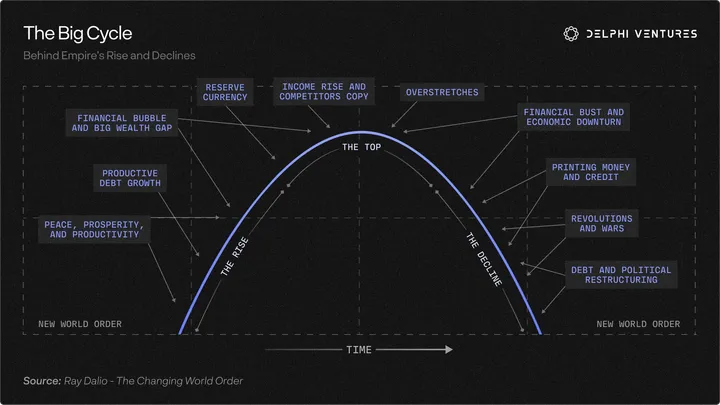
However, as investors, young people, and parents, we have never been more optimistic. The economic potential for our grandchildren may never have been brighter. Entrepreneurs of the 2020s are dreaming not of B2B SaaS and consumer internet markets, but of space data centers, interstellar travel, clean energy, reversing aging, and machine gods.
History is starting to operate again. Ambitions are moving forward in sync. Our industrial-age institutions are shaking, while the machinery age is struggling to be born.
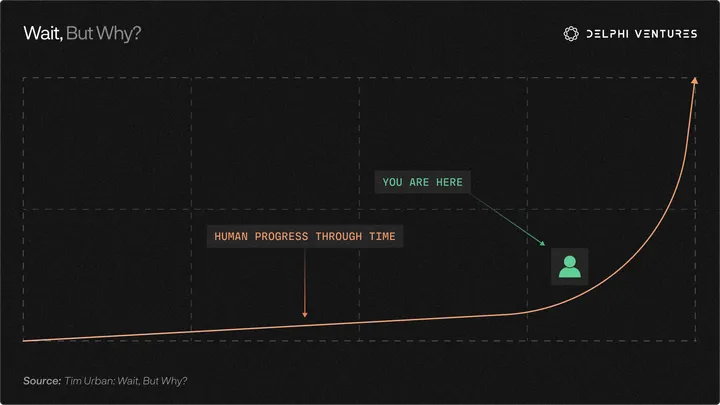
It is impossible to predict what the world will look like in 2035, but it promises to be stranger. More unpredictable. More astonishing.
Simultaneous occurrences.
1. AI and Automation
Summed up in three words: "Leopold is right." At almost every critical juncture, those betting "we don’t have enough computing power" have consistently won. Time and again.

Arbitrage from Silicon Valley to New York is still valid.
We can now convert silicon and energy into intelligence. Bottlenecks will arise—computing power, data, electricity—and then be broken, increasingly with the assistance of synthetic rivals being nurtured.
Capabilities continue to accelerate...
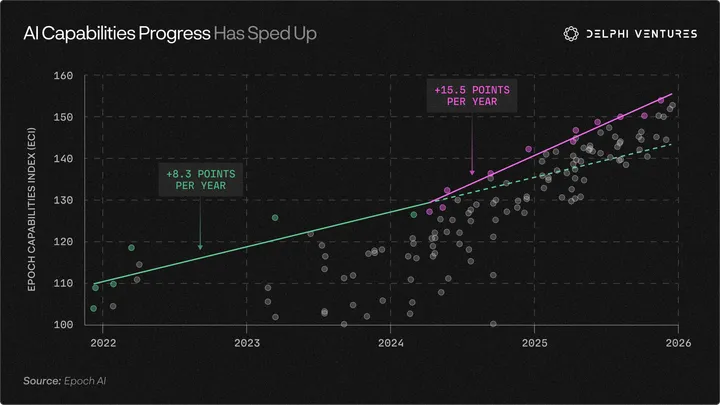
Meanwhile, computing power continues to grow...
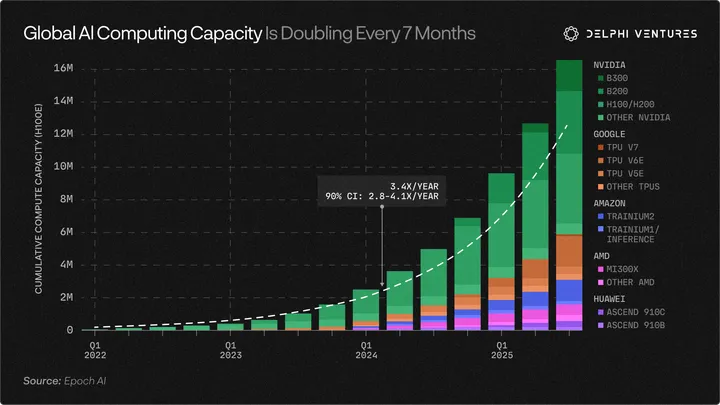
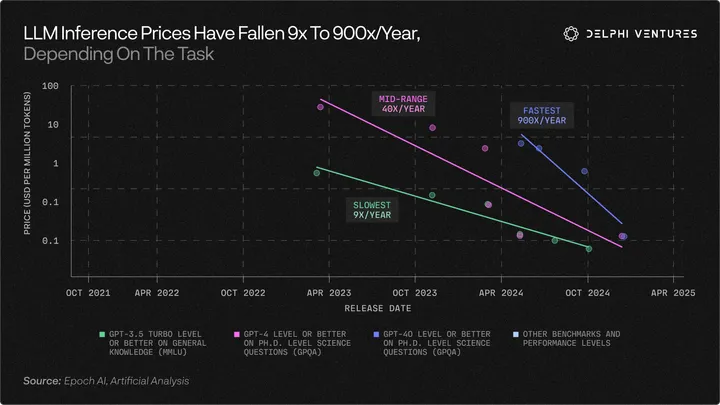
Meanwhile, reasoning costs continue to plummet...
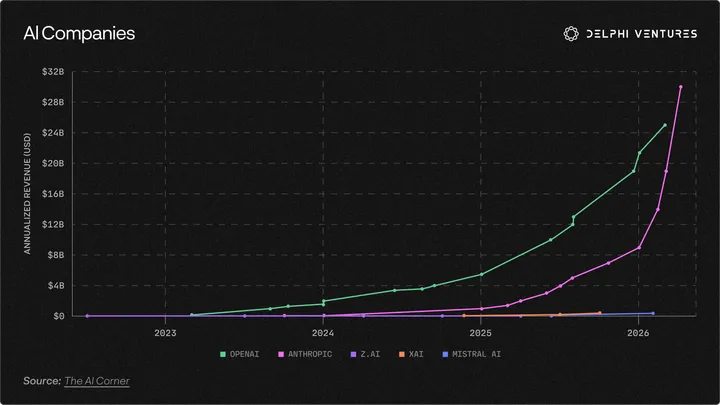
Meanwhile, traction is reaching a turning point...
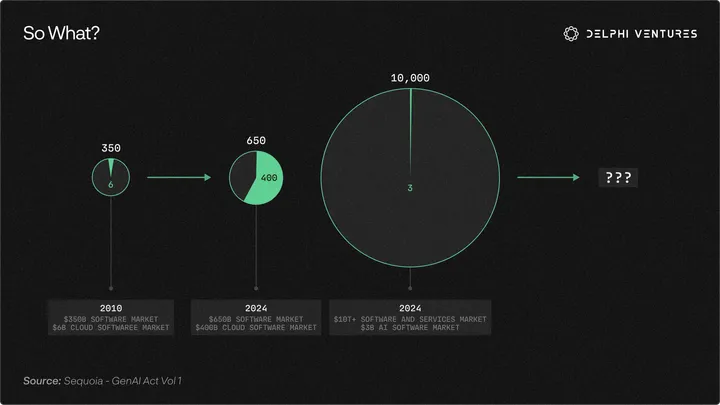
The target TAM is a large part of all white-collar services...
It is likely to expand to manual labor... (possibly too conservative)...
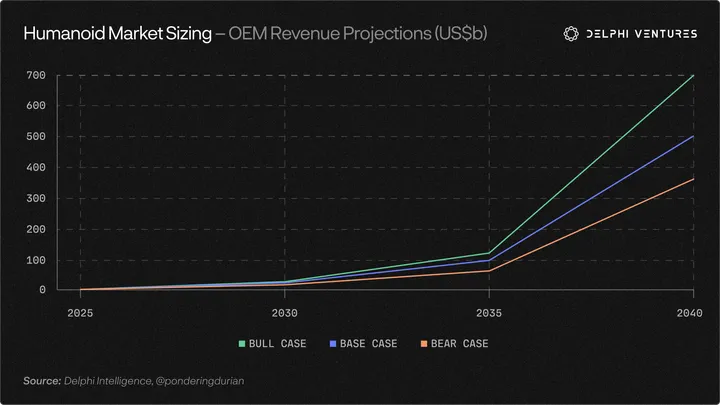
Perhaps a concise way of saying it is: "The demand for intelligence seems limitless".
This is the part short sellers have never priced correctly: efficiency should have killed this trade. DeepSeek should have been the moment the music stopped. Instead, each collapse of token costs does not shrink the market but drowns it. Every time prices drop by an order of magnitude, it drags a thousand previously uneconomic workloads above water level. We do not have a surplus of computing power. We have a demand function that wakes up hungrier every time we feed it.
Relative winners may change, but the pull remains constant.
Gaining Faith
Increasingly, the performance of investments depends on how early the allocators truly became "AGI-pilled".

There is a small circle whose epicenter appeared in San Francisco in 2022, but has been (surprisingly slowly) expanding outward. The neurodiverse crowd in Hayes Valley, lurkers of the Less Wrong forum, the OpenClaw hosts in Liangzhu, and an increasing number of boards of some of the world's largest companies that first "gained faith". The rewards are rich.
Skeptics are increasingly being forced to yield.
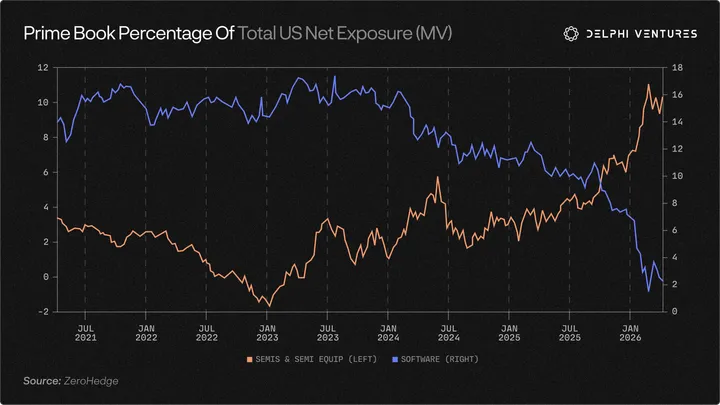
Industry after industry will be put before the machine gods to be judged worthy or unworthy. To become fuel for model acceleration or prepare to be devoured.
However, the appetite of the machine gods is evolving, requiring more and different inputs to satisfy its ever-expanding ambitions. LLMs have drained decades' worth of internet text. Diffusion models have drained photographs. Video models are the obvious next step. True agentic workflows are piecing them all together, requiring real-time multimodal environments capable of reinforcement learning to deliver increasingly longer temporal range tasks perfectly.
Nonetheless, this first wave of major digital AI feels trapped. Overly reliant on language. Overly digitized. Locked in data centers.
The next phase of AI promises to realize the original promise of the Internet of Things more comprehensively. An intelligent internet. An interactive network of environmental, distributed AI, hybrid clouds and edges, digital and physical, reasoning and latency, performance and cost. Continuous learning.
The next phase of AI looks more like Jarvis, but at a global scale. Injecting AI capabilities not just into white-collar workflows but along the entire production value chain.
The Silicon Tower of Babel will continue its heretical climb toward heaven, but they will be supplemented by lighter, more flexible, and interactive distributed networks, which are mutually beneficial in the data → model performance feedback loop. Environmental computing and continuous learning will become popular trends.
2035 looks less agentic RL, more Elon-pilled: SpaceX x xAI x Tesla x Optimus x Neuralink x Starlink all coordinated and complementary, ideally across broader parts of the economy in a modular network form.
Guiding Investment Themes
The agent economy is on the way. The internet is rapidly remolding for agents.
Indexing, discovery, payment, and commerce will be rapidly redesigned for agents to become the primary consumers and producers of digital information.
Networks that most effectively coordinate data, computing power, and intelligence will be extremely valuable—from vertically integrated companies to fully distributed networks and hybrid stacks in between.
The demand for intelligence will continue to exceed supply for the foreseeable future.
Taiwan Semiconductor Manufacturing's production capacity remains a bullish enthusiasm bottleneck limiting supply, making it unlikely for the worst excesses of fiber surplus to occur.
Assuming the law of scaling holds until proven wrong. More computing power = more capability, this = more demand for computing power has proven effective. Invest in centralized performance bottlenecks: memory, electricity, EUV, manufacturing capacity, photonics, space-based networks, etc.
The best people now have greater leverage.
The power law of capital, talent, and value capture/creation will only increase, and the prices paid by the few who can effectively mobilize them will soar.
Barbell strategy: The best investment opportunity is either founders and ideas or a $100 billion company headed towards trillions, betting on the greatest upside or most probabilistic compounding.
API in the real world is the next logical frontier.
Language is insufficient to understand and act correctly in a complex world. The trillions in capital expenditures on data center spending will increasingly shift toward helping digitally native intelligence understand and have agency in the atomic world.
The next phase of AI will tilt to the edge: hybrid edge-cloud networks recognizing the substantive trade-offs in costs, latency, and privacy that AI needs to escape the data centers.
3D printing
New materials
Precision manufacturing
Reducing dependency on extended supply chains within specialized categories
Macroeconomic impact
Capital is scarce again: recent interest rates remain high
Polarization continues: K-shaped economy exacerbates as most are hit by cheap dopamine while a minority surpasses.
Beware of leverage assets based on service sector labor (mortgages, credit, consumption, etc.).
Politics shifts sharply to the left, inequality worsens, and anti-AI sentiment rises, leading to higher taxes, more surveillance, and stricter capital controls.
Inputs initially see inflation spike, followed by massive deflation in services, and then deflation in goods.
The reversal of "catch-up growth" brought by globalization—winners of AI begin to pull ahead; China may be the last emerging economy to rise to relative prosperity through manufacturing-led pathways.
Macroeconomic impact:
Capital is scarce again: interest rates remain high in the short term
Polarization persists: K-shaped economy intensifies, as most are knocked down by cheap dopamine while a minority achieves surpassing.
Beware of consumer spending leverage assets based on service sector labor (mortgages, credit, consumption, etc.).
Politics sharply shifts left, inequality worsens, and anti-AI sentiment rises, leading to higher taxes, more surveillance, and stricter capital controls.
Inputs initially see inflation spike, followed by massive deflation in services, then deflation in goods.
The reversal of "catch-up growth" brought by globalization—AI winners begin to pull ahead; China may be the last emerging economy to climb to relative prosperity through manufacturing-led routes.
Potential Seed Investment Sweet Spots
Macro judgment is quite a consensus; the entry points are not. Look for compounded advantages that models cannot absorb:
Vertical data foundries: As reasoning costs approach zero, scarce inputs become verifiable—those establishing costly truth-seeking data and reinforcement learning environments. Seek categories that are difficult for reality to annotate (biomedicine, robotics, hardware/EDA, law, materials).
Agent compliance: Everyone is launching "agents". The core challenge is consequence-heavy, legal, and insured actions—transferring funds, prescribing, filing documents, dispatching, signing—realized through some license, collateral, or insurance.
Grid transformation: Behind-the-meter power, interruptible training as load, data center thermal energy, and fragmented, dual-use long-tail backflow: advanced packaging, chip interconnects, specialty materials, etc.
The data flywheel of embodied AI. Betting on leaders who ship actual volume early and internalize core components—the flywheel will compound rapidly in one of the largest TAMs in history.
In short, prepare for a world without excess computing power, but still constrained by intelligence. A world where software becomes abundant. A world where agents, rather than humans, become the primary economic actors. A world where AI permeates the physical world through hybrid networks. A world where scientific discoveries accelerate, diseases are cured, GDP growth nears double digits, and we return to space—yet political turmoil surges, population structures reach crisis levels, asset seizures and nationalization become the norm, and measured IQ declines...
In any given quarter, expectations may run ahead of reality. Over a ten-year horizon, the world will have fundamentally shifted, but too few are aware of the full impact.
In short, what if this isn’t a bubble?
2. Multipolarity
Donald Trump's re-election in 2024 will be a referendum by the American people on the existing world order. This order first emerged in 1945 and entered hyper-speed in 1989 with the victory of American liberalism, reshaping the world in its image. Global supply chains, free capital movement, a temple dedicated to a single omnipotent god: the American consumer.
It is now being rejected.
The peace dividend and material abundance brought by the post-Bretton Woods system are undeniable, but the structure itself planted the seeds for its eventual demise. The inevitable tension between liberalism and national interests. The elite system and inequality. Global capital and domestic labor. The Triffin dilemma proves inescapable: a democratic society enjoying reserve currency status hollowing out domestic industrial production with paper IOUs, waking up decades later to find an almost adversarial opponent with a different view on social prosperity supporting the material goods production it has become addicted to. Supporting the supply chains of its multinational corporations. Fueling its military power factories. Enabling the lenders who make its fiscal deficits possible.
The vulnerabilities in national security and the relative stagnation of the American middle class have initiated the countdown for this eighty-year world order.
So... what now?
The hegemon that established the post-Cold War globalization world order is now abandoning it. The one that maintained ocean security, nurtured global supply chains, ensured secure passage for energy and commodities, provided fuel for the machine’s endless consumption through deficits, and opened capital markets to the world as a safe haven for those trade surpluses is now... nations today are scrambling to address the obvious vulnerabilities that have emerged. This renewed focus on redundancy, energy security, technological sovereignty, and military restructuring will undoubtedly benefit fiscal deficit, commodity, and long-term inflation proponents, all occurring in the timely context of unprecedented global debt.

The obvious investment opportunity is to position oneself ahead of each pole as they scramble to consolidate their camps in this divorce.
But the second-order effects may not be so apparent.
The end of the world is just the beginning
As Peter Zeihan noted in his eponymous book: globalization is fragile. Globally optimized supply chains, free flow of energy, low insurance costs, lack of military conflict, the ability to harness the lowest-cost labor—all of these coalesced under the aegis of American hegemony, forming a symbiotic relationship where wealthy nations can continue to consume anti-inflationary goods, while poorer nations can ascend along the ladder of agriculture → low-cost manufacturing → urbanization → services to greater material welfare.
This system is being dismantled.
As nations scramble to reduce their reliance on global supply chains... as they rearm in the midst of American retrenchment... as they diversify away from US debt... as they seek to shore up energy reserves... as the AI capital expenditure supercycle is underway... it is clear that commodities, energy, and hard currency are mispriced in the ten-year horizon.
However, the nation that facilitated this system—the United States—is also the one most able to exit with minimal consequences. The United States is surrounded by friendly neighbors. It has the most powerful military in the world. It is energy independent. It is food independent. It is leading the AI revolution. It needs to cut consumption to properly reindustrialize, but this is uncomfortable—not catastrophic.
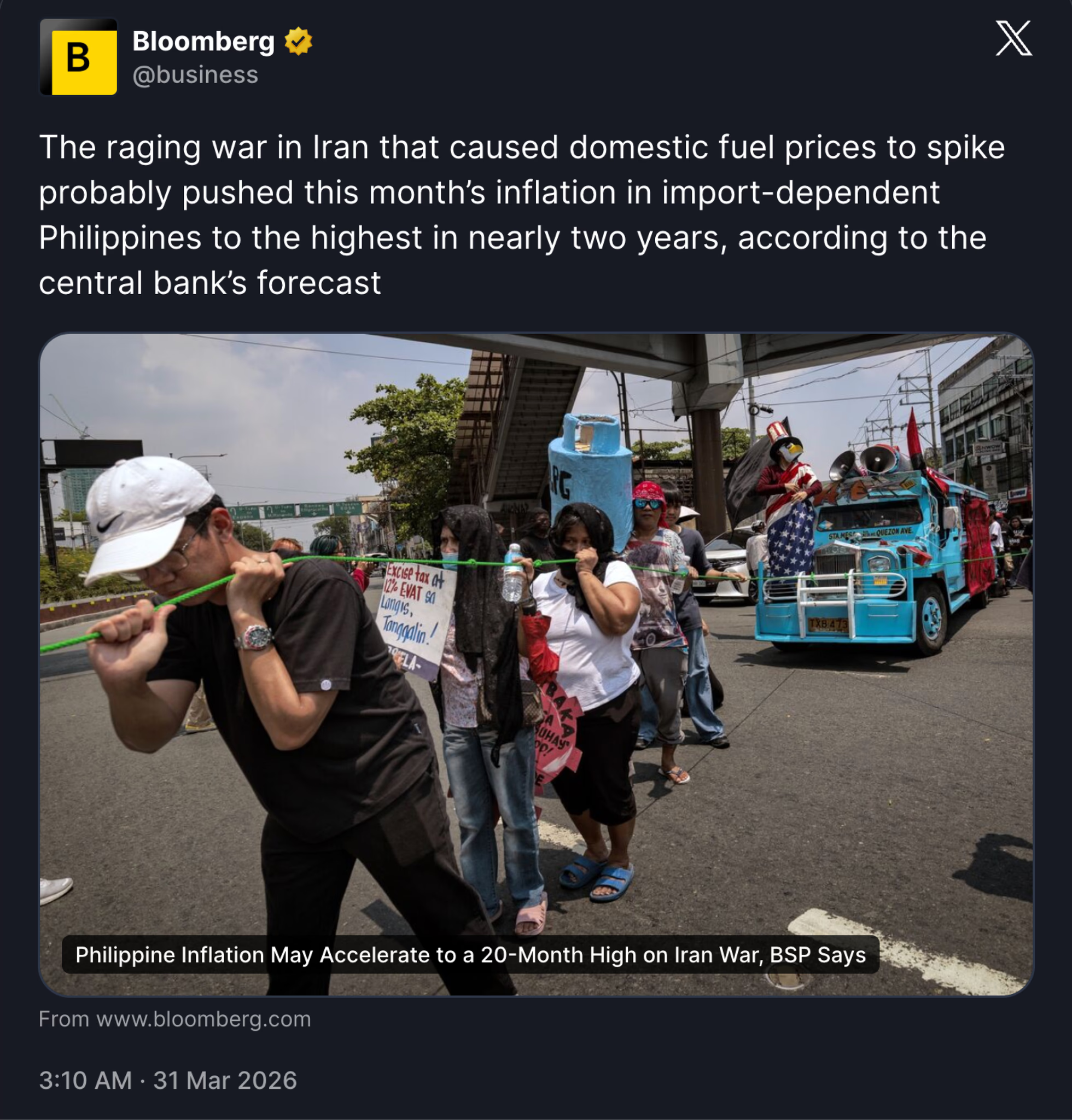
The United States withdrawing from the existing world order is a more significant concern for everyone else, few of whom—bar possibly China—have been preparing for it. We see this in the natural gas issues in Europe post-Ukraine war. We see this in the energy crisis unfolding in East Asia and Southeast Asia following the closure of the Strait of Hormuz. We see this in the flight of Middle Eastern expatriates amid an unexpectedly prolonged conflict.
In modern mercantilist games, the United States is best positioned to become more self-sufficient. China is naturally in a markedly worse position—surrounded by hostile powers, energy-dependent, food-dependent, and technology-dependent—but that is precisely why it has been dying to invest in renewable energy, semiconductors, military build-up, and food security for decades. China has been artificially keeping its currency undervalued for decades, reinvesting surpluses in strategically vulnerable areas, preparing for a multipolar world.
Other nations have not.
In a large-scale industrial paradigm, many developing economies' greatest assets are abundant, low-cost labor as capital scours the globe for cheaper inputs. In a world hostile to maritime trade, rising insurance costs, and sustained high energy prices, capital and computing power-rich nations will invest in domestic automated production. The demographic dividend turns into a demographic burden.
While the 2000s to 2020 were decades of globalization, harnessing abundant human labor, and convergence, with "developing" economies "catching up" to "developed" counterparts, the next decade promises to reverse these macro trends. Countries with abundant capital, elite cutting-edge technical talent, scale, and the political will to fully implement AI and robotics will re-accelerate. The global remainder may be split in two: those with relevant natural resources or niche industrial processes serving the AI, robotics, and military supercycle, and those left with large amounts of fast-depreciating human labor.
The pair trade is quite clear.
Potential Seed Investment Sweet Spots
Macro is shouting "go long commodities, short bonds"—but these aren't seed checks. However, the divorce throws up a multitude of fundable, founder-shaped problems:
Reshoring processing: Rare earth separation and magnet manufacturing (China holds ~90%), uranium enrichment and HALEU (Russia dominates, with every SMR startup silently dependent), and de-DJI'ing the Western drone stack—motors, flight controllers, optics.
Tools for reshoring: Every reshoring enterprise now faces a "certified second supplier" problem. Sub-tier supply chain mapping, bottleneck exposure intelligence, friend-shore outsourcing procurement markets, vendor certification software. Software stacks to assist large-scale reshoring efforts.
Open weights are becoming the default base layer for the non-American world. Services, middleware, and tool layers around open models represent an obvious stack for cost-sensitive Global South and any business allergic to American frontier lock-in.
Repricing the risk itself. As the US ceases insuring maritime pathways, the world's insurance premiums rise. Parametric and war/political risk insurance tech, supply chain disruption insurance, geopolitical risk pricing intelligence. Everyone is rushing to new defense behemoths, but companies repricing this risk will materially benefit.
Vertical farming and gene-edited agricultural products: The Dutch model is gaining attention globally; crops bred for resilience against extreme weather.
The Triffin paradox has a pipeline layer. As the official sector reverses dollar repatriation, street demand for dollars in emerging markets paradoxically rises—central banks de-dollarizing, corner dollars. Dollar acquisition and trade finance tracks continue to spread.
3. Demographic Structure (and Longevity)
In 1950, four countries had birth rates below replacement level. By 2024, that number is 136 (covering 71% of the world). China's total fertility rate has fallen to about 1.0, indicating a low population in the hundreds of millions by 2100. In Italy, Portugal, Greece, Japan, and South Korea, over one-third of the population will be >65 by 2050. Every day, 10,000 Americans in the Baby Boomer generation turn 65, with the Social Security trust fund expected to go bankrupt in the early 2030s.
We are living longer, giving birth to fewer.
The implications for budgetary finances, elderly care, healthcare costs as a percentage of GDP, and labor participation rates are evident. The welfare state of the industrial era was predicated on maintaining birth rates above replacement level; a Ponzi scheme driven by contributions from an increasing number of young participants. With the rapid inversion of demographic structures brought by modernity, the model has been broken.
So... who will pay the bill for these unfunded debts?
The most obvious and perhaps likely solution is a combination of currency devaluation and accelerated automation. A cocktail of money printing, taxation, agent productivity, and robotics.
However, another, more optimistic scenario is budding. Extending human lifespans, allowing for more healthy productive years. The mountain factors show clear signs of reversing cellular aging. From NewLimit to Altos Labs to Life Biosciences, companies focused on longevity are gaining billions in funding. Given the FDA's framework, each company targets specific organ diseases, but the grand vision is to treat aging itself.
Compared to the massive capital infusion and valuation spikes seen in the AI and robotics space, market enthusiasm in the AI x biology crossover area has surprisingly remained low until recently. The industry's decline from its 2021 peak has been particularly brutal, but the vast computing power going live is providing novel insights into previously locked molecular mysteries—the protein folding, multi-gene traits, cellular mechanisms—these fields are increasingly falling within the realm of the understandable.
To echo Demis Hassabis, "If math is the language of physics, then machine learning is the language of biology."
This is a huge cake.
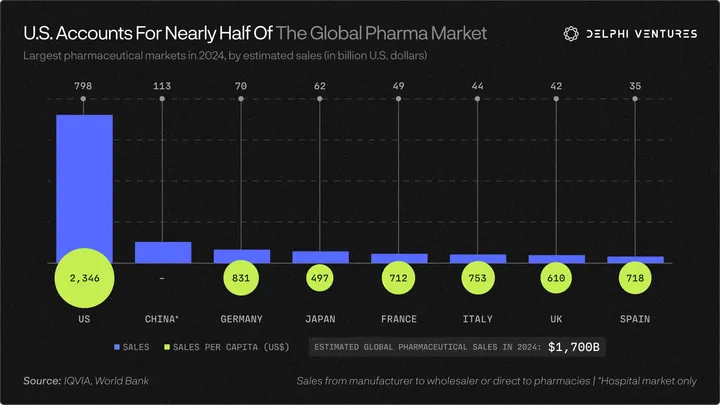
As we refine our understanding of biological mechanisms, it’s hard not to think these numbers will significantly rise. GLP-1 is just the tip of the iceberg.
Once you can edit genomes and reverse cellular aging, most of the discretionary income of the post-scarcity age will likely flow in that direction. In the grand scheme of economics, the only real currency is time. By training millions of GPUs to study the most atomic units of life, the greatest achievement of the 21st century may be that we learned how to manufacture more time.
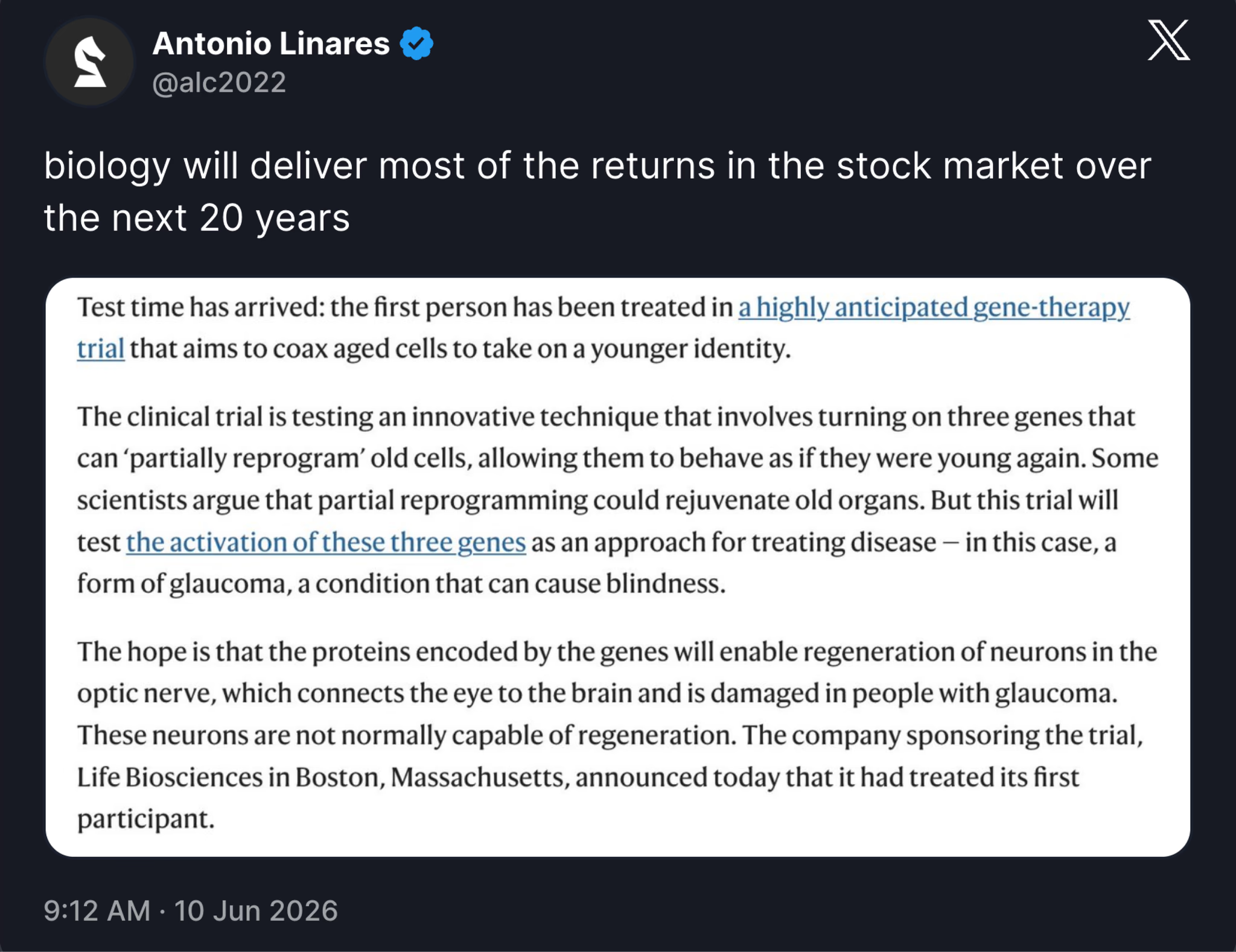
In the medium term, I hope the greatest gift AI gives humanity is an extension of lifespan, which will greatly enhance productivity in later years, helping us maintain balance in population structure before large-scale deployments of humanoid robots.
In the long term, I hope the deflation that AI brings will lead to a rebound in birth rates. Embryo screening. Advances in reproductive technology. Artificial wombs. Reduced costs of child-rearing. Working hours decrease by 50%. I suspect the 21st century will witness a substantive shift from building identity around work to building identity around personal passions and family.
We hope our investments can play a small role in pushing this future to come.
Potential Investment Areas in Seed Rounds
The longevity field lacks data: aging clocks need longitudinal multi-omics data, which is rare. Biomarker and biological age companies, home multi-omics sampling, and ultimately implantable biosensors can quietly create training sets.
Human enhancement: Enhancement/assistance of vision, voice, mobility, etc.
Brain-machine interfaces: Human-machine interfaces that bypass skin and language barriers to achieve tighter feedback and faster bandwidth communication.
AI for tradespeople: Reshoring manufacturing + grid construction + population collapse, all point to the shortage of electricians, plumbers, HVAC technicians, and linemen.
Reproductive frontier: Artificial wombs are still in early stages, but in vitro gamete generation, IVF automation, and multi-gene embryo screening all show real opportunities.
Demographic dividend: The 60-80 age group is historically the wealthiest yet underserved consumer market. Fintech for equity conversion, longevity risk products, and late-life productivity tools all seem to be underexplored categories.
Stalemate: The Paradox of Technological Acceleration
So, we seem to be in a dilemma. Without technological acceleration, we risk being trapped in a doom loop of demographic structure, deficits, and degrowth. With technological acceleration, we face a higher probability of apocalypse and runaway inequality exacerbating polarization.
Our viewpoint is that technological acceleration is the only true option; it requires careful management and proactive efforts to diffuse benefits to ensure societal support.
Debt/GDP has exceeded 300%. The demographic pyramid is inverted. Fiscal deficits are high and only expected to increase. Nearly every dimension of reindustrialization, national security, climate transition, grid capacity, etc., requires massive investment.
As Ray Dalio reminds us, in every crisis characterized by local currency-denominated debt, governments inevitably resort to printing money. In the tightrope between austerity, rising debt, and increasing yields, the inevitable outlet is currency.
To quote Keynes quoting Lenin: "There is no more subtle and sure means of overturning the existing basis of society than to debauch the currency."
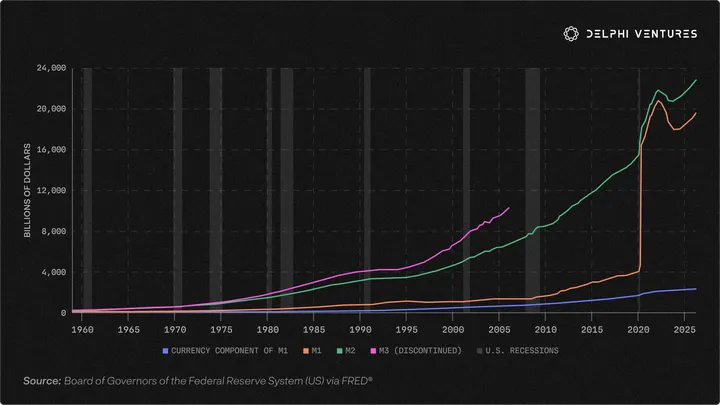
These grievances are erupting in real-time.
Populist politics is rising globally. The cost of living crisis is a major culprit. The speed of money creation exceeds production. Given the reversal of globalization, the cost of rearming in a multipolar world, and rising medical costs in aging societies, deficits will only continue to grow.
Ironically, automation is the only real exit for most nation-states to escape the fiscal doom loop, but the structural inequality it brings is almost certain to provoke backlash, making it difficult to implement. The largest obstacles now are political.
The obvious question is: What pace of acceleration can society tolerate? How do we ensure that benefits are widely distributed? Given that value creation is increasingly concentrated in large corporate entities, pure market forces seem unlikely to lead to politically tolerable outcomes.
For me, four dynamic and mutually influential futures unfold before the West:
Technological feudalism: Continuing the current trajectory without adjustments: Capital rapidly converts into agents and embodied intelligence, with huge gains concentrated in the narrow pockets of San Francisco and New York. Having a small share of computing power and data flywheel is the answer, but it may provoke political resistance, such as...
Maximizing China-ization: Political discontent leans towards authoritarian states supported by advanced technology: stricter capital controls, higher taxes, more surveillance in exchange for greater security, convenience, stability, and public works. However, this overreach will invite backlash from creators in a world of fluid capital and talent flow, fueling...
Flight to the network: Balaji-style libertarianism dissolves industrial-age institutions: capital fleeing to friendlier jurisdictions, crypto wallets, distributed AI, and those who remain face fiscal pressure. Or...
We barely make it. We find a way to traverse the narrow corridor, accelerating just enough to avoid the doom loop, diffusing/re-distributing just enough for broader societal support—to usher in a golden age within the existing institutional framework rather than through radical reform.
Before the intelligence boom, scenarios two and three seem oddly probable. Therefore, Delphi Ventures’ thesis heavily relies on crypto: establishing a better, uncorrupted parallel system for exchange, collaboration, and wealth preservation as the structural realities of demographic inversion, rising deficits, political fracturing, and currency devaluation play out.
A barbell strategy between hard assets and internet-based alternative value storage remains a powerful way to hedge against these macro trends: positioning ahead of nations solidifying dependencies—going long on commodities, energy, and defense, while shorting fiat currencies and bonds. Getting ahead of devaluation and confiscation in Bitcoin, Zcash, and the distributed agent economy, hedging against non-G2 emerging markets and bankrupt municipal authorities.
However, with the onset of the intelligence revolution in November 2022, we appear to have increasingly found a golden ticket: the productivity boom of the next decade could override the swords of Damocles posed by demographic structure, deficits, and devaluation.
Previously, we supported entrepreneurs creating outside the existing system. We will continue to do so. However, given this evolution, we will also invest in the most outstanding talents within existing paradigms as it is being reborn before our eyes.
Yes, the challenges are daunting. We face soaring debt, spiraling deficits, political polarization, a global cost-of-living crisis, the return of war and great power politics, and uncontrolled AI risks. Watching the news or X information feed, it is hard not to feel hopeless.
Don't be fooled.
By 2035, the entire world and low Earth orbit will be filled with accelerating computing power. We see turning points in agent capabilities, robotics, rocket launching, advanced materials, novel therapies, and more.
The future belongs to the optimists. Invest accordingly.
We certainly will.
Thanks to @ZeMariaMacedo for the initial ideas of this article, @cannngurel for feedback, and Neco of @Delphi_Design for producing the charts.
免责声明:本文章仅代表作者个人观点,不代表本平台的立场和观点。本文章仅供信息分享,不构成对任何人的任何投资建议。用户与作者之间的任何争议,与本平台无关。如网页中刊载的文章或图片涉及侵权,请提供相关的权利证明和身份证明发送邮件到support@aicoin.com,本平台相关工作人员将会进行核查。


