Author: Wall Street Jiewen
The seemingly calm global financial markets are accumulating energy for a storm.
Yie-Hsin Hung, CEO of State Street Investment Management, told the Financial Times this week that the new Federal Reserve Chairman, Walsh, is intentionally reducing forward guidance, making it increasingly difficult for the market to grasp the path of monetary policy, "this will introduce volatility and uncertainty."
The exchange rate of the yen against the dollar broke the 162 threshold this week, reaching a nearly 40-year low, raising market alertness around the potential risks of yen carry trades. Amundi's investment director Vincent Mortier's suggestion is: diversify risks as much as possible and hedge comprehensively.
Meanwhile, the volatility index (VIX) of U.S. stocks remains low, but internal market pressures have quietly risen to near-high levels in recent years. UBS's derivatives strategy team’s "Turbu-lens" market fragility indicator currently reads as high as 0.9 (on a scale of -1 to 1), the highest level since mid-September 2025, and historically such readings often predict a phase increase in VIX. At the same time, the earnings expectation for the second-quarter earnings season is as high as 24%, amplifying potential downside risks.
The new Fed chairman brings policy uncertainty
For the market, the brand new Fed leadership is currently one of the main sources of uncertainty.
After taking office, Chairman Walsh deliberately narrowed the scope and frequency of external communication, actively reducing forward guidance on the next steps of monetary policy. The Financial Times quoted analyst views stating that from a macroprudential perspective, this approach is defensible — guiding market expectations is not the core job of the Fed, and a more streamlined and coordinated external communication may yield more benefits than drawbacks.
However, when this policy narrative is compounded by Walsh's ambition to promote reform, along with the ongoing turmoil in Iran, the situation becomes complex. The inflation concerns driven by rising oil prices have led to significant corrections in the bond market this week, primarily because investors are uncertain whether Walsh will respond to the recent modest but meaningful rise in oil prices, and are unclear about his overall inclination toward future Fed policy direction. Bond market yields are currently approaching 4.6%, further increasing the valuation pressures on the equity market.
Yen approaching a dangerous critical point again
The yen is once again becoming a potential "trigger point" in global markets.
This week, the dollar-yen exchange rate broke the 162 threshold, with the yen hitting its weakest level in 40 years, as the market bets that Japanese authorities will allow inflation to run at relatively high levels while remaining cautious about interest rate hikes.
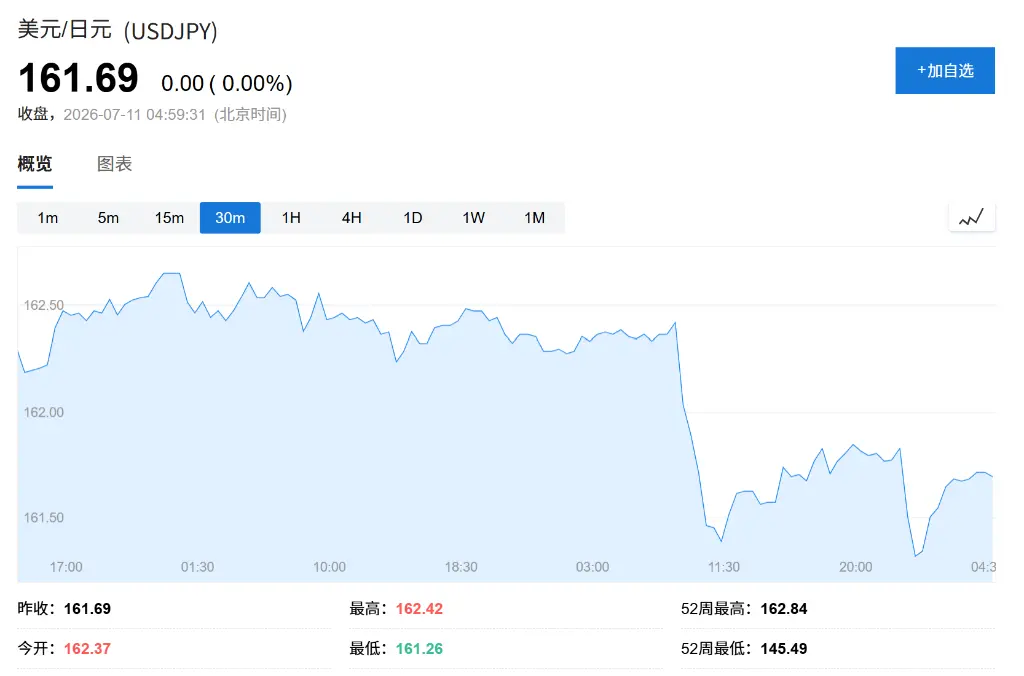
The systemic risks surrounding the yen mainly arise from two transmission pathways. Firstly, the Japanese authorities may need to sell U.S. dollar assets—especially U.S. Treasury bonds—to intervene in the foreign exchange market and stabilize the yen, which may trigger ripple effects in the global bond market. Secondly, there still exist large positions in the market that involve low-cost yen borrowing to buy other global assets. If the yen were to surge significantly, these positions would face pressure to close, and the aftershocks could spread to currently unpredictable corners of the market. The Bank of England also pointed out this week that leveraged funds (i.e., borrowed funds) have been a major driver of the recent strengthening of global stock markets, with a rapid growth in scale—this has never been a reassuring signal.
VIX remains calm, market fragility rises to historic high
Barclays strategist Emmanuel Cau characterizes the current phase of U.S. stocks as a "dangerous summer window," believing there are dark currents beneath the seemingly stable market benchmark. A team of Barclays strategists led by Anshul Gupta pointed out that the recent decline in VIX coincides with a seasonal calendar window where fluctuations usually narrow, representing a "brief sweet period" with limited sustainability.
More concerning is the significant divergence between indexes and individual stocks. UBS strategist Maxwell Grinacoff's team pointed out that current single-stock volatility has exceeded index volatility by over three times. The team warns that the probability of this gap narrowing in the summer is high — during which any significant re-pricing of monetary policy or geopolitical disturbances may trigger sharp increases in index-level volatility. If systematic strategies further increase leverage, this fragility indicator reading "may truly reach +1".
The seasonal liquidity shortage of summer further amplifies this issue. Every summer in the Northern Hemisphere, senior traders and investors take vacations, leaving behind more junior teams, resulting in shrinking trading volumes and a sharp decline in market liquidity. Spreads widen, and even in the absence of substantive new information, various assets such as stocks, bonds, and foreign exchange are more likely to experience violent fluctuations. A vivid precedent occurred in the summer of 2024: a disappointing U.S. inflation data that was not severe unexpectedly hit the dollar hard, boosted the yen, and caused tech stocks to crash, with the Japanese stock market plummeting 12% in a single day, leading to widespread speculation that the Fed would cut interest rates urgently.
High expectation earnings season, risks lie in unmet expectations
Against this macro backdrop, a high-expectation earnings season is now officially underway, further centralizing market risks.
Analysts expect a 24% growth in second-quarter earnings for S&P 500 constituent stocks, and a 12% expectation for the STOXX Europe 600. Unlike previous earnings seasons, analysts have consistently raised forecasts ahead of the reporting period, and strong confidence means that once actual performance disappoints the market, the adjustment potential is greater, and the decline may be steeper.
The technology sector, in particular, needs close attention. According to Barclays estimates, from October last year to now, Apple, Meta, Amazon, Alphabet, Microsoft, and Nvidia have collectively evaporated about $2 trillion in market value. Notably, the chip giant Nvidia, with a market value of $5 trillion, now has a price-to-earnings ratio comparable to that of the snack company Hershey, indicating a significant cooling of market enthusiasm towards it.
The fields of gold and oil have also seen unexpected reversals for investors. After a strong performance at the start of 2026, gold prices recently recorded the largest monthly decline since 2008, falling more than 11%; oil prices, despite warnings from energy experts, also fell against the trend. These changes point to a reality: market consensus is breaking down, and the reliability of the mainstream narrative logic has been significantly discounted.
In choosing hedge strategies, given that stock differentiation and sector rotation may continue during earnings season, the effectiveness of index-level hedge tools may be limited. Maxwell Grinacoff suggests, "single-stock options may offer better opportunities on a tactical level." Vincent Mortier from Amundi provides a broader suggestion: diversify risks as much as possible and hedge comprehensively — this way, "the whole summer can be a relaxing vacation, which is a nice goal."
免责声明:本文章仅代表作者个人观点,不代表本平台的立场和观点。本文章仅供信息分享,不构成对任何人的任何投资建议。用户与作者之间的任何争议,与本平台无关。如网页中刊载的文章或图片涉及侵权,请提供相关的权利证明和身份证明发送邮件到support@aicoin.com,本平台相关工作人员将会进行核查。


