Author: insights4vc
Translation: ShenChao TechFlow
ShenChao's Introduction: Robinhood launches its own Layer 2 chain and "tokenized stocks," seemingly moving stocks on-chain, but in reality, users only receive a repackaged bond certificate—lacking voting rights and not representing true equity. The extent to which this packaging game can go depends on whether users, developers, and regulators can accept the contradiction of "simple interface, complex underlying."
Robinhood's actions can easily be misinterpreted if one only looks at the surface. On the surface, the story is captivating: a large retail brokerage launches a public, Ethereum-compatible, Arbitrum-based Layer 2; it supports wallets, ETH gas, cross-chain bridges, tokenized market exposure, and DeFi integration; it aims to make financial products cheaper, more portable, and more global. This is mostly true.
The real strategic issue lies beneath. Robinhood is building a permissionless financial chain, but the assets that make this chain strategically interesting are not genuinely permissionless financial objects. They are repackaged claims of rights still bound by law. This chain may be freely deployed. Tokens may be transferable between supported wallets. But economically meaningful tools still rely on issuers, prospectuses, custodians, authorized participant networks, sanctions and KYC controls, jurisdiction exclusions, oracle designs, and legal recourse that seems entirely different from direct shareholding.
This is the broker chain paradox. Robinhood's opportunity lies in hiding this complexity well enough to make the products feel simple, global, and useful. Robinhood's risk lies in users, developers, and regulators refusing to ignore the underlying complexity. If users think "tokenized stocks" are just "stocks," then the gap between language and legal reality will turn into a product liability issue. If regulators think the packaging is clear and fairly disclosed, the structure may expand. If they believe the packaging encourages misunderstanding, the expansion may just stall at the point where the story becomes interesting.
From this perspective, Robinhood Chain is neither a purely crypto experiment nor a simple extension of a brokerage application. It is an attempt to create a new tier in the middle: a consumer-facing financial stack that feels intuitively straightforward but underneath has deep structuring, strict controls, and specific jurisdictions. This is commercially reasonable. But it is also inherently fragile. If Robinhood cannot maintain the illusion of simplicity without exaggerating what users actually own, no part of the strategy will work.
Robinhood's Current Position and Super App Ambition
Robinhood's launch of Robinhood Chain is not a defensive move. The company starts from an unusually advantageous operational position—for a brokerage that only a few years ago was seen by many investors as a cyclical retail trading platform.
Robinhood (Nasdaq symbol: HOOD) plans to release its Q2 2026 financial report after the market closes on Wednesday, July 29, 2026.
Revenue structure is critical because it shows where the business is actually monetizing today. In Q1 2026, options generated $260 million in trading revenue, stocks $82 million, event contracts $104 million, other trading revenues $43 million, and cryptocurrencies $134 million. The standout growth line is event contracts, which rose from $3 million in the same quarter last year to $104 million, while crypto revenue fell from $252 million to $134 million. Therefore, the launch of Robinhood Chain comes at a time when the company's earnings are still primarily driven by active retail trading, high-margin products, and balance sheet monetization, rather than any existing on-chain business line.
This distinction is important for both strategy and valuation. Robinhood Chain is not saving the business. It attempts to create a new interface on top of an already functioning business. This makes the initiative more credible because the company has the capacity to experiment. It also makes the initiative easier to exaggerate, as the existing earnings engine remains rooted in mature brokerage economics.
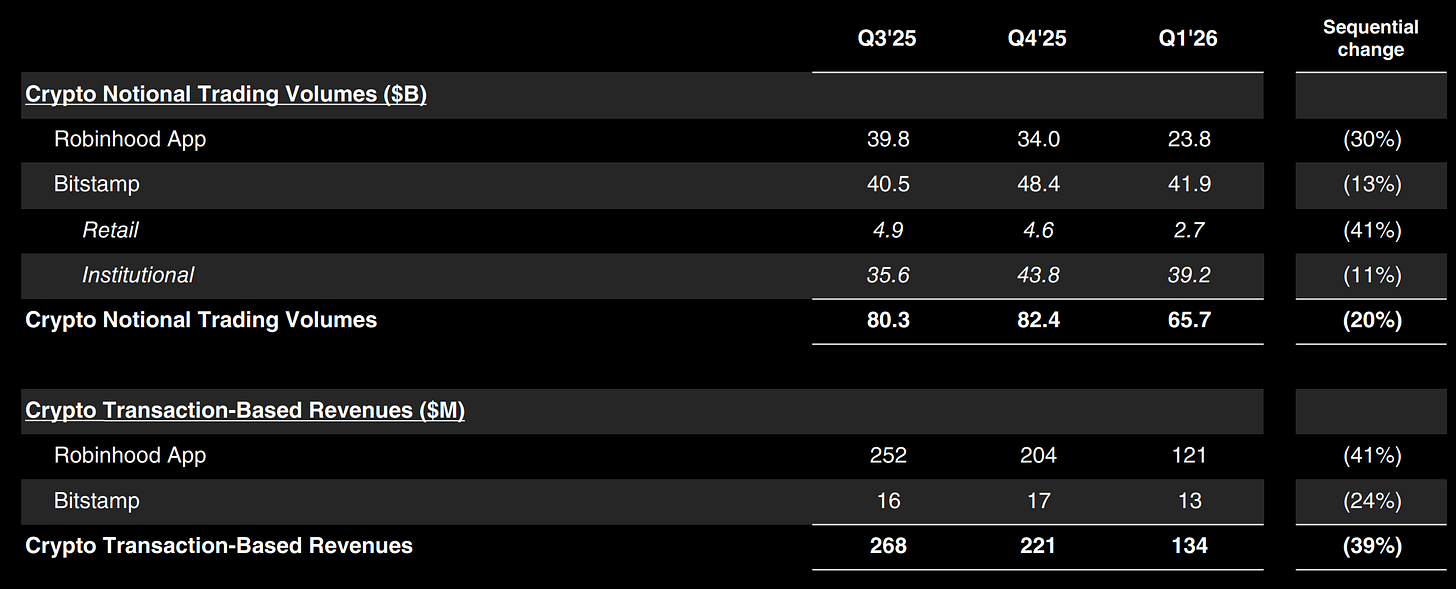
The remainder of the balance sheet and user engagement points in the same direction. Robinhood disclosed a $17 billion margin book, $16.7 billion in cash and deposits, $27.4 billion in retirement assets under custody, and $66 billion in nominal crypto trading volume for Q1 2026, of which $42 billion came from Bitstamp and $24 billion from the Robinhood app. This last number is particularly relevant. Bitstamp has already made Robinhood's crypto footprint look more like infrastructure rather than an isolated retail trading feature.
From Brokerage Application to Financial Super App
Robinhood's strategic logic now appears more coherent than when the company initially began to add scattered products around its core brokerage. In Q1 2026 and subsequent public materials, the company no longer just describes product expansion. It sketches a more complete operating model: brokerage, options, futures, event contracts, banking, Gold, retirement, crypto, wallets, private market access, AI tools, global licensing, tokenized assets, and DeFi-associated revenues. Management's talk of building a "global financial ecosystem" is not just corporate rhetoric. It is an attempt to explain how the various layers fit together.
The broader stack now includes several individual parts that might seem incoherent when viewed separately. Robinhood Banking and higher cash engagement are important because they deepen deposit and balance relationships. Robinhood Gold is important because it increases subscription upsell rates and supports premium packaging models. Retirement is important because it extends the lifecycle of assets and reduces purely cyclical trading. Futures and event contracts are important because they improve participation and monetization intensity. Crypto is important because it offers a 24/7 market, self-custody tracks, and global funding flexibility. Bitstamp is important because it expands institutional and international coverage. Wallets are important because they give Robinhood a credible non-custodial interface. Robinhood Chain is important because it provides a programmable settlement layer where, in principle, all these financial activities can begin to converge.
The company's international direction reinforces the same point. Robinhood is expanding into Canada through WonderFi, disclosing regulatory progress in Singapore, and describing its UK crypto plans. The significance of these steps is not just new territory, but because they create a testing ground for products that do not entirely conform to the American retail brokerage rule set. Tokenized packaging and wallet-native products are easier to introduce at the edges of the group rather than bringing them into the regulated core of the US application overnight.
The strategic statement is simple: Robinhood Chain is important because it may allow Robinhood to extend its consumer distribution advantage into programmable finance without having to overnight convert the core US brokerage into a crypto-native venue. This is why this chain should be interpreted as an infrastructure strategy, rather than a release marketing gimmick.
What Is Robinhood Chain?
Robinhood Chain's documentation describes it as an Arbitrum Layer 2 chain built on Ethereum, using Ethereum blobs for data availability, and ETH as the native gas token. Robinhood Wallet natively supports it, and other EVM wallets can be manually added. Assets can be transferred onto the chain using standard Arbitrum bridges or partner routing. Public materials also emphasize that the chain is open and permissionless, EVM-compatible, and designed for tokenizing real-world assets.
Robinhood's July 2026 launch materials state that the chain is built to "institutional standards" on the Arbitrum platform, naming Uniswap as the AMM on day one and Pleiades as a proprietary AMM/self-trading venue. Robinhood's technical documentation adds that Stock Tokens are standard ERC-20, with each token having Chainlink price sources, and company actions reflected via on-chain multipliers rather than rebalance changes to balances.
However, the public documentation is not uniformly complete on all infrastructure issues. We found clear documentation on connectivity, gas, cross-chain bridges, token formats, and oracle designs, but fewer explicit public explanations regarding sorting decentralization, governance pathways, proof-of-failure state, or the exact current production roles of each named infrastructure partner. This does not imply that the system is weak; it means that some institutional-level due diligence questions still require more disclosure than what is currently provided in public documents.
The main conclusions are straightforward. Robinhood Chain is real but still early stage. It has infrastructure, partners, and associated real-time products. What it does not yet have are proof of lasting liquidity, extensive developer adoption, seamless regulatory portability, or substantial revenue contribution. This distinction is important. A public mainnet and several real-time products are enough to take the strategy seriously. They are not enough to prove it.
The Legal Reality of Stock Tokens and On-Chain Stocks
The most important sentence in this article is also the simplest: Robinhood's Stock Tokens should not be described as on-chain stocks. They are tokenized economic exposure to securities wrapped in legal packaging.
Robinhood's on-chain Stock Tokens are described in public materials and prospectus documents as tokenized debt securities issued by Robinhood Assets Jersey Limited. They provide economic exposure to reference stocks or ETFs, but users do not gain direct legal ownership of the underlying securities, beneficial ownership of such shares, or typical shareholder rights like voting. Product documentation is clear on this point, and the prospectus framework is clearer than much of the marketing shorthand surrounding "stock tokens" implies.
Robinhood Europe's earlier "Classic Stock Tokens" are legally different again. These products are described as derivative contracts between users and Robinhood Europe, UAB. They cannot be transferred to external wallets and can only be entered into or terminated through the Robinhood Europe platform. The legal boundaries there are even less vague: customers are dealing with derivative exposure, not tokenized holder rights claims.
Newer on-chain products are more aggressive in distribution but more conservative in legal structure. This is exactly why it may work. Tokens can behave like crypto assets at the interface layer: on-chain transfers, holding in compatible wallets, referencing in DeFi, and pricing by oracles. But the underlying claims of rights remain conservative: debt securities issued in Jersey, managed by a prospectus, secured, and with limited recourse, referencing underlying shares. Robinhood has not dismantled securities law. It has packaged around it.
This structure also relies on designated service providers and legal control points. The underlying research review identifies Robinhood Assets Jersey Limited as the issuer and tokenizer, Bitstamp Global Ltd. as the authorized offeror in relevant terms under examination, and Alpaca Securities LLC as the custodian and broker of the reference series. These roles are critical because the desire for globally portable tokenized exposure is still connected in practice through highly traditional financial pipelines.
Even the asset-backed story is more complex than this phrase implies. Robinhood's materials claim that each token is backed 1:1 by the underlying stock. The prospectus framework describes isolated accounts for each series but also permits securities lending. During the lifecycle of a securities lending transaction, the issuer's economic exposure operates through collateral and contractual rights, rather than through holdings of untouched shares held in custody. This difference may matter under stress conditions. It introduces risks of borrowers, collateral, operational, and recovery value that may be unfamiliar to retail users deriving simple intuitions from the product name.
Corporate actions and dividends are also indirect. Robinhood's materials explain that dividends are handled through a multiplier mechanism adjusting the token reference economics rather than distributing direct shareholder allocations to users. The prospectus also flags considerations around withholding taxes and Section 871(m) equivalents regarding dividends. Again, this does not render the product defective. It makes it structured. Users should keep their eyes open when purchasing this structure.
Transferability is real but not absolute. Robinhood states on-chain Stock Tokens can be held and transferred on supported blockchains and compatible wallets. At the same time, documentation allows for certain circumstances to pause, freeze, and restrict; purchases or redemptions remain subject to KYC, AML, sanctions compliance, and jurisdiction exclusions. This is closer to a programmable, packaged, conditional product rather than an unrestricted holder tool.
The commercial conclusion is straightforward. The product is aggressive in distribution but conservative in legal structure. This combination is not a defect. It may be the only viable route to market. But it also means that Stock Tokens should be assessed as a legal and market structure experiment that makes economic exposure portable rather than as an on-chain alternative to actual stock ownership.
Digital Assets as Infrastructure, Not Just Trading Revenue
Robinhood's digital asset strategy is now too broad to fit into the old framework of "crypto trading revenue." Cryptocurrency as a revenue line remains important, but its role as infrastructure is becoming increasingly significant. This shift is precisely the deeper meaning of Robinhood Chain.
Crypto trading revenue still matters, but it no longer tells the full story. In Q1 2026, Robinhood generated $134 million in crypto trading revenue, a significant decline from the previous year, even though nominal cryptocurrency trading volume reached $66 billion. Out of this $66 billion in nominal trading volume, $42 billion came from Bitstamp and $24 billion from the Robinhood app. In other words, Robinhood's digital asset footprint has extended beyond its consumer-facing crypto label.
Bitstamp is central here. In June 2025, Robinhood completed its acquisition of Bitstamp for approximately $200 million in cash and explicitly positioned this transaction as gaining global exchange capabilities, institutional clients, white-label infrastructure, staking, institutional lending, and broader licensing coverage. In subsequent documents, Robinhood has already described Bitstamp as expanding the institutional side of the business to services such as on-exchange lending, over-the-counter settlements, post-trade settlements, and institutional perpetual contracts. If a company still views cryptocurrency as an adjunct to its retail business, it would not say this.
Robinhood Earn demonstrates the same point from the consumer side. Public materials describe a simple process: users buy USDG on Robinhood Crypto, transfer it to a self-custody wallet, and then borrow through Morpho. Robinhood cautiously discloses that this wallet is non-custodial and that withdrawal times depend on the liquidity of the funding pool. Morpho describes Robinhood Earn as a gradual rollout for qualified US users. This is not just about adding yield to cash balances; it is about educating the Robinhood user base that DeFi can hide behind the interface without customers needing to have crypto-native behavior.
The stablecoin angle is important because it may be more enduring than any single speculative trading cycle. If Robinhood can transform stablecoin balances into an invisible funding track, it gains a portable, programmable financing layer for wallet-native activities, international capital flows, and future collateral use cases. In this model, stablecoins are not the product itself but the settlement medium underlying the product. This is a strategically more important role.
Robinhood Wallet is the user-end bridge to this tech stack. Supporting materials show that this wallet now covers multiple major blockchains, including Robinhood Chain itself. This is significant because wallet strategy is where brokerage distribution and crypto infrastructure meet. Brokers can custody, wallets can aggregate. Robinhood increasingly hopes to have both in the same customer relationship.
Why Lighter Matters
Lighter is one of the clearest examples of Robinhood's infrastructure positioning. Lighter provides Robinhood with advanced on-chain trade design without having to build a crypto-native perpetual contract exchange from scratch. Public materials describe Lighter as a customized zero-knowledge rollup with order matching and settlement proof, price-time priority execution, and emergency exit designs for when certain operations are not processed timely. Robinhood Wallet materials describe perpetual contracts in the wallet, including settlement mechanisms and funding rate dynamics, with the underlying decentralized protocol responsible for handling settlements.
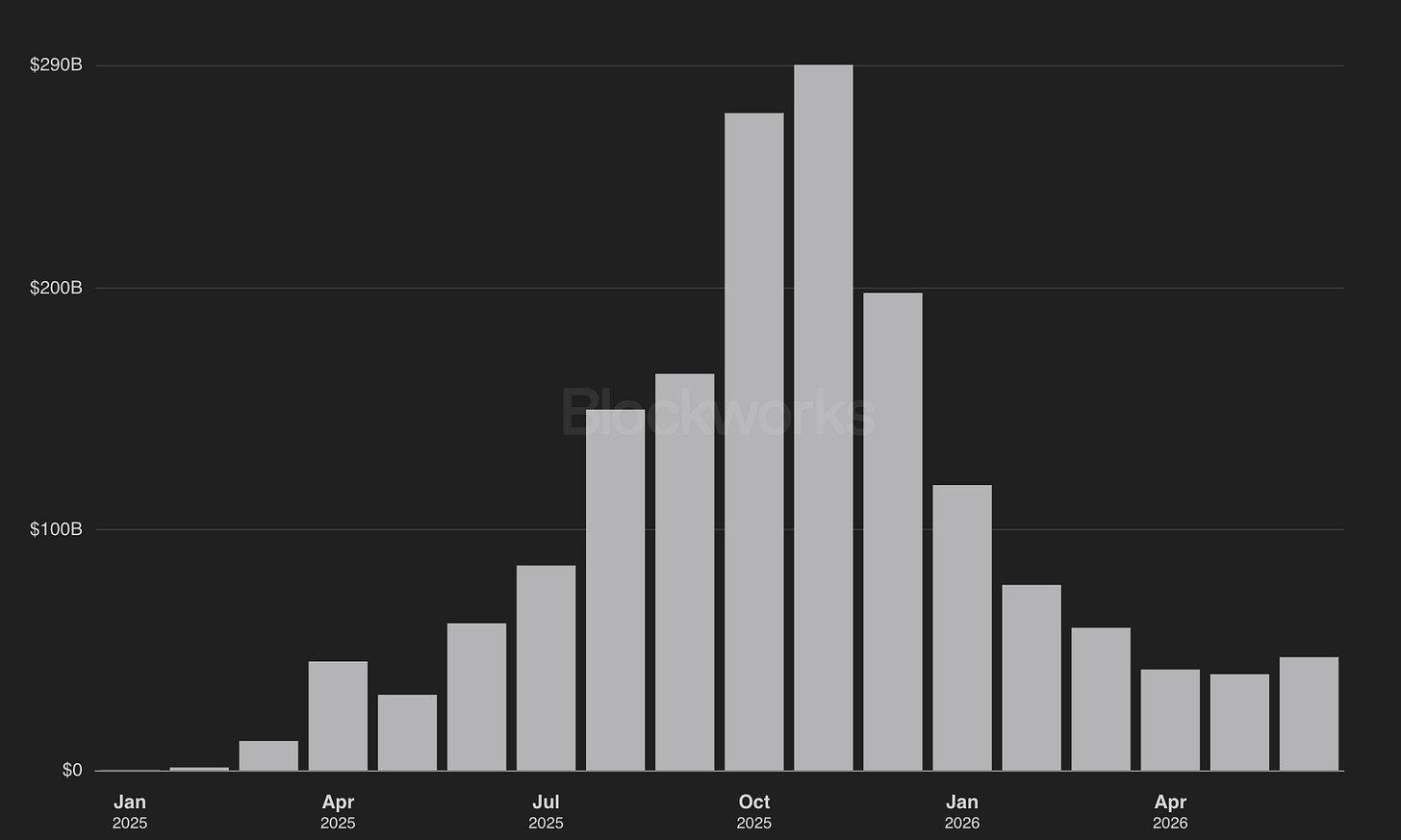
Perpetual contract nominal trading volume (Source: Blockworks)
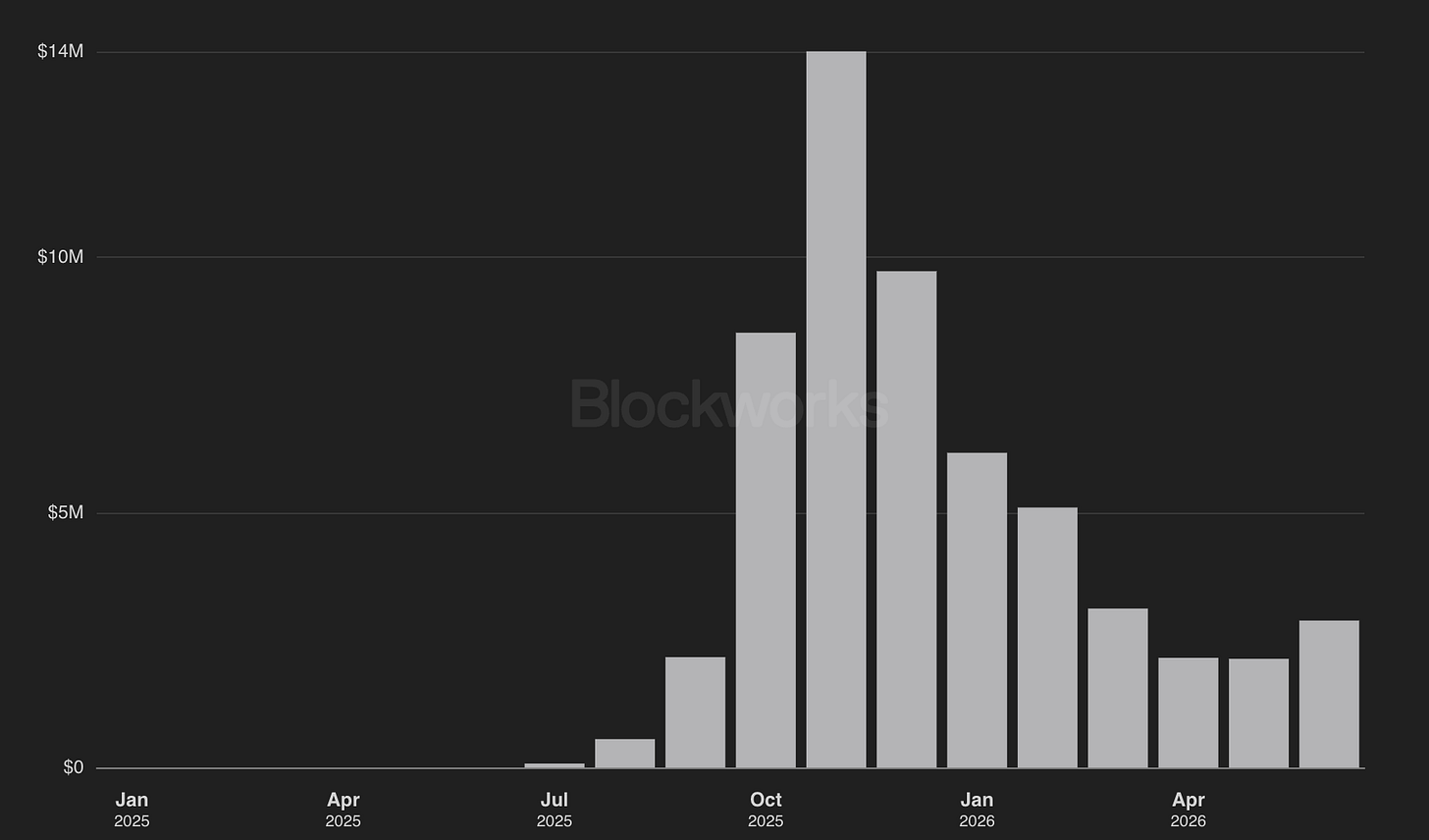
Revenue (Source: Blockworks)
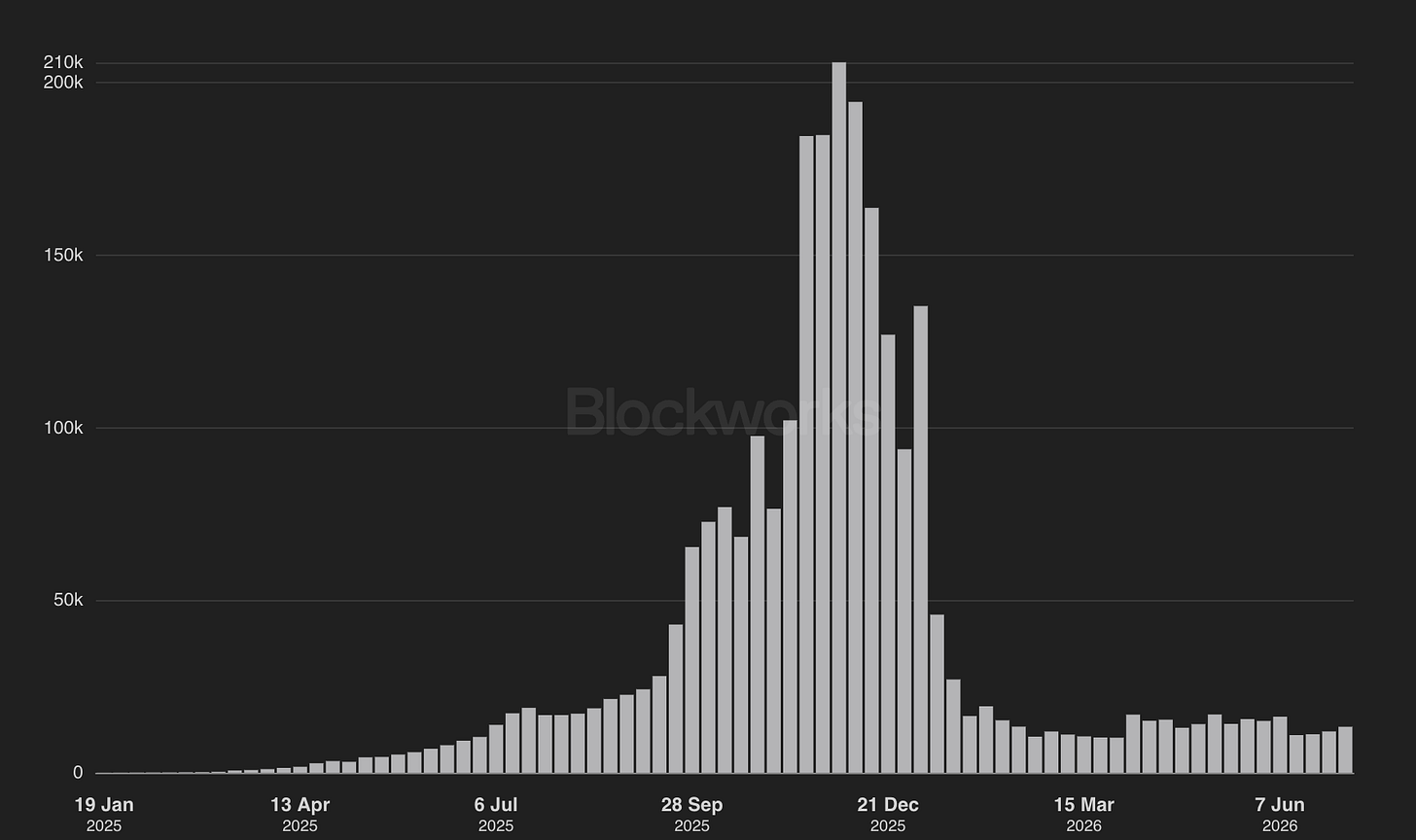
Traders (Source: Blockworks)
This has several strategic uses. It expands the wallet's participation surface. It allows Robinhood to test high-frequency, high-participation trading demand in a self-custody environment. It shortens the time to market for products. It gives Robinhood access to the economic models and user behaviors of global 24-hour trading without transferring the entire burden to the regulated US brokerage framework.
But Lighter also heightens brand challenges. Perpetual contracts bring leverage, liquidation, incentive-sensitive liquidity, and the risks of retail losses closer to the Robinhood ecosystem. Lighter's own documentation explicitly states that RWA markets trade around the clock and use margin mechanisms. This may be commercially appealing, but these layers of product may also bring political, regulatory, and reputational friction for mass-market brokers.
Thus, the correct conclusions are narrower than the market may hope. Lighter is not proof that Robinhood can own the perpetual contract economics like Hyperliquid; it is proof that Robinhood can connect crypto-native trading infrastructure to its consumer wallet funnel. This is strategically meaningful, but it is not the same as owning a trading venue.
Risk Disclaimer:
insights4.vc and its newsletters provide research and information for educational purposes only and should not be considered a form of professional advice. We do not advocate for any investment actions, including the purchase, sale, or holding of digital assets.
The content reflects the author's views and does not constitute financial advice. Please conduct your own due diligence before engaging in digital assets or related technologies, as they carry high risks and values may fluctuate significantly.
免责声明:本文章仅代表作者个人观点,不代表本平台的立场和观点。本文章仅供信息分享,不构成对任何人的任何投资建议。用户与作者之间的任何争议,与本平台无关。如网页中刊载的文章或图片涉及侵权,请提供相关的权利证明和身份证明发送邮件到support@aicoin.com,本平台相关工作人员将会进行核查。
