Author: Claude, TechFlow
TechFlow Introduction: If you still see crypto VCs as merely buying coins, Paradigm's new $1.2 billion fund will make you reassess. This institution, managing nearly $12 billion and one of the most formidable in the crypto space, is explicitly directing its fourth fund's capital towards AI, robotics, and crypto, while the backdrop shows that out of $510 billion in global venture capital in the first half of the year, crypto only captured $10.8 billion. Traditional money is voting with its feet; the question is whether it still values purely crypto projects.
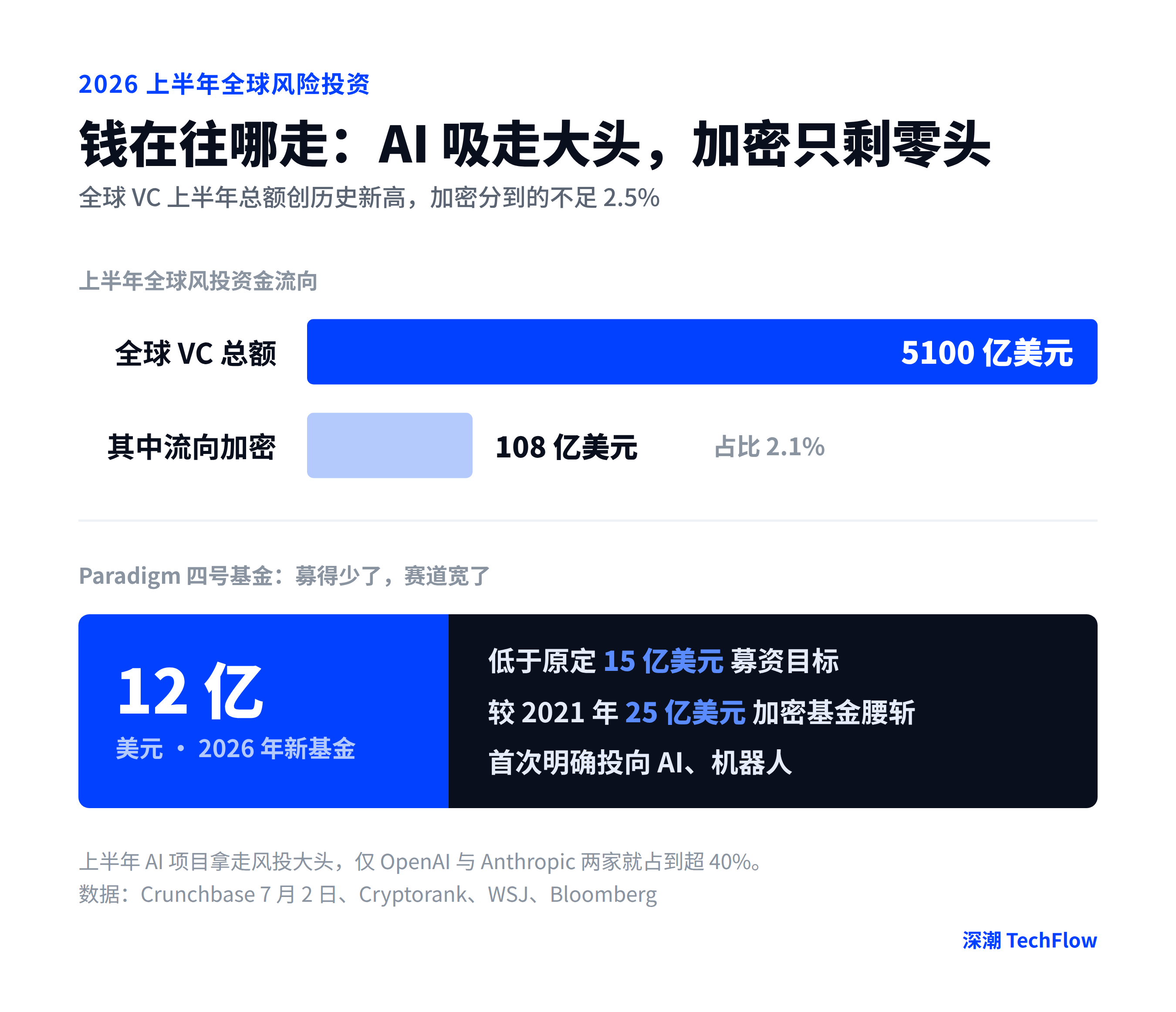
On July 8, crypto venture capital giant Paradigm announced the completion of the fundraising for its fourth fund, amounting to $1.2 billion, which expands from crypto to AI, robotics, and other cutting-edge technologies. This is the fourth fund since the company's establishment and the third venture capital fund.
Managing Partner Alana Palmedo wrote on the X platform that this $1.2 billion will be invested in "steep exponential growth." Those who supported them eight years ago believed in the cutting edge of crypto; now they are doubling down on "colliding frontiers" of AI, crypto, space, deep tech, and energy. Co-founder Matt Huang was quoted in a Bloomberg interview stating that crypto was their first frontier, which still excites them, but there are now too many issues that cannot be ignored.
For the crypto industry, this is not just a tactical adjustment from a small institution. Paradigm, founded by Huang (former Sequoia partner) and Fred Ehrsam (co-founder of Coinbase) in 2018, is one of the largest venture capital firms in the crypto space, managing nearly $12 billion by the end of 2025. For such an institution that has "crypto-native" written on its signage to publicly divert half its ammunition to invest in AI and robotics is itself a signal.
$1.2 billion below expectations, halved from the previous crypto fund
The figure of $1.2 billion is interesting when viewed against Paradigm's own fundraising history.
In 2021, the firm raised a $2.5 billion crypto fund, and in 2024 it raised an $850 million early blockchain fund. This $1.2 billion is more than half of what was raised in 2021. Moreover, it is noteworthy that, according to a February report from The Wall Street Journal, Paradigm originally planned to raise up to $1.5 billion for this new fund, but ultimately fell short of its target by about $300 million.
The fundraising did not meet expectations, but the direction has widened. With less money, the number of lanes to invest in has actually increased, indicating one thing: the single lane of crypto can no longer accommodate the capital that top institutions want to invest.
For those holding crypto assets or focusing on the primary market, the implication is that the total amount of crypto bullets from top VCs is shrinking, and early pure crypto projects may face a more discerning and dispersed pool of funds in the future.
$510 billion in venture capital in the first half of the year, with crypto only receiving $10.8 billion
The real reason for Paradigm's shift lies in the entire industry's funding flows.
According to Crunchbase data from July 2, the total global venture capital in the first half of 2026 reached $510 billion, setting a historical high for half-year investments and exceeding last year's total of $440 billion. A large share of this capital went to AI, with just OpenAI and Anthropic together accounting for over 40% of the financing in the first half. (Disclosure: Anthropic is the developer of the content tool Claude from TechFlow; this data comes from public reports, not provided by Anthropic.)
In sharp contrast, the situation for crypto is stark. According to Cryptorank data, only $10.8 billion flowed into crypto in the first half of the year, less than 2.5% of the global total. While AI funding exploded, crypto investment cooled, which directly led to Paradigm's decision to expand its investment lanes.
Bloomberg's statement is more straightforward; Palmedo describes it not as a "choose one" compromise but as an abundance of "too many things to invest in." The implication is that Paradigm believes it has enough capital and research capability to invest in both sides without having to sacrifice one to fulfill the other.
Crypto has not been abandoned, but downgraded to "one of the frontiers"
Palmedo and Huang have repeatedly emphasized that they have not given up on crypto, and this statement requires careful consideration.
In the new fund investment disclosed by Paradigm, crypto still occupies an important position: the decentralized derivatives exchange Hyperliquid, the stablecoin public chain Tempo co-incubated with Stripe, and the prediction market platform Kalshi. In the open-source tools area, they continue to invest in Ethereum development tools Foundry and Reth. These are currently the most active themes in crypto, including decentralized trading, stablecoin infrastructure, and regulated event markets.
However, the list of non-crypto investments is equally long: autonomous drone delivery company Zipline, rapid manufacturing platform SendCutSend, space defense startup True Anomaly, and Nous Research (developer of Hermes Agent), which focuses on open-source AI. According to CoinDesk, among the projects already invested by the new fund, Zipline's valuation reached $7.6 billion in January this year, and True Anomaly's valuation was $2.2 billion in April.
Huang's stance is that crypto and AI are not zero-sum competitors; there is significant overlap between the two. Paradigm has also specifically pointed out a cross-project, EVMbench, which is a blockchain security benchmarking test developed in collaboration with OpenAI. (Disclosure: OpenAI is a competitor of Anthropic.)
For crypto practitioners, the signal here is that even in the eyes of the most steadfast crypto VCs, crypto has already transitioned from being "the only lane" to "one of the frontiers." The dilution of funds and attention is a fact, and whether this is good or bad for specific projects will depend on whether they stand at the intersection of crypto and AI.
Not just Paradigm, old money in crypto collectively expands.
Paradigm is not the only example; in recent months, crypto VCs have collectively been expanding beyond crypto.
According to Bloomberg, in May, crypto VC Haun Ventures raised $1 billion, simultaneously supporting crypto startups while expanding into AI for the first time. In June, Framework Ventures raised $400 million for its fourth fund, targeting both crypto and AI, robotics, and energy. Along with Paradigm, the three leading crypto VCs have all coincidentally integrated AI into their investment scopes within two months.
This wave of expansion has both defensive and offensive aspects. On the defense side, the crypto market has become more institutionalized, more regulated, and more concentrated on a few large platforms, leading to a decrease in early projects able to absorb large venture capital checks. On the offensive side, AI and robotics are creating a new wave of company founding cycles, and the scale and urgency are precisely what VCs desire.
For those looking to enter the primary market of crypto, this trend means that in the future, it may increasingly be difficult to exclusively follow top VCs by only investing in crypto. These institutions are treating crypto as part of a "cutting-edge technology stack" rather than as a whole. The next big company they incubate may not even fall within the crypto category.
免责声明:本文章仅代表作者个人观点,不代表本平台的立场和观点。本文章仅供信息分享,不构成对任何人的任何投资建议。用户与作者之间的任何争议,与本平台无关。如网页中刊载的文章或图片涉及侵权,请提供相关的权利证明和身份证明发送邮件到support@aicoin.com,本平台相关工作人员将会进行核查。


