The hierarchical state is accelerating comprehensively.
Written by: William M. Peaster
Translated by: Baihua Blockchain
The Ethereum research circle has recently been in full swing. From July 4th until now, Vitalik Buterin has first reorganized the long-term direction of Ethereum, then published a new research post titled "Extremely Lean Chain," and also specifically emphasized a proposal to introduce Bitcoin-style UTXO into Ethereum.

Each of these developments is interesting individually, but putting them together makes it clearer to see what Ethereum is evolving into.
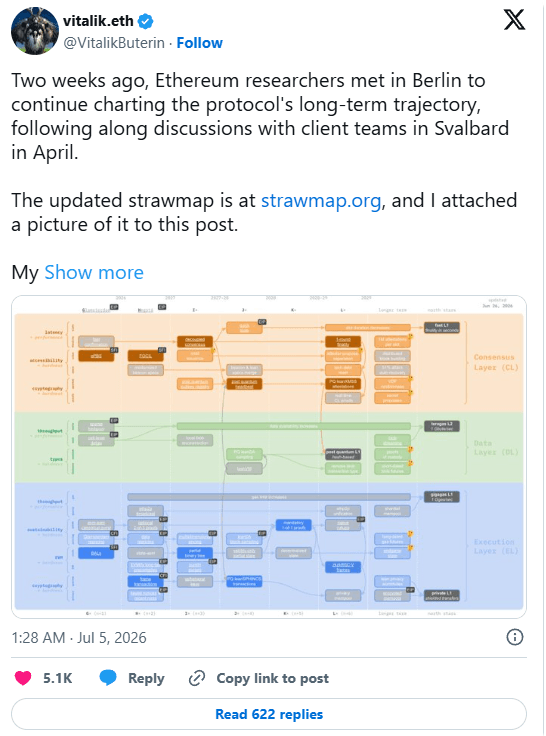
Two weeks ago, Ethereum researchers met in Berlin, continuing the discussions held in Svalbard in April with the client team, and further planning the long-term evolution of the protocol. The updated strawmap has been released, and I have attached the image in this post. — vitalik.eth, July 4, 2026
The background here is the so-called strawmap, which is what the Ethereum Foundation refers to as the "route draft" — a sketch of Layer 1 upgrades covering the end of this decade, which was just updated in late June. Subsequently, on July 4th, Vitalik provided his summary of these changes:
"Lean Ethereum is not a one-time single-point upgrade, but a set of improvements that will be rolled out to the Ethereum network over the next three to four years. But don't get me wrong, it is indeed the third major iteration of Ethereum, just as Merge was the second."
He further stated that on this evolutionary arc, almost all major components in the network will be replaced: from how blocks are validated, to how consensus is achieved, to what 'state' itself truly means. So, what will happen next?
Of course, the strawmap is not a single linear narrative. However, from these main trends and combined with Vitalik’s comments, we can summarize several major themes. For example:
Validation is replacing repeated execution — Currently, each Ethereum node re-executes every transaction to verify if the calculations on the chain are correct. In the Lean era, nodes will check cryptographic proofs, namely recursive STARKs. This change will make "proof of correctness" itself cheaper, thus further promoting execution scalability, lowering hardware requirements, and providing more room for subsequent optimizations.
Ethereum is starting to undergo "state slimming" — A multi-layer state system is taking shape. The current flexible yet heavier "dynamic" state will still be retained, but the space for future growth will be more limited. In contrast, the newly emerged states will be cheaper and slightly less flexible but will allow for more aggressive scaling. Vitalik gave a hypothetical example of Ethereum in 2030: the former would be about 2TB, while the latter could scale up to 100TB. Migration to these new state types will not be mandatory, but economic incentives will play a role, as they can significantly reduce costs for projects and users.
Privacy and quantum resistance become design pillars — While most public chains are still 1) completely transparent and 2) slow to act on quantum resistance solutions, Ethereum researchers have already elevated the privacy experience and quantum defense to must-have considerations, building their core design principles around them. As Vitalik stated: "When designing new content for Frames, mempool, and the state tree, we will explicitly ask: 'How can quantum-safe and non-intermediated privacy protocol transactions go through this system? What are the costs?'"
These advancements will not land in one upgrade like Merge but will be dispersed throughout 6 to 7 forks occurring between now and 2029. Of course, this is called a strawmap because it is just a route draft; the Ethereum Foundation has also emphasized that this timeline and route serve more as coordination references rather than definitive blueprints.
However, it is exciting that new mechanism proposals related to this are emerging almost daily.
A typical example right now is: This morning, Vitalik published "The Extremely Lean Chain," a design proposal aimed at compressing the Ethereum consensus layer to an almost extremely minimal state.
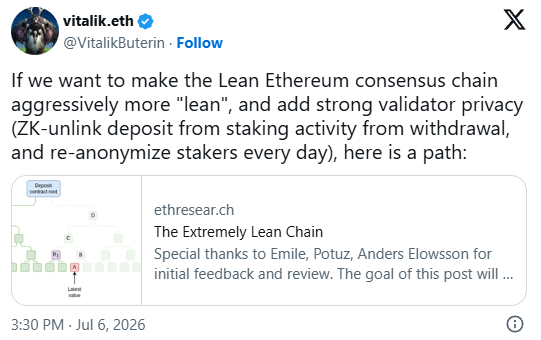
In the current Ethereum architecture, the Beacon Chain needs to keep a rather bulky record for each validator and handle balance updates for all validators in each epoch. In the evolutionary version proposed by Vitalik, the data stored on-chain for each validator would only require approximately 6 bytes, representing a 95% reduction from the current situation of about 121 bytes.
The way this mechanism operates is: every day, each ETH staker generates a ZK proof to validate their updated balance and submits it to the chain. Thus, Ethereum essentially shifts from "keeping books" to "checking receipts." If a staker misses submitting their proof for a day, they can temporarily not participate in attestation, but once they make it up, they can regain the ability without being slashed.
As Vitalik stated, the greatest benefit of this path is that it "could allow consensus to scale to millions of validators if necessary." Will this become the basis for lowering the staking threshold to 32 ETH in the future? We will have to see. But this design has other advantages; for example, in its complete form, validators might even re-register daily with a new public key, paving the way for anonymous staking.
However, Vitalik’s "Extremely Lean" proposal is only one of the noteworthy directions at the moment. Another mechanism draft that could also have a massive impact on Ethereum has just been released by Ethereum Foundation researcher Toni Wahrstätter, titled "Native UTXOs on Ethereum."
What would happen if we directly borrowed Bitcoin's transaction model? This is the core of this proposal. Today, receiving a payment on Ethereum leaves a permanent record. When an address first holds ETH or some token, every node must permanently keep this state item — even if the address was only used once. Multiplying this model across billions of payments, the state inflation crisis indeed becomes a significant issue.
Wahrstätter’s thought is to shift to Bitcoin-style UTXO, which essentially is an expendable package of value that gets consumed once spent. Furthermore, in the Ethereum version of the solution, there’s no need to store UTXOs themselves on the chain. Their details can remain in the chain's historical data, to be proven when needed; while in the permanent state of the chain, only a bit needs to be retained for each UTXO to indicate whether it has been spent.
According to Wahrstätter’s calculations, this shift could reduce the permanent state related to payment flows by about 99.8%. Combined with innovations like frame transactions, this new transaction method would also enable newly generated addresses to receive and spend funds without holding ETH for gas, paving the way for a smoother stealth address experience on Layer 1.
Looking at the bigger picture: if such concepts can ultimately be implemented on Ethereum, then this network will become healthier, more durable, more flexible, and closer to that future-oriented North Star. Personally, I am most interested in these new state types and how they will affect the application layer, homogeneous tokens, and NFT experiments.
But regardless of what the next steps will be and when they will arrive, Ethereum's progression direction is clearer than ever before. This is bullish.
免责声明:本文章仅代表作者个人观点,不代表本平台的立场和观点。本文章仅供信息分享,不构成对任何人的任何投资建议。用户与作者之间的任何争议,与本平台无关。如网页中刊载的文章或图片涉及侵权,请提供相关的权利证明和身份证明发送邮件到support@aicoin.com,本平台相关工作人员将会进行核查。


