EDX Markets, which originated from Wall Street, recently secured a $75 million exclusive investment from Eastern Capital SBI Holdings.
Written by: DeepSeek
Edited by: Chopper, Foresight News
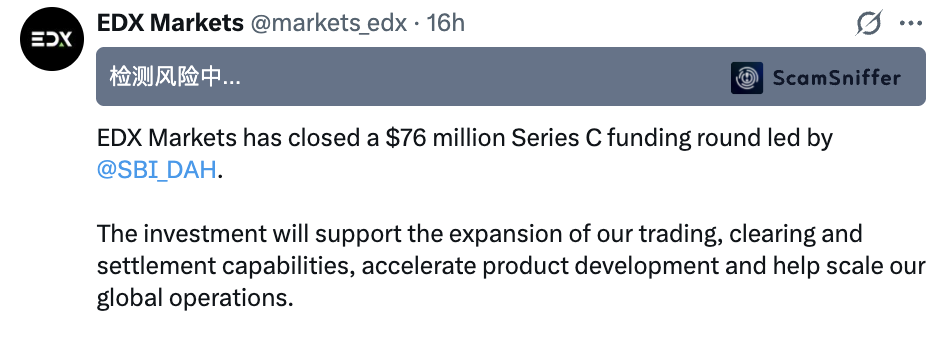
On July 7, institutional-grade cryptocurrency exchange EDX Markets, supported by Wall Street giants such as Citadel Securities and Fidelity, announced the completion of a $76 million Series C funding round. This round was exclusively invested by Japan's financial group SBI Holdings, and according to Nikkei News, SBI acquired approximately 20% of EDX Markets through this investment. This is the first time EDX Markets publicly disclosed the specific scale of a single financing round, as previous funding amounts were not announced.
The $76 million financing scale stands out particularly against the backdrop of an overall cautious trend in cryptocurrency venture capital. However, what truly caught the market's attention is not just the money but the string of names behind EDX.
The "Dream Team" of Wall Street Takes the Stage, Targeting Institutional-Grade Crypto Trading Market
According to official information, EDX Markets was established in 2022 as a cryptocurrency exchange aimed at institutions, boasting an unprecedented lineup of founding investors including Citadel Securities, Fidelity, Charles Schwab, Virtu Financial, as well as top venture capital firms such as Paradigm and Sequoia. The platform officially launched trading on June 20, 2023.
This background itself forms the biggest differentiator for EDX Markets. In an industry environment where cryptocurrency exchanges generally face a "trust deficit," having names like Citadel Securities—one of the world’s largest market makers, Fidelity—managing over $40 trillion in assets, and Charles Schwab—one of the retail brokerage giants with over 34 million active accounts—all listed as shareholders in a cryptocurrency exchange is a powerful endorsement of credibility.
The core philosophy of EDX Markets can be summarized in one sentence: to bring the most mature risk management frameworks from traditional financial markets into cryptocurrency trading.
Unlike crypto-native exchanges such as Binance and Coinbase, EDX Markets operates on a non-custodial model, meaning the exchange itself does not hold clients' digital assets, allowing clients to freely choose custodians. This design aims to eliminate the conflict of interest where the exchange acts as both referee and player, and prevents a repeat of FTX-style misappropriation of client assets. The EDX Markets website emphasizes that member assets are protected by segregated accounts in case of bankruptcy.
Another key design is the central clearinghouse. EDX Markets has set up EDX Clearing, responsible for the daily net settlement of all matched trades on the platform. In traditional financial markets, exchanges and clearinghouses are usually separate entities, with exchanges facilitating trades and clearinghouses ensuring that transactions are settled completely. EDX brings this structure into the crypto world, allowing institutional clients to not worry about counterparty default risks while having a default fund to ensure timely settlements. EDX also offers leverage of up to 5 times, and users can access all counterparties without needing to sign bilateral agreements. According to official disclosures, EDX Clearing has settled transactions worth billions of dollars since its launch.
EDX Markets currently operates three main business segments.
The core platform EDX Markets serves as a spot trading venue for U.S. institutions. In 2024, the company established its international business hub EDXM International in Singapore and plans to officially launch a perpetual contract trading platform in July 2025, offering 44 cryptocurrency trading pairs to qualified institutional clients outside the U.S. Singapore, as a financial center in Asia, was chosen for its regulatory environment and talent pool.
In January 2026, EDX Markets launched EDX FlowConnect, a "Crypto-as-a-Service" product. FlowConnect allows financial institutions to provide digital asset trading services to their clients without needing to build their own infrastructure, including spot trading, perpetual contracts, stablecoin deposit/withdrawal, and clearing settlements. This system is built on EDX Markets' proprietary matching engine and market structure.
In May 2026, Ripple Prime integrated with EDX, enabling institutional clients to directly access EDX's spot and perpetual contract liquidity through Ripple's prime brokerage platform.
Volume Climbs, Licenses Awaiting Approval
EDX Markets has limited publicly disclosed operational data. According to an official press release, in the first 10 months of 2024, the platform's total trading volume surpassed $36 billion, with a single-day trading volume peak reaching $685 million.
EDX also launched the first non-U.S. dollar stablecoin KRWQ in both the spot and perpetual contract markets, attempting to bring the hundred billion-dollar Korean won market onto the blockchain. These moves indicate that the platform is actively expanding its product line, but the gap in liquidity depth and market coverage compared to leading exchanges remains evident. For an exchange backed by Wall Street giants like Citadel Securities and Fidelity, market expectations for its scaling up are clearly higher than the current track record.
If trading volume represents EDX Markets' "present," then the OCC license represents its "future." On April 2, 2026, EDX Markets officially submitted an application to the Office of the Comptroller of the Currency (OCC) to establish EDX Trust—a national trust bank. Just a week prior, the OCC revised the regulation 12 CFR 5.20 to explicitly allow national trust banks to conduct non-trustee custodial activities. EDX submitted its application the day after the rule change, indicating it was well-prepared.
If approved, EDX Trust will operate as a federally regulated trust bank, providing digital asset custody, trade clearing, settlement, and risk management services. More importantly, EDX will gain federal regulatory priority, allowing it to operate nationwide without applying for money transfer licenses in all 50 states. EDX CEO Tony Acuña-Rohter stated in the announcement: "EDX Trust enables us to meet the evolving needs of banks and large financial institutions as we expand their digital asset strategies."
However, this path is not without resistance. The Independent Community Bankers of America (ICBA) has submitted a letter of opposition to the OCC, arguing that expanding national trust bank licenses to crypto firms "exceeds the historical boundaries of trust bank powers," potentially leading to regulatory arbitrage and financial stability risks. The OCC's final decision will set an important precedent for the regulatory status of crypto custody. As of July 2026, the application is still under review.
SBI's Strategic Investment: From Wall Street to Asia-Pacific
Jamil Nazarali, the founder of EDX Markets, was formerly the head of global business development at Citadel Securities. After the platform launched, Nazarali served as CEO until December 2024, and then transitioned to executive chairman, with the former CTO Tony Acuña-Rohter taking over as CEO. Acuña-Rohter previously served as CTO of ErisX, which was acquired by Cboe in 2021 and became the predecessor of Cboe Digital.

Tony Acuña-Rohter, CEO of EDX Markets
With a founding team from Wall Street, EDX has carried the genes of traditional finance from the very beginning. However, another strategic pillar beyond "Wall Street origins" that has enabled this exchange is the capital from the East—Japan's SBI Holdings.
SBI Holdings is one of Japan’s largest financial groups and has been active in the digital asset space in recent years. Recently, SBI acquired cryptocurrency exchange Bitbank for 46.7 billion yen (approximately $289 million). Additionally, SBI’s subsidiary SBI VC Trade partnered with Ripple to launch the dollar stablecoin RLUSD in Japan, while SBI's new trust bank issued the yen-denominated stablecoin JPYSC, which is Japan's first yen stablecoin supported by a trust bank.
EDX CEO Tony Acuña-Rohter stated that SBI's global influence and experience in digital assets and financial services make it a strong strategic partner, and this investment will help EDX "double down" in the Asia-Pacific region.
Big Names Backing Do Not Conceal Liquidity Gap, EDX's Challenges Have Only Just Begun
The institutional-grade cryptocurrency trading space where EDX Markets operates is becoming crowded. Its main competitors include other institutional-focused firms such as Rulematch. Greater competition comes from crypto-native exchanges like Binance and Coinbase, which have unmatched liquidity advantages. EDX's differentiation lies in "institutional trust and compliance," which happens to be the primary consideration for many traditional financial institutions entering the crypto world.
Challenges are also very real. EDX Markets' website clearly states that its trading platform and clearinghouse are not registered with the SEC, FINRA, or CFTC in the U.S. Whether the OCC's trust bank license application will be approved remains uncertain. Furthermore, although SBI's investment supports the expansion into Asia-Pacific, there are already established local competitors in the Asian market.
However, macro trends are favorable for EDX. The Series C funding for EDX coincides with ongoing investor confidence in crypto infrastructure companies. Trading systems, clearing networks, and payment channels continue to attract funds from crypto funds and traditional financial institutions.
Since its launch in 2023, EDX Markets' expansion path clearly points to one goal: to become the default entry point for institutions into the crypto world. The $76 million Series C funding and SBI's strategic stake are merely another footnote on this journey. The endorsement of names like Citadel Securities, Fidelity, and Charles Schwab adds a powerful backing to this footnote.
免责声明:本文章仅代表作者个人观点,不代表本平台的立场和观点。本文章仅供信息分享,不构成对任何人的任何投资建议。用户与作者之间的任何争议,与本平台无关。如网页中刊载的文章或图片涉及侵权,请提供相关的权利证明和身份证明发送邮件到support@aicoin.com,本平台相关工作人员将会进行核查。


