Author: Claude, Deep Tide TechFlow
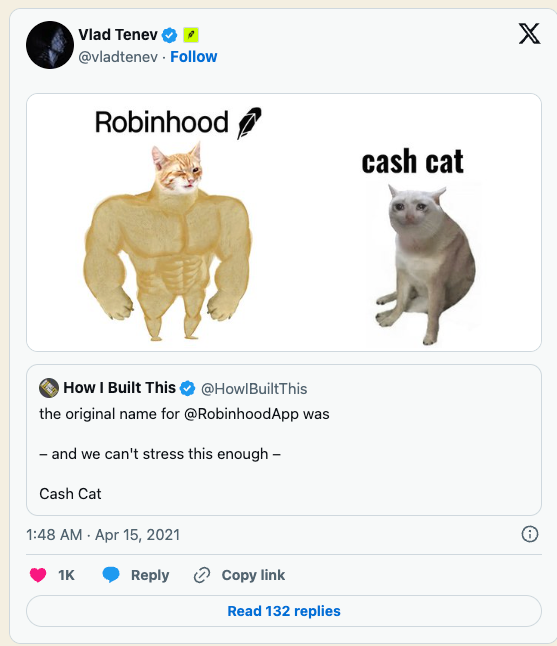
Deep Tide Introduction: One week after the launch of the Robinhood Chain mainnet, the official promoted US stock tokens have not gained traction, while a meme cat called CASHCAT became popular first, surging over 1700% in 24 hours, with a market cap surpassing 120M. Its entire narrative is captured in one sentence: the working name during Robinhood's startup was CashCat, a story shared by CEO Tenev himself, who even tweeted a play on words on the day of the surge. Meanwhile, pump-and-dump accounts impersonating "Roaring Kitty" have already synchronized their positions.
Attracting traffic and retail attention still relies on memes.
Robinhood spent a year paving the way for its blockchain, positioning the tokenization of US stocks as the core story. However, the first truly popular asset on-chain is a cartoon cat holding cash.
According to GMGN monitoring, on July 8, the meme token CASHCAT on Robinhood Chain reached a market cap of over 120 million dollars, with a 24-hour surge exceeding 1700%. Within hours, different data platforms reported rising figures, and according to CoinGecko, CASHCAT was primarily traded on Robinhood Chain's Uniswap V3, with the CASHCAT/WETH trading pair seeing a trading volume of about 28 million dollars in 24 hours. For a new chain that has only been online for a week and has a limited number of ecological applications, this cat represents the current traffic itself.
On the seventh day post-mainnet launch, the first asset to gain popularity is a meme
Let’s outline the background.
On July 1, Robinhood officially launched the Robinhood Chain public mainnet at a press conference in London. This is an Ethereum Layer 2 based on Arbitrum technology, unveiled jointly by CEO Vlad Tenev and crypto business head Johann Kerbrat. The official positioning of this chain is quite "serious," with the core product Stock Tokens tracking the price performance of over 200 US stocks and ETFs, open to more than 120 jurisdictions (excluding US users), with DeFi protocols like Uniswap and 1inch being deployed on the first day. Robinhood also promised to cover all gas fees for the first 90 days.
According to the official script, the stars of this chain should be tokenized US stocks and RWA (Real World Assets on-chain), but the script has not unfolded as expected. In the first week after the mainnet launch, the most active trading pair on-chain has not been any US stock token, but CASHCAT. Retail investors have set the tone for this "retail brokerage's chain."
For holders, the warning is very direct: currently, the trading depth of CASHCAT is concentrated on a single DEX's single trading pair, the new chain has thin liquidity, and price readings vary dramatically across different platforms, with slippage and pin risk far higher than that of mature chains' memes.
"Former name" archaeology, Tenev has shared the story of CashCat
CASHCAT’s rise is supported by a genuine company history.
Tenev recalled the process of naming the company in early interviews, "The original working name was actually CashCat, but everyone felt that this name wasn't powerful enough. My wife would introduce me to friends by saying they are Robin Hood of finance, working for the little guy. That's how the name Robinhood was established." This oral history has been quoted in multiple company retrospective articles after the GameStop incident, making it verifiable "archaeological material," and this is the biggest difference between CASHCAT and other meme coins that have fabricated stories.
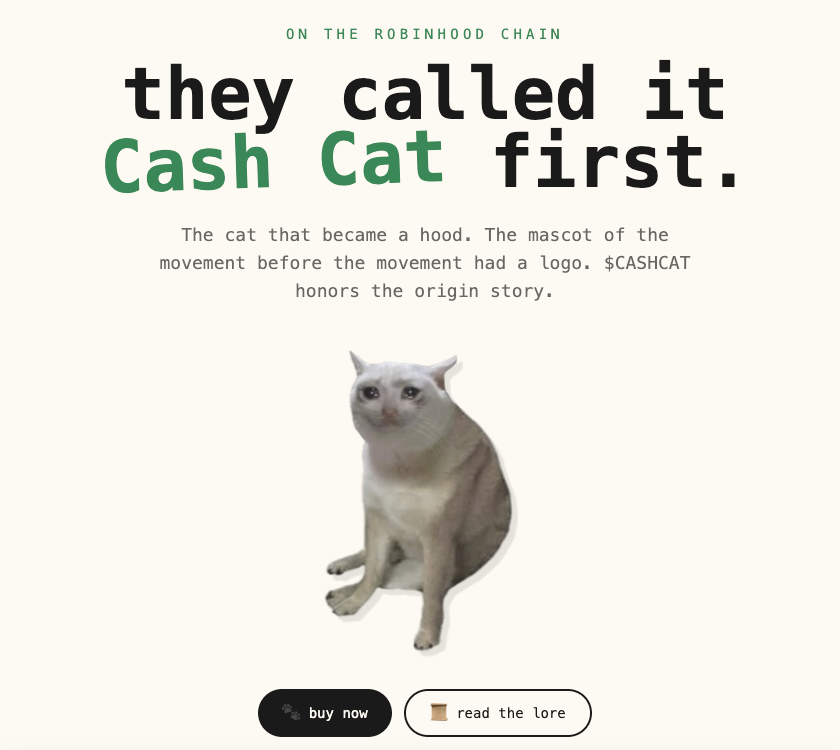
The structure of the token itself is extremely simple. According to the project's official website, there is a total supply of 1 billion, with zero taxes for buying and selling, and all liquidity pool tokens have been burned, positioning itself as "zero utility, 100% cat." The official website also clearly states that the project has no connection to Robinhood, describing it as "fan fiction with a ticker."
The narrative is genuine, but the product is irrelevant. Readers need to distinguish between these two aspects: Robinhood’s history provided this cat with a narrative, but the company did not endorse it. The token’s value is entirely built on attention, and when that attention fades, there is no support.
Tenev tweets a play on words, market interprets it as half an endorsement
What really pushed the market to a climax was Tenev himself.
On July 8, Tenev posted on X platform, "We are building Robinhood Chain into the best RWA public chain... but it also works great for memes." This tweet received over 500,000 views within hours. He did not mention the name CASHCAT, but the timing of the post coincided with the day of the surge, leading the community to interpret it as an approval or even a boost for the meme's popularity on-chain.
There’s a layer of historical irony here. In the 2021 GameStop short squeeze battle, Robinhood was called to Congress for restricting retail investors from buying GME, becoming the "villain" in the retail narrative. Five years later, this company’s blockchain successfully completed its cold launch, relying exactly on the meme culture that retail investors excel at, with the object of speculation still being a name discarded by the company itself. The CASHCAT website even played on this pun, "Cash Cat does not do options, nor does it engage in payment for order flow (PFOF)."
For traders, it is necessary to discount the actual value of this tweet. Tenev’s play on words is separated from Robinhood's endorsement by an entire compliance department. The company has made no commitments regarding custody, listing, or liquidity for meme tokens, and the effective period for emotional catalysts is usually measured in hours.
Pump-and-dump schemes and fake "Roaring Kitties" are already in place
Once the heat is up, the tools for preying on retail investors are also ready.
The first is cross-chain knockoff tokens. According to aggregated monitoring information from CoinGecko, a same-named CASHCAT deployment has appeared on the Solana chain. The original contract is deployed on Robinhood Chain, with the address starting with 0x020b and ending with 18b4, while tokens with the same name on other chains are unrelated to the original.
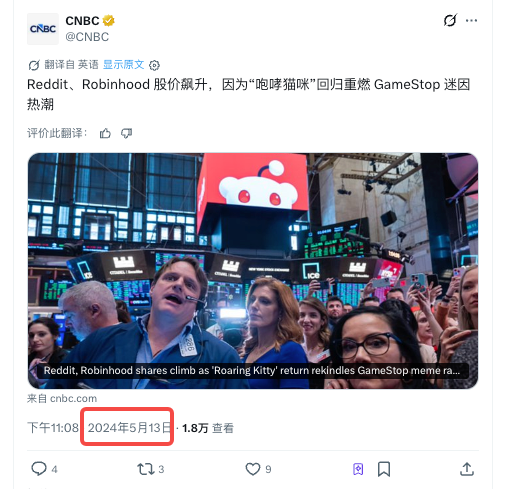
The second is fake big influencers issuing calls. For example, an X account with the ID "RK," whose username closely resembles that of GameStop event protagonist "Roaring Kitty," Keith Gill, tweeted that "CASHCAT is the first important meme on Robinhood Chain," attaching a Solana contract address in the tweet.
New chains, new memes, fake accounts, cross-chain clones, this combination has harvested people in every round of the meme market in the past. If you decide to participate now, at the very least, do three things: verify the contract address, only use official or mainstream cross-chain bridges, and keep your position controlled like a lottery ticket.
The current total value of CASHCAT is just a good story plus a wave of attention, neither of which have any retention mechanism.
免责声明:本文章仅代表作者个人观点,不代表本平台的立场和观点。本文章仅供信息分享,不构成对任何人的任何投资建议。用户与作者之间的任何争议,与本平台无关。如网页中刊载的文章或图片涉及侵权,请提供相关的权利证明和身份证明发送邮件到support@aicoin.com,本平台相关工作人员将会进行核查。


