The Trump family is not simply "speculating" in cryptocurrency, but is gradually building a crypto business landscape around the political brand, social media traffic, stablecoin access, Bitcoin mining, and media platforms.
Written by: Liu Honglin
Is Trump’s current administration good or bad for the crypto industry?
This question has always been divisive in the crypto community. Supporters argue that Trump has pushed cryptocurrency from the fringes of regulation to the center of American politics, providing greater policy imagination for stablecoins, Bitcoin reserves, exchange regulation, and mining companies. Opponents assert that Trump has tied celebrity tokens, political access rights, presidential family businesses, and the crypto market together, causing many ordinary investors to bear the consequences of price volatility and information asymmetry.
But the controversy is yours; old Trump remains silent, only wishing to make money.
Recently, the U.S. Office of Government Ethics made public Trump’s 2025 annual financial disclosure report. This 927-page document consolidates much of the information that was originally scattered across news articles, official websites, and blockchain discussions into a clearer map.
Overall, the Trump family’s crypto empire consists of five main sectors: Official Trump Meme Coin (Official Trump Meme / TRUMP), World Liberty Financial (WLF) and the USD1 stablecoin, crypto wallets and governance token assets, American Bitcoin Company (ABTC), and Trump Media & Technology Group (TMTG) along with Truth.Fi.
From these disclosures and public materials, it becomes clear that the Trump family is not simply "speculating" in cryptocurrency; rather, they are gradually creating a crypto business landscape by integrating the political brand, social media traffic, stablecoin access, Bitcoin mining, and media platforms. What the Trump family has obtained from the crypto industry is no ordinary investment income.
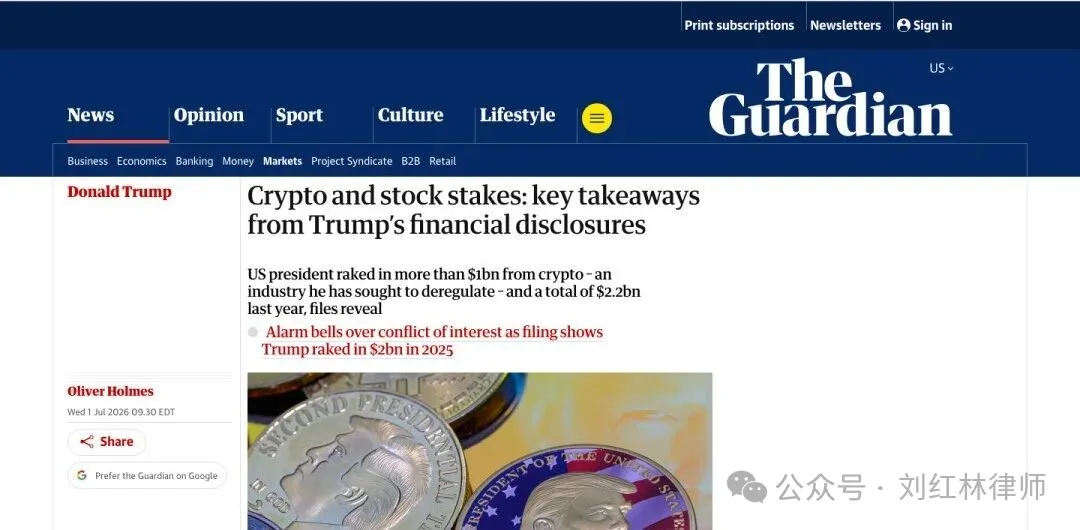
Screenshot of the Guardian’s report on Trump's financial disclosures regarding crypto income
How the Trump Family Makes Money in the Crypto Sphere
The money indicated in the financial disclosure can be categorized into four types: realized income, disclosed assets, equity projects participated in by family members, and rights that may continue to be monetized in the future.
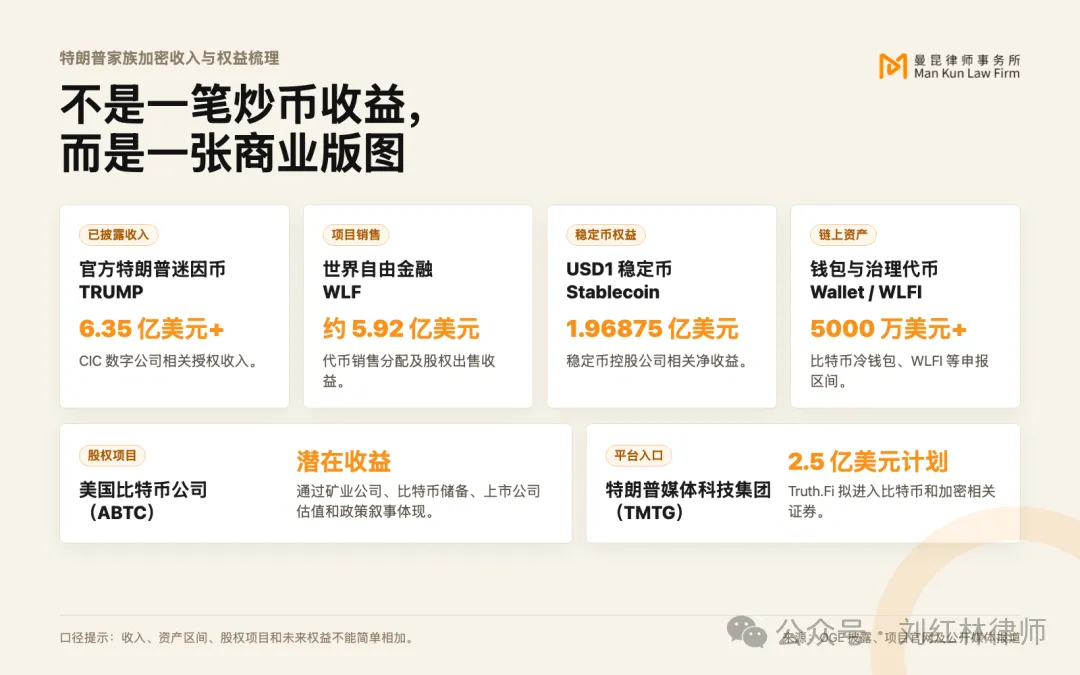
Summary of the Trump family’s crypto income and equity
The first type is the income that has already been disclosed.
The most typical example is the income from the Official Trump Meme Coin (TRUMP) authorization. The disclosure report shows that CIC Digital, which is 100% owned by the Trump Trust, handles NFT and meme coin authorization. The royalty income related to Celebration Coins amounts to $635,068,835. In other words, just from the TRUMP coin and related brand licenses, the reported income exceeds $635 million.
The second type involves income from project sales, equity sales, and stablecoin holdings.
World Liberty Financial (WLF) is the most significant part in this context. The disclosure report indicates that DT Marks DeFi holds 38.25% equity in WLF Holdings; WLF Holdings possesses the sole membership rights of World Liberty Financial and obtains relevant economic rights. Based on various token sale allocations and equity sale revenues listed in the report, WLF-related earnings are approximately $592 million.
The USD1 stablecoin is not merely a simple official product. The disclosure report notes that DT Marks SC holds 38.25% equity in the stablecoin holding company; contributions from new members and the sale of Class C units resulted in a net income of $196,875,000. This figure indicates that the stablecoin line has entered Trump's disclosure listing, rather than being just external "project planning."
The third type comprises wallet assets and governance tokens.
The disclosure report reveals that CIC Digital owns a Bitcoin cold wallet valued at over $50 million; it also lists wallet assets including Ether, USDC, LINK, AAVE, and others. The DTTM operating company additionally holds 15,750,000,000 WLFI governance tokens, similarly declared to be worth over $50 million. These represent asset ranges and do not equal realized sales, but they indicate that the Trump family's exposure in crypto exceeds mere cash income.
The fourth type concerns equity and capital market stories involving family members.
The American Bitcoin Company (ABTC) is participated in by Eric Trump and Donald Trump Jr., with Hut 8 holding 80% equity in the company, whose business includes Bitcoin mining, Bitcoin reserves, and capital market financing. The potential income from such projects is reflected more in family equity, public company valuations, Bitcoin prices, and policy narratives.
Therefore, the money the Trump family makes in the crypto industry cannot be summarized by a single figure; if we consider wallet assets, governance tokens, future stablecoin revenues, mining company equity, and media company valuations, the Trump family’s business landscape in the crypto market would be much larger.
Official Trump Meme Coin (TRUMP): Turning Political Traffic into Licensing Income
The most easily understood by ordinary investors is the Official Trump Meme Coin (TRUMP).
In January 2025, Trump-related entities launched the Official Trump Meme Coin, turning the political symbol of "Trump" into a digitally tradable asset on-chain. The project’s official site calls it the "only official Trump meme coin", while its disclaimers are worded cautiously: it is not an investment opportunity, not an investment contract, not any type of security, nor a product of political activities or governmental institutions.
The homepage of the TRUMP coin website immediately shows how this project integrates political symbols, community identity, and trading access.
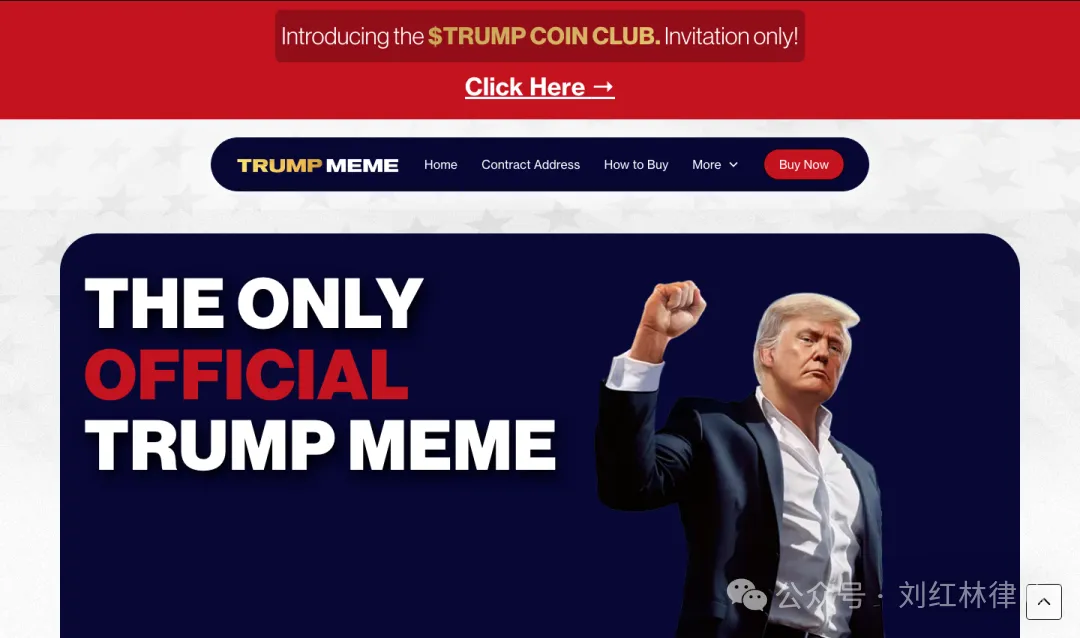
Homepage of the TRUMP coin website and Coin Club entrance
Official distribution is also key. On the first day, 200 million TRUMP coins will be in circulation, with the total amount expected to increase to 1 billion within three years; CIC Digital and Fight Fight Fight, two affiliated entities, collectively hold 80%, subject to a three-year unlocking arrangement. The website also states that CIC Digital and Celebration Cards can earn revenue from trading activities.
As long as the name Trump can draw attention, as long as the market has trading volume, and as long as holding coins and activities can continue to generate topics, this project can earn income not just from the coin price itself.
When ordinary influencers launch meme coins, the controversy mainly focuses on misleading marketing, market manipulation, and investor protection. When a president-related entity issues a meme coin, the question deepens: Are buyers purchasing a high-volatility entertainment asset, or are they buying a chance to be close to the president?
In 2025, the TRUMP coin project hosted a VIP dinner event. The website still shows entrances to "TRUMP COIN CLUB" and the Mar-a-Lago dinner. If the largest coin holders can gain opportunities to meet the president, then token holdings become not just financial assets but also tradeable tickets for access rights.
This is also the most distinctive aspect of the TRUMP coin. It ties political identity, community ranking, market price, and offline engagement opportunities together. Buyers think they are speculating on coins, but the project is selling the symbol itself: "Trump."
World Liberty Financial (WLF) and USD1: The Real Business in Stablecoins
If the Official Trump Meme Coin (TRUMP) represents the front-end traffic business, World Liberty Financial (WLF) and USD1 constitute the back-end financial infrastructure business.
The project positioning of WLF is significantly more complex than the TRUMP coin. It attempts to create a financial product suite surrounding stablecoins, on-chain lending, governance tokens, and wallet access. The product line showcased on the WLF website includes the USD1 stablecoin, on-chain lending markets, AI agent payment tools, and wallet access.
The disclosed report indicates that this income comes from several sources: equity sale revenue from the WLF holding company, token sale allocations under different wallets and asset categories, and revenue related to the stablecoin holding company. Its income-generating methods are not limited to one: at the front-end, governance tokens can be sold; at the equity level, interests can be sold; at the stablecoin level, long-term income expectations can be formed through reserve assets and institutional adoption. By looking at these projects together, we can understand why the media views WLF and USD1 as one of the core sources of the Trump family’s crypto wealth.
The business logic of stablecoins appears simple: users exchange dollars for stablecoins, and issuers use dollars, cash equivalents, or short-term government bonds as reserves. The true large sums often lie in the interest generated by reserve assets, institutional adoption scenarios, transaction channels, and financial product combinations. The larger the scale, the greater the reserves, and the more apparent the potential earnings.
Multiple media reports have mentioned that the Abu Dhabi-related investment entity MGX has used USD1 to participate in a $2 billion investment arrangement with Binance, the world's largest crypto asset trading platform. The parties involved can certainly claim this as a commercial collaboration and deny any improper benefit transfers. However, the observation is that the presidential family has economic rights tied to stablecoins, while those stablecoins are being adopted by large foreign capital and global trading platforms. This combination naturally raises issues of conflict of interest, foreign influence, and regulatory credibility.
For the industry, the significance of WLF and USD1 reaches further. While the TRUMP coin can easily be understood as a political meme coin, stablecoins are the infrastructure for payments, clearing, reserves, cross-border funds, and on-chain finance. If the presidential family has economic rights here, the controversy goes beyond "who lost money buying coins," but rather challenges the boundaries between public power, regulatory direction, and private gains.
American Bitcoin Company (ABTC): Mining, Power, and Bitcoin Reserves
The Trump family’s crypto layout includes not only coin issuance, licensing, and stablecoins, but also Bitcoin mining.
Public records show that the American Bitcoin Company (ABTC) involves two of Trump's sons, Eric Trump and Donald Trump Jr., and is linked with the mining infrastructure company Hut 8. Business Insider reported in April 2025 that Hut 8 would hold 80% equity in ABTC; American data centers hold the remaining share. The company is led by Matt Prusak, with Eric Trump serving as Chief Strategy Officer. The official description of Hut 8 and ABTC emphasizes their aim to become a highly efficient pure Bitcoin mining company while establishing a strong strategic Bitcoin reserve.
The ABTC website positions itself as building the backbone of American Bitcoin infrastructure. It breaks down its strategy into three layers: the first layer is large-scale mining, emphasizing ASIC mining machines, data centers, power supply, and operational efficiency; the second layer focuses on Bitcoin reserves, aiming to enhance each share of Bitcoin accumulation using mined coins and capital market tools; the third layer involves ecological services, attempting to extend around mining, computing power, financial tools, and Bitcoin asset management.
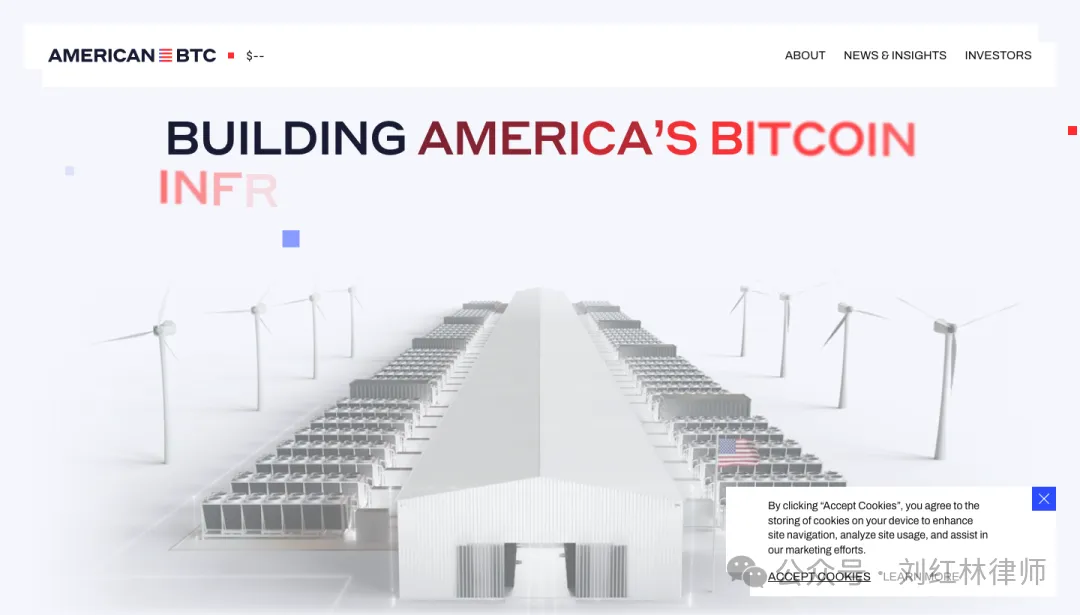
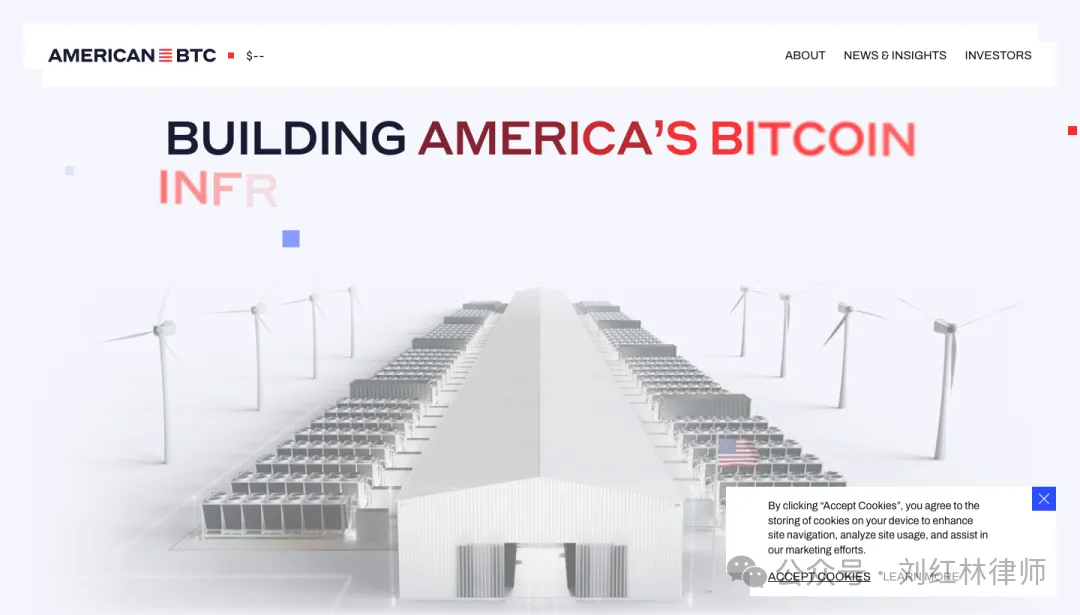
ABTC homepage: The narrative of American Bitcoin infrastructure
The American Bitcoin Company (ABTC) is an important component of the Trump family’s crypto business landscape, because family members participate as shareholders, management, or in strategic roles, linking Bitcoin mining, U.S. energy, capital markets, and the Trump political brand together.
Its potential earnings are not merely based on a single coin’s short-term price increase, but rely on company valuation, Bitcoin reserves, and policy narratives. As long as Bitcoin prices rise, mining company valuations increase, and the company can acquire mining machines, energy, and financing at lower costs, family equity may be magnified.
Many discuss Trump's crypto wealth, focusing solely on the TRUMP coin price. However, looking at the industry chain, ABTC illustrates the point better: the Trump family is not only making money near the exchange market but is also including mining rigs, energy, computing power, custody, capital markets, and Bitcoin reserves into their business narrative.
Bitcoin mining heavily relies on power, machine supply, custody facilities, financing costs, and regulatory attitudes. When the Trump administration promotes strategic Bitcoin reserves and crypto-friendly policies, mining companies associated with the Trump family are naturally perceived by the market as beneficiaries of policy narratives.
The controversy also extends to machine supply. The Guardian reported in October 2025 that ABTC procured over 16,000 advanced mining machines from Bitmain, paying with pledged Bitcoin rather than cash, with the pledge arrangement potentially extending for two years. The report described this as preferential treatment for a company partly owned by Eric Trump and raised concerns about foreign influence and national security. Hut 8 responded that these conditions arise from a long-term commercial relationship, while Bitmain denied any political motives.
Trump Media & Technology Group (TMTG): Integrating Social Media Traffic into Financial Products
The Trump family also has a line that continues to crypto-tokenize media platforms and surrounding licenses.
Trump Media & Technology Group (TMTG) is the parent company behind Truth Social. Originally a media platform with strong political community characteristics, it announced in 2025 the launch of Truth.Fi, preparing to enter financial services, Bitcoin, and crypto-related securities. The Guardian reported that TMTG plans to invest up to $250 million into investment accounts, Bitcoin, and similar crypto assets or crypto-related securities, to be managed and held by Charles Schwab.
The significance of this line does not lie in its formation of large authorization fees, like the Official Trump Meme Coin (TRUMP), but in converting Trump’s social media platform into a potential financial product access point. A social platform with users who have strong political identification can naturally sell funds, themed products, and crypto access. The issue is, when the core figure behind the platform is also the President of the United States, this access becomes not just a commercial traffic gateway but also connects to public power.
Subsequently, TMTG's cooperation with crypto.com sparked new ethical controversies. Reports from AP indicated that crypto.com had faced regulatory scrutiny during the Biden administration, with investigative pressures alleviating after Trump's victory; afterward, crypto.com donated to Trump-related political committees and formed collaborations related to a $1 billion level Cronos token reserve with Trump Media Company. Both crypto.com and the White House denied any inappropriate connections.
Additionally, there is the smaller peripheral line of NFTs issued by Melania Trump. While it may not be the largest financial segment, it illustrates the same logic: the Trump family is adept at breaking down personas, identities, communities, and political symbols into sellable, collectible, and tradable digital assets.
Putting all these projects together, the Trump family’s crypto business landscape becomes clear:
The Official Trump Meme Coin (TRUMP) is responsible for turning political traffic into meme coins and licensing income;
World Liberty Financial (WLF) and USD1 connect the family brand to stablecoins, DeFi, and financial infrastructure;
The American Bitcoin Company (ABTC) connects Bitcoin mining and capital market narratives;
Trump Media & Technology Group (TMTG) and Truth.Fi transform social media platforms into financial access points.
The Real Controversy Around the Crypto President
This is why the controversies Trump brings to the crypto industry are difficult to summarize with a simple "Trump is fishing, those willing can take the bait,” and they cannot be judged solely based on the success or failure of individual projects.
When an ordinary project issues a coin, regulators mainly look at whether there has been public fundraising, income promises, misleading retail investors, or market manipulation. But when a presidential family is involved with crypto projects, buyers may be purchasing not only a high-risk asset but also an imagination of political branding, regulatory expectations, access rights, and policy direction. When foreign capital, trading platforms, regulated entities, and presidential family businesses establish commercial relationships, the outside world can hardly perceive this as ordinary market collaboration.
For the crypto industry, this represents a very complex victory.
Trump indeed brought cryptocurrency to the political center of Washington, allowing Bitcoin reserves, stablecoin legislation, mining companies, exchanges, and crypto ETFs to gain greater imaginative space.
But the cost is also clear: the closer the crypto industry gets to the power center, the less possible it is to explain itself solely with terms like "decentralization," "free market," and "voluntary transactions."
Thus, what this article intends to convey is not whether "Trump helped or harmed crypto." A more accurate statement is that the Trump family has simultaneously brought the most attractive and the most questionable facets of the crypto industry to the forefront.
It proves that crypto assets can attract enormous political attention, while also reminding the market: when political identity itself becomes a financial asset, price volatility is no longer merely an investment risk; it also entails power, trust, and public responsibility.
免责声明:本文章仅代表作者个人观点,不代表本平台的立场和观点。本文章仅供信息分享,不构成对任何人的任何投资建议。用户与作者之间的任何争议,与本平台无关。如网页中刊载的文章或图片涉及侵权,请提供相关的权利证明和身份证明发送邮件到support@aicoin.com,本平台相关工作人员将会进行核查。


