Author: Claude, Deep Tide TechFlow
Deep Tide Overview: If you're still holding Ethereum and the price has dropped more than half this year, you may want to know who is still entering at this level.
The answer is the most conservative money on Wall Street. A tokenized currency fund called JLTXX from JPMorgan has seen its on-chain scale grow from 200 million dollars to nearly 700 million dollars in just seven weeks, rising about 250% in a month, and it only runs on Ethereum. In the same week, BitMine, led by Tom Lee, bought approximately 73 million dollars in ETH, bringing its total holdings to about 4.8% of Ethereum's circulating supply. The price of ETH is falling, but institutions are hoarding, and these two things are happening simultaneously.
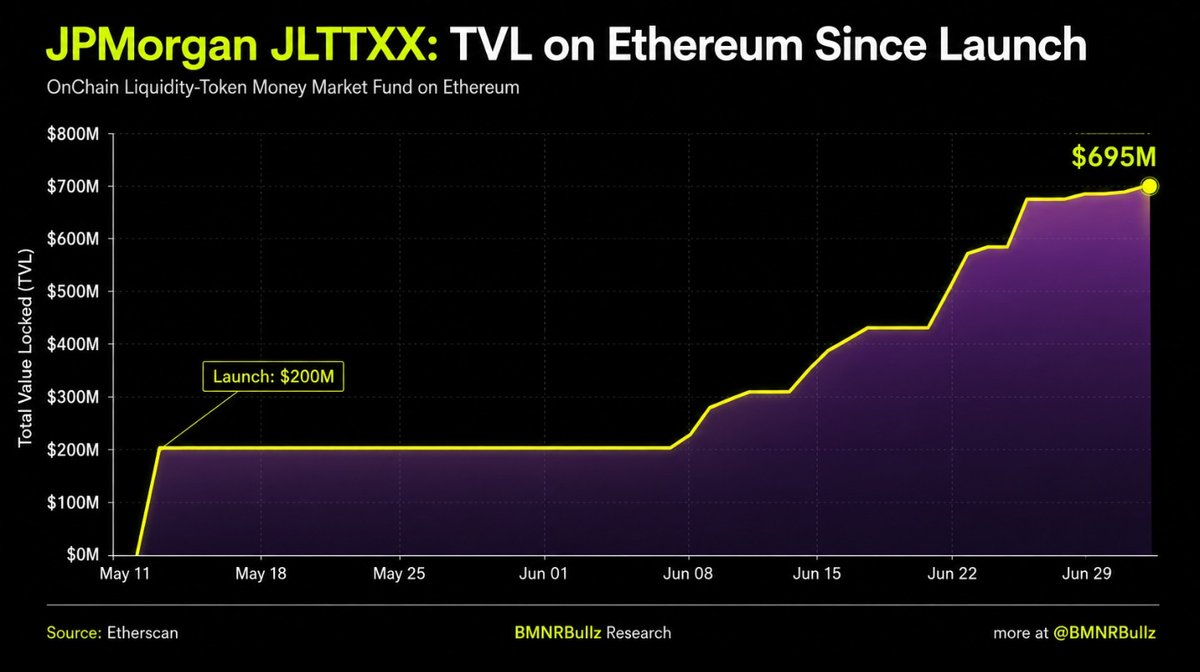
JPMorgan has quietly turned a tokenized fund into one of the fastest-growing products in recent years.
According to cryptocurrency financial media The Defiant, JPMorgan's OnChain Liquidity Token Money Market Fund (code JLTXX) has seen its on-chain management scale grow by about 250% in the past month, with data from blockchain analysis platform Token Terminal. This fund operates solely on Ethereum.
From 200 million to nearly 700 million in seven weeks, JPMorgan starts with its own funds
JLTXX launched on May 13, with JPMorgan initially investing 100 million dollars of its own funds as a seed, and custodian Anchorage Digital also participated in the initial subscription, with a total on-chain lock-up on the launch day of about 200 million dollars. According to a tweet from ethereuminsti, this figure reached 695 million dollars seven weeks later, an increase of 248%, closely matching the approximately 250% given by Token Terminal.
This fund invests in very conservative assets, all consisting of short-term U.S. Treasury bonds and overnight repurchase agreements fully collateralized by Treasuries or cash, identical to the safest assets in traditional money market funds. What's truly different is where it runs. JPMorgan has its own private settlement network called Kinexys, but JLTXX, like the first tokenized fund MONY launched by the bank last December, chose to operate on the public Ethereum mainnet rather than its own chain. The choice of a bank with its own blockchain infrastructure to place its product on a public chain itself signals something significant.
For those holding ETH, the implication here is: Ethereum is gradually transforming from a speculative asset into a foundational ledger for compliant financial products in the eyes of institutions. This type of demand is largely unrelated to short-term price fluctuations, but will solidify into long-term network usage.
The growth behind is the reserve demand for stablecoins
JLTXX's rapid growth can partly be attributed to it being used as reserves for stablecoins.
According to disclosures from Dune analysis accounts, this fund has been added to the reserve asset pool of the USDG stablecoin, along with BlackRock's BUIDL and Superstate's STBXX. This move indicates a growing demand: stablecoin issuers need U.S. Treasury exposure that meets the rules of the GENIUS Act, which can be held on-chain. The GENIUS Act is stablecoin legislation passed in the U.S. in 2025, specifying the conditions reserve assets for stablecoins must meet, and tokenized U.S. Treasury money market funds fit perfectly into this position.
JPMorgan designed JLTXX to allow subscriptions in cash as well as in stablecoins, effectively placing this fund directly at the intersection of regulated finance and crypto-native infrastructure. It’s not alone in this field; BlackRock has submitted documents to the SEC for two tokenized money products, one of which involves tokenizing a share class of its existing 6.1 billion dollars selected Treasury liquidity fund on Ethereum. BlackRock's BUIDL is currently the largest tokenized fund in the world, managing over 2.8 billion dollars in early 2026 across eight blockchains.
Those looking to enter can read a direction from this: stablecoin reserves are a clearly growing pie, and institutions almost unanimously have chosen Ethereum as the layer to carry this pie.
BitMine buys 73 million dollars in a single week, nearing 5% of circulating supply
While traditional finance approaches Ethereum from the asset side, the on-chain accumulation of tokens has not stopped.
According to a holding update released on Monday by BitMine Immersion Technologies (NYSE: BMNR), the Ethereum treasury company chaired by Tom Lee of Fundstrat, in the past week, it purchased 42,197 ETH, amounting to about 73 million dollars at that time. This purchase pushed BitMine's total ETH holdings to 5,742,237 tokens, approximately 4.8% of Ethereum's circulating supply. BitMine's own accounts total the value of crypto and other assets at 11.1 billion dollars, with ETH valued at 1,800 dollars each, along with 206 BTC, a 180-million-dollar stake in Beast Industries, a 71-million-dollar stake in Eightco Holdings, and 527 million dollars in cash and securities.
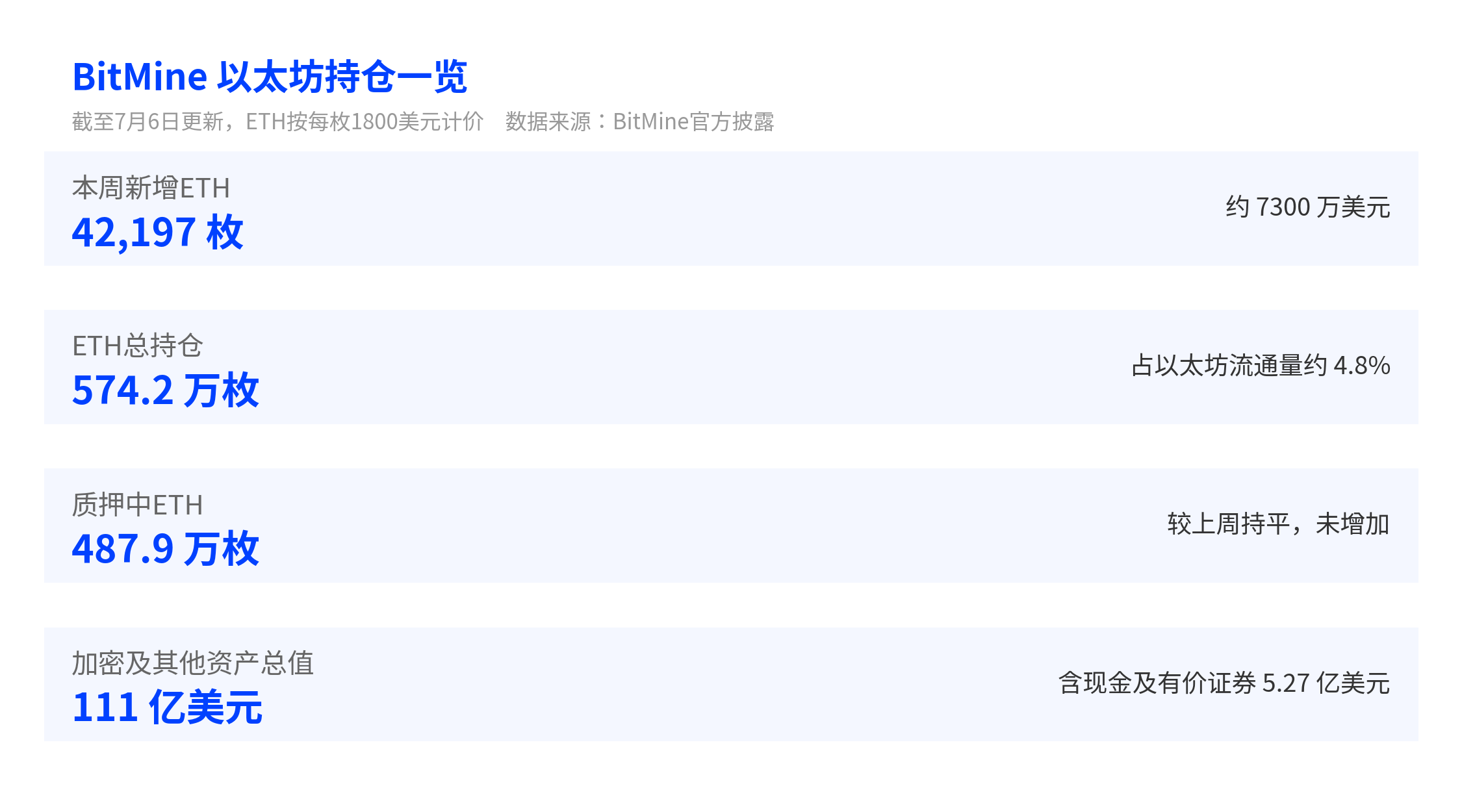
One detail worth noting for holders: BitMine's staked ETH amount is fixed at 4,879,157, the same as the previous week, meaning no newly added tokens were staked this week. The company's public goal is to control 5% of Ethereum's total supply, and the weekly accumulation method is approaching this threshold.
A risk warning is necessary: BitMine's holdings value is highly dependent on price, valuing ETH at 1,800 dollars in its accounts, whereas as of July 6, the spot price of ETH was approximately 1,747 dollars, already below its pricing benchmark. In June, insiders even warned that the company had a cash gap of about 30 million dollars, which Tom Lee publicly denied at the time. For those following this type of treasury company to go long on ETH, the dual leverage of the company's stock price and coin price is a double-edged sword.
Prices are falling, institutions are buying, how to read this divergence
Putting the two clues together presents a peculiar picture: institutions are accelerating their entry, while the price of coins is going down.
This year has been tough for Ethereum. According to various market data sources, ETH has fallen over 50% from its historical high of about 4,900 dollars in August 2025, and the first three quarters of 2026 have seen three consecutive quarterly bearish candles, a first in recorded history. The spot Ethereum ETF also recorded net outflows in June. On-chain activity is also declining; according to Glassnode data, the 14-day average of active addresses dropped from about 795,000 in early February to about 420,000 in June, a decline of about 46%.
Thus, JPMorgan's fund scale, BitMine's growing holdings, and the secondary market's coin price tell two different stories. Institutions are buying Ethereum as a settlement layer and compliant asset base for the long term, betting on stablecoin reserves and tokenized assets; meanwhile, the secondary market is selling short-term liquidity, sentiment, and ETF funding. These two matters can diverge for the long term, and who will cash out first remains uncertain.
For holders or those looking to enter, the operational implication here is: institutional hoarding of coins and the narrative around tokenization are real fundamental changes that are occurring, but they do not constitute a floor for short-term prices. Historically, large holders concentrating their buying does not always signal clean buy signals, as the previous round of whale accumulation in February was followed by a local peak. Treating institutional entries as long-term logic can be acceptable, but being cautious about using it as a basis for timing the bottom is advisable.
免责声明:本文章仅代表作者个人观点,不代表本平台的立场和观点。本文章仅供信息分享,不构成对任何人的任何投资建议。用户与作者之间的任何争议,与本平台无关。如网页中刊载的文章或图片涉及侵权,请提供相关的权利证明和身份证明发送邮件到support@aicoin.com,本平台相关工作人员将会进行核查。


