Strategy has broken its promise of "never selling coins" and has begun cashing out to pay dividends.
By: Dong Jing, Wall Street Journal
Strategy is paying for its capital structure with Bitcoin. This largest corporate Bitcoin holder is facing a mathematical dilemma triggered by its own business model—when the stock price premium disappears and the financing window narrows, the promise of "never selling coins" has quietly given way to the liquidity pressure of reality.
The Wall Street Journal article stated that on July 6, Strategy disclosed that it sold 3588 Bitcoins from June 29 to July 5, cashing out approximately $216 million to pay dividends on its preferred stocks. This is the largest Bitcoin sale in the company's history and its third sale since launching its Bitcoin strategy in 2020.
After this announcement, MSTR's stock price fell more than 5% during trading, and Bitcoin dropped to approximately $61,800, below the company's average holding cost of about $75,700. The company confirmed a digital asset loss of $8.32 billion in the second quarter, coinciding with a 14% drop in Bitcoin prices.
The market's wary sentiment stems not only from the sale itself but also from the logic shift behind it. Strategy holds 843,775 Bitcoins, accounting for about 4% of the total Bitcoin supply globally; any large-scale sell-off could significantly impact the coin's price.
According to the Wall Street Journal's analysis, Strategy's core valuation indicator, mNAV, has fallen below 1, meaning the market values the company less than its Bitcoin holdings, fundamentally undermining its business logic of "exchanging premium stocks for Bitcoin."
“Never Sell Coins” Promise Loosens, Sale Scale Expands a Hundredfold
Strategy has long viewed "never selling Bitcoin" as the foundation of its business model, but this promise has shown clear cracks.
At the end of May this year, the company broke tradition for the first time, selling 32 Bitcoins, cashing out about $2.5 million to pay preferred stock dividends, and emphasized that this move was solely to fulfill commitments to preferred stock investors and did not represent a strategic shift.
However, the latest round of sales has expanded to 3588 Bitcoins, approximately a hundred times the amount sold in May. According to the company's disclosures, 1363 Bitcoins were sold at an average price of about $59,300, while the remaining 2225 Bitcoins were sold at about $60,800.
The Wall Street Journal article stated that the proceeds from this sale will be specifically used to pay the second quarter dividends for four preferred securities: STRF, STRE, STRK, and STRD, as well as STRC's June monthly dividend. Selling Bitcoin has ceased to be a one-off symbolic operation and is gradually being integrated into the company’s routine financing system.
Notably, Strategy announced on June 29 that the board had authorized the sale of up to $1.25 billion in Bitcoin for stock buybacks, as well as to pay interest and preferred stock dividends. This marks the company's official abandonment of the philosophy of "sticking to Bitcoin."
It is important to note that the capital structure supporting this business model is under increasing pressure.
Analyst Zach Pandl pointed out that Strategy incurs approximately $1.5 billion annually in preferred stock dividend expenses, which its software business cash flow cannot cover. When cash reserves are insufficient, the company can only continue financing or sell Bitcoin.
As of July 5, Strategy holds 843,775 Bitcoins and has cash reserves of $2.55 billion. The company estimates that this cash buffer can provide about 17 months of interest and preferred stock dividend payment space without needing to touch its crypto assets.
Strategy's operational logic is becoming increasingly clear: continue to buy coins when financing is smooth, and sell a small amount of Bitcoin to pay dividends when financing tightens, maintaining the closed loop of capital operations.
Although immediately after the first sale at the end of May, the company quickly bought back 1550 Bitcoins, and in April and May, it completed large-scale purchases of $2.54 billion and $2 billion respectively, the sustainability of this system is now under question as Bitcoin prices remain pressured.
mNAV Falls Below 1, Core Business Logic Faces Fundamental Challenges
The core of Strategy's business model lies in utilizing stock premiums as "currency" to continue purchasing Bitcoin. The quantitative anchor for this logic is the company's self-created mNAV indicator.
According to the Wall Street Journal analysis, Strategy defines mNAV as the ratio of the company's enterprise value to the value of its Bitcoin holdings. At its peak, this indicator has maintained a high premium, allowing the company to continually issue stock to purchase more Bitcoin, operating similarly to traditional acquisitions where companies use overvalued stock as currency for continuous acquisitions.
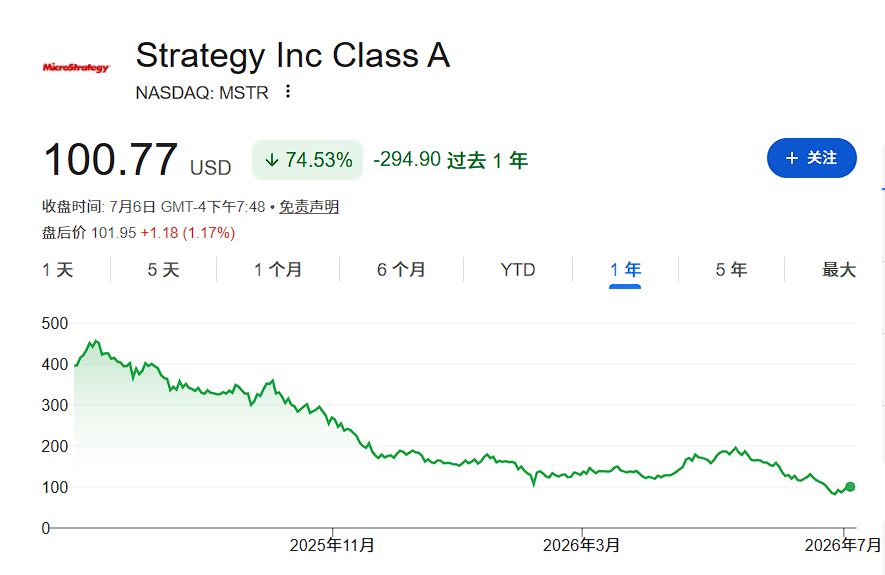
However, as MSTR's stock price has cumulatively fallen about 75% over the last year, mNAV fell below 1 last month, meaning the market values Strategy below the book value of its Bitcoin holdings, and this "snowball" logic has begun to operate in reverse.
What is even more alarming is that this indicator itself has systemic overestimation issues. The Wall Street Journal pointed out that Strategy uses the principal of debt and the par value of preferred stocks to calculate enterprise value, rather than market values. However, as the prices of the company's bonds and preferred stocks have plummeted alongside the stock price, this calculation method has become severely distorted.
On June 26, for example, Strategy reported an mNAV of about 0.99, but if debt and preferred stocks were calculated at market values, the actual mNAV would only be about 0.89. At that time, the company's debt was trading at a 7% discount, and each series of preferred stocks was trading at a total discount of about 28%.
As of last Thursday's close, Strategy's official website showed an mNAV of 1.09, but when calculated at market values, the actual figure was only about 1.04, and the premium space has become extremely limited.
Sell-off Pressure and Market Chain Reactions
Strategy's Bitcoin holdings involve systematic implications for any sale actions.
Strategy's Bitcoin accounts for about 4% of the total global Bitcoin supply. Even a small-scale operation like selling just 32 Bitcoins for $2.5 million in May has put significant downward pressure on Bitcoin prices and MSTR's stock price.
Analysts believe that while the sale of 3588 Bitcoins is still only a tiny part of its holdings, market concerns about potential large-scale sell-offs have significantly intensified.
According to Strategy's own logic, when mNAV remains undervalued, the company should sell Bitcoin to buy back its own securities. Investors are closely watching whether this signal will evolve into a large-scale action.
To stabilize the preferred stock price, Strategy raised the dividend yield of its largest preferred stock series STRC to 12% on June 29, attempting to attract buyers and push the price back to par. This move itself indicates that the company is much more concerned about the price of the preferred stock market than it presents in mNAV calculations.
The Wall Street Journal noted that if the market continues to value Strategy in the undervalued range and does not retreat, the company will face a depletion of cash and will be forced to significantly use its Bitcoin reserves. Strategy may have bought itself some time, but how much longer this period will last remains uncertain.
免责声明:本文章仅代表作者个人观点,不代表本平台的立场和观点。本文章仅供信息分享,不构成对任何人的任何投资建议。用户与作者之间的任何争议,与本平台无关。如网页中刊载的文章或图片涉及侵权,请提供相关的权利证明和身份证明发送邮件到support@aicoin.com,本平台相关工作人员将会进行核查。


