Key Takeaways
- Spot bitcoin ETFs lost $5.4B in H1 2026, their first negative half-year since launch.
- DWF Labs said AI drew capital away as Blackrock’s IBIT posted $5B in outflows.
- Ether ETFs lost $1.47B, while DWF Labs expects crypto infrastructure to keep growing.
Spot bitcoin exchange-traded funds (ETFs) have recorded their first losing half-year, breaking a streak of steady accumulation that had defined the category since launch.
According to analysis by DWF Labs, bitcoin ETFs ended the first half of 2026 with $5.4 billion in net outflows. The reversal came after two years of largely uninterrupted demand, during which cumulative net flows had reached $56.6 billion at the start of the year.
The first quarter opened weak. January erased $1.6 billion in flows, and by Feb. 23 cumulative net inflows had fallen to $53.8 billion. That represented a $2.8 billion drawdown in less than eight weeks.
April briefly restored confidence. Cumulative flows recovered to $59.8 billion by May 6, helped almost entirely by Blackrock’s IBIT, which DWF Labs said accounted for 99.6% of the category’s April inflow. But the recovery faded quickly.
From May 15 to June 3, bitcoin ETFs suffered 13 straight trading sessions of outflows, the longest such streak since spot products launched. The run pulled $4.4 billion from the category and erased April’s gains.
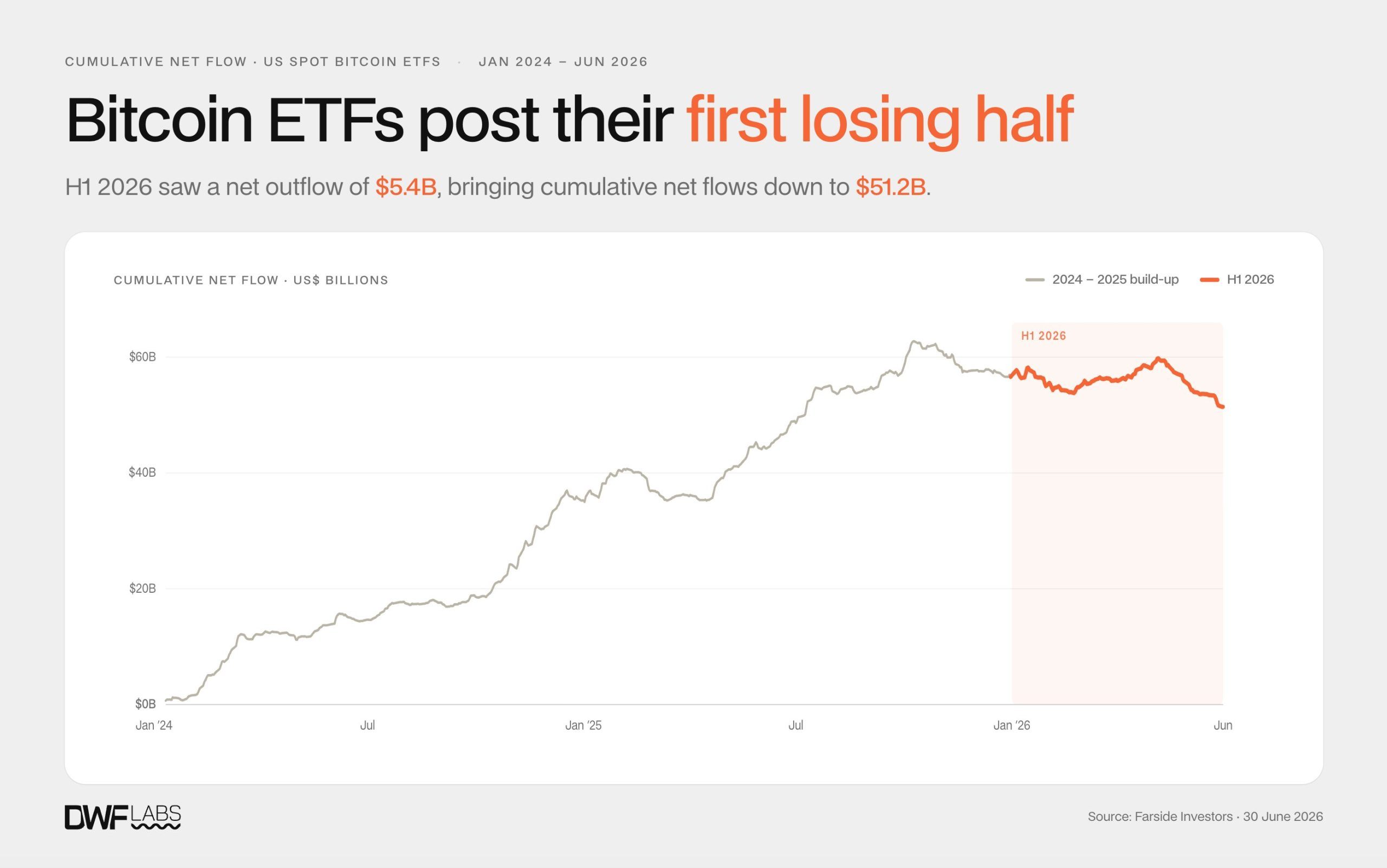
Source: DWF Labs
Blackrock’s IBIT remains the dominant bitcoin ETF by historical flows. Since launch, the fund has attracted $60.3 billion in net inflows, or 3.3 times the total of every other fund, excluding Grayscale’s GBTC, combined.
DWF Labs said IBIT became the default institutional vehicle for bitcoin exposure, despite not having the lowest fee, because of Blackrock’s distribution reach across allocators and investment platforms.
For much of the ETF era, IBIT and other lower-cost funds absorbed outflows from GBTC, which has lost $27.1 billion because of its 1.5% fee and years of trapped holders exiting after conversion.
That pattern broke in 2026.
IBIT recovered in March and April, then saw heavy redemptions in May and June. DWF Labs said the fund posted $5 billion in net outflows across those two months alone, more than all previous IBIT outflow months combined.
The weakness was not limited to bitcoin. Spot ether ETFs also ended H1 2026 in negative territory for the first time since launch, with $1.47 billion in net outflows across 123 trading days. The period included 73 negative days and 49 positive days.
Cumulative ether ETF inflows stood at $10.9 billion on June 30, down 28% from their October 2025 peak of $15.1 billion. That October peak also marked the month bitcoin ETFs began their own 18.4% drawdown.
DWF Labs noted that staked ether ETFs have gained traction since U.S. regulatory guidance in 2025 cleared the way for protocol staking in certain products. Grayscale activated staking on ETHE and its mini trust, 21Shares began staking distributions on TETH, and Blackrock launched ETHB in March.
Still, inflows into yield-bearing products were not enough to offset broader selling.
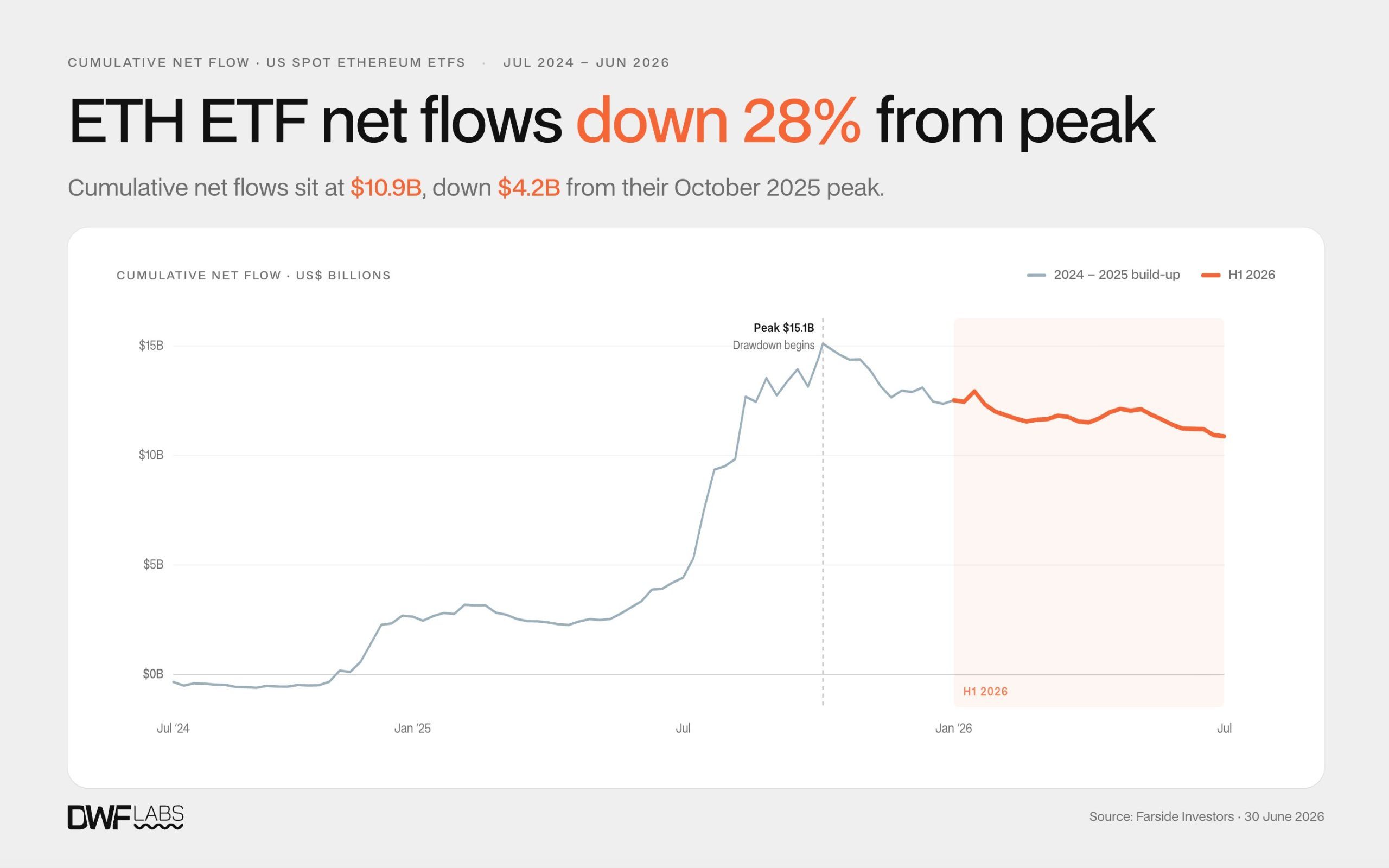
Source: DWF Labs
DWF Labs said institutional and retail enthusiasm has cooled as AI captures a larger share of capital and attention. Even so, the firm noted that about $80 billion remains in bitcoin ETFs, much of it from investors who previously lacked easy access to BTC exposure.
DWF commented that, “The flows reflect broader sentiment toward crypto as an asset class. The fundamentals for crypto have never been stronger.”
The message is cautious, not fatalistic. ETF flows have turned, but the infrastructure around crypto is deeper than in prior cycles.
免责声明:本文章仅代表作者个人观点,不代表本平台的立场和观点。本文章仅供信息分享,不构成对任何人的任何投资建议。用户与作者之间的任何争议,与本平台无关。如网页中刊载的文章或图片涉及侵权,请提供相关的权利证明和身份证明发送邮件到support@aicoin.com,本平台相关工作人员将会进行核查。


