Author: bayeslord
Translated by: Shenchao TechFlow
Shenchao’s Introduction: bayeslord (@bayeslord) is an anonymous yet influential account in the AI × crypto circle, not promoting products, not chasing trends, but rigorously pushing down the technical core of scaling laws and algorithmic depth.
This blogger recently wrote a list of 46 items, projecting the future development of technology, AI, and related technologies. It is believed that everyone is using the efficiency curves of the past to understand AI, while the real big leap has yet to come; intelligent production may still have four to ten orders of magnitude remaining.
He discusses everything from algorithm acceleration to robots, capital, and a permanent underclass, finally landing at the sharpest point: mutually assured destruction (MAD) may fail, military and police will be automated, and AI laboratories may be nationalized.
The original post has nearly 1 million views. Although the views are extreme, each point is relatively coherent and worth a read for general technology readers.
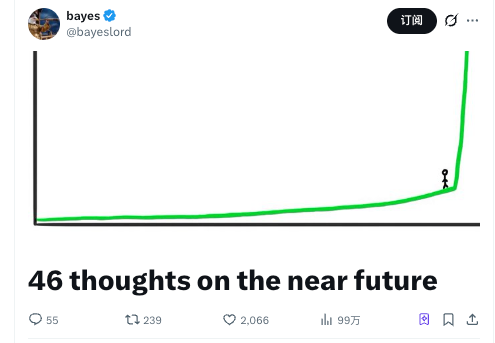
This list is based on a tweet thread I posted on June 4, with some modifications and additions. Several people said the original was too difficult to read, so I organized it into this version.
Intelligence
1. Algorithmic progress will catch everyone off guard. The entire world—markets, governments, militaries, companies, and individuals—is using recent years' production efficiency and patterns to understand the impact of AI and to judge how things will likely unfold. Even those new laboratories claiming to believe in “recursive self-improvement” feel it's just the old routine with an intelligent agent running in a loop. It’s not like that. I suspect that in terms of intelligent production, there are still many orders of magnitude left to cover, possibly up to ten, with four to seven being more likely. In principle, exceeding ten isn’t impossible, but it would clash hard with my suspicion about the true limits allowed by physical laws. It’s unlikely but hasn’t been ruled out. If this judgment holds, then the real trajectory of events and how they superficially appear are not the same thing; a big leap is approaching. Anything that happens in this direction will make the world seem far stranger than what almost everyone has priced in.
2. We are in the early stages of takeoff. AI improving AI could ultimately be the most consequential step in history. This cannot be guaranteed because we do not know how far we are from the physical and computational limits of intelligence, but I bet it is still a long way away (as mentioned earlier, squeezing out 4 to 10 more orders of magnitude of intelligent output per unit of computing power seems possible).
3. Since we have entered the takeoff phase, algorithmic research is accelerating. Computing power is still a scarce resource, but the opportunity cost of researchers' time has decreased because you can directly send an intelligent agent to run any task, even if it’s just messing around. It might bring back something useful. All new ideas carry a “debt of optimization,” and this debt can now be repaid with unsupervised token consumption. Massive research scaling law curves will be traversed one by one.
4. AI models will continue to strengthen, especially frontier models. The only real wall is physics. Models are becoming increasingly autonomous, smarter, and continuously improving. Math and code are being conquered by large-scale reinforcement learning, with everything else lagging behind. The distinction between “verifiable” and “non-verifiable” as a meaningful boundary will slowly disappear. Moving forward, automated AI research and AI learning will increasingly resemble one and the same thing. Training a model well is intrinsically tied to how well the model learns on its own. Sample efficiency, creativity, and all other limitations will be resolved, approaching algorithmic optimality at any scale.
5. The idea that long-task intelligent agents must have an equal length of training data is incorrect because generalization exists in the time dimension. Long tasks are not just piled by the attribute of “long.” This relates to LeCun’s (1-e)^n error accumulation fallacy. What is actually happening is error correction. Error correction occurs simultaneously at multiple scales, from single token generation to each step in long tasks. The reason METR’s chart moves upward is partly due to intelligent agents beginning to reach the escape velocity of error correction.
6. A level of engineering-grade deep learning science is about to emerge. It will push us toward the algorithm maturity phase of AI at a speed much faster than most expect—although, as mentioned earlier, it's still unclear how far this path can go. For example, a science studying scale invariance will significantly enhance the scale and return of useful experiments because an experiment on one GPU can inform you how to do it with a hundred thousand.
7. Every field of human technological activity will have its own “37th move” moment (the move AlphaGo made against Lee Sedol that transcended human intuition), and then shortly thereafter, the “37th move” itself will seem outdated. I am talking about all fields.
8. Computing power will continue to improve. Today’s best matrix multiplication machines are still far from the physical limits of AI accelerators. There is still significant room for improvement in digital silicon. There are many candidates for new substrates, and the algorithm debts they owe will be automated and squeezed to the extreme, but we still do not know what is optimal for AI in terms of space, energy consumption, time, manufacturability, and cost. Photonics and random silicon are interesting candidates, but I also expect the singularity itself to be surprising.
9. How far a laboratory can lead partly depends on the returns from automation and scale, including those brought by deeper algorithmic depth. If the practical (and theoretical) aspects of deep learning remain shallow, then in the long run, the moat probably won’t primarily be algorithmic because secrets are relatively easy to uncover. Ultimately, distillation plus data plus time can catch up to computational scale, but it might be a bit slower. Currently, it seems we are partially in this state, but even if that is true, no one can guarantee it will always proceed this way.
10. If deep learning becomes less shallow as scale increases, then every incremental improvement in automation and scale will exchange for algorithms secrets that others can increasingly not reach. This state partially seems to apply to us now. The end point of both scenarios is when marginal utility returns saturate with scale and research. We don’t know where that point is. It could be two orders of magnitude away from today, or it could be twenty. No one knows.
Intelligent Supply Chain
11. For at least the next few years, computing power will be a fiercely contested resource. But during this time, it will begin to commoditize, and we will look back and laugh at the meagerness of the 2020s. Scale is expanding and working, capital is coming in, turning the flywheel again and again. More matrix multiplication machines, more fabs, and more energy are on the way. The bottleneck of intelligent production is temporary. Potential economic slowdown is not included.
12. The nature of intelligent supply chains is changing. Right now, it is highly concentrated in the hands of laboratories. But laboratories are automating the core thing that makes them stronger—the researchers and the discovery of algorithmic advantages. Once this process begins, assuming open source keeps pace, especially if laboratories do not lock down AI researcher models, the advantages of laboratories will shift to easier financing, more computing power, exclusive data, business relationships, and good products. This indeed depends on how the aforementioned issue of algorithm depth plays out and other factors.
13. Distributed training will reduce the need for large-scale construction of centralized data centers, giving some advantages to non-hyperscale vendors. However, in the dimension of maximum scale training at a single time, it will not surpass hyperscale vendors.
14. Automated AI experiments will lead to the widespread discovery of algorithm secrets because these secrets are inherently easier to distribute than full-scale training. It is unclear how far this path can go, but I expect it to be quite far. As mentioned earlier, the fundamental depth of deep learning remains unknown, and the upper bound of this judgment depends on that unknown.
15. Although these forces appear advantageous to academia and open source on the surface, they may still shrink due to the costs and opportunity costs of computing power. For example, is using GB300 to serve GLM5.2 or Fable worth more, or is it better to conduct non-cutting-edge research in some academic lab, or to develop Mythos 2 internally at Anthropic? The market will calculate where the greatest demand lies, and currently, that place indeed seems to be the labs. This means open-source labs might become more computing-hungry, even if they have money, provided they haven’t locked down computing production in advance. Even if they have locked down, they still have to consider the opportunity costs of conducting research versus leasing computing power. Refer to the collaboration between Colossus and Anthropic.
16. In an environment where AI capabilities begin to become stimulating (the next 0 to 18 months), open source may also begin to face difficulties on a societal level, especially if we accelerate security at a slow pace—which so far has indeed been quite slow.
17. As capital floods into laboratories, open source may begin to shrink. There is a coordination issue here: apart from laboratories (and perhaps the government), no one wants a token monopolist. But if this issue can be resolved and the regulatory environment is friendly, the outcome could be acceptable.
Robots
18. Robots will have a moment similar to ChatGPT in November 2022, followed by another moment like Opus 4.5 in November 2025. Neither has happened yet, but they are coming, and they will arrive faster than people think, as a result of rapid AI advancement, including the engineering of physical systems accelerated by AI. The gap between these two moments in robotics will not likely be three years.
19. However, physically stacking the number of robots worldwide may have to wait until 2030 or even later. While we produce about 100 million cars a year, humanoid robots are much smaller than cars. Considering that we also manufacture 1 billion smartphones annually, reaching the scale of 100 million robots per year by 2030 is reasonable if capital and algorithms move fast enough. Achieving 10 million units a year is certainly doable; we are already working on that in the drone market. As long as the software can demonstrate that humanoid robots are worth the price on a small scale, it can leverage unlimited capital, with the amount leveraged being proportional to the quality of the proof.
20. What today seems like a hard ceiling for robots will disappear, including poor sample efficiency, relatively scarce data, expensive and difficult hardware design for hands and motors, the fractal complexity of the physical world, and the implicit knowledge about how we work in the world that hasn’t been documented (like plumbing). World models seem useful, but which specific one isn’t important. Research into scaling laws will be refined until the utility diminishes.
21. The global demand for robots easily reaches hundreds of billions, especially when various forms are aggregated. There are too many physical jobs worthy of automation. The market will find a way to solve this, and people probably won’t stand in the way.
Progress
22. Science is becoming automated and virtualized. This means many of the advancements needed in this world will come from automated laboratories and simulations. We do not know the complete computational limits of virtualization, but robotic-driven laboratories in fields such as biology and materials science will dismantle many bottlenecks and push the boundaries of “verified virtualization” to enhance sample efficiency and the net returns of “becoming reality.” Essentially, in every field, we will have some combination of neural models, explicit simulations, and real-world experiments, jointly improving every dollar and every minute spent in fields like biology and materials science.
23. The law of progress is everywhere. In deep learning, they are called scaling laws. It is difficult to determine when an S-curve on any given curve saturates, and it is also challenging to know if there is a new S-curve on the horizon. The key to understand here is that the engine of civilizational progress itself has a law of progress. Our progress is likely saturating, like most natural processes, but we do not actually know where saturation will occur. The maturity of technology and civilization could be very close or very far away. We are at such a historical juncture: one, we have hardly invested any resources into progress, but that is changing rapidly; two, we are automating the machine that directly produces more progress. We are in an interesting era.
24. A future of scaling up or scaling out. From zero to one or from one to n. How much progress the universe allows us to make in breadth and depth is an open question. Breadth is easier to estimate, as it is roughly “how many steps can we compute from now on, given that the laws of physics still allow for it?” On the other hand, how “deep” that computation can be—in the broadest sense of the word—is unknown. In some versions of the future, technology trees grow to incredible depths, and the accessible computational universe is so rich that we keep inventing and discovering until physics stops us, assuming it can. Other versions are flatter: we quickly fill a shallower technology tree and reach technological maturity relatively easily, and then scale it out until we're satisfied or until physics gets in the way.
Capital and Production
25. More capital with more intelligence means a reinforced capitalism, leading us to the market equilibrium more quickly. In the long term, this should naturally lead to deflation, with most important goods competing to approach zero marginal cost, including AI, food, housing, healthcare, electronics, entertainment, and travel, provided we don’t let people stand in the way. In some cases, they probably will.
26. Mining will be automated. Land, sea, and air transport will be automated. Factories will be automated. Workers will be automated. Distribution centers will be automated. The maintenance, improvement, and expansion of the entire supply chain will be automated.
27. There will be humans still having jobs for a long, long time. What proportion of humanity falls into this category is an open question. Those who say this number will be very high are overly confident, and those who say it will be zero are equally so. However, it is indeed hard to imagine how long humans can still contribute on the margin in the “knowledge” part of knowledge work. Some demands, like for doctors, may decline significantly—if we have ultra-intelligent AI doctors at $20 a month, combined with on-demand testing and significant health improvements from advancements in medical technology. But because we have cartelized doctors, we may continue doing so, and being a doctor may still be a good profession. Demand for entertainment will likely rise, but production costs will fall, and the technical need for humans in entertainment has already diminished significantly. But we care about other humans, so perhaps we will continue to care about them, and actors may become more lucrative. A way of thinking that can help you understand how this evolves is: how many intermediaries are there between today’s worker and consumer in the supply chain? For a TikTok influencer, it’s zero layers. For a doctor, it’s zero layers. For a factory worker, there are many layers. Whether a job can be de-intermediated, whether it can be eliminated by competition, and whether it is replaceable will largely determine its outcome. This analysis is quite nuanced, and this section cannot be fully conveyed, but it should be noted that all of this assumes we do not encounter a cliff-like collapse in demand—if too many people do not work, and productivity or government efficiency cannot support universal basic income or universal healthcare, such a collapse may occur.
28. Related but not contradictory to the points above: a “permanent underclass” may indeed exist. In the better worlds where it materializes, it appears more like highly constrained agency rather than severely harmed income. For most, this is ultimately acceptable; our agency has long been highly constrained by modern society, but it requires psychological adaptation, which may take time and could be painful.
Culture and Psychology
29. The human mind currently grows and adapts very slowly, but this will change. The key is to change in a positive direction, which may not be easy for some. An abundance of intelligence and automation will allow us to engineer far more durable psychological structures than those of today—today’s setup is evolutionary baggage that doesn’t fit our environment. Psychiatry and psychology will, within a few decades, complete a thousand years’ worth of innovations. Humans will fundamentally become better. The crude, decayed “direct connection to pleasure” is overestimated as a risk because we will have more sophisticated and diverse mental engineering available.
30. In an extremely uncertain world, people will fight for power, status, and wealth more ferociously than ever, and in the process, they will betray their own kind with easy conscience. They will invent all sorts of reasons to justify their actions as good, even great. Just look around.
31. You will live to see unbelievable awkwardness.
32. There is now an obvious dual discourse at play: those who are about to become, or already, the wealthiest 0.01% say that AI will benefit everyone, do not worry about jobs, while simultaneously refusing to relinquish their wealth to be part of random humanity on Earth, even if the duration is one year, five years, or twenty years. People can see this, and have begun to respond. To be clear, I also would not give up my position, but I also do not say everything will be perfect (and I am not among the wealthiest 0.01%). The result is that we risk constructing an unjust world. Some care about this, and I think this issue should be discussed more frequently. Moreover, to be more blunt, the way American politics handles these issues is terrible.
33. Elon appears very likely to become the first trillionaire. Broadly speaking, it is not hard to imagine that the demand for chips, robots, and spaceships will increase to over a thousand times the current levels, and a sizable chunk of that he could likely capture.
Coordination
34. Better coordination is needed at every scale of society, and this is clear. Based on our current understanding of coordination, it has weaknesses and risks, but it is likely we haven’t even scratched the surface. Will there be a Satoshi-level figure to take down Moloch (embodying the pernicious competition where everyone is forced to participate and none can exit)?
35. Coordinating internationally on AI would likely be a good idea. We may want treaties and GPU counts. This could be designed to: first, slow down the spiraling accumulation of confrontational power in the military and government; second, minimize the impact on science and other important areas of advancement. We may not achieve this because GPUs are too universally powerful. We managed it with nuclear weapons because, apart from lunatics, no one genuinely wants to use a nuclear bomb.
36. A pause or slowdown in AI laboratory coordination now seems more likely than in 2023. There are many trade-offs here, but I feel the arguable value of a pause is slightly higher today than it was in 2023. The argument “the pause would be wasted” is harder to establish now because we have automated research—though not fully (what we have are automated engineering). To be honest, personally, I do not support a pause right now, mainly because it would interrupt too many other aspects of traversing the singularity on that tightrope; there may be dragons hidden in the technology tree, and the adversaries are very real.
Power, Violence, Security, Freedom
37. I regret to inform you that our universe may be fragile in the sense described by Bostrom (philosopher Bostrom’s “vulnerable world hypothesis”: technological progress may reveal some ability that, once discovered, is sufficient to destroy civilization). It is possible that the current world possesses some freedoms that we cannot quickly coordinate to control while maintaining good governance and freedom conforming to our norms (those norms are sufficient for the truth of our world, aside from a panopticon prison). Note that in such a world, the accumulation of power is a slippery slope. Many such worlds end up being very bad for most people. I wish this were not true, but it may very well be.
38. The spread of AI will occur at some non-zero speed, regardless of how many potential limiting factors exist. There are too many computers in the world, and the exchange rate of FLOP for intelligence is at the lowest it has ever been. Don’t bet on things stagnating.
39. The concept of a “permanent underclass” implies the existence of a “permanent upper class.” This presupposes a group of people who, for some relatively unjustifiable reason, possess more rights. That reason is fundamentally always implied or realized, supported by violence. But perhaps a world with advanced AI is a world where humans no longer have justifiable reasons to rule, with no universally acknowledged abilities or status that surpass other humans. This will never be 100% realized, but it may become increasingly important to consider. I suspect that in practice, moral and pragmatic arguments will diverge significantly, and perhaps that is for the best.
40. Forces in various directions will push institutions to transform, and these forces may lead to tyranny. There are many paths to that, some under the guise of security, while others are benign power expansions—the ceiling is strong AI with fully automated military supply chains and fully automated weapons. We need better institutions.
41. There may be a multitude of zero-day vulnerabilities outside. In the realms of networks, biology, infrastructure, neurology, memes, and physics. We do not fundamentally understand the returns of algorithmic depth and consistency in these domains, whether from the defensive and robustness side or the destructive side. The algorithmic depth of nuclear weapons is not out of reach for the smartest humans in the world. Tomorrow our machines will reach the next level, and the level after that. Right now, we know a little bit about the very shallow disaster rates in terms of algorithms, while we know almost nothing about what could happen in an algorithmically deep civilization.
42. A related statement: there may be some really awful things hidden in the technology tree. We genuinely do not know.
43. The capabilities of scaled robots present genuine takeover and coup risks that surpass mere computational models, as well as more mundane things, like new attack surfaces and vectors for cyberattacks. We should take these risks seriously and strive to reduce them.
44. Mutually assured destruction is built on technologies from the 20th and early 21st centuries. We are about to undergo rapid technological transformation, possibly compressing a millennium's worth of change into a very short period. This means MAD is not a foregone conclusion. The problem is solvable, but it is neither completely certain nor is it a clean and tidy overthrow, as achieving decisive advantage requires extremely low tolerance for error, which may not be feasible at all. In the past, some have broached this topic in a rather unserious manner, which I believe is wrong and irresponsible. This is one of the most serious topics we can discuss. People feel anxious about it, which is right, but I think it's time to talk about it.
45. The main mechanisms of armies, police, and governmental enforcement will be automated, and will be smarter than humans. You can interpret how you see fit.
46. Finally: AI laboratories may ultimately face strong forms of nationalization. In my opinion, the U.S. system is not particularly compatible with this, but there are many paths toward nationalization that do not appear to be blocked by a conservative or liberal political environment. In principle, laboratories could remain coordinated with the military and intelligence agencies on the backend without being more conspicuous than the positions they currently adopt. The federal government possesses the unilateral power we describe, and it is extremely dangerous. Private companies possessing that power is another matter, as they typically do not directly implement violence and are not legally permitted to do so. I am not particularly fond of nationalization, but this world is perplexing, and it seems to be getting increasingly perilous.
免责声明:本文章仅代表作者个人观点,不代表本平台的立场和观点。本文章仅供信息分享,不构成对任何人的任何投资建议。用户与作者之间的任何争议,与本平台无关。如网页中刊载的文章或图片涉及侵权,请提供相关的权利证明和身份证明发送邮件到support@aicoin.com,本平台相关工作人员将会进行核查。


