
On July 6, 2026, the official version of Tencent's Hy3 was released. Compared to the preview version released at the end of April, Hy3 has made particularly significant progress in productivity tasks such as software development, office productivity, financial modeling, front-end design, and game production. Currently, Hy3 has already integrated with core businesses such as WorkBuddy, CodeBuddy, Yuanbao, ima, Marvis, QQ Browser, Tencent News, WeGame, Tencent LeXiang, Sogou Input Method, Tencent Maps, and WeChat Official Accounts, with nearly 50 additional services queued for integration.

The official version of Tencent's Hy3 has been officially released
As domestic large models bid farewell to mere parameter expansion and shift towards the competition of inference costs, agent execution rates, and ROI in vertical scenarios, can Tencent's strategy of "underlying model + massive internal business scenarios" carve out a differentiated path in the productivity competition among developers and enterprise procurement? To answer this question, we need to dismantle it from the underlying logic of the model architecture, the practical performance of specific productivity tools, and the overall layout of the Tencent AI ecosystem.
What has Hy3 supplemented in productivity tasks from preview to official version?
To understand the value of the official version of Hy3, one must first grasp its architectural choices and iterative logic. After Yao Shunyu joined and led the Hunyuan team to "rebuild," Tencent's development route for large models exhibited a clear turn. Hy3 no longer blindly pursues trillions of parameters, but instead adopts a MoE (Mixture of Experts) architecture that integrates fast and slow thinking. According to the technical specifications released on Tencent's official website and GitHub, Hy3 has a total parameter count of 295B, with 21B active parameters and an MTP layer of 3.8B, supporting a context length of 256K.
The core purpose of this architectural design is to balance inference costs and task performance. The 21B active parameters mean that when handling the vast majority of routine tasks, the model does not need to mobilize all computing power, thus significantly reducing inference delays and API call costs. For developers and enterprise procurement, this directly relates to the monthly API bill scale and the application's response speed. On the pricing strategy, the preview version had already dropped the input price on Tencent Cloud's TokenHub to a minimum of 1.2 yuan per million tokens, with the individual version plan starting at 28 yuan per month. According to reports from media such as Interface News, the official version of Hy3 has further reduced prices compared to the preview version.
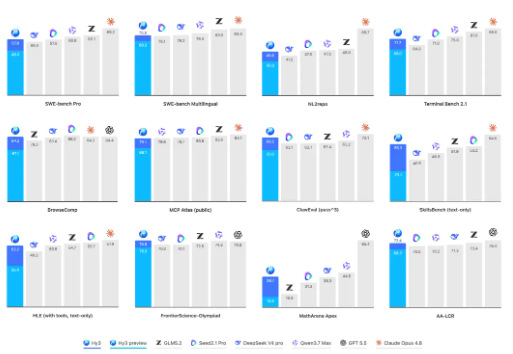
In addition to architecture and pricing, the most crucial improvement of the official version compared to the preview version lies in the quality of post-training data and the expansion of RL (Reinforcement Learning) computing power. Official information indicates that Hy3's intelligence level is superior to similarly sized models and can compete with flagship models boasting 2 to 5 times the parameter scale. This enhancement is not reflected in the scores on public leaderboards but is concentrated in the usability of practical productivity tasks such as software development, front-end design, and financial modeling.
In software development scenarios, models need not only to understand code syntax but also to comprehend business logic and engineering standards. The official version of Hy3 introduced more high-quality code libraries and engineering practice data during the post-training phase, making it more aligned with actual project specifications when generating code, thereby reducing the secondary modification costs for developers. In front-end design scenarios, the model's understanding of UI layout and style adjustments is deeper, allowing generated pages to not only function correctly but also visually conform to modern design trends.
In vertical fields like financial modeling, which lack publicly available third-party benchmarks, Hy3's capability enhancement mainly manifests in its understanding of complex business intents and executing multi-step tasks. Through official demonstrations and scenario adaptability analysis, it can be seen that Hy3 is capable of completing complex financial formula derivations and data associations in tables based on natural language instructions. This significantly lowers the threshold for non-technical employees in finance and other fields to use advanced data analysis tools. From the perspective of model capability evolution, the release of the official version of Hy3 marks Tencent Hunyuan's complete shift from "parameter expansion" to "pragmatism and agent capability." The model is no longer just a chatbot but is designed as a foundation capable of understanding complex business intents and executing multi-step tasks.
Developer Perspective: CodeBuddy and Hy3's Code Productivity Testing
For the developer community, the most critical productivity scenario for large models is undoubtedly code writing and architecture design. CodeBuddy, which has integrated with the official version of Hy3, is the most direct window to observe its code productivity.
According to publicly available data from Tencent Cloud and Tencent's official website, CodeBuddy currently covers over 95% of Tencent's internal engineers, and overall coding time has been reduced by 40%. This penetration rate is leading among domestic large model vendors' internal development tools. For external developers, CodeBuddy's value mainly lies in rapid prototype building and front-end UI generation.
In actual development scenarios, front-end UI generation has always been a pain point for AI programming assistants. Traditional AI programming assistants could often write functionally correct code but required significant manual modifications from developers regarding UI layout and style adjustments. Many developers have reported that CodeBuddy, based on the Hy3 foundation, is "aesthetically aligned" when generating front-end code. The generated code framework and components can run almost directly without modifications and visually meet modern front-end design standards. This capability enhancement stems from Hy3's quality strengthening of front-end design task data during the post-training phase, enabling the model not only to understand code logic but also to "understand" design aesthetics.
Moreover, CodeBuddy has a high level of integration with Tencent Cloud Services and APIs. For developers deeply utilizing the Tencent Cloud ecosystem, CodeBuddy can automatically recognize cloud service interfaces and generate calling code that complies with Tencent Cloud standards. In cloud-native application development, configuring cloud service interfaces often requires referencing extensive documentation, but CodeBuddy automates this process, significantly lowering the development threshold for cloud-native applications. Developers only need to describe their needs in natural language, and CodeBuddy can generate complete code snippets containing cloud service calls while automatically handling details such as authentication and error retries.
However, all tools have their limitations. Some senior developers have pointed out that when handling large-scale complex architecture reconstruction or low-level algorithm optimization tasks that require strong pure logical reasoning, the reasoning capability of the Hy3 foundation still falls slightly short compared to DeepSeek V3/R1 or Claude 3.5/4 series. With its extremely high code reasoning ability and cost-effectiveness, DeepSeek has established a strong reputation among geek developers and is the default integration model for many third-party open-source tools.
In contrast, Tencent Hunyuan, through encapsulated tools like CodeBuddy, has lowered the barriers to using AI programming, focusing on "seamless collaboration within the Tencent ecosystem." It is more suitable for mid-level and junior developers and application-level research and development teams that require rapid product delivery, frequent front-end interface adjustments, and heavy reliance on Tencent Cloud infrastructure. For those pursuing extreme logical reasoning limits or needing deep customization of AI workflows, CodeBuddy's customization capabilities are relatively limited, and it may not be as flexible as directly calling the DeepSeek API or using open-source frameworks. This difference is not merely a comparison of advantages and disadvantages but represents different product positioning: CodeBuddy aims for "out-of-the-box" and "efficient collaboration" within a specific ecosystem, while models like DeepSeek offer higher logical reasoning limits and customization freedom.
Enterprise Procurement Perspective: WorkBuddy and the Office Productivity Scene Cycle
If CodeBuddy is Hy3's weapon for developers, then WorkBuddy is Tencent's moat built for the enterprise procurement market. According to Tencent's Q1 financial report and media reports from DoNews and others, based on daily active users, WorkBuddy has become the first in China's AI-native office intelligent agent market.
When evaluating AI office tools, what enterprise procurement values most is not the scale of model parameters but whether it can seamlessly integrate into existing office workflows while ensuring data security. WorkBuddy's core advantage lies in its deep integration with WeChat Work and Tencent Docs. In practical office scenarios, WorkBuddy can automatically generate meeting minutes and sync them to Tencent Docs; when processing Excel data, it can complete data cleaning and chart generation with high accuracy. Notably, WorkBuddy supports "remote controlling" computers via mobile phones, which addresses many pain points in mobile office scenarios.
In traditional enterprise office workflows, organizing meeting minutes often requires dedicated personnel to spend a significant amount of time. WorkBuddy can leverage Hy3's speech recognition and natural language processing capabilities to record meeting content in real-time, automatically extract key topics, resolutions, and to-dos, generating structured meeting minutes. This not only saves labor costs but also improves the accuracy of information transmission. In data processing, WorkBuddy can understand users' natural language instructions, completing complex data filtering, pivot table generation, and chart drawing in Excel. For employees unfamiliar with advanced Excel functions, this greatly reduces the barrier to data analysis.
The advancements brought by the official version of Hy3 in office productivity and financial modeling scenarios further enhance WorkBuddy's enterprise-level service capabilities. Although there is a lack of publicly available third-party testing data in the financial modeling scene, from official demonstrations and scenario adaptability, it is evident that Hy3 understands complex financial logic and can construct financial models in tables based on users' natural language descriptions. For instance, users can request WorkBuddy to predict cash flow for the next three years based on historical revenue data, and WorkBuddy can automatically select an appropriate forecasting model, generate calculation formulas, and draw trend charts. This capability has high practical value for employees in finance, accounting, and other non-technical positions.
However, enterprise procurement must also be wary of the migration costs associated with ecological binding. Tools such as WorkBuddy and Tencent's Agent have sacrificed some customization capabilities for enterprise-level security and ease of use. The optimal experience heavily relies on the Tencent product matrix. For enterprises that have deeply adopted non-Tencent ecological office platforms like Feishu or DingTalk, the costs of fully migrating to WorkBuddy and WeChat Work are extremely high. Tencent has successfully locked in enterprise users within its ecosystem by packaging Hy3 as a low-threshold enterprise-level agent through its SaaS office toolchain, but in cross-ecological competition, this closed or semi-closed cycle also poses certain expansion limitations. When making decisions, enterprise procurement must weigh the efficient collaboration offered by WorkBuddy against the long-term dependency risks caused by ecological binding.
Nearly 50 businesses queued for integration: Tencent AI Ecosystem's "Scaffolding" Strategy
After the release of the official version of Hy3, the most striking aspect is not the model's parameter count but its huge ecosystem integration scale. Currently, Hy3 has taken the lead in integrating with core businesses such as WorkBuddy, CodeBuddy, Yuanbao, ima, Marvis, QQ Browser, Tencent News, WeGame, Tencent LeXiang, Sogou Input Method, Tencent Maps, and WeChat Official Accounts, with nearly 50 additional businesses lined up for integration.
This comprehensive access strategy reflects Tencent's unique development trajectory in the AI ecosystem. Unlike ByteDance, which relies on Douyin's vast traffic to target C-end companionship and light office work, Tencent's AI deployment does not depend on a single super app but embeds Hy3 as the underlying engine into a massive number of high-frequency business flows. We can intuitively understand this "scaffolding" strategy through a "Tencent Hunyuan Hy3 Ecosystem Access Business Matrix":
| Scenario Category | Accessed Products | Core Capabilities Supported |
|---|---|---|
| Office Productivity | WorkBuddy, WeChat Work, Tencent Docs | Meeting minutes generation, data cleaning, cross-end collaborative actions |
| Software Development | CodeBuddy | Code generation, front-end UI design, cloud API integration |
| Content Consumption | Yuanbao, ima, Tencent News, WeChat Official Accounts | Long article summarization, knowledge base Q&A, content intelligent recommendation |
| Life Services | QQ Browser, Sogou Input Method, Tencent Maps | Intent recognition, local life search, intelligent navigation planning |
| Game Production | WeGame | Game asset generation, player behavior analysis, intelligent customer service |
From this matrix, it can be seen that Hy3's capabilities are being broken down into various finely granular APIs, supporting almost all core applications within the Tencent system. The message summarization of WeChat Official Accounts, the smart association of Sogou Input Method, and the intent understanding of Tencent Maps all reflect Hy3's influence. This "model + massive business scenarios" closed loop forms a unique moat that distinguishes Tencent from other large model vendors.
The "rebuilding" of the Hunyuan team led by Yao Shunyu has the core logic of "polishing" the model in real business and complex scenarios. With nearly 50 businesses queued for integration, it means that Hy3 will undergo reinforcement learning with extremely rich real user data. This feedback loop based on massive real business flows is a data asset that is difficult for any third-party independent large model vendor to reach. It not only enables Hy3 to perform more stably in various long-tail scenarios but also accelerates the evolution of its agent capabilities, making it better understand "business intentions" rather than merely "user instructions."
For example, in the content consumption arena, after Yuanbao and ima integrated with Hy3, they can provide more accurate long article summaries and knowledge base Q&A services. When users read long reports or articles from public accounts, Hy3 can quickly extract core viewpoints and intelligently recommend content based on users' historical reading preferences. In the life services scenario, after QQ Browser and Tencent Maps integrated with Hy3, they can better understand users' natural language search intents, providing more precise local life searches and intelligent navigation planning. These seemingly dispersed application scenarios actually constitute a vast data flywheel that continuously feeds back to Hy3's model capabilities.
Horizontal Comparison: The Productivity Route Competition between Hunyuan Hy3 and Domestic Large Models
In the domestic large model market of 2026, Tencent Hunyuan Hy3 faces strong competitors such as Alibaba Tongyi, ByteDance Doubao, Baidu Wenxin, and DeepSeek. By sorting through publicly available information, we can construct a "Comparison Table of Mainstream Domestic Large Model Specifications and Pricing" to objectively present the foundational strengths of each:
| Model Name | Total Parameters | Active Parameters | Context Length | API Input Price (Reference) | Core Ecosystem Scenarios |
|---|---|---|---|---|---|
| Tencent Hunyuan Hy3 | 295B | 21B | 256K | Approximately 1.2 yuan/million tokens | Social collaboration, gaming industrialization, SaaS office |
| Alibaba Tongyi Qianwen | Not disclosed (mainly open source) | Not disclosed | 128K+ | Very low (focus on price war) | E-commerce, DingTalk collaboration, Alibaba Cloud infrastructure |
| ByteDance Doubao | Not disclosed | Not disclosed | 128K | Very low (focus on C-end popularity) | Douyin traffic, entertainment, fragmented productivity |
| Baidu Wenxin 4.5 | Ultra-sparse MoE | Not disclosed | 128K | Medium | Government and enterprise digitization, search, full-stack AI infrastructure |
| DeepSeek V3/R1 | 671B | 37B | 128K | Very low (focus on cost-performance ratio) | Pure code reasoning, geek development, third-party integration |
From this comparison, it is evident that the paths of various manufacturers have shown significant differentiation.
Alibaba Tongyi Qianwen focuses on an extremely open-source ecosystem and "price slashing." Versions like Tongyi Qianwen 3.7 iterate very quickly and fully integrate with Alibaba's e-commerce, DingTalk, and Alibaba Cloud. Its strategy is more inclined towards attracting developers to use its open-source models and commercializing based on the advantages of Alibaba Cloud's infrastructure. For enterprise-level developers needing private deployment and deeply customized model weights, Tongyi Qianwen offers an attractive option. Alibaba builds ecological barriers through open source and then commercializes through cloud services, following a typical "infrastructure-driven" route.
ByteDance Doubao relies on Douyin's vast traffic, emphasizing C-end companionship, light office work, and extremely low pricing. Doubao is also currently intensifying efforts in deep thinking models, but its core audience still leans towards C-end general entertainment and fragmented productivity scenarios. For creators who need to quickly reach mass C-end users and perform lightweight content generation, Doubao is a low-cost choice. ByteDance's strategy is "traffic-driven," diluting model costs through a large user base and then monetizing through advertisements or value-added services.
Baidu Wenxin 4.5 adopts an ultra-sparse MoE architecture, targeting the government and enterprise market, full-stack AI infrastructure, and search scenarios. Baidu excels in traditional government and enterprise digitization and search genes, holding an advantage in markets with extremely high data security requirements, such as government and finance, where full-stack privatized solutions are needed. Baidu's approach is "government-enterprise-driven," locking in high-net-worth clients by providing full-stack solutions ranging from chips to frameworks to models.
DeepSeek, with its extremely high code reasoning ability and cost-effectiveness, has established a strong reputation within the developer community, becoming the default integration model for numerous third-party tools. It is purely the choice for "geeks/developers," but still relies on third-party ecosystems for non-purely coded scenarios such as enterprise-level office collaboration and UI generation. DeepSeek's strategy is "technology-driven," winning developers' minds through exceptional model performance and extremely low prices.
In comparison, Tencent Hunyuan Hy3's differentiated competitive strength lies in social collaboration, gaming industrialization pipelines, and SaaS office toolchains. The optimal experience of Hy3 highly relies on Tencent's product matrix. For developers and enterprise teams already using WeChat Work, Tencent Docs, and Tencent Cloud, Hy3 and its ecological tools provide minimal collaborative friction. Tencent's approach is "scenario-driven," embedding models into massive internal businesses, honing the models using real data, and outputting capabilities through SaaS tools. The advantage of this approach is that models perform stably in real scenarios, while the downside is limited cross-ecological expansion.
The release of the official version of Tencent Hunyuan Hy3 is not just the emergence of a new model but marks the transition of Tencent's AI strategy from "rebuilding" to "fully landing." By abandoning mere parameter expansion and shifting towards pragmatism and agent capability building, Hy3 has achieved substantial progress in core productivity tasks such as software development and office productivity. The queue of nearly 50 services for integration showcases Tencent's "scaffolding" strategy of refining models using massive internal scenarios. Whether this strategy can help Tencent carve out a differentiated path in the competition of domestic large model productivity ultimately depends on Hy3's ability to continuously improve its core reasoning capabilities under the protection of the Tencent ecosystem and to reduce the migration costs of cross-ecological use. For developers and enterprise procurement, Hy3 and its ecological tools offer a highly integrated, low-threshold productivity option, but its capability boundaries still require careful assessment regarding extreme customization and cross-platform collaboration.
免责声明:本文章仅代表作者个人观点,不代表本平台的立场和观点。本文章仅供信息分享,不构成对任何人的任何投资建议。用户与作者之间的任何争议,与本平台无关。如网页中刊载的文章或图片涉及侵权,请提供相关的权利证明和身份证明发送邮件到support@aicoin.com,本平台相关工作人员将会进行核查。


