

Every Monday, Wednesday, and Friday, focusing on the crypto market, Japan, South Korea, A-shares, and Hong Kong stocks, reviewing the market with data and seizing opportunities with trends, produced by PANews.

Last Friday, the U.S. stock market was closed for the holiday, and today's "Wall Street Morning Report" could not be published, with the three major U.S. stock index futures rising across the board. The hottest memory ETF DRAM rose over 7% in after-hours trading, becoming the focus of the market. Specifically in U.S. stocks, companies such as SanDisk, Western Digital, Seagate Technology, ASML, Applied Materials, and Micron all recorded significant gains.
Meanwhile, crypto-related stocks also rose across the board with the rebound in Bitcoin prices. Strategy increased by 3.5%, while stocks of well-known crypto platforms such as Circle, Coinbase, and Robinhood rose by over 2%.
BTC's "Liquidity Tug" Between 63,000 and 66,000
Bitcoin briefly surged to around $64,000 over the weekend, then fluctuated around $63,000. The core contradiction in the market has not disappeared: whether to extend the rebound and challenge the target of $66,000, or pull back again under the "Monday curse."
Both bulls and bears are now struggling at the $62,600 200-week moving average. Analyst Doctor Profit warns that the current trend is exactly the same as the "ultimate trap" before the cryptocurrency crash in 2022— when there was also a pretense of reclaiming the 200-week line, enticing retail investors to FOMO in, only to directly reverse and smash the price to $15,000. He states that last week's weekly close above this 200-week average is likely a deliberate illusion created by market makers, suggesting that a complete liquidation wave could be expected in September to October, driving prices down to the deep pit of $40,000 to $50,000.
Analyst Murphy also pointed out that although the price has rebounded, the spot trading volume reflecting current trading activity is rapidly shrinking, with no real demand to support this; this is merely a sentiment recovery rebound. Moreover, the long positions in perpetual contracts have an excessive premium, and the risk of long positions being caught in a chain reaction is continually accumulating. Once the open interest rises again, the intense battle between bulls and bears will bring rapid and sharp volatility.
What happens next? Astronomer mentioned that they have taken profits at $64,000 but continue to watch the ultimate target of $66,000, believing the current adjustment is a "fake Monday" washout. Daan Crypto Trades and Killa warned that $59,000 to $61,000 is a key support zone; once it breaks below, it could lead to Bitcoin prices quickly testing $51,000 and $49,000.
Key Points for Today:
SpaceX will be incorporated into the Nasdaq 100 index on July 7
Berachain will undergo the PoL Next upgrade on July 7, and the BGT token will be deprecated
NEAR forecasts to announce significant news on July 7
Hyperliquid (HYPE) will unlock approximately 452,000 tokens on July 6, valued at about $30.9 million
RedStone (RED) will unlock approximately 40.85 million tokens on July 7, valued at about $4.1 million
Upbit 24-hour trading volume ranking: XRP, SLX, BTC, ETH, AI
Bitcoin spot ETF: A net outflow of $527 million last week, marking 8 consecutive weeks of net outflows
Ethereum spot ETF: A net outflow of $13.67 million last week, marking 8 consecutive weeks of net outflows
HYPE spot ETF: A net inflow of $4.3157 million last week
XRP spot ETF: A net inflow of $17.19 million last week
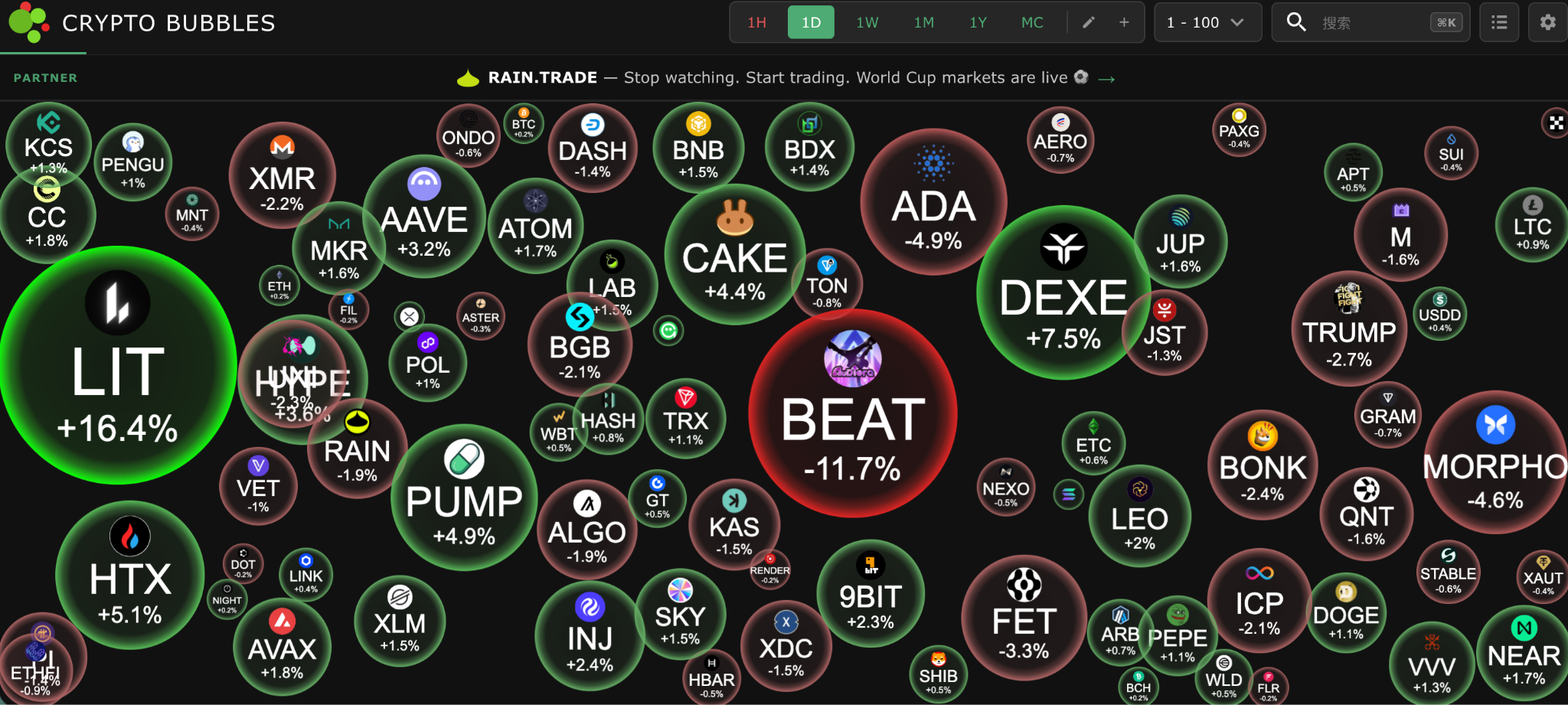
Today’s largest gain among the top 100 cryptocurrencies by market cap: LIT up 16.4%, DEXE up 7.5%, HTX up 5.1%, PUMP up 4.9%, CAKE up 4.4%.
Japanese Stock Market Slightly Drops 0.01%, Market Focuses on Yen Exchange Rate and Interest Rate Hikes
On July 6, the Nikkei 225 index closed slightly down 0.01%. Last Saturday, Micron Technology initially invested 1.5 trillion yen to expand its Hiroshima plant to produce HBM, but could not prevent extreme fluctuations in the chip sector. Japan's SoftBank Group and Tokyo Electron also experienced significant declines, reflecting investors' fatigue towards the long-term upward trend driven by AI.
In the next day or two, the entire market will closely monitor changes in the yen's exchange rate. Due to Intel's sudden announcement of significant price increases for some consumer and server CPUs (with increases reaching hundreds or even thousands of dollars) due to rising supply chain costs, Japan faces serious imported inflation pressure. Mainstream institutions in Japan predict that if the yen continues to be under pressure, the Bank of Japan may release signals for interest rate hikes in the macro statements in the coming two days to stabilize the market.
KOSPI Plummets, Chip Sector Highly Volatile
The Korean market has entered a clear period of fluctuation after being propelled by AI trading as the Korea Composite Stock Price Index rose over 3% during trading but eventually closed down 0.46%, mainly impacted by profit-taking in the semiconductor sector.
The market previously relied heavily on AI and memory chip trends, but after rapid valuation increases, funds began to reassess sustainability of profits.
In terms of weight stocks, Samsung and SK Hynix became the core of volatility. The Bank of Korea has issued warnings, indicating that the double-leveraged ETFs linked to Samsung Electronics and SK Hynix are excessively reckless. Since these two tech giants account for nearly half of the total market capitalization of the Korean stock market, individual investors' reckless leverage behavior has increased market risks. Once a market correction occurs, market makers' hedging operations could amplify the risk of one-sided dumping.
Samsung is set to release preliminary earnings reports on July 7. The market generally predicts that due to the surging demand from artificial intelligence and a more than 40% month-over-month increase in traditional memory prices, its second-quarter profits will surge 18 times to reach 86 trillion won, with some brokerages even optimistic that profits could reach 90 trillion won. Additionally, Samsung is currently negotiating with customers to raise general DRAM prices by 20% in the third quarter.
This week, there are two major macro events that could completely change the direction of the Korean stock market:
SK Hynix will complete its $29 billion U.S. stock listing plan this week, expected to be listed on Nasdaq on July 10. Optimists believe this could directly enhance the company's valuation and attract trillions of passive funds; however, cautious institutions like GAM warn that raising massive funds for expansion at the cycle peak often signals the industry's peak.
Korea officially launches 24-hour around-the-clock foreign exchange trading starting July 6 to challenge the MSCI developed market upgrade. However, the won is currently at a 17-year low, and around-the-clock trading may amplify short-term speculative fluctuations in forex.
Although there is short-term technical pullback pressure, investment bank Goldman Sachs still holds a bullish outlook on Korean stocks for the second half of the year in its strategic report on July 5. Analyst John Kwon firmly believes that Korea's profits will grow by 320% throughout the year, and the KOSPI's forward P/E ratio is only an extremely cheap 6.65 times, the lowest level since the financial crisis. This combination of ultra-high growth and historically low valuation makes Korean stocks the cheapest hunting ground in Asia, maintaining a bullish target of 20% and aim for 12,000 points. They specifically highlight six major opportunity lines: 1. Defense and shipbuilding industrial stocks, 2. Physical AI robots, 3. Power infrastructure, 4. Low price-to-book ratio governance reform stocks, 5. Re-inflation financial stocks, and 6. Semiconductor equipment supply chain.
Innovative Drugs "Full Resurrection", Hong Kong Stocks Welcome "High Odds" Rebound

A-shares today officially implemented new trading regulations, expanding fixed-price trading to the entire main board, and the price fluctuation limit for ST stocks has been relaxed to 10%. All three major A-share indices closed lower, with the Shanghai Composite falling by 0.06%, Shenzhen Component down 1.16%, and ChiNext Index down 1.77%, while the STAR Market 50 Index rose 0.91% against the trend.
On the trading floor, previously crowded sectors suffered heavy losses, while lower-level sectors welcomed significant bursts:
Computing hardware and chip semiconductors became heavily affected areas. Affected by the severe shock from Korea, high-position hardware stocks such as PCB and CPO suffered a stampede, with Jin'an Guoji and China National Glass directly hitting their daily limits, and Defu Technology plummeting over 10%.
Innovative drugs and CRO sectors surged significantly. The National Medical Products Administration issued heavy new regulations seeking opinions to include eligible cell and gene therapy (CGT) drugs in the "30-day approval fast track." Huahai Pharmaceutical, Gan Li Pharmaceutical, and Luoxin Pharmaceutical all directly hit 10% limits, with First Pharmaceutical Holdings even briefly reaching a 20% limit. Orient Securities believes that China's innovative drugs are not only improving in performance but also accelerating platform technology output, making their fundamentals for overseas expansion very strong.
The pig farming sector also saw significant rises, with Muyuan Foods and Wens Foodstuffs Group rising over 3%, and Juxing Agriculture & Animal Husbandry soaring nearly 7%, mainly due to a strong rebound in pig prices since July and tightening of large pig inventories.
In Hong Kong stocks, after a continuous decline for 9 months and a more than 33% correction in Hang Seng Technology, today finally saw a strong rebound. The Hang Seng Index rose 0.83%, and the Hang Seng Tech Index rebounded 1.16%, with technology stocks being the main driving force.
Internet giants led the charge. Tencent surged nearly 4% because its WeChat AI assistant "Xiao Wei" started internal testing, with JPMorgan predicting it could bring over 100 billion in revenue by 2030. Kuaishou surged over 5%, with its Quling AI officially starting commercialization.
Hong Kong innovative drugs were also booming, with China Biologic Products and WuXi Biologics soaring over 7%.
CICC's latest research report points out that the recent sharp decline in Hong Kong stocks is mainly due to over 70% of the constituent stocks in the market being concentrated in consumption and internet-to-consumer (toC) businesses, lacking AI hardware; thus, their performance is similar to "A-shares minus AI." However, currently, Tencent's forward P/E ratio has dropped to 11.2 times, a historic low, and the buyback scale of Hong Kong-listed companies exploded to 30 billion in June. Simultaneously, overseas funds' allocation to Chinese stocks has fallen to historical lows, making the "extremely undervalued and high odds" of Hong Kong stocks the best defensive strategy for investors.
According to market monitoring, domestic foreign exchange reserve data will be released in the next one or two days, while more crucially, the U.S. Trade Representative's Office will hold a hearing on July 7 to review tariff plans on 60 global economies. On the same day, CEOs of tech giants including OpenAI and Apple will gather at the Sun Valley Summit. CICC predicts that although Hong Kong stocks face historically significant release pressures in July and September, under the backdrop of extreme under-allocation and a decline in U.S. bond yields, the marginal improvement in policies prior to the July Political Bureau meeting could trigger a strong "odds rebound" at any time.
免责声明:本文章仅代表作者个人观点,不代表本平台的立场和观点。本文章仅供信息分享,不构成对任何人的任何投资建议。用户与作者之间的任何争议,与本平台无关。如网页中刊载的文章或图片涉及侵权,请提供相关的权利证明和身份证明发送邮件到support@aicoin.com,本平台相关工作人员将会进行核查。


