Written by: Rita
Trend Guide
The Morgan Stanley CPO supply chain report shatters the market's beautiful fantasies. The market's current narrative about CPO is: "Exploding AI chip demand → NVIDIA/Broadcom need to co-package optics → Explosion in Spectrum switch orders → Suppliers benefit." But the supply chain inspection data in the report tells a different story: global CPO switch shipments will only be 23k units in 2026 and 59k in 2027, which is an order of magnitude less than market expectations. The real bottleneck is not in technological innovation (GlassBridge is mature) but in TSMC's PIC capacity ramp-up (only 10kwpm in 2026, 25kwpm in 2027) and the yield rate of optical engines (currently 20-50%). This means that for investors holding NVDA and AVGO, CPO demand may again fall below guidance from Q4 of 2026 to mid-2027, leading to stock price suppression. The recommendation is clear: do not buy "CPO theme" stocks in the first half of 2026. Instead, buy after the disappointment in Q2 of 2027, when TSMC's yield data will be clearer and real demand will gradually emerge.
NVIDIA/Broadcom's CPO orders are severely overestimated
NVIDIA and Broadcom's shipments of Spectrum switches in 2026-2027 are far below market expectations. The FOCI report indicates that NVIDIA's contribution to FOCI's revenue in 2026 will only be 18%, indicating that the actual shipment volume of CPO switches is much smaller than the macro narrative suggests. If you see NVIDIA or AVGO adjusting guidance in mid-2026 due to unmet CPO demand expectations, this disappointment stems from capacity and customer validation rhythm issues, not from the technology itself. The data provided by Morgan Stanley is cold but undeniable: global CPO switch shipments will be 5k units in 2024, about 15k in 2025, and only 23k in 2026. Compared to market expectations in 2024 (many analysts believe that CPO shipments will exceed 100k in 2026), the actual numbers represent less than 22% of those expectations.
TSMC's PIC capacity and yield rate are the true constraints
The real constraints come from two aspects. PIC (a key intermediary for photonic interconnects) capacity is the first bottleneck. The report points out that TSMC currently has a monthly capacity of 500 wafers for PIC, with a future goal of expanding from 10kwpm in 2026 to at least 25kwpm in 2027. By comparison, TSMC's typical capacity expansion cycle is 12-18 months, and this timeline suggests that PIC capacity may still be a bottleneck before mid-2027. This is only the intermediary capacity of PIC, downstream also requires consideration of the complete optical engine insertion process, packaging yield rate (currently only 20-50%), and the final system integration validation. Looking at the actual shipment of optical engines at 0.39k sets last year, the 2027 target is only 7.78k sets, and 48.60k sets in 2028.
The yield rate dilemma for optical engines is the second bottleneck. The report mentions a key data point: the EPIC wafer test for Insertion 2 has shortened from "one wafer per day" to "one wafer in 6 hours." This sounds positive, but conversely, it shows how severe the previous yield issues were, requiring a significant acceleration of the testing process. The current installation yield rate is still only 20-50%, with a target of 50% for 2028. If the yield rate is still stuck at 30-40% by the end of 2027, it means the actual usable production of optical engines will be far below the nominal capacity.
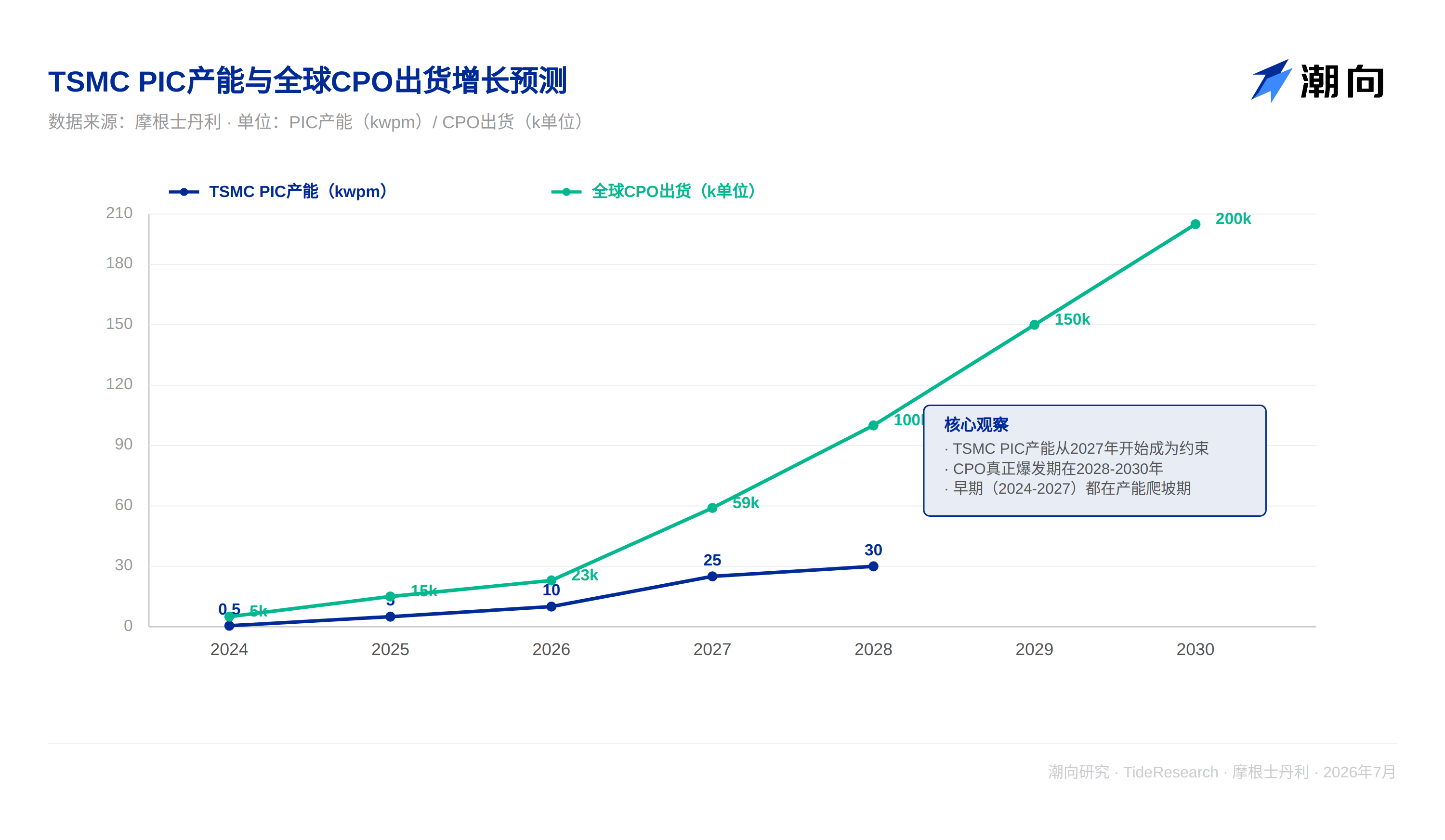
For investors holding TSMC, the contribution of the CPO business to profits over the next two years may be much smaller than the management's optimistic statements. TSMC usually emphasizes the expansion of CPO capacity in its financial reports, but the actual utilization rate and yield rate pressures may cause this business's gross margin to be lower than expected. It is expected that TSM 2026-2027 financial guidance will include cautious wording regarding CPO (such as "uncertainty in yield rate improvement"), which may become a pressure point for the stock price. NVDA's Spectrum switch shipment curve (23k→59k→100k) indicates that this business's contribution to revenue in 2026-2027 is minimal and cannot become a "new growth engine" narrative. If NVDA adjusts its data center division's growth rate in its 2027 financial report due to unmet Spectrum shipment expectations, do not be surprised. The risk for AVGO is even higher, as AVGO's base is smaller than NVDA's. Once Broadcom's CPO orders are downgraded, the stock price reaction may be more severe.
The CPO opportunities of optical equipment companies are severely overestimated
Optical fiber and optical equipment companies in the U.S. stock market (such as Lumentum and Coherent) have severely overestimated their CPO opportunities. The Morgan Stanley report mentions that the main FAU and optical engine suppliers are primarily Taiwanese and Japanese companies (FOCI, TFC, Senko), but U.S. stock investors will ask: What about these optical equipment companies? The answer given in the report is straightforward: CPO orders are still too small to constitute game changers. For example, actual shipments of optical engines for the entire year of 2026 are only 0.39k sets, 7.78k sets in 2027, and only 48.60k sets in 2028. Compared to Lumentum's annual revenue typically in the range of 1.5-2 billion, even with high gross margins, the CPO business may only contribute a few tens of millions in revenue in 2026-2027. More crucially is the uncertainty of the technological path: traditional FAU routes face long-term challenges from Corning GlassBridge. GlassBridge avoids precision manufacturing through passive alignment of glass waveguides, meaning traditional process-intensive FAU may gradually be replaced. GlassBridge itself has not yet been widely applied (the report explicitly states "far from reaching large-scale production"), so who ultimately wins this technological battle remains uncertain. However, if GlassBridge ultimately prevails, companies dependent on traditional high-precision FAU processes (including U.S. optical device companies) will see their long-term profit margins squeezed.
The advice for holding stocks like LITE and COHR in the optical equipment sector is: do not buy or increase holdings merely because of "CPO demand." The revenue contribution from CPO in 2026-2027 is minuscule and insufficient to alter the overall trajectory of these companies. Instead, focus on their performance in other high-speed signal applications (such as high-speed interconnects for data centers, 5G base stations, etc.), rather than CPO. If you see LITE or COHR raise guidance based on "CPO order prospects" in 2026, proceed cautiously. This may indicate that management is overstating the significance of small orders.
AllRing faces risk of CoWoS capacity downgrade, low CPO participation in A-shares
The story of AllRing is more complex. In 2026, its revenue related to CoWoS is expected to account for 79% of total revenue, mainly from equipment supplies to TSMC and ASE/SPIL. However, Morgan Stanley's supply chain checks show a shift: TSMC's CoWoS capacity expectations have been downgraded from 45kwpm (previously) in 2027 to 40kwpm, and from 75kwpm to 70kwpm in 2028. This indicates that TSMC's expansion drive for CoWoS is weakening, possibly because demand for CoWoS from high-end AI chips is not expanding infinitely, and new processes like CoPOS may gradually replace it after 2027. AllRing's expected revenue growth rate for 2027 is 53% (from 7.4 billion to 11.3 billion), but this growth forecast is predicated on a steady expansion of CoWoS, steady growth in Flip Chip, and the rapid rollout of new CPO packaging. Any delay in any segment (for example, if TSMC's CoPOS test yield has not reached expectations, or if a customer’s CPO integration is postponed) will drag down overall growth.
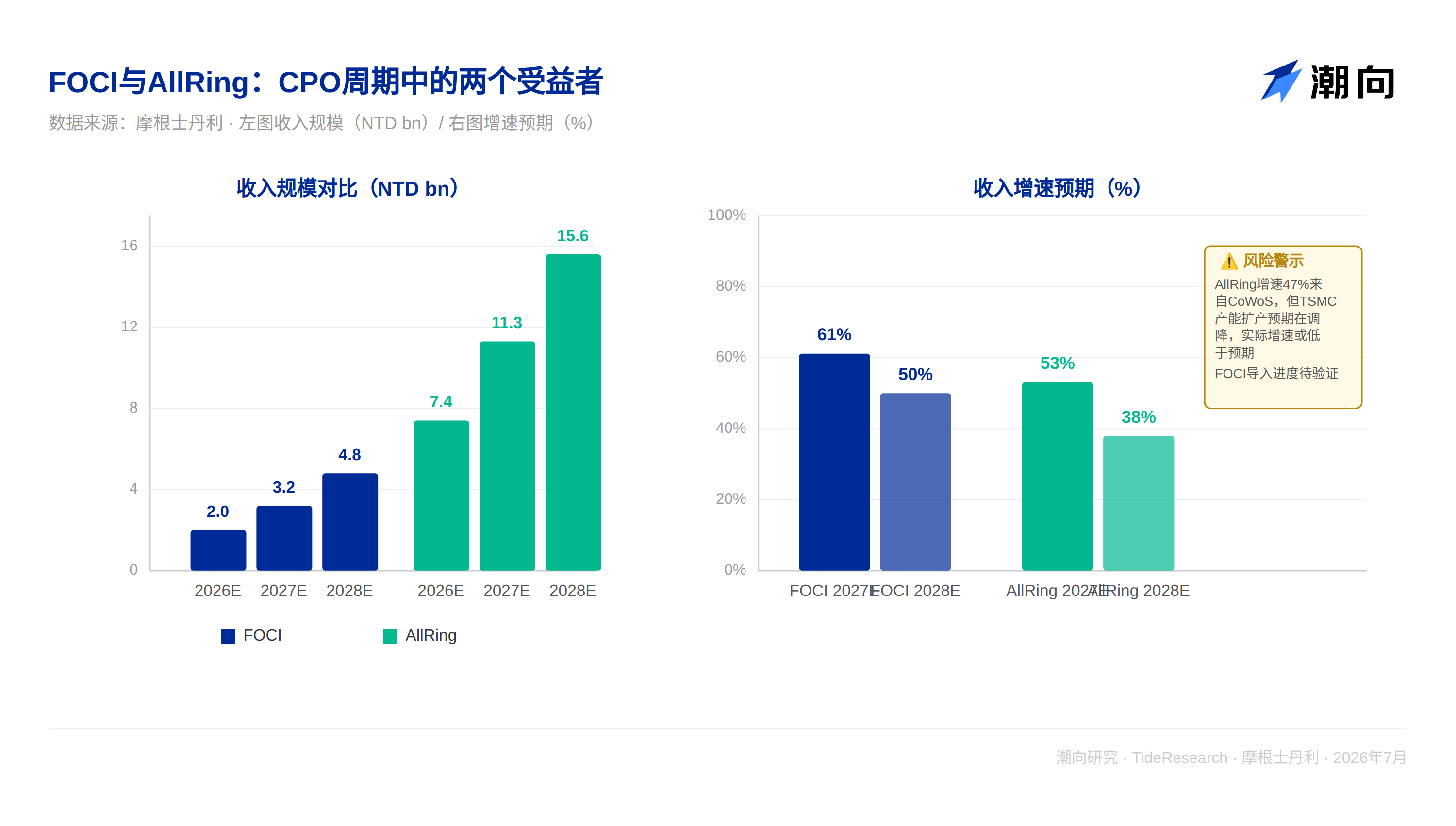
Regarding A-shares' participation in CPO, the reality is more complex than just "complete absence." SMIC (688981), as the largest wafer foundry in China, surely has R&D investment in CPO processes. Leading optical module companies like Zhongji Xuchuang (300308) and Xinyi Sheng (300502) also have relevant product lines in high-end optical interconnects. Tianfu Communication (300394) offers high-end optical connectors that are not limited to traditional low-frequency applications. Chip design companies like Huawei are also advancing their own CPO solutions. The real bottleneck is that A-share enterprises still lack core process equipment (such as PIC processing equipment and optical engine manufacturing) and high-end FAU/GlassBridge in these segments. The major benefits are concentrated in the relatively mature segments like downstream optical modules and chip design. This leads A-share investors to realize that if they chase "CPO concepts," they are actually gaining only indirect benefits, rather than direct benefits from core equipment/processes.
Trend Perspective
The most valuable thing Morgan Stanley achieved in this report is revealing the true tight constraints in the CPO cycle, rather than explaining how GlassBridge disrupts FAU. The report points out that the real factors determining whether CPO can rapidly explode are whether TSMC's PIC capacity can expand to 25kwpm on schedule, whether the yield rate of optical engine insertion can quickly rise from 20-50% to higher levels (especially the 50% target for 2028), and whether key customers like NVIDIA and Broadcom can advance system-level validation on time. If any of these three conditions falters, the entire CPO cycle will be delayed. The critical constraints are the fulfillment of foundry capacity and process nodes, not the innovation of FAU connectors themselves. In contrast, the technological maturity of GlassBridge itself is relatively certain, and the real risk lies in the depth of the supply chain.
The advice for U.S. stock investors is clear: do not chase the high prices of NVDA, AVGO, and TSM's "CPO concept" stocks. If you see them surge due to strong CPO demand in Q2 or Q3 of 2026, it is actually a shorting opportunity. Wait for the disappointment after Q2 of 2027. At that time, TSMC's yield data will be clearer, and the real CPO demand will gradually emerge. That will be the true buying opportunity. Remain cautious towards optical companies like LITE and COHR. The income contribution from CPO in 2026-2027 is too small to support these companies' high valuations.
The advice for A-share investors is to treat this report as a "contrarian indicator." If you see A-share chip concept stocks surge due to "CPO opportunities," it actually indicates that the market has overhyped these opportunities, and you should be alert to adjustment risks. The real domestic substitution opportunity will only arise after the CPO industry chain matures and when overseas suppliers encounter trade barriers. Currently, A-shares have virtually no substantial participation in the high-end chip packaging and optical interconnect fields. In the optical connector field, Tianfu Communication mainly produces low-frequency optical connectors for data centers and does not involve high-speed optical integration for CPO. Although photoresists and specialty gases may benefit from increased chip capacity, their correlation with CPO is not as direct as in the U.S. stocks.

Disclaimer
This article is a compilation and interpretation of third-party broker research reports by Trend Research. The ratings, target prices, profit forecasts, and related judgments quoted in the article are only the opinions of Morgan Stanley analysts, representing the institution's position and not the viewpoint of Trend Research; it does not constitute any investment advice.
The market carries risks, and decisions should be independent. This article should not be taken as a basis for buying or selling any securities.
免责声明:本文章仅代表作者个人观点,不代表本平台的立场和观点。本文章仅供信息分享,不构成对任何人的任何投资建议。用户与作者之间的任何争议,与本平台无关。如网页中刊载的文章或图片涉及侵权,请提供相关的权利证明和身份证明发送邮件到support@aicoin.com,本平台相关工作人员将会进行核查。


